The road becomes a canvas, with Chalkbot

A few days ago, someone asked me for an example of how to use social networking or blogging tool in a really different way. I had a couple of personal examples. I wish I had seen this.

  • Not just a short message, but a digital-to-chalk application of micro-blogging.
  • Not updates about ‘what I had for breakfast,’ but why I support your cause.
  • Not yet another cancer ribbon, but a ground-up message supporting Livestrong

This is a really fascinating example of how people send a message to others, using a ‘platform’ we take so much for granted –the road.

I found it via the Nike Tour de France microsite, where people can upload messages that get printed on the road via a bot. They send their message via …. you guessed it, Twitter.


How does it work? The device uses a 48 nozzles-spray to write with emulsified chalk on the street. If you like to participate, send a message to the Chalkbot Twitter account.

Check some messages, here.

Texting while driving game, scary. But does it really prove a point?

I saw this game featured at The New York Times, where you are moving fact on a multi-lane freeway and have to respond fast to numbers indicting you need to change lanes. On the side is a cell phone with a canned message.

The goal is to send a message and also change lanes fast.

While it obviously proves a point –that no amount of multi-tasking skills can help you avoid making mistakes– the game is too simplistic. There are much more stimuli coming at you on the road, apart from the crazy drivers out there. I don’t know anyone who will try to claim that texting and driving is OK. (Except, of course there are people like this.) The AAA has stats that say someone doing it increases chances of an accident by 50 percent.  So I wonder if anyone may actually try to prove a point and win this game.

This game could have been more effective if it made it almost impossible to complete a message by changing/varying the responses a driver needs to make.

I just hope there are better demos out there that communicate this.

In a related story, texting and driving ban in New York is about to be approved.

Quotes for the week ending 18 July, 2009

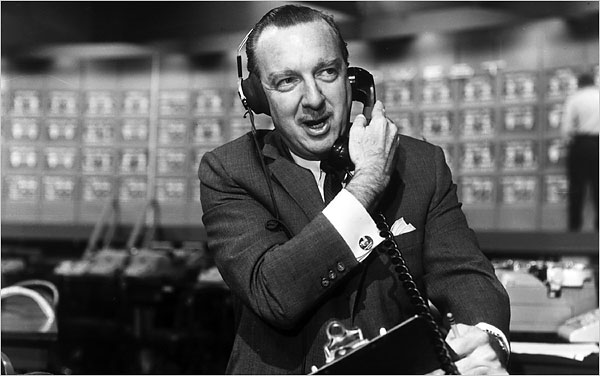
As we say farewell to ‘the most trusted man in America, I wanted to dedicate this week’s Quotes of the Week to Uncle Walter, a role model for me, and for many in journalism, and storytelling.

In seeking truth you have to get both sides of a story.”

“Everything is being compressed into tiny tablets. You take a little pill of news every day – 23 minutes – and that’s supposed to be enough.”

“Television [is] a high-impact medium. It does some things no other force can do-transmitting electronic pictures through the air. Still, as an explored, comprehensive medium, it is not a substitute for print.”

“Objective journalism and an opinion column are about as similar as the Bible and Playboy magazine”

“It wasn’t just that he narrated the spikes in modern history …Mr. Cronkite’s air of authority, lightly worn and unquestioned, was unusual even then.”

Allesandra Stanley, in The New York Times, about Walter Cronkite, who died on Friday.

“And that’s the way it is.”

Great summaries of his life here:

CBS News

Walter Cronkite School of Journalism and Mass Communication

What’s good for Gangplank is good for Phoenix, me!

I’ve been talking so a lot of entrepreneurs and people who are passionate about living in the Phoenix area recently.

The reason? I been unwittingly –unceremoniously– thrown into the job market that many of you know very well.

It’s got its downsides: too many looking for too few openings, people willing to try anything/ take on any job just to put food on the table.

I hear you. I’ve actually conducted a workshop for job seekers recently. In fact I am planning a few more.

But I am hugely optimistic, because there are entrepreneurs in this city that are truly inspiring. If you haven’t heard of Green Nurture and Gangplank, you have been missing something. (I did not pick the letter G at random, believe me.)

Gangplank’s beliefs should be enough to get anyone fired up:

  • We believe that Phoenix can be a fantastic center for innovation—once committed.
  • We believe that web professionals should focus on collaboration over competition, and that ideas should be shared freely.
  • We believe that small businesses, micro-businesses, and freelancers, bridged together in common cause, will be the core of this revolution in Phoenix.

So when people ask me if I am interested in looking outside the Valley, I say no. It’s bleak, it’s hot, and depending on what day you pick up the newspaper, it could be disappointing. I’m just not buying the doom and gloom.

I’m still at the Decision Theater, but am actively looking for a great new opportunity out here.

Give me a call at 602.750.3476.

I’ve got some ideas that could  redefine what it means to be the hottest state.

If Henninger can do it, so can Montini

I love Don Henninger’s column in the Phoenix Business Journal. He comes across as the neighbor you always bump into when you mow your lawn –and happily gets in the way of that awful chore.

A few weeks back, when he wrote about ‘Seeing a Tweetie bird‘ I knew this was the moment I was expecting. “I’m a Twit” he opened with, admitting he was late in arriving, but inviting us to interact –minus the what-we-have-for-breakfast stuff. (Find him here on Twitter.)

E.J. Montini, another wonderful writer here in the Valley is right now going through a similar process. In last week’s Republic he’s all Facebooky but not all atwitter, he says.  Montini already maintains a blog. My guess is that it won’t be long before he’s carving out 140-character column-like posts. Any bets?

I’ve seen news people I would least expect take on parts of social networking and blogging that must have gone against the grain of what they were taught at J-school.

You can do it Montini!

Some useful links:

Quotes of the week ending 11 July, 2009

“It’s very important that my anger, my cold anger about the way our staff have been treated … doesn’t turn into a rhetorical volley to the Iranian regime, because that doesn’t do anything for our people or for reform in Iran.”

Britain’s foreign secretary, David Milliband, on  the release of one of its embassy staffers in Tehran.One other staffer remains in custody.

“The station wanted to do slushy, beautiful music and I quit.”

Leo LaPorte, about how his podcasting career took off late, being interviewed by his daughter, Abby who started her own podcast, Abbey’s Road.

“The falling cost of hand-held video cameras gave birth to a generation of pornographers with little interest in drama beyond a clichéd plot involving a pizza delivery boy.”

Paul Fishbein, president of the AVN Media Network, an industry trade publication.

“It is dangerous to film around Han Chinese if you have blonde (sic) hair and white skin. They get angry.”

Melissa Chan, an Al Jazeera reporter from XinJiang, via Twitter, after ethnic rioting broke out on in Urumqi, China between the Uighur minority and Han Chinese.

Could United Airlines unbreak his guitar?

David Caroll has a new song, and United Airlines has a huge headache.

The airline became the reluctant promoter of a protest song when it broke –indeed smashed– Dave Carroll’s guitar. I won’t go into the story (read it here) but suffice to say United staff gave him the cold shoulder that many companies have gotten away with for two long.

But they didn’t factor in the power of music, a dissatisfied customer’s social media footprint, and  a country song on YouTube.

“United breaks guitars,” croons Carroll, and those three words (plus a very funny video re-enactment on the tarmac)  have the potential to undo all United’s  great PR. A Taylor acoustic guitar could be replaced for about $3,500.  A company’s reputation will cost hundred’s of times that figure.

But unlike other unhappy endings of PR snafu’s, I like the twist here. Having written two songs, Mr. Carroll has given United an opportunity to influence the outcome of the third.

Go for it United! You can turn this trilogy into a raving sensation, not just on YouTube, but as a case study that proves organizations could listen — even if they have to be dragged into the conversation kicking and screaming.

Diplomacy’s BFF, social media, opens third way

In 2005, an article that largely went unnoticed about using technology appeared in Hoover’s Digest. It was authored by someone names Jared Cohen.

In it he analyzed the pent-up resistance in Iran, and what it means for the future stability in the Middle east.

“That resistance, however, no longer appears in traditional forms of oppositional activity, such as massive political demonstrations and an organized opposition. Instead, it often manifests itself in the form of a “passive revolution,” a widespread social resistance that, given its methodology of engaging in activities that are antithetical to the regime’s values, is political in and of itself.”

He spoke of something called ‘virtual association’ a form of symbolic social networking among people who were passively resistant. These real, but invisible networks posed a threat to the status quo, he said, because “there is no leadership, network, or covert movement to crack down on.” Cohen also predicted there would come a Tipping Point, when those networks could be nourished.

That Tipping Point came in June this year, with the media bans and snuffing out of any form of protest.  That idea of  ‘nourishing’ the assets inside a country appears to have been turned into a diplomatic policy.

In April, the State Department took a technology delegation from Google, Twitter, AT&T and a few other companies to Iraq. According to TIME, the person behind the idea of a technology delegation was Jared Cohen.

I find this interesting because for decades, we have adopted a for-us-or-against-us approach to how we deal with the rest of the world.  Now, a consensus toward a Third Way is being taken seriously at all levels. It involves first listening to those unlike us, seeing what ways they engage between themselves, and try to become part of their conversation.

Goli Ameri, US Asst. Undersecretary of State has also referred to this approach this third way: bringing people together to create greater mutual understanding. Dialog and exchange all fit nicely into the template of social media, which has no use of message-force multipliers –a failed PR strategy that is as crass as the phrase– and the likes.

Public diplomacy has been hamstrung with a top-down we-talk/you listen approach for decades. Today we have begun to understand the antenna is more important than the loudspeaker.

If social media and the possibilities they open up are making people try new ways of listening, connecting, and engaging we will be all better off for it.

Quotes for the week ending 4 July, 2009

“Hire those who lean forward, who are curious and interested, who listen before they answer, who love learning.”

Valeria Maltoni, in a Twinterview with Jason Baer

“The marketing industry’s idea of a two-way communication is to put an 800 number or a web address in an ad and take orders.”

Josh Bernoff, Groundwell

“All those are my screwups”

Chris Anderson, on being accused of plagiarism in his new book, Free: The Future of a Radical Price

“Venus played as if she had someplace to go and she was in a major league hurry to get a great dinner.”

Serena Williams’ father on watching his daughter in the semi-finals.

“… the menus on the Kindle DX need to be made so blind students can use them,”

Chris Danielson, director of public relations at the National Foundation of the Blind, commenting on the story that a blind student at Arizona State University filed a complaint against ASU to avoid the use of the reading device until the menus are accessible to blind students.

“The work we’ve done with Jack and Twitter is a good example of the way we can work with Silicon Valley companies.”

Jared Cohen, State Department’s policy planning staffer, on taking Silicon Valley companies such as Google, Twitter and other startups to talk to government officials, business people, and students in Iraq

“ambient awareness”

Clive Thompson, on what Twitter is good at creating; quoted by Steven Johnson in a TIME, about how Twitter cwill change the way we live.

Word Cloud, an interesting lens + tracking tool

Two months after I posted my word cloud, I revisited it via Tweetstats, and can see how by looking at a word cloud over time, I can track how my focus has shifted.

WordCloud_Mytweets_2_July09

I use a lot of short URLs, via Hootsuite –hence the looming OW factor!

But also News and Flu has come into play. The latter has loomed large ‘cos I’ve talked about the communications implications of  my social media engagement around swine flu, and pandemic planning exercises at Decision Theater, my workplace.

My marketing and media side tells me that this would be a great way to keep track of a long term event.

Speaking of which, here’s a word cloud (left) about news in Iran –with an interesting visual twist. It was made from 84,000 tweets.

Word and Tag clouds could be used from variety of crowd-sourced sites. Take this: I looked up a word tag cloud on Michael Jackson –from people who tagged stories via Delicious. You can be sure the cloud’s focus would move from ‘legacy’ and ‘Barbara Walters’ to messier topics such as estate, drugs etc.