My new weekly radio show!

I almost forgot to break the story here. I started a radio show last week, focused on business. It’s called Your Triple Bottom Line.

Yes, it’s around the ‘Three P’s’ –People, Planet,Profits. I’m more into the first and the last Ps. (I leave the middle P to my wife, a small business owner, whom you would call a ‘deep green’ person.)

But it’s a great experience, being on radio. I trained at the BBC in London many years back as a producer, and have been a closet radio person all my life. Which is odd, being also into digital media. But I still maintain that radio is the true real-time medium, the first channel that brought communities and conversations together. The Internet simply borrowed the language and the model!

Derrick Mains and I co-host the show. There’s a social media angle here! I host and produce a podcast for GreenNurture, and Derrick has been a co-host of that show. Why radio? Have we got it backwards? There’s no short answer for this, but you will understand if you listen to the kind of guests we bring on every week.

Infographics pack stories – you unzip the meaning

The way I see infographics it’s not just to tell a story. That was the purpose an infographic was originally intended to serve.

I see it performing a different function in a media-saturated world. Fighting the attention economy!

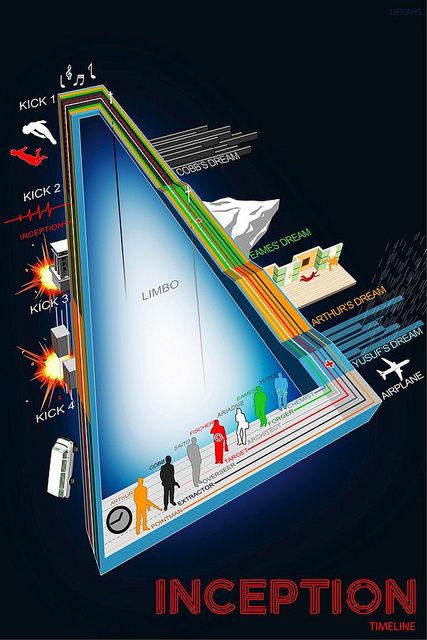
Inception infographic

Take a look at this. It’s not evident first what it’s trying to ‘say’ about the movie.

It’s a way of letting the reader unpack a level of meaning that would be different from the next reader.  It’s perfect for movies and complex narratives, where there is no one universal meaning. Great directors compress ideas and leave it for moviegoers to discover those nuances.

Oddly enough, journalism and advertising works in the opposite direction –even though both like to be also known as genres of storytelling. They like to bring pure clarity, and therefore unpack the details for the audience. (Check this simple, timely one on BP’s spending.) Worked until about five years ago. Today, consumers, newspaper readers (some call them media snackers for good reason!) don’t want that level of explanation.

Maybe you don’t have the capacity to embed an infographic into your commmunictaion, but you could learn the secret of leaving the reader to unzip his or her own meaning.

Fragmented Vs integrated? How do you share content?

Fragmented or integrated?

It’s easy to pick the latter, because it sounds like the right thing to do. Depending on what you are trying to achieve it’s not that easy though. Here are two scenarios:

Scenario A: You are launching a new service that is relevant to 30 percent of your audience. You’ve got the usual suspects –um, channels — in place with Facebook, LinkedIn, YouTube, a blog and two Twitter accounts. Do you make spread your content across all of these?

Scenario B: You a teaching a class, and most of the attendees use Facebook rather than email, but you also have a series of video updates. Do you stick with Facebook, or add a blog to the program which will feed Facebook embed YouTube videos?

I don’t want to say I know the best answer. (It may take a bit of digging deeper into the usage patterns of the audience etc.) But I often lean heavily on closing the gap between communication channels. It takes some planning ahead, but you only have to connect the dots once, and thereafter, it’s easy to pick and chose the channels you like to integrate.

I pointed this out toward the end of the webinar I was conducting last Monday. To demonstrate it…

Continue reading here.

Blogging and micro-blogging, joined at digital hip

I can’t stress enough how easy it is to connect the dots between your communication channels using digital media, if you plan ahead to do so.

Passport To Digital Citizenship
To “Tweet or Not To Tweet?”  |  2nd Webinar in the 6-part series on Social Media

I pointed this out toward the end of the webinar on Monday (it was Sunday night here in Arizona) as Steve England, Gary Campbell and I were presenting at the second webinar on social media.

While Steve was presenting I took this photo of one of our screens (the one bringing in a Skype video feed from the venue in Colombo). Here’s what I did:

Notice the attendees who had logged in –visible on the bottom left of this photo. Also, on the right is Tweetdeck, through which we were monitoring the hash tag #USELK2010 that we were using for the event.

Cross-posting this from the webinar blog.

How do you market a BP gas station?

It must be one of the toughest brands on earth to market right now: BP gas.

Don’t you think this corny use of Elvis is a true mark of desperation?

Interestingly, boycotting BP gas stations may sound like the right thing to do -emotonally — but I’ve heard it said that BP actually sells gasoline to non-BP branded stations.

I wonder why the independent BP station owners have not come out with an information campaign about their local roots, to ward off more boycotts.

Meanwhile the BoycottBP Facebook page has some 800,0000 people ‘Liking’ it, and 26 albums of photos. Maybe it’s a toxic brand to even get close to, but I wonder why some PR firm doesn’t reach out and assist this helpless group of  independent station owners.

Are you more social today than you were two years ago?

Questions like this come to my mind as I walk into any office, and see people slouched over their iPhones, BBs and laptops. I get a passing nod and try to not butt into what’s apparently some very exciting Twitter chat.

Or when you watch teenagers in a room chatting while multi-tasking, infatuated by each other’s screens.

I advice people on how best to balance digital and analog, so I come across these complaints and concerns a lot. Which is why I am anxious to see how Social Media Day, today pans out.

We are meeting  up -um, tweeting up — in Tempe this evening, at Madcap Theater.

I highly recommend this contrarian idea about today, if only to help you think about what the social part of social media is really about.

Crowd-sourcing employees in Phoenix

Incentives and employee motivation go hand in hand, as we have been noting here.

So this story strikes close to our heart, since it is right here in Phoenix. It’s not some hi-tech company doing this. It’s the City of Phoenix!

You may not hear the word ‘insourcing’ often, because its evil nemesis outsourcing gets so much of press. But drawing ideas from the well that’s within the organization is often overlooked. Often there are no mechanisms in place for ideas to bubble up, resulting in apathy or timidness in generating suggestions.

This story by Lynh Bui today (in the Arizona Republic)  talks of 25 out of 175 ideas being implemented in 2009-2010. That’s about a 11 percent success!

Now what if the City of Phoenix was to open up the valves in the employee idea reservoir, and say, aim at generating 720 ideas next year (a measly 60 a month). That same 11 percent rate would then triple the number of implemented ideas.

Incentives are great. But many employees don’t always wait for these to get started. Bui’s observation is spot on: “Employees aren’t necessarily turning in ideas just for the awards.”

Oil, tweets, and the gushing blogosphere will drown BP

There is no such thing as a ‘top kill’ procedure (the attempt BP made to put a huge concrete dome on the leak in the Gulf of Mexico) to cap off the gushing anger at BP  in the blogosphere.

Each day brings a new wave of voices –comments, creativity, social media channels –to shame the company that has caused the worst environmental disaster here in the US. Like this logo attack.

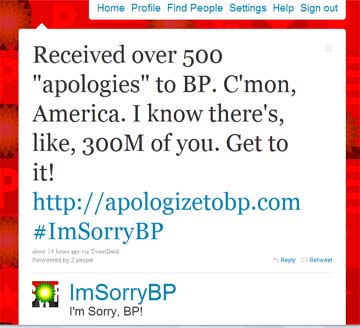
This one, a blog called Apologize To BP taps into the collective wisdom of anyone who has a twitter account, or some time to add some content to the site.

A post contributed by one David Diehl, alongside this picture, is titled ‘Sea Of Contrition.’ He apologizes to the captain of BP this way:

“Thanks again for inviting me to the yachting excursion this last weekend. I’m so very sorry I ate up all of your delicious shrimp during the preliminary revelry on Friday. The staff did indicate it was the last of the Gulf shrimp…”

Apologize, is acerbic and funny, obviously, but content like this (and there are hundreds of tweets being fed into the web site every minute) create a virtual gusher that intentionally or not contaminates anything that BP tries to do by way of PR.
I know, most PR people tend to say that it’s inappropriate to even use ‘ BP’ and ‘PR’  in the same sentence; the company has made so many PR blunders it’s not even funny.

The site urges readers to submit  “videos, photos, quotes, whatever you want, as long as you apologize…”

The feed of tweets into the site is a smart way to keep content flowing through the pages, even while it feeds the tweet-hungry searchers who only see it on the micro-blogging platform. The hashtag #ImSorryBP

At the time of writing, this Twitter account has had just 213 followers. I’s one more way that people will channel their frustration.

There are more. Check these hash tags that are being used to aggregate the comments and conversations:

#BP (of course, usurping the brand initials)

#oilspill

#gulfoilspill

So, despite the news that BP is trying to clean up its online rankings using SEO tactics such as buying keywords, it’s quite apparent that the groundswell is not going to be more powerful.

Passport to ‘Digital Citizenship’ Webinars next week

Really happy to announce a series of Web conferences that I will be starting next week for the U.S Embassy in Colombo, Sri Lanka.

Webinar on social media - US Embassy, Colombo Sri LankaThis follows a digital video conference I conducted last year for the U.S.E, in association with the US State Department.

These six workshops –Webinars– are designed to be more interactive; the majority of participants will be at one location in Colombo. They were selected based on their application and response to a survey on the state of social media in Sri Lanka.

We are covering the usual suspects: Blogs, social networking, micro-blogging, video sharing and social search.  The attendees are from diverse backgrounds: advertising, corporate communications, government, web-based businesses, management, universities, media and non-profits.

Presenters: To make these sessions more focused and relevant I have brought on board some top practitioners to co-present with me. They are:

Dan Wool, a corporate communications and PR consultant for APS, a large electric utility in Arizona. Dan co-founded one of the world’s top blogs on public relations, marketing and social media.

Steve England, Chief Technology Office of MobileSoft, an advocate of on-demand digital printing who advises large tech companies and international advertising agencies on interactive marketing.

Gary Campbell, a communications manager at Arizona State University, a former print journalist turned digital, who has led numerous university training sessions in social media.

I will also bring in a few ‘surprise’ guests who will pop-in with some real-world examples of how they are using a particular strategy in their communication!

Google’s Caffeine rocks, but don’t shut your eyes to offline information

I’ve been waiting for Caffeine for a long time, since I heard it being mentioned at SMAZ last year. So this week we get a taste of what a caffeinated search looks like.

It’s Caffeine, and it’s finally a way to see real-time information (not archived results).

If you’re concerned about page ranking, keywords, meta-tags and most importantly rich content, it’s worth trying to understand how the complex Google search algorithm works. Not that even the so-called experts know, because there is the secret-sauce factor that Google will not disclose.

However, this video from Google is as far as they will go. serving as a refresher course in search:

But is it that all?

Now while I find Caffeine a terrific improvement, I don’t only rely on (or recommend) Google to deep dive for all information. It’s easy assume that ‘everything’ is out there online, having been spidered and indexed online, when the fact is there are stacks of information you may never see or know exists.

Unless you make a trip to a library!  Or visit bookstores, read journal abstracts –the ones that have not gone digital yet — or scale the walled gardens of subscription-only sites.

So I have two questions to the search experts:

  1. Do real-time search results change how archived content shows up? All those white papers, videos, sample book chapters, podcasts etc. Do they get buried and pushed down away from the main results page?
  2. Is Caffeine –the real-time engine — trying to be Bing –the relevance engine? Or is it the other way around?

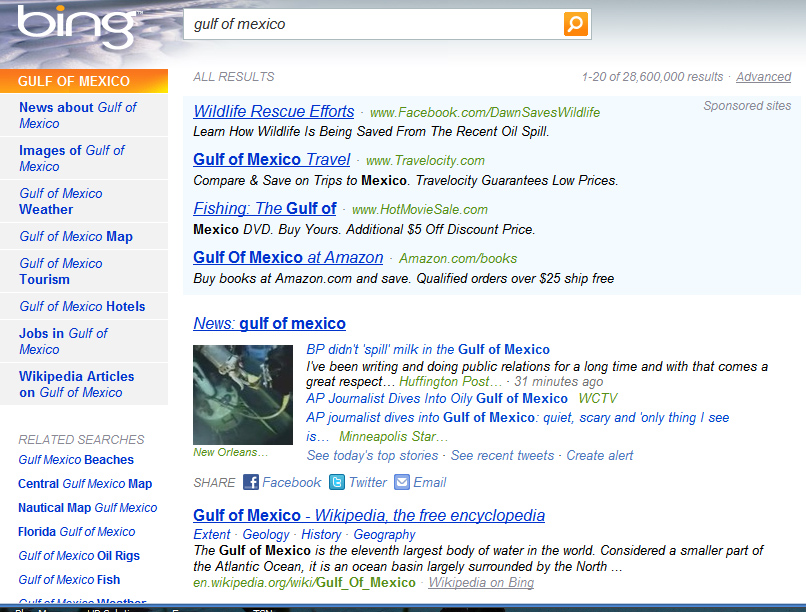
I took a screen shot of similar searches for the keywords “Gulf of Mexico” on Google and Bing today. Big differences!

Google Caffeine - search for "Gulf of Mexico" 9 June 2010

Bing search results - "Gulf of Mexico" - 9 June 2010

Take this one from the Associated Press. A story about a reporter who dived into the oily waters in the Gulf. It’s up there on Bing, but not on Google.

The story is probably a good metaphor of how murky it is when you dive into search as well. “I open my eyes and realize my mask is already smeared,” the unnamed reporter says.