Use of video in TSA blog, brilliant!

Video and blogging have never been better suited for each other. I tell my clients to consider using a simple video camera to record events because you never know when it may come useful.

Not just to CYA, but to capture the energy or interaction of a moment that lends itself to a deeper commentary in a blog post.

But in this case, the Transportation Security Administration (TSA) using video in their blog to quickly respond to a complaint, was a perfect way to diffuse the situation. The complaint: That a woman had been ‘separated’ from her child at a security checkpoint. They use 9 videos to support what they say -and these are also posted to YouTube.

Sidebar: Incidentally, if you are contemplating revamping your web site, the TSA web site is a great example of how to make a web site more social media friendly.  Note the 5 social media elements on the right navigation bar, and the request for feedback via the blog etc.

To get back to the blog: One thing about that blog post that’s easy to miss. Notice how they title the post, and the videos. They are not shy to use the phrase used in the complain, “TSA Agents took my son.”

It would been have so easy to spin it into something else, wouldn’t it? Blogger Bob’s comments come across as being truly sincere, and not just a prepared, lawyered comment.

Quotes for the week ending 10 Oct 2009

“In the surround-sound media environment of today, there is no shortage of places you can go to see an expert’s view of business and where it is headed. What I took from the first day of the World Business Forum, however, was just how important passion is as a common thread in the people (and their organizations) who are accomplishing something.”

Rohit Bhargava, on the World Business Forum

“While 60% of employees use word processing daily, only 42% actually create documents.”

Forrester Research report on technology adoption in the workplace.

“In a real-time, social media world, marketing has to react immediately to the successes and shortcomings of operations, product development, legal, finance, customer support, and the idiosyncrasies of company personnel.”

Jason Baer, on how social media gives everything a marketing focus.

“A turtle travels only when it sticks its neck out.”

Tweet by @lspearmanii

“Hi! This is your aspirin bottle calling. I haven’t seen you in a while…”

Peter Svensson, of the Associated Press, on the technology that connects the pill bottle cap to an AT&T network.

“Does our Cicero even glance at his speeches before reading them in public?”

George Will, conservative columnist for the washington Post, on Obama’s overuse of words and concepts in his speech at Copenhagen.

“Nice headlamps”

Headline of a billboard ad for a Northern Ireland used-car web site, that got the advertisement banned in the UK. The accompanying visual was not about cars…

Twinterview with Steve England tomorrow

Tomorrow at 10 am (Pacific) I will be conducting a Twitter interview with Steve England, of NewMediaMarketing.

If you are not familiar with NewMediaMarketing, it’s a company that does some amazing things in audience engagement, using smart tags.

I won’t try to explain what a smart tag is –except link to this— since Steve will be fielding questions that would clear any doubt you have about this.

For those who folllow this blog, this is the fifth ‘Twinterview in the series. The last one was in August, so it appears I have been slacking. Well, between starting my own consulting gig, and ransiting out of ASU, let’s just say that September whizzed by!

How to follow the Twintervew:

  • You could follow it at @heyangelo, or @englandsc
  • Time permitting, I will be live-blogging the session here as well.

Two years of ‘broad public access’ at State Dept blog

Last week Dipnote, the blog by the State Department, turned two.

So much has happened in two years. It was the year that the iPhone debuted, and Microsoft bought a stake in Facebook. A few months before that TIME named all those people creating content and connecting through social media as the ‘Person of the Year’ – the famous “YOU” issue.

Luke Forgerson, Managing Editor of Dipnote

Luke Forgerson, Managing Editor of Dipnote

Dipnote took to this new way of communicating with amazing flair. If there is one example of I’ve been using repeatedly to illustrate how any organization could stop firing press releases and start a conversation, it’s been them.

Think about it. Foreign policy to many is as sexy as watching paint dry. But given the right angles –heck, the right to loosen up– and the interest in listening as much as speaking, it turns out to be a different animal.

I have talked to many organizations who are terrified at the thought of saying something that could come back to bite them. Blogs, and videos, and photos pulled from a diverse group of individuals seem like total anarchy to them. It might damage the brand, they fear. The question I get asked a lot is ‘What if someone says something nasty?” –followed by “should we publish that too?”

I won’t go into the responses I give, but you’d think a group of people who represent the brand image of a country must have thought about this a lot. There must be bookshelves of white papers and journals on this subject in their offices. There must be legal advisers shaking their heads in disbelief.

And yet…

If you look at the social media initiatives the State Dept has rolled out over the past few years, these ‘government employees’ seem to take to new media in a way you’d expect of a marketing organization. Maybe they understand that good marketing is all about good communication. It’s more than the ingredients of ‘technology and talent‘ that Sec. Clinton spoke about.

It’s about using social media as an antenna not a bullhorn.

Get-rich-tweets and why we fall for them

I want to apologize to any of you who follow me on Twitter if you received a direct message from me saying “hey, I made $384 yesterday. this website showed me how.” Apparently my account was hacked because I may have clicked a link in a similar message from others in my network.

I had contacted two senders from whom I received the suspicious DMs with the shortened URL, and thought I was immune. A reader to my post at ValleyPRBlog confirmed that I too had taken the bait.)

So why are we so vulnerable to the garbage that gets  passed around the Twittersphere faster than you could say Phish? One word: Trust.

  • We screen less: We are so inherently trusting of those in our network, we don’t always take time to check if the email jokes, the ‘Must Read This’ links, or the PPT attachments are safe.
  • We click more. I tend to click more on a shortened URL because I see so much of them. The link economy teaches us to prefer clicking on links rather than typing a URL out.

I have made the point elsewhere that there will soon arise  Trusted Friends, or Network Curators, and these may not even be major brands; they could be individuals with great credentials. People we value, and… trust like crazy!

Speaking of which, I am about to purchase a book on the subject called Trust Agents –co-authored by Chris Brogan and Julien Smith. It comes highly recommended. Brogan’s original thesis for the book was that it was about: “people who use the web in a very human way to build influence, reputation, awareness, and who can translate that into some kind of business value.”

Quotes for the week, ending 25 Sept 2009

“Lots of traffic, lots of talking, lots of everything. But listening to each other…”

Title card in YouTube video aimed at the leaders attending the UN General Assembly in New York this week. The video-as-open letter was by RelaxZen, a mood-altering drink –that was shipped to every world leader.

“We’ve also re-engaged the United Nations. We have paid our bills….”

Barack Obama, in his address to the United Nations General Assembly, on the commitment of the US to change.

“You are only as relevant as their problem, and your pitch has to be empathetic of their situation.”

Nathan Wagner, Relevant Chews,on selling

“But of course we’re meeting all the time. We’re both involved in all the main meetings and talk all the time.”

Prime Minister Gordon Brown, responding to claim that Number 10 was snubbed by the White House, with regard to a personal meeting between the two heads of state.

“LookingGlass automatically rates each posting as positive or negative, so the Zune HD team could rank comments according to sentiment and see how customers are responding to the product and the campaign to sell it.”

Microsoft statement about its new image management tool that lets companies monitor, analyze and engage in social media, via its Silverlight technology

“These Squidoo lenses are for sale.”

Ike Pigott, at Media Bullseye, on Seth Godin’s rebranding Squidoo as a social engine that aggregates online chatter about a brand or company.  Pigott also calls this a sinister act of piracy! Squidoo already has “900,000 hand built lenses.”

“Chiggy-Wiggy.”

Soundtrack from the Bollywood movie, Blue, featuring Kylie Minogue and Oscar-winning composer, A.R. Rahman –he of of Slumdog Millionaire.

Students’ G-20 project gives hope

For all those who equate young people and the Me-Generation, with limited interests, take a look at Voices of 21.

It’s a project by students of the University of Pittsburgh, and it’s named for a god reason -to add a 21st ‘voice’ to the 20 global voices at G-20 summit going on in their neck of the woods. It’s goal is

to inspire a more inclusive and constructive dialogue on global economic stability that will resonate with the Pittsburgh community and beyond.

This analysys of the protests, for instance is enlightening. A rather long post, it is written by fourth-year student majoring in Law and Global Political Economy, Eli Baumwell.  I don’t mind the length, and will probably use it as an example of those who complain that wonder if this generation is all about short form content and  Facebook-y status updates!

Thanks to Danny Stoian, at the Department of State, for pointing this site out.

Your new digital address? It could be Zooloo!

My first impression on checking out Zooloo was that it could fall into the category of YAWN — yet another whizzbang network. Would people have time for one more social entanglement?
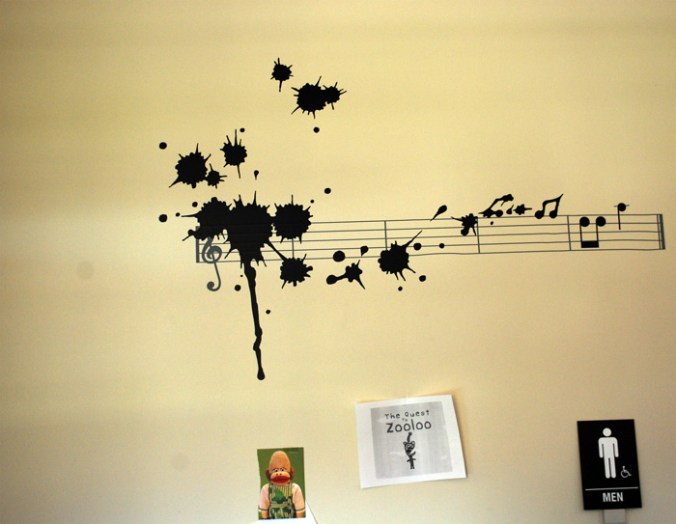
Mural2I sprung the question to Zooloo’s CEO  Jeff Herzog who was inexplicably swinging a golf club when I visited the the offices. In the age of smart pointing devices and tons of content, a club as an over-sized pointing device might be a good idea –in case I completely missed the point 🙂

“Social is just one component,” he said, quickly focusing on the big differentiation: the fact that you could register, build and customize your digital footprint in a snap. ” Zooloo is a dashboard that brings together your digital and social life.”

In other words, a way to rein in internet clutter.

Like you, I am very suspicious of shiny new objects, and anything that promises to be game-changing, despite Herzog’s reputation for having created iCrossing. (Full disclosure here: I worked very briefly for iCrossing.) The mural on the wall (above), and toys strewn on the floor give you a sense that this is not your typical tech firm.

On the other hand, I work in an organization that uses a visualization space as a digital dashboard –a very large dashboard— so I know its potential in a data-rich world. But could a ‘dashboard for your digital life’ have enough takers?

For instance: How would a personalized social network be relevant to those people who did not spend their entire lives on the Net, I asked.

Long pause.  “Who are they?” he asked.

We laughed.

I was thinking of teachers, and hair-dressers, and the mechanic at my car dealership, a coffee shop owner… I ask them all the time, and they think all this tweeting, and blogging is a waste of time.

“Even for someone who spends just one-third of his or her life online, a dashboard like this would make that one-third of time spent online very productive,” Herzog shot back. It is “just 15 percent of the experience.” What’s connected to it, what surrounds that dashboard, is what differentiates it.” Hard to disagree with that. Still, Zooloo as a pretty neat concept. If not exactly novel (with such tools as Page Flakes, and apps like Eventbox) it fills a huge need. If one of the four benefits work, we could be talking of Zooloo the way we once talked about other brands with double O’s in their name:

  • One digital address. It will be the home of your personal brand, and where you can be contacted — “your next cell phone number,” as Zoolooites call it.
  • Time management: Why spend all that time opening up Facebook, LinkedIn, Twitter, Plaxo, Flickr and Gmail, when you can access and update all of them in one place?
  • Privacy filter: We struggle with whom we can share what. Grandma doesn’t need to see what we uploaded to SlideShare. My directors don’t need to see my vacation photos. One dashboard with many filters can take away this headache. My LinkedIn buddies don’t need to see my Google docs…
  • A kind of lifehack: Simplifying everything we will add on to our already cluttered lives –blogging, shopping, file storage, email, news etc

I was a bit disappointed that it didn’t let me embed WordPress. The default blogging app was clumsy, to say the least. MAybe we are spoiled with the streamlined WordPress and Typepad interfaces. In the next few weeks I will check  it out a bit more, here. I’ll keep you posted.

Quotes for the week, ending 29 Aug 2009

“He took the long view. He never gave up. And though on most issues I very much wished he would give up.”

John McCain, on his friend and Senate adversary, Ted Kennedy who passes away this week.

“IBM is trying to push this debate onto social nets via the most convenient device–the remote you’ve just used to switch channels. “

Fast Company story on the new move to get TV viewers to micro-blog from the couch.

“I would say I’m a different GoDaddy Girl.”

Erin Kalin, a mother and singer who is the latest GoDaddy Girl, who hopes to be a role model for young girls.

“I like to call that person The TMI  Guy.”

A post from CaliberPulse, on how each one of know someone who posts Too Much Information

“a kind of virtual race to get as many people online by the Olympics alongside all the real physical races that will be going on.”

Martha Fox, the British government’s digital champion.

“It’s a balance between the issue and the (one) person …“Pick people who symbolize the issue.”

Kimberly Dozier, on the challenges of being an ’embedded journalist’ in a session (‘Reporting from the frontlines’) at the SPJ Journalism Conference in Indianapolis.

Connecting the dots between interview and podcast

iPadioI had never heard about iPadio, until I stumbled on a podcast-like audio comment that had been recorded by Yang-May Ooi, on her Blackberry, commenting on me!

It had been recorded soon after she left a Twitter interview I had asked her to join, with Silvia Cambie. More about that and their book, here.

iPadio is a nifty solution. It enables what is techniclaly called Phone Blogging. All you need to do is talk on your phone by calling a toll free number and using a PIN, and it live-streams the audio comment directly to your blog !  Nothing to download, too. How neat is that? When you listen to her comments you get a sense of the immediacy and spontaineity. This could easily be turned into a longer podcast. And because it was being streamed live, I could have been listening to it while interviewing her co-author — thereby creating an interesting feedback loop. Apparently there’s a way to post the audio file to Facebook, as well.

As Yang-May observes (since had been followed and participated in the Twinterview on her phone) these are the early manifestations of multi-channel, real-time communictaions. It also shows how easy it is becoming to connect the dots between different forms of communication.

I am testing it out this week. If you have used it, or a similar service, leave a comment. I would love to pick your brains.