Quotes for the week ending 19 Sept, 2009

“We sound like a support group for superheroes. ‘By day I do this, by night…'”

Joe Michels, on the Phoenix iPhone Developer Group, or Pi.

“The more times he is required to write “I will not call the president a liar” on a special blackboard set up in the well of the White House, the bigger hero he will become to a large chunk of the population.”

Michael Kinsley, on the Joe Wilson umbrage against Obama.

“Hello, Kevin Rudd. We are Anonymous. We have been watching you.”

Hackers who sent an anonymous message via a video and a manifesto (on this web site), to Australian Prime Minister.

“Google economist sees good signs in searches.”

Washington Post article on how search is predicting an economic recovery.

“From a technical perspective, the recession is very likely over at this point.”

Ben Bernanke, Federal Reserve Chairman

“My answer is not the answer, it is an answer. If you have a better or different answer, put it in the comments.”

Josh Bernoff, on a post that responds to social netiquette questions he receives.

Three lessons in storyteling from the story of ‘stuff’

Yesterday while interviewing Mara DeFilippis, founder of Arizona’s Arizona’s Green Chamber of Commerce, she mentioned ‘The story of stuff’ and I realized I had not seen it for some time now.

I revisited the site and discovered that it now has an international site, with the story told –via sub-titles– in Arabic, Hebrew, German, French, Spanish, Russian, Portuguese, Dutch, Mandarin and Thai!

I also realized how there are some very powerful storytelling techniques at work, and I like to highlight three that anyone could inject into any form of communication:

Passion: Annie Leonard is no doubt a great presenter, but her passion for what she is presenting is what really makes the story come alive. We often present on topics we are very familiar with, and tend to get jaded. Our body language, and choice of words can convey that passion.

Connective Tissue: Good storytellers weave in and out of facts with an ulterior motive, drawing connections, building toward the denouement. This 20-minute video is packed with facts. But they all build a story of how the ‘system’ works –or doesn’t. She connects the dots for us as we listen.

Great mix of human & visual elements. In a digital world, it’s easy to amp up the ‘performance’ or use illustrations or stock photos to move a story forward. Leonard’s conversational technique interacts so well with the illustrations hovering above her head, it’s hard to see one without the other.  In storytelling people and images should not be an either/or choice. Even when there is no video or visual, it’s possible to paint images with words.

So the next time you are presenting, or telling Your Story, take a closer look at this video and you will probably find more than the three elements I highlighted.

Enjoy!

Quotes for ther week, ending 12 Sept 2009

“Stories are a terrible way to store information.”

Zach Echola,  a founding member of Wired Journalists, on the role of journalism in providing context. Howard Owens and Ryan Sholin were the other two founders of Wired Journalists, an amazing resource!

“Things fall apart; the center cannot hold. Facebook, the online social grid, could not command loyalty forever.”

Opening line in an article in the NYT on people quitting Facebook.

“we now tweet and friend and tag. But that’s not all—we also listen.”

Colleen Ringer, Comms Manager, blogging about Downtown Phoenix Partnership’s new web site that launched this week. The site has bloggers and several social media options to help users find useful information and build a community.

“Probably not.”

Jim Nail, chief marketing and strategy officer of TNS Cymfony, on whether brands should respond to criticism via social media. The quote was in a  story about a false story about P&G’s Always circulating via social media.

“don’t worry we won’t tell your followers!”

TwittDir, yet another ‘let us help you get famous on Twitter’ type appliications that asks you to add your name in a directory chock full of models, sexed-up people.

“If you were expecting an Apple jetpack or an Apple hovercraft, or even an Apple tablet, you didn’t get that.”

Michael Gartenberg, a technology analyst on Steve Jobs reapparance at Apple’s launch of the iPod Nano.

Goodbye, ASU. Hello Public Radius!

Today is my last day at ASU’s Decision Theater. Taking some time off to pursue some very exciting opportunities that have come up.

PublicRadius_logoThis includes starting out my own consulting practice, Public Radius that is in soft launch mode.

Public Radius is all about helping organizations resize their  circle of influence. Individuals and organiztions have a defined radius. But defined does not have to be fixed.

Can we bridge the gaps between physical and digital networks? Certainly! Some of us do it unconsciously. Some of us do it strategically.

Generating ‘dotted lines’ between these circles of influence is what Public Radius is all about. You will hear more about this shortly!

For attendees at social media conference y’day

Hyperlinks may seem insignificant, but they can be subversive, helpful and enlightening.

At last evening’s video conference I suggested that one way of improving our communication is to embrace this ‘link economy.’ And since social media is the connective tissue, it keeps this economy humming.

It involves some loss of control, which makes it unsettling to some, but it also opens up plenty of new opportunities. I see these as falling into four groups:

  1. Collaboration  – It’s almost impossible to use social media with a control-freak, silo mentality
  2. Crowd Sourcing – We soon learn that ‘they are smarter than I’
  3. Content Curation – While everyone is creating, some of us better start curating
  4. Community Building – Social networks are nothing but communities.

Social Media lets us:

  • Conduct due diligence faster, deeper
  • Look at trends, by mapping out events as they break –swine flu, forest fires, crime rates
  • Bypass bottlenecks — from network outages, censorship, slow feedback
  • Tap into the ‘wisdom’ of the crowds –citizen journalism

Two great Citizen Journalism sites:

One other interesting way to enlarge a story I omited to mention: The Lede from The New York Times. By the way, it happens to be a blog!

On the topic of Citizen Journalism and Civic Journalism:

The purpose of civic journalism is “not to inform the public, but to form the public.”

– Charlotte Grimm, Scripps Howard Foundation

Pay attention to these:

  • Wolfram Alpha –a search engine that will knock your socks off!
  • TwtPoll –If you use Twitter, and want to check the pulse of your followers, try this!
  • TweetDeck – aA desk-top application that will help you manage multiple Twitter accounts
  • iPadio – a simple way to podcast from your iPhone
  • Flickr – much more than a way to share pictures with your inlaws!
  • BlogTalkRadio.com – a simple way to create a podcast using a phone!

Finally:

  • Forget scoops, and consider ‘swoops’
  • Less Content Creation and more Content Curation

Quotes for the week, ending 5 Sept, 2009

“Fox knows that spewing this kind of sensationalistic crap to reporters will get her lots of press.”

Missy Schawttz, of Pop Watch, commenting on on Megan Fox’ rant against Transformers director Michael Bay.

“Some days we talk about the weather. Some days we talk about the ‘Chicken Dance.’

Alecia Dantico, on building community using Twitter.

“How’s the German car-maker whipping up an alt-fuel frenzy? With videos of lawnmowers.”

Fast Company review of ads by Audi, that rumor has it, might announce an electric powertrain

“Study finds prime time on the Internet is 11 p.m.”

Findings from a new study that shows there has been a shift in surfing times.

“So when I get upset about A BRAND NEW $1,300 APPLIANCE NOT WORKING, it’s not like I’m getting upset about the fact that my butler has bad breath.”

Heather Armstrong (a.k.a. Dooce) who blogged and tweeted about her Maytag washing machine on August 26th. It included a Tweet that went “So that you may not have to suffer like we have: DO NOT EVER BUY A MAYTAG. I repeat: OUR MAYTAG EXPERIENCE HAS BEEN A NIGHTMARE.”

” @dooce We are trying to contact you by phone. Please DM me with your contact information. Thank you!”

Response from Whirlpool, via Twitter on the night of August 26th,

BTW: Guy on phone at Maytag headquarters was phenomenal. Super nice, super helpful.

Heather’s response to Whirlpool’s response.

“Phoenix has a reputation,” Moriarty says. “Joe Arpaio. Dry heat. That kind of junk. It’s not a personality…”

Jonathan Mcnmara, in Phoenix New Times, on the attempt by Jeff Moriaty to create cultural identity for Phoenix.

“Malicious pseudo-environmentalists”

Review of a ‘scareware’ vendor, reviewed by ZD Net,which calls it “a new social engineering tactic” (with a promise to donate $2 to save the Amazon forests).

Your new digital address? It could be Zooloo!

My first impression on checking out Zooloo was that it could fall into the category of YAWN — yet another whizzbang network. Would people have time for one more social entanglement?
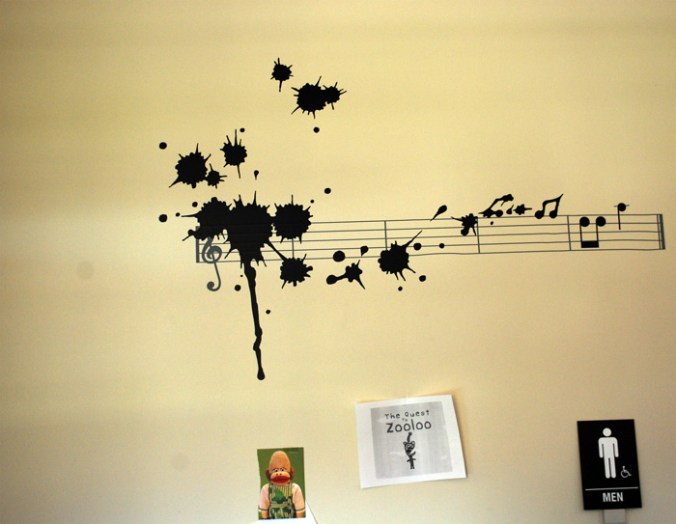
Mural2I sprung the question to Zooloo’s CEO  Jeff Herzog who was inexplicably swinging a golf club when I visited the the offices. In the age of smart pointing devices and tons of content, a club as an over-sized pointing device might be a good idea –in case I completely missed the point 🙂

“Social is just one component,” he said, quickly focusing on the big differentiation: the fact that you could register, build and customize your digital footprint in a snap. ” Zooloo is a dashboard that brings together your digital and social life.”

In other words, a way to rein in internet clutter.

Like you, I am very suspicious of shiny new objects, and anything that promises to be game-changing, despite Herzog’s reputation for having created iCrossing. (Full disclosure here: I worked very briefly for iCrossing.) The mural on the wall (above), and toys strewn on the floor give you a sense that this is not your typical tech firm.

On the other hand, I work in an organization that uses a visualization space as a digital dashboard –a very large dashboard— so I know its potential in a data-rich world. But could a ‘dashboard for your digital life’ have enough takers?

For instance: How would a personalized social network be relevant to those people who did not spend their entire lives on the Net, I asked.

Long pause.  “Who are they?” he asked.

We laughed.

I was thinking of teachers, and hair-dressers, and the mechanic at my car dealership, a coffee shop owner… I ask them all the time, and they think all this tweeting, and blogging is a waste of time.

“Even for someone who spends just one-third of his or her life online, a dashboard like this would make that one-third of time spent online very productive,” Herzog shot back. It is “just 15 percent of the experience.” What’s connected to it, what surrounds that dashboard, is what differentiates it.” Hard to disagree with that. Still, Zooloo as a pretty neat concept. If not exactly novel (with such tools as Page Flakes, and apps like Eventbox) it fills a huge need. If one of the four benefits work, we could be talking of Zooloo the way we once talked about other brands with double O’s in their name:

  • One digital address. It will be the home of your personal brand, and where you can be contacted — “your next cell phone number,” as Zoolooites call it.
  • Time management: Why spend all that time opening up Facebook, LinkedIn, Twitter, Plaxo, Flickr and Gmail, when you can access and update all of them in one place?
  • Privacy filter: We struggle with whom we can share what. Grandma doesn’t need to see what we uploaded to SlideShare. My directors don’t need to see my vacation photos. One dashboard with many filters can take away this headache. My LinkedIn buddies don’t need to see my Google docs…
  • A kind of lifehack: Simplifying everything we will add on to our already cluttered lives –blogging, shopping, file storage, email, news etc

I was a bit disappointed that it didn’t let me embed WordPress. The default blogging app was clumsy, to say the least. MAybe we are spoiled with the streamlined WordPress and Typepad interfaces. In the next few weeks I will check  it out a bit more, here. I’ll keep you posted.

Quotes for the week, ending 29 Aug 2009

“He took the long view. He never gave up. And though on most issues I very much wished he would give up.”
John McCain, on his friend and Senate adversary, Ted Kennedy who passes away this week.

“IBM is trying to push this debate onto social nets via the most convenient device–the remote you’ve just used to switch channels. “

Fast Company story on the new move to get TV viewers to micro-blog from the couch.

“I would say I’m a different GoDaddy Girl.”

Erin Kalin, a mother and singer who is the latest GoDaddy Girl, who hopes to be a role model for young girls.

“I like to call that person The TMI  Guy.”

A post from CaliberPulse, on how each one of know someone who posts Too Much Information

“a kind of virtual race to get as many people online by the Olympics alongside all the real physical races that will be going on.”

Martha Fox, the British government’s digital champion.

“It’s a balance between the issue and the (one) person …“Pick people who symbolize the issue.”

Kimberly Dozier, on the challenges of being an ’embedded journalist’ in a session (‘Reporting from the frontlines’) at the SPJ Journalism Conference in Indianapolis.

Connecting the dots between interview and podcast

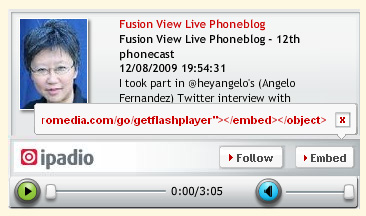
iPadioI had never heard about iPadio, until I stumbled on a podcast-like audio comment that had been recorded by Yang-May Ooi, on her Blackberry, commenting on me!

It had been recorded soon after she left a Twitter interview I had asked her to join, with Silvia Cambie. More about that and their book, here.

iPadio is a nifty solution. It enables what is techniclaly called Phone Blogging. All you need to do is talk on your phone by calling a toll free number and using a PIN, and it live-streams the audio comment directly to your blog !  Nothing to download, too. How neat is that? When you listen to her comments you get a sense of the immediacy and spontaineity. This could easily be turned into a longer podcast. And because it was being streamed live, I could have been listening to it while interviewing her co-author — thereby creating an interesting feedback loop. Apparently there’s a way to post the audio file to Facebook, as well.

As Yang-May observes (since had been followed and participated in the Twinterview on her phone) these are the early manifestations of multi-channel, real-time communictaions. It also shows how easy it is becoming to connect the dots between different forms of communication.

I am testing it out this week. If you have used it, or a similar service, leave a comment. I would love to pick your brains.