“Customer experience with be huge in 2010”

In a great conversation with Nathan Wagner of Creative Refinery on customer experience, which he says will be the big differentiation in 2010.

Also testing how the integration of email and Word Press – and posting this directly via a Blackberry.

We are at Gold Bar coffee shop in Tempe. Nathan’s an old friend who advises clients on creating value increasing sales.

Update: Had to go in via the web to reformat the photo and headline. Since this was an experiment I had forgotten to write the headline in my subject line. The photo was taken on my phone by a fellow customer. By default, the phone’s email program uses the image name (usually a string of letters) as a subject line, so you need to watch out for that.

Word Press does have a few custom settings –short codes as they call them -for including the category of the post, making it a draft etc. I can see these expanding as more people begin to use smart phones to create content.

I like to see short codes to:

  • Resize the photo
  • Add some basic HTML
  • Include a URL

Quotes for the week ending 5 Dec, 2009

“The general consensus about my hair, among our team and the client, was that it was distinctive and instantly recognizable — a characteristic we ad people long for in our campaigns, but it sounds funny when we’re talking about my hair.”

Andy Azula, the guy in the U.P.S. whiteboard commercials, in a Q & A with Stuart Elliot. He has a Wikipedia entry!

“Once you start restricting access on the websites, if you have content that can broadly be found somewhere else, then you really restrict the number of people coming to websites.”

Emily Bell, Guardian’s director of digital content, on a regional British newspaper publisher charging for online news content.

“She’s more caustic than a manure lagoon.”

Paul Shapiro, senior director of the US Humane Society Factory Farming Project, on Kerry Trueman, a contestant for the Huffington Post contest for citizen journalists. One person will be chosen to report from the Copenhagen climate change summit next week.

“Most painful for us is not the minaret ban, but the symbol sent by this vote.”

Farhad Afshar, of the Coordination of Islamic Organizations in Switzerland, com

And speaking of symbols…

“It’s that image that has been shattered, sort of like the back window of his SUV, but maybe I’m pushing another metaphor too hard.”

Bill Saporito, on Tiger Woods’ apology

“I realize there are some who don’t share my view on that. But for me, the virtue of privacy is one that must be protected in matters that are intimate and within one’s own family. Personal sins should not require press releases and problems within a family shouldn’t have to mean public confessions.”

Tiger, having dealt with his ‘transgressions’ in a 6-paragraph apology, on his web site.

Are airport posters just wallpaper?

I always wonder what kind of response a poster at an airport gets.
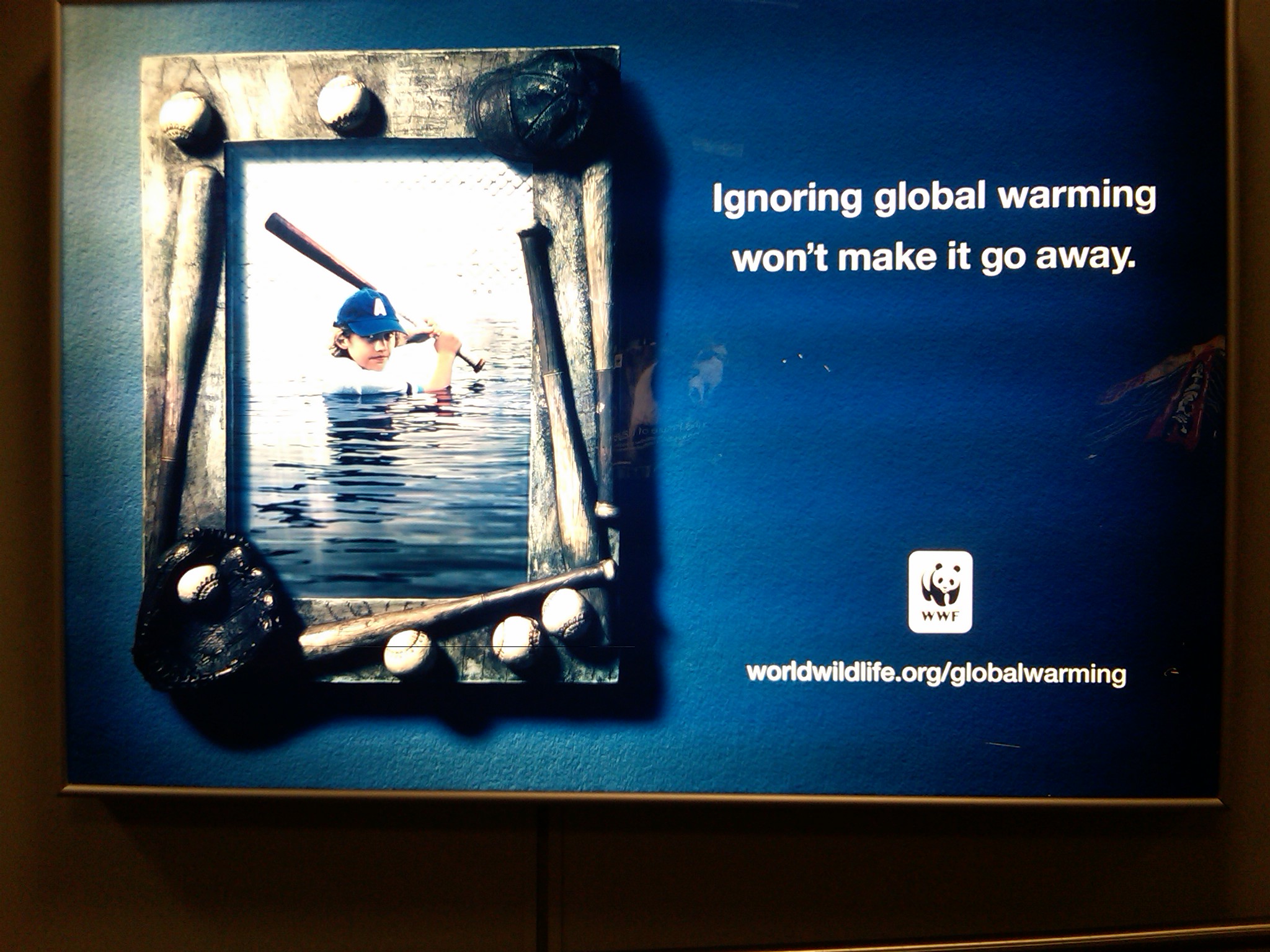
I saw this one at Salt Lake City yesterday, and it caught my eye because it was an attempt to humanize global warming.

But what is one supposed to do with this message? Rush over to a computer and login to the web site? The URL defaults to the WWF web site, and the landing page has nothing to do with the message –“ignore global warming and…”

And yet organizations continue to spend on this kind of wallpaper.

Who’ll be the Citizen Journalist at ‘Hopenhagen?’

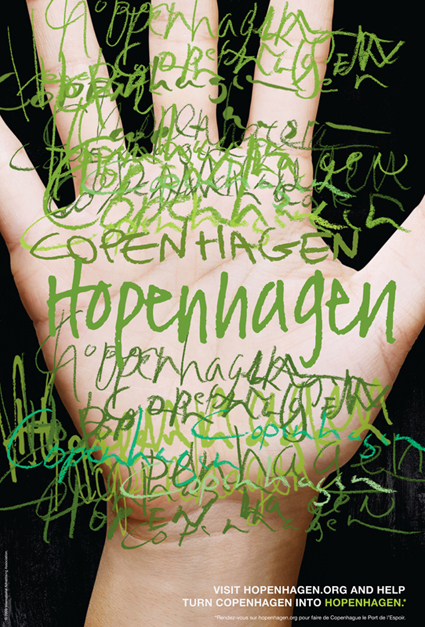
I’ve been following the Hopenhagen campaign from many angles. I wrote about it in several places, because it’s an interesting collision of a global movement, and social media.

No wonder the Huffington Post is running a contest, asking for submissions from would-be citizen journalists, to report from Copenhagen next week. It’s looking for an ambassador who’ll represent HuffPo. I wish I could have entered the contest myself. It’s almost too late, but if you know of someone who has the credentials –passion, really– send them this link today! Deadline is tomorrow –1 Dec.

Such an impressive line up of contenders. I love how David Kroodsma makes his pitch. On a bike, but only to state how he’s used his wheels to educate people across 21,000 miles.

There are lots of other good entries. But it’s not all about one’s YouTube or Facebook savvy that counts. I’m rooting for an ambassador that’s a passionate story-teller.

Watch this space for more on this.

Quotes for the week ending 27 Nov 2009

“Teachers begin using cell phones for class lessons”

AP story about a Florida teacher using a  phone-based scavenger hunt to teach Spanish

“I myself straddle the line between political commentator and a member of the political universe … it’s not easy being a woman.”

Meghan McCain, commenting on Hillary Clinton facing the media

“Lesson: Don’t dumb down your information. We’d prefer the full story.”

Sheila Scarborough. Guest blogger at Old Media, new Tricks, on the web site FiveThuirtyEight, and political reporting

Quotes for the week ending 21 Nov 2009

“She is not a girl, and she is not a pinup.”

Susan Estrich, Columnist, on Sarah Palin, saying she hates defending her, but is annoyed at Newsweek for featuring her on the cover in running shorts.

“I am applauding Bebo …I don’t understand the  logic for the others not following suit.”

Jim Gamble, of Child Exploitation and Online Protection Centre (Ceop), saying social networking sites need a help button for children to report predators  bullying.and bullies

“we should not make the perfect the enemy of the good,”

Barack Obama, conceding that the Copenhagen summit would not come up with a binding agreement on global warming.

“A portable device with an appropriate wifi connection, and a very powerful browser.”

Google CEO, Eric Schmidt’s definition of a Netbook, in a broad discussion of the future of the internet.

“Huh? If you’re already a Fortune 100 company, ‘brand awareness’ is probably not your biggest problem.”

Fast Company, commenting on a study by Weber Shandwick, that says only about 3/4 of Fortune 100 companies have Twitter accounts, few follow best practices, and most are chasing after brand awareness.

“Would I be cynical if I said I believed Apple was secretly fueling the hype by leaking bits and pieces of information to raise expectations? Does it matter?”

Linda Vandevrede, at ValleyPRBlog, on the role of PR in hype, or whether it evolves in some ‘organic’ way.

Microsites tilted toward sustainability get clever

When talking about social media to a group, I often step back to get them to pay attention to how to design for interactivity. After all, social media is all about interactions, right?

I like to note how wicked a wiki could be (though no one ever talks of wikis anymore, with all the tools around Facebook and Twitter). I mention how Microsites can do a lot of things their POW –that’s Plain Old Web sites, in my book) can never do. All this thanks to social media elements that are almost invisible.

So I want to comment on two microsites that came on my radar this week. Toyota and Timberland.

The Toyota site works like a cross-section between an ad and a social network. Timberland is more complex. I’ll take that first here:

Timberland’s Earthkeepers is so complex it could easily be a mistaken for a grass roots movement, or a cause-marketing campaign such as Hopenhagen. Indeed, it has a cause-driven section called ‘Don’t Tell Us It Can Be Done’ (launched this week), aligned with the Copenhagen summit. As the press release states, it is “a movement that encourages citizens of the world to challenge government leaders attending the United Nation’s Conference…”

It has definitive calls to action – Take Steps, Make Pledges, Shop Responsibly etc.  The Twitter site is actually set up to track 12 students on a bus tour supporting the cause, rather than the typical corporate tweets. Their ‘Heroes’ are doing more than sporting Timberland attire. They are doing things like this.

There is a lot more, and it points to how web sites are getting built up so much around engagement, that very soon these microsites will be the template for the macro-sites. You know: the  standard corporate sites with dated, static information.

Toyota’s Beyond Cars, is a different animal: Dynamic content on steroids. Almost too much information. It’s an ever-changing grid of visitor-generated content (a term I like to use because it is more appropriate in this case than User-Generated). You could sort through four categories of content – innovation, environment, community, economy, with a floating navigation bar. It asks for story submissions using text, video or photos. Not sure if these go through content moderation, but it has a real-time feeling about it.

Unlike Timberland Beyond Cars is not connected to a specific cause other than to make a positive impact on the economy and environment –which is somewhat of a cliche if it ends there. But the very intent, to tap into ideas from the crowd, is bold and inspiring –yes, and visually very appealing. I wish they had thought it through into not just Twitter and Facebook, but beyond cars, literally –into activities not involving wheels. As someone who has two Toyotas in the garage, I have vested interest in this brand, obviously. I could think of a dozen, inexpensive things they could do.

What do you think?

  1. If you have some ideas, jot them down here as a comment. I will add to it next week.
  2. Which microsite do you prefer, and why?
  3. What do you think of a site like Timberland’s that stays behind the scene, as opposed to Toyota’s which is very much a branding exercise, with a cause tacked on?

Hopenhagen: inspiring creative, but no offline visibility?

I’ve seen a lot cause marketing campaigns, so perhaps my expectations are high for this one, particularly.

The presentation by Ogilvy Earth (yes they did set up a group with this name for sustainability-related clients) is eye opening,.

It hinges on the word ‘Hopenhagen‘ which initially struck me as yet another clever pun. But it’s been well thought out, to focus on this city less as a destination for activists and tree huggers, and more as a symbol, a buzz word, a starting point for conversations, individual and collective actions…

Two things going for it:

  • An impressive media-backing. Speaking of media, those donating TV, print, radio, online and ‘out-of-home’ media include The Economist, EuroNews, The Financial Times, GOOD Magazine, Google, Harvard Business Review, International Herald Tribune, Reader’s Digest, National Geographic, Newsweek, Scientific American, Business India, Time Warner Cable, and a host of others. JFK and Los Angeles International airports, the Thomson Reuters building in Times Square, and even The Wall Street Journal, typically not supportive of such global warming attention, is also in this group.
  • The campaign is bristling with social media elements –with the usual suspects – Twitter, Facebook, a YouTube channel. There’s an interesting ‘passport’ to be obtained. I like how someone has setup a simple way to use the campaign as a Twitter background, at Twibbon.com.  The flash mob, that was also part of the campaign, and turned intio a video,  ‘sunbathing’ is very funny, though it’s not gone quite viral. Watch this:

But while all this is impressive and works well in the digital world, I was hoping to see more real world events, local visibility, community calls to action. Passports and online petitions can go so far.

The city of Copenhagen itself has adopted the campaign. Why stop with that?

  • Why shouldn’t citizens of other cities adopt the idea as well? Or claim ‘sister city’ status with Hopenhagen?
  • Where are the meet ups, the walks, the school programs, the spontaneous –copycat flash-mobs events, even– the engagement of utility companies, art venues, universities, churches and temples etc?

We get so focused on digital media, with its global reach, we often forget to communicate, through local channels, and our human networks. If people can change their Twitter background, they will be ready to change some aspects of their analog life as well, if only for a few weeks.

It’s not too late. If only Ogilvy Earth could get slightly more down to earth …

Quotes for the week ending 14 Nov, 2009

“Yes, it’s important to change the light bulbs and windows, but it’s even more important to change the laws and the policies,”

Al Gore, in Phoenix, keynoting the GreenBuild conference

“When put together, we have the tools and technologies to solve three or four climate crises … But the missing element is political will.”

Al Gore in Cambridge Mass, at a book signing of Our Choice.

“Who wouldn’t buy a pair of socks for the Mount Olympus of commercial exposure?

Mitch Albom, on American Eagle’s promotion that lets a customer enjoy the his or her 15 seconds of fame on a billboard in Times Square, — the ‘famous airspace that once featured a giant winking penguin…’

“And the fun won’t end Nov. 27 …”

Story in the Associated Press about how shoppers would  the  checking social media sites for Black Friday specials

“Facebook is for brands – the careful ones”

Headline of a great post by Neville Hobson, commenting on research about using Facebook, about the need to not act like marketers!

“It’s a hole in your heart, just like 9/11.”

Spc. Chris Monge, on the tribute to 13 soldiers killed at Fort Hood, Texas

Public Radius is two months young

Can’t believe it’s been nearly months since I left ASU, and hung out my own shingle, PublicRadius.

PublicRadius_logoBut it’s been two wonderful months. I have been travelling, blogging a lot, conducting interviews, and managing (monitoring) Twitter feeds etc, apart from writing for two magazines.

As a result, I’ve been neglecting my blog here at Hoipolloi Report. But what has really amazed me is that when I occasionally glance at my page visits , traffic is up — sometimes inexplicably rising.

But from this weekend I plan to integrate the blog a lot more into my client work. So many great stories have been put on hold. But it has been worth it. So here are some random thoughts about this mini anniversary:

  • I often refer to a blog as the ‘center of gravity’ of traditional and digital communications –and this extends into media relations, reputation building, and managing relationships. It’s certainly been my starter kit in all these areas as I take Public Radius forward.
  • A blog teaches me about how to tell complex, many-sided stories in a people-friendly way, while being search-engine friendly as well.
  • Working in the digital space opens your eyes to the value of face-to-face communication. Yes I conduct business via Skype video conferencing, and interact with my LinkedIn and Facebook contacts. But nothing beats a great brainstorm on a napkin, seated in coffee shop (where I am writing this).
  • People don’t care about the tools. We tend to talk too much about Twitter workarounds and Facebook apps, when what people (and businesses) really care about are conversations. When electricity was first invented, I suspect people blabbered about plugs and light switches until someone told them to shut up.
  • Photography and Podcasting somehow complete the circle of storytelling, branding and reputation building. Both let you observe, record, and capture nuances that often get lost. I covered a conference last weekend using both. My camera bag was heavy, but my ‘stories’ are are that much more colorful.