Text-Hillary needs to switch to Tweet-Hillary

Having followed and reported on the State Department for years, I was glad to see Hillary dive into interactive mode on her recent trips to Asia and the Middle East.

Particularly on the openness to respond to text messages from anyone. These were her responses that have just been published online.

However I have two problems and a suggestion:

  • The questions may be legitimate, but there’s just no way of knowing who’s sending them, and when. In this transparency era that the administration is rightly talking up, we the people like to see who’s txt-ing.
  • Clinton’s responses are way too long. One ran into 200+ words. No, I am not suggesting 140 characters or nothing. I love long form answers, but it seems out of sync to respond to a 24-word question with a minor speech.  I know, I know, you didn’t text back those replies. By the way, who in their right  minds uses words like “to end the Gaza blockade and allow humanitarian aid to enter (based on UN Security Council Resolution 1860).” in a text message, with proper spelling, to boot?
  • My suggestion to the Secretary: It’s about time you started responding to people via Twitter as well. @ClintonNews account would be fine to start with. Don’t give up accepting SMS, because we all know that’s what most of the world still uses. But also remember, 60 percent of Twitter traffic comes from international users. Convinced?

Quotes for the week ending 27 February, 2009

“Orbiting swarms of junk careen into each other like billiard balls, creating unpredictable sprays of debris, which in turn meld with other space garbage to weave a moving net around the atmosphere.”

The Wall Street Journal‘s Robert Lee Hotz, on the debris of space junk caused by colliding satellites.

“My love of TweetDeck just keeps growing …Love, love, love it.”

IABC Chair, Barbara Gibson, on the new features of Tweetdeck.

“Twitter users may donate their avatar and replace it with an image of the red female sign.”

“NCMFathom, which is asking Twitter users to micro-blog to raise 0.10 a tweet from March 2 – 5 this year.

“After getting a lot of angry calls at my office from frustrated customers, I realized we could do a better job of listening to and supporting you.”

Yahoo’s new CEO Carol Bartz, on her blog, Yodel Anecdotal, about her first one and a half months on the job, and the changes being made.

“Sometimes the face of a brand is a fictional character.”

Chris Brogan, on the Bigelow Tea company’s project, Constant Comments. The company’s president Cindi Bigelow is a prominent figure in its communication.

“There is a differance (sic) between op/eds and news.”

Reader comment on the Rocky Mountain News web site, in response to the last story of the newspaper, “Goodbye, Colorado.” The paper began in 1859. The reader suggested that it demonstrated market forces were doing the right thing.

Webinar on social media measurement

I cannot attend this one but I just heard from Angela Sinickas about a Ragan webinar she is conducting this afternoon on measuring social media.

The idea of knowing and measuring what effect social media has on the business you are in, drives people nuts –sometimes in a good way.

Yesterday I showed a colleague in the office how I track visitors to our blog, Light Bulb Moments, and she wanted to know “where I got those from.” That it was just the built-in dashboard for WordPress blew her away. And that’s not even getting into Google analytics.

Social Media analytics has got a lot more complex, and necessary. Before diving into any social media tool, first think of what results and measures you would like to have. Start with the end in mind, I guess.

Listen to Angela describe it in a much more succing way here.

Quotes for the week ending 22 February, 2009

“I would be happy to buy him a cup of coffee –decaf!”

White House Press Secretary, Robert Gibbs, to the press, on the CNBC host Rick Santelli’s rant about Obama’s housing plan. Gibbs suggested Mr. Santelli ‘download, hit print and read the report.’

“It’s a crisis that strikes at the heart of the middle class. It begins with one house at a time in Mesa, Glendale or Tempe…”

President Barack Obama, on his visit to Dobson High School in Mesa, Arizona, where he announced the details of the housing plan that intends to address the key issues at the heart of the financial crisis.

“Thank you all for watching out for my brand, I appreciate each and every message”

Jeremy Owyang, to the many people who have informed hiom about the fake Twitter accounts in his name. Reported by Jacob Morgan.

“Business journalism sources come in all shapes and sizes, and my experience is that the ones who purport to have the most explosive stories are typically exaggerating their claims.”

Chris Roush, blogging at BusinessJournalism.org, on the need to verify a source that claims to be a whistleblower, in relation to a story of one in the Bernie Madoff fraud case

“Micro-payments won’t solve newspapers’ pay-or-perish problem, at least not under current proposals.”

Marshall W. Van Alstyne, associate professor, Boston University joining the debate on how to rescue journalism

“Twitter has a lot of power to, with simple changes like that, change the ecology of the system.”

Leo Laporte, host of the podcast, This Week in tech (TWIT) on the new feature that Twitter adds that gives some users a hugs boost in followers.

Quotes for the week ending 15 Feb 2009

“To the young people of China, please learn a lesson from this…”

Michael Phelps, in a another apology, this time to Chinese fans on a video call.

“Mass for us is a business that doesn’t work.”

Tom Ascheim, Newsweek‘s chief executive, on the redesign of the magazine that will focus on a narrow segment.

“Amazon’s new Kindle e-book reader gets slimmer”

Amazon.com’s release of a slimmer version of its Kindle electronic reading device for $359

“I watched Nadya’s publicist on Dr. Phil the other night, and was ashamed for our profession.”

Linda VandeVrede, on ValleyPRBlog.com, commenting on a post about PR becoming tainted by ‘publicists.’

“The worst thing about the Suleman story is the way the freak-hungry media has rewarded her delinquency every step of the way.”

Tina Brown, writing for The Daily Beast, about the media’s swooning over Nadya Suleman and the cctuplets story

“Possibly in his law office, his feet on a cluttered desk, …his clothes a bit too small to fit his uncommon frame — maybe wondering if somebody might call him up and ask him to be commerce secretary.”

Barack Obama, using Abraham Lincoln’s birthday as a way of making light about how yet another nominee, Judd Greg, for the commerce secretary post withdrew from the post.

“It is like sitting there watching my house ransacked by a gang of thugs.”

Arnold Kling of the Cato Institute, one of those making symbolic but noisy objections to the new stimulus package that was approved by the Senate and the House this week.

“Reporters, bloggers, and the general public are being denied an opportunity to review one of the most important pieces of legislation sent through Congress in a long time.”

The Sunlight Foundation’s Paul Blumenthal, on the dangerous practice of ‘hiding’ the stimulus bill from the public and slamming it through.

“It could have been a computer failure or a human error.”

Russian space expert, Igor Lisov, on the collision of a Russian and US satellite, that raised the questions about the need for some type of international air traffic control with so much of space junk.

“Yesterday I testified before the Senate Budget Committee…”

Douglas Elmendor, Director of the government’s Congresional Budget Office, in a blog post about controlling health care costs. His no-frills blog is one of the many social media initiatives taken by the Federal government.

Blogging the salmonella outbreak

There are divisions of the Federal government  you probably never knew existed or paid attention to that are blogging –such as this or this.

So as they get up to speed with new media, it’s interesting to watch how the latest outbreak of salmonella poisoning –and the massive recall of peanut butter — has been enough to get a blog going. It’s barely two weeks old.

Called the PeanutButterRecall blog, the directors of the CDC and the FDA have begun communicating without simply relying on the statutory press release.

The site runs a bit slow, especially the link to the government database that lists hundreds of products from cookies to pet food to store brands, and the map is not exactly interactive, but who cares? Without waiting for the perfect format someone in the bowels of the crisis seems to have given the order for the PB Recall be covered from their perspective, with so many media lenses trained on them. One more thing, they also have a Twitter account.

Good job!

Sidebar: You can appreciate what these guys are doing when you look at the other Peanut Butter blogs out there. These are mainly run by fans or foodies, but they seem to be carrying on as if nothing has happened to the product.

Quotes for the week ending 7 February, 2009

“If people have ideas about how better to use these tools, please let me know…”

Secretary of State, Hillary Clinton at a town hall meeting with state employees on the need to use new technologies to communicate with people across the world.

“Dear Orlando Hilton: Your coffee is tasty, but $4.50 4 a bottle of water?”

Tweet from IABC’s Leadership Institute event in Florida, an event covered by many IABC tweeps.

“We have many measures in place to reduce the likelihood of your posts being seen as SPAM, but instead look much more natural and real.”

The latest attempt to automate twitter, and let marketers target people with ‘pre-defined messages’ to followers. If it smells like SPAM….

“Reckless”.

Britain’s Tory party, opposing the government’s use of Big Brother-type use of millions of closed circuit cameras and a DNA database for surveillance.

“I engaged in behaviour which was regrettable and demonstrated bad judgment.”

Olympic gold medalist, Michael Phelps, apologizing after a British newspaper published a picture of him smoking marijuana.

“It says it’s sunny in Arizona!”

Child in video for GE about the ‘smart grid’ that has a companion web site with some clever animation about alternative energy.

“From icy Davos to snowy London. No10 admin is gazing at a foot of the stuff outside his apartment window. Thank heavens for remote working!”

Tweet by Number 10, Downing Street, suggesting Gordon may have been telecommuting, too while London froze.

“Obama summoned a conga line of Anderson, Katie, Brian, Chris and Charlie…”

Syndicated columnist Maureen Dowd on President Obama’s use of the media to get past the Tom Daschle faux pas

“bad script, lame sets, and horrific acting.”

Blabbermouth‘s Jeff Goodman on the success of GoDaddy Super Bowl ads that use misogyny and a risqué script to drive viewers to the ‘store.’

Phoenix media’s warm glow. It must be the sun!

For every three bad news stories you hear about traditional media, there  is one good news story.
Guess what, I have three!

Cenpho TV – CenPho, which stands for Central Phoenix (at Cenpho.tv) is a media site that features video stories about events in downtown Phoenix. Featuring Dave Brookhouser and Jacqui Johnson, they are carving out a media format that has not been tried this way with so much social media elements.  Traditionally cities and entertainment venues go only so far in publishing their fare, with eNewsletters etc.  CenPho uses  Twitter, posts videos to YouTube etc.

Tech News Arizona – an online news portal, TechNewsArizona focuses on another niche that is often covered badly here in a state. Ariziaona likes to think of itself as a technology business haven, so this is an admirable attempt by my friend Ty Young to fill the slot. This slot –science and technology– they believe could be the engine of the our future.

Arizona Guardian. This is a business idea begun by former staffers of the Tribune. It’s at ArizonaGuardian.com. As my friend and co-blogger Len Gutman describes it, it covers politics and the Capitol from all sides — “Right, left and no holds barred.” By the way, it’s also got a great blog!

Faced with budget cuts, duct tape and cardboard box works!

Since it’s Friday, thought I’d share something far removed from the social media and marketing stuff you see here. Call it my glass-is-half-full story.

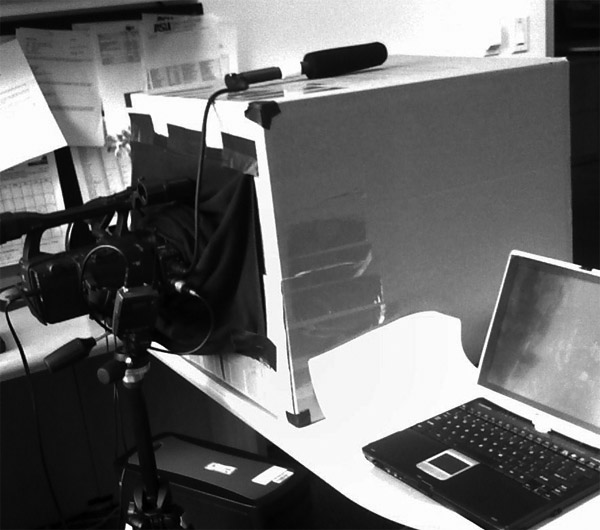
I work with people with an unusual skills at the Decision Theater. But how often do you find someone who could put together a home-made teleprompter? With nothing more than a cardboard box, a sheet of glass he pilfered from me, some buggy freeware, and a bit of duct tape, my colleague Dustin Hampton is ready to shoot a series of videos featuring simulated news reports.

panflu_2

The laptop makes the mirrored text scroll onto the flat screen monitor taped down at a 45-degree angle. It is then reflected up at the sheet of glass –on the other side of the camera you see here!

Yes, like everyone else in the state, the universities are facing budget cuts. But there’s work to be done. This project involves pandemic flu planning. I like to think of this as our way of not sitting back and waiting for the sun to rise.

(cross posting from LightBulb Moments)

Will Clinton’s push for ‘smart power’ bring networked diplomacy?

At the heart of diplomacy, says incoming Secretary of State Hillary Clinton (speaking at her visit to the State Department yesterday) is smart power. I trust this is not as something analogous to ‘soft power.’  To me smart power would be all about taking diplomacy into a 3.0 world. We all understand what 2.0 stands for, since this thinking debuted three years ago.

Like web 3.0 thinking (see Google’s Eric Schmidt take a crack at it), the folks looking at how to engage in diplomacy 3.0 would do well to understand how information, ideas, even value systems move virally across networks. They would do well to look at a paper that was written by the Carnegie Endowment for International Peace, titled ‘Network Diplomacy.” Amazingly, it was written in 2001! It’s about networked intelligence, dialogues, listening, sharing and trust.

Much of what it talked about is more or less accepted now in business and public relations –and only grudgingly in diplomacy. I say this because I asked a friend at a State Dept agency about networking and he said they were disallowed from joining networks for security reasons. That didn”t seem right since I know from closely tracking Dipnote, how engaged and networked some of them were.

Rules against networking existed in the murky 1.0 world. Where we locked down our employees, and monitored what links they clicked on, and then blamed them for not sharing knowledge or having rotten data. Or as they called it in the intelligence 1.0 era, for having ‘faulty intelligence.’

Back to the Carnegie paper, it observes that networks trump hierarchies, and that foreign policy is not just a sum-total of discrete events but an ongoing global engagement. To this end,

“networks are able to bring together much broader communities to flexibly address problems in ways that hierarchies often cannot.”

Let’s hope we see ‘smart power’ grids roll out fast!