
Here is the podcast of our first radio show, Your Triple Bottom Line
Our guests were:
- Cindy Laurin, co-author of The Rudolph Factor
- Andrew Nisker, film-maker, producer of documentary, Garbage
Here is the podcast of our first radio show, Your Triple Bottom Line
Our guests were:
 I almost forgot to break the story here. I started a radio show last week, focused on business. It’s called Your Triple Bottom Line.
Yes, it’s around the ‘Three P’s’ –People, Planet,Profits. I’m more into the first and the last Ps. (I leave the middle P to my wife, a small business owner, whom you would call a ‘deep green’ person.)
But it’s a great experience, being on radio. I trained at the BBC in London many years back as a producer, and have been a closet radio person all my life. Which is odd, being also into digital media. But I still maintain that radio is the true real-time medium, the first channel that brought communities and conversations together. The Internet simply borrowed the language and the model!

Derrick Mains and I co-host the show. There’s a social media angle here! I host and produce a podcast for GreenNurture, and Derrick has been a co-host of that show. Why radio? Have we got it backwards? There’s no short answer for this, but you will understand if you listen to the kind of guests we bring on every week.
Why is it that people who ride public transport don’t do a lot of talking? But give them a wi-fi connection and they’ll be chatting with a lot of others.
So when I saw a post (from Barbara Gibson) about London cabs using Twitter, it got me thinking.
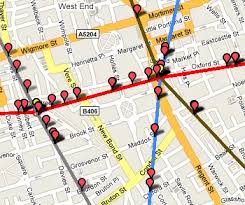 What if Twitter becomes a conversation starter on subways and trains? Already, there’s a head start in this direction among FourSquare users. It’s easy to discover like-minded users in a restaurant or public event.
But to get back to cabbies. If branded cab companies are letting customers order a cab with a tweet, it’s not too difficult for cabbies such as @cleanaircabphx or even new services such as RideCharge @taximagic to create ad-hoc networks so that passengers might find some common interests within a certain geographic region.
Buses and Subways could be even better in this, considering they have fixed routes and predictable (and well segmented) passenger demographics.
The point of all this is not to encourage more commuters to ignore each other because they could have some wonderful conversation with someone in another bus, another cab. But the ideal situation would be if commuters start connecting with people in the way it used to be –by finding common, topical subjects worth having a conversation about.
But this one’s more of a directory of blogs.
And getting back to micro-blogging, here is a parallel. An aggregation of Tweets from Tube commuters.
To “inform, sell, engage and support.” How much simpler could anyone have put it?
There are many questions that could be addressed with this answer. Such as:
 Lionel Menchaca has put up this schema that I wish I had a few days back. It’s outlines how Dell uses social media in Brand Reputation Discussions, Customer Service and Segment Discussions.
But here’s something that bears watching –and I am certain it will end well.
In a response to this post by Menchaca, a customer going by the name of Maria posts a looong comment. It’s very reminiscent but not as harsh as the infamous Dell Hell post. She goes on to state that:
I believe I have given Dell every reasonable opportunity to make this right, but I cannot afford to lose any more time and valuable productivity because of a defective product. I would like to send the computer back for a refund.
As a big fan of Digital Nomads, I’ve been watching -and dissecting –Dell’s engagement across many social media channels. I can be sure this is going to come to one more grand denouement.
 I’ve been conducting a series of webinars on social media, and we reached the halfway mark last week. The series was called Passport To Digital Citizenship.
The topics have been:
In this webinar we talked about fans and friends –especially the difference between ‘lower case’ friends and ‘upper case friends.’ How do you engage your network? How do you turn on your hub? And most importantly, how do you get ready for an increasingly mobile user?
If you attended the 3rd webinar, here are two handouts. you may find useful.
I had one participant suggestion –to create a discussion group on Facebook.
I’m a sucker for using applications that feed the content I like to get to, through one big funnel. You know, those aggregators, and hubs and portals that promise to deliver all of your interests in one clean dashboard?
Trouble is, I realize I often have too many funnels.
So I’ve been very interested in how Flipboard works for the iPad. It promises to reign in “the stuff you care about all in one place.” Content aggregration, in other words.
What’s more interesting than the aggregation, however, is the layout; how it re-organizes various types of content and pulls it into a reading experience. No wonder they call it ‘your magazine.’
Which brings me to the idea of what a magazine means to us now, as we seek out knowledge in a multi-media, social-media enriched world.
I’ve said it before: I’m a magazine junkie –the printed kind. If I had to choose one, I’ll go with #2 above. The filter. Incidentally, that’s how I choose my online content as well when it comes to RSS readers or search tools.
What’s your idea of a magazine?
The way I see infographics it’s not just to tell a story. That was the purpose an infographic was originally intended to serve.
I see it performing a different function in a media-saturated world. Fighting the attention economy!
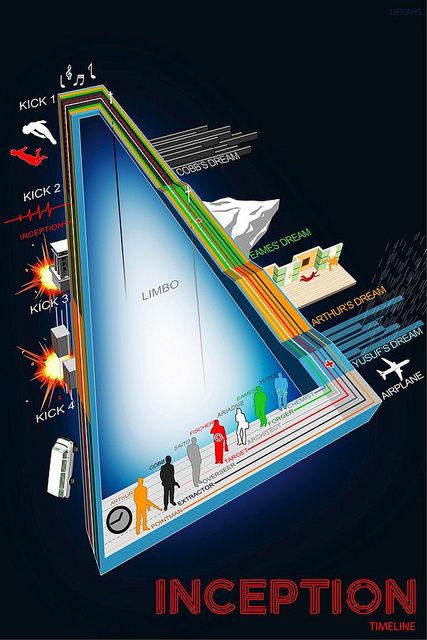
Take a look at this. It’s not evident first what it’s trying to ‘say’ about the movie.
It’s a way of letting the reader unpack a level of meaning that would be different from the next reader. It’s perfect for movies and complex narratives, where there is no one universal meaning. Great directors compress ideas and leave it for moviegoers to discover those nuances.
Oddly enough, journalism and advertising works in the opposite direction –even though both like to be also known as genres of storytelling. They like to bring pure clarity, and therefore unpack the details for the audience. (Check this simple, timely one on BP’s spending.) Worked until about five years ago. Today, consumers, newspaper readers (some call them media snackers for good reason!) don’t want that level of explanation.
Maybe you don’t have the capacity to embed an infographic into your commmunictaion, but you could learn the secret of leaving the reader to unzip his or her own meaning.
Resuming my snapshot of the best quotes from around the world on communications, marketing, media and social media.
“An increasingly addictive activity”
“The future of infographics will be about telling stories. Telling them in an interesting and compelling way.”
“the journalist isn’t a writer; he is a technician.”
“When people feel they have some kind of social relationship with others in the company, there tends to be greater collaboration between them.”
Human Resource Executive, on the potential and perils of social networking in the workplace.
“The $35 iPad lookalike from India”
Blurs the Lines Between Online and Offline.”
Fragmented or integrated?
 It’s easy to pick the latter, because it sounds like the right thing to do. Depending on what you are trying to achieve it’s not that easy though. Here are two scenarios:
Scenario A: You are launching a new service that is relevant to 30 percent of your audience. You’ve got the usual suspects –um, channels — in place with Facebook, LinkedIn, YouTube, a blog and two Twitter accounts. Do you make spread your content across all of these?
Scenario B: You a teaching a class, and most of the attendees use Facebook rather than email, but you also have a series of video updates. Do you stick with Facebook, or add a blog to the program which will feed Facebook embed YouTube videos?
I don’t want to say I know the best answer. (It may take a bit of digging deeper into the usage patterns of the audience etc.) But I often lean heavily on closing the gap between communication channels. It takes some planning ahead, but you only have to connect the dots once, and thereafter, it’s easy to pick and chose the channels you like to integrate.
I pointed this out toward the end of the webinar I was conducting last Monday. To demonstrate it…
 Now that the BP oil leak has been stopped —or so we hear today — has anyone considered that it may be time to create some good juju for PR, after what BP has successfully done in maiming the industry?
Many of us PR and non PR types have railed against the dark stain that BP’s oil spill is leaving. I have tremendous respect for those who handle corporate PR whether they are consultants or internal PR folk. It’s a tough job getting the organization to say it as it is, and to stop publishing mindless statements just for the sound-byte effect.
So I was hoping to see a coalition of PR agencies coming together, perhaps under the umbrella of PRSA, and the CIPR (British PR association), to bring in some of the largest booms (thought leaders) and heavy equipment (smart technologies) to stop polluting our pristine beaches (er, reputation).
PRSA’s mantra is “Advancing the Profession and the Professional.” Looks like the industry has been mugged by flaks who are effectively planting land mines along this path. Search for BP at PRSA’s web site and you see articles such as “Can the BP brand survive Tony Hayward?” I was hoping to see some folks come out say why “BP’s PR has been toxic for their business.”
 Meanwhile BP continues to write about its wonderful response about how it is “Flying higher to get closer to spill response,” and its sea bird rescues.
And nobody in the PR industry seems to mind.
 Hoipolloireport