How indispensable could Alexa be?

I have been curious about Google Home and Amazon’s Echo, purely from a tech perspective. Also it’s interesting to keep an eye on where AI is going. It’s easy to be cynical, because a piece of always-on hardware that ‘listens’ to everything going on in your home all day is well, a bit creepy.
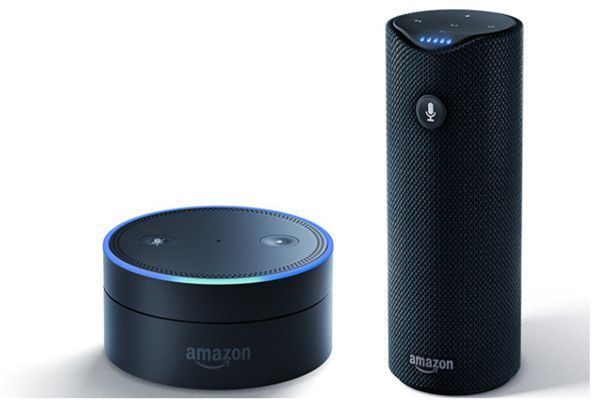
Not that it worries millions of iPhone users who also have an AI agent, Siri, just waiting to be asked something.  But these devices are prone to being hacked, besides invading one’s privacy. (I know of several people who have a sticker over the camera on their laptop lid, for good reason. Hey, Facebook’s Zuckerberg does!)

So a few days ago I tested Alexa in a friend’s home. He’s been using it a lot –he asks Alexa what’s the best route to work, and to play music off his playlist etc. I asked Alexa a simple question, “Alexa, How long will it take to get to the Moon?” Without missing a beat Alexa responded with an answer (3 days) qualifying it with something about development of rocketry. The next few questions a bit predictable, such as asking for the bio of a country singer, and to play some of Keith Urban’s music. When Alexa got stumped, it was probably my accent, or it did not get the context right.

But my friend says he asks Alexa to add items he will need in the store to his shopping cart, and picks up the list on his phone when he is in the store. He recently installed a smart thermostat so it is feasible that one day he could ask Alexa to change the temperature (and his wife could ask Alexa to change it back!) But as we brainstormed how it might change our lives I wondered, once the fascination (of talking to a piece of hardware) wears off, if we might find Artificial Intelligence too useful to ignore.

For instance, I would love to be able to ask Alexa or Google Home to:

  • Forward my article to LMD magazine, but please change the last sentence to (and I could dictate it). It would save me from logging back onto the computer, and opening my email etc.
  • Send a Text alert to my friend in Worcester (whose phone number I have forgotten) about an upcoming event
  • Buy a copy of a (name title of book) from Amazon, use Prime, and pay for it with my gift card, not a credit card.
  • Print a copy of my recent Lesson Plan on a black-and-white printer, double-sided, on Monday morning by the time I get to school

Will that day come soon? Are we there now? Is this too much information to be put out there in the cloud? Will Keith Urban send my daughter an autographed T-shirt? Just kidding!

When a speech gets waterlogged.

Pity the speechwriter on the White House payroll. I envision the person banging his or head on the keyboard, every time the boss speaks. The most recent being Trump’s description of relief efforts in Puerto Rico.

“The response and recovery effort probably has never been seen for something like this. This is an island surrounded by water. Big water. Ocean water.”

Trump’s speechwriter must be probably wondering:

  • Why state the obvious in a tragedy caused mostly by water?
  • Why heap on adjectives such as ‘big’ and ‘ocean’?

“This is an island sitting in the middle of an ocean. It’s a big ocean, it’s a very big ocean.”

Perhaps he believed that things might have been different had it taken place in a small ocean? Leaves us scratching our heads if it’s possible the real estate mogul knows of some islands surrounded by something other than water? (Blue Gatorade, perhaps?)

Whatever it is, my sympathies go out to Stephen Miller, Trump’s senior speechwriter, who’s probably right now trying to tell the boss to stick to the teleprompter. Or at least run a phrase through a cliché-extracting machine.

Algorithms do make mistakes! A teaching moment after Vegas

It’s so easy to assume that ‘algorithms‘ can do no wrong. Did you even use the fancy word prior to ‘Search Engine Optimization’ ?

So Google’s statement that, after the Las Vegas tragedy (and the inaccurate news that ensued via social media) they had to go in and over-ride the algorithm, says volumes.

“Unfortunately, early this morning we were briefly surfacing an inaccurate 4chan website in our Search results for a small number of queries. Within hours, the 4chan story was algorithmically replaced by relevant results. This should not have appeared for any queries, and we’ll continue to make algorithmic improvements to prevent this from happening in the future.”

Here’s what is worth teaching.

  • A search result that pops up may not be accurate. In fact it can be deliberately misleading. (The Tom Petty headline, being the latest in ‘inadvertent’ mistakes.)
  • Cross-reference your ‘facts’. Read the whole article before drawing a conclusion.
  • The headline in a tweet or a trending FB post is an incomplete picture. Or often carries a bias. Former Facebook ‘news curators’ have admitted they were instructed to artificially inject selected stories into the trending news module.

An algorithm is just “a process or set of rules” that are set up in advance for sifting through data, and making calculations with complex variables. Algorithms are not writ in stone. Especially when there is some Artificial Intelligence involved, they are supposed to ‘learn’ from the complexity and adjust. Sometimes they aren’t good learners, and are easily misled, or tricked.

And so are we!

Plans afoot for Space Day 2017

Just announced plans for Space Day at Salt River Elementary – our 6th year!


  • This year’s focus is on the Moon, rockery and spacesuits.
  • The student competition is to design a future spacesuit 
  • Each class in every grade level will experience one facet of space science
  • When: Oct. 26th, 2017    Time: 8:30 am – 3:00 pm

As the event grows bigger each year, my thanks to those who will be supporting it:

  • Orbital ATK, Arizona
  • Jet Propulsion Lab, California
  • Autonomous Collective Systems Lab, at ASU
  • SpaceTRex, University of Arizona
  • Challenger Space Center, Arizona


Space science is a fascinating field, and gives us who focus on STEM an ability to widen the lens. Consider some of the recent developments


News we’d love to hear

Remember that Anne Murray song with the line, “Sure could use a little good news, today“? Imagine if the headlines went like this:

“Twitter bans Donald Trump’s Twitter handle, citing cyber-bullying clause.”
“Uber discontinues plans for self-driving cars.”

“CNN to replace words like ‘optics’ and ‘weaponized’  with words in plain English.”


Sneaking in VR to the class

This year I’m using VR both as a project, and as a motivation tool – to create a brochure. My 6th graders understand some editing and formatting skills. So to raise the bar, I got them to research and put together a brochure on Virtual Reality.

Granted it’s a lot of work. Understanding VR itself takes some time. They must create content for the 6-panel document, look up content, find pictures etc. As work progresses, there is a parallel discussion of what VR looks like, using a few cardboard headsets I acquired. One student even brought in two headsets. (One had cost him just five bucks!)

The incentive was that any student who showed me they had three panels formatted, and with required content, would get to experience a VR roller-coaster ride. Didn’t think a 40-minute class could move so fast!

Funny how sneaking in a piece of tech into a lesson can accomplish much more than a hand-out!

Our obsession with data – Symptom or Trap?

It’s hard to pinpoint when the word ‘data’ slipped into everyone’s conversation. Was it around the time we became aware that search engines were using data to understand user behavior? When data became their currency for pricing ads?

Data gathering amounted to accountability. data bestowed scientific accuracy. In some of the industries I used to be in, we had sexier terms: Metrics, and Analytics. (Combine the words to give it an aura of science –call it Data Metrics!) If you want to get more geeky, we also called some data ‘KPIs‘ – Key Performance Indicators. Today, hardly a week goes by when you don’t hear of Source Data, Meta Data..and the mother of all data we know as ‘Big Data’.  And  this spilled over to all other sectors. So it’s no wonder we hear phrases such as:
  • “So where’s the data?” ( “Where’s the evidence”)
  • “This is good data for us.” (Which used to be “this supports our point of view.”)

What happens when there is no data? If a tree falls in the forest, and and there is no data, is it lumber? Just asking!

What happens when you don’t treat people as data? My wife has been teaching Montessori for the past, say, 28 years. The Montessori method does not use report cards. No data files. No spreadsheet to forward to the preschool the student will move to. But on any given day, she has what some might call ‘data’ in her head. Specific ‘performance indicators’ about each student. Montessori teachers know exactly at what development phase a child is, whether he/she is moving from Number Rods to more complex math to grasp the units, tens, hundreds, and thousands. The child is not a piece of data, as there are more holistic considerations.

Which makes we wonder: Are we data driven or just unthinkingly data obsessed? Nicole Laskowski quoting a Gartner study, thinks we are the latter:

 Metrics and innovation don’t always mix. In fact, according to the analysts, having a singular focus on current performance metrics can create what’s known as “analysis paralysis,” where so much time is spent analyzing the data that a decision never gets made and risks are never taken.

It’s not the Tech companies’ fault. We simply assumed we could all run our lives like the Google’s of this world. Speaking of which, few know that Google’s founders, Larry Page and Sergey Brin were Montessori students. I’m willing to bet that their teachers had absolutely no metrics to indicate that they would become the founders of a data-driven culture. Or maybe they did – they just didn’t call it data!


As trust far as trust in media goes, funny how radio beats the Internet

Interesting how the one place we associate with up-to-the-minute information is the least trusted. While what some would call ‘old school’ media –Radio! –consistently earns people’s trust.

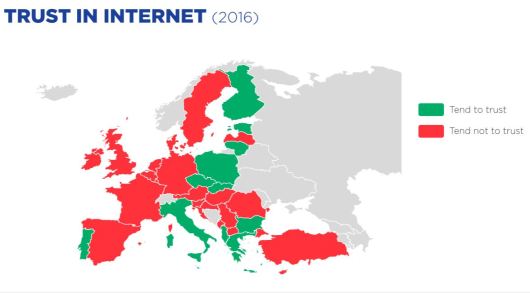
Among several studies looking at media trustworthiness I was fascinated by this European study. (Trust in Media, 2017 by EBU)/ Some highlights:

  • 64% of countries surveyed find radio the most trusted
  • 59% of citizens in the EU trust radio
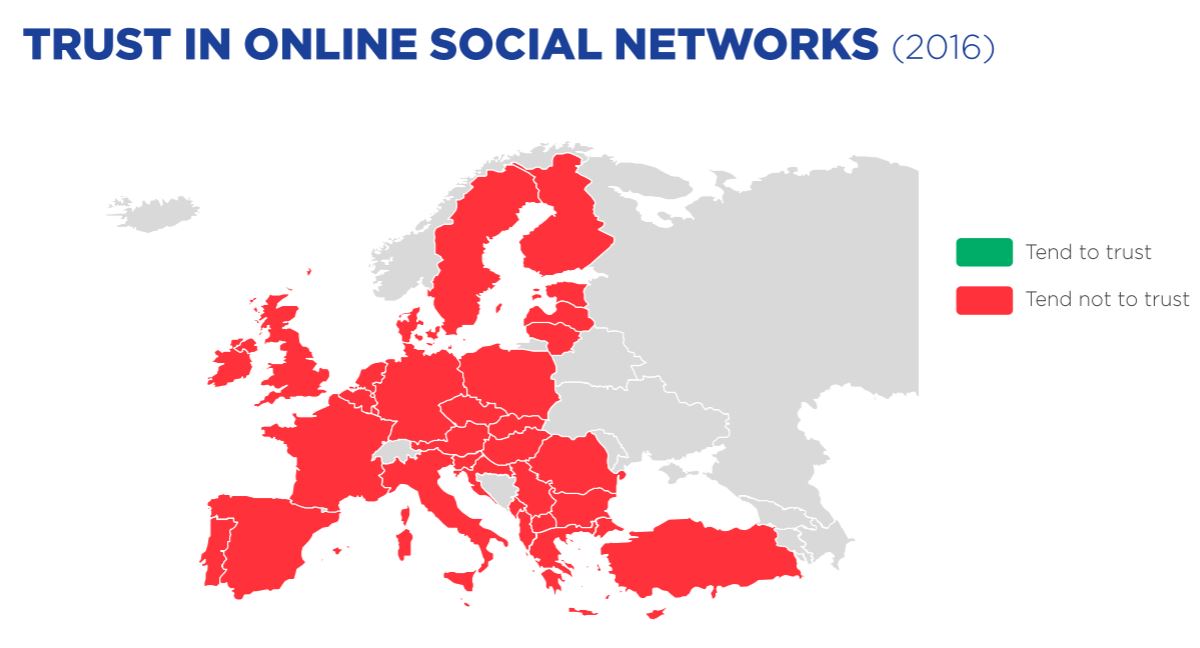
  • Social networks are the least trusted (except in eastern Europe)
  • In 12 out of 33 countries 64% of citizens mistrust the Internet

Check these snapshots. The Internet is seeing red!


It gets worse on networks we sign up to –if only to connect with those whom we assume are trustworthy.


Which begs the questions.

  • How did we get here?
  • Or better still, why have we – who often comprise the ‘sources’ of news on social networks –misused the resource?

Thanks, Cassini for all your work. And catching our ‘wave’

Cassini, the robotic spacecraft that traveled for nineteen years (and some 948,149,234 miles), came to a sad end today, as it flew into Saturn. It’s demise was planned, however for good reasons.

It was one ambitious mission in 1997. A knowledge excursion to parts of our solar system that were previously beyond our reach. Through Cassini, we learned about and discovered more of Saturn’s moons, we got to see the make up of its spectacular rings, and learned that the gas planet does have its own hurricanes. It carried a probe, which it landed on one of Saturns’ moons using a parachute. It beamed back data through NASA’s Deep Space Network, and as you’d expect from any celebrity now, Cassini had its own Twitter handle, @CassiniSaturn.

Cassini’s full name is Cassini–Huygens, being born of a project collaboration between three space agencies from the US, Italy, and Europe.

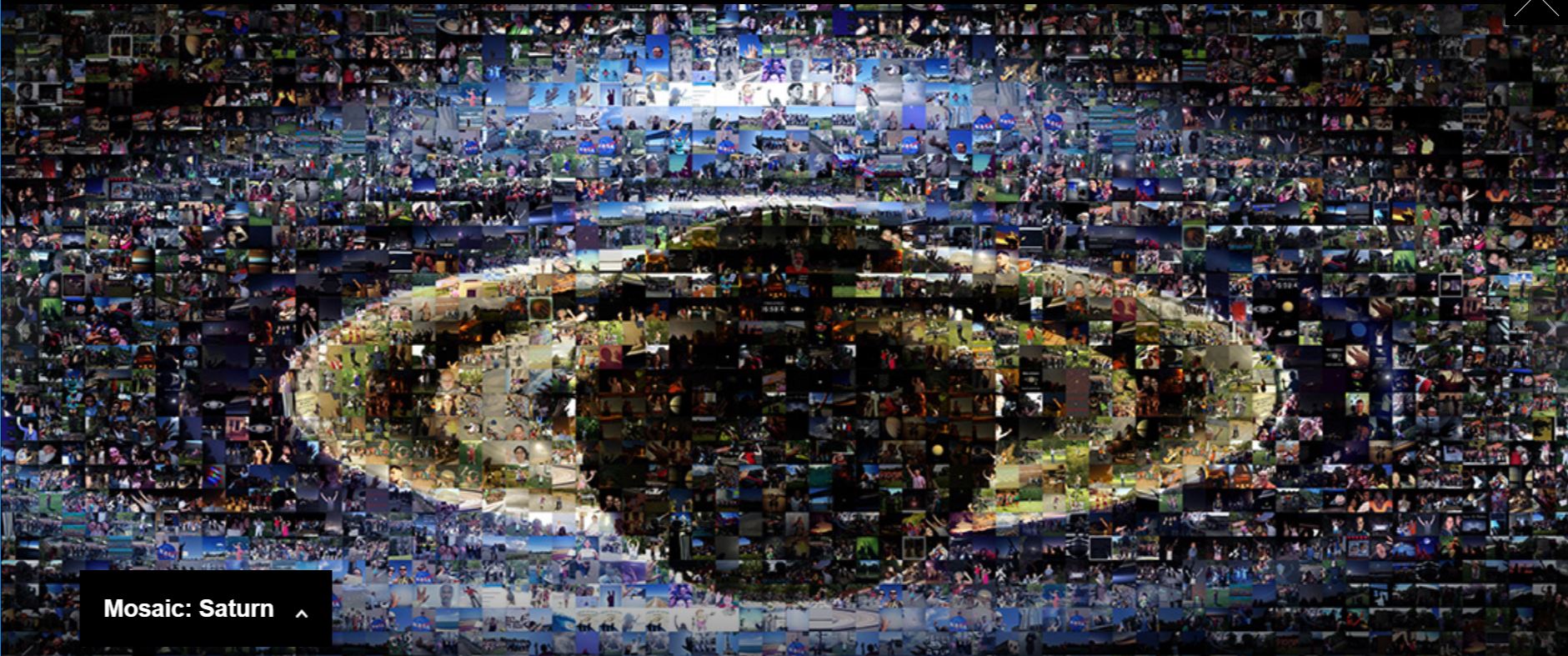
Cassini was used for interesting aerial photo-op. It took place on July 19, 2013. The folks who programmed Cassini turned the spacecraft back toward Earth to take a picture of earthlings waving at it. The images were then beamed back and stitched together in a huge mosaic of the Saturn system, itself! More about that event, here.


Storytelling with Google Earth. Neat multimedia tool!

I found an interesting way to use Google Earth to enhance a lesson. It’s called TourBuilder.  It’s set up like a slide deck, and is quite intuitive. You need to have a Google account to log in and use it.

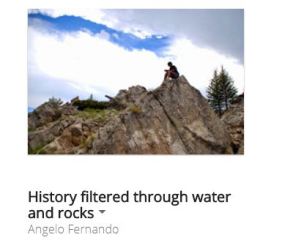
Ideally you need to have your images and videos ready to use. But you could search and embed them from other image sources – including yours, if your images are searchable. I tried my hand at it, creating a story based on a fascination with geology, and photography of rocks, canyons, geysers, and gorges. The ‘tour’ starts in Arizona at the Grand Canyon, hops across to Wyoming to Yellowstone, and then to Ithaca, NY.

You could check it out here

It’s possible to use this as a way of documenting a road trip, for instance, and attach specific dates to each stop. A great way to supplement journaling, and deeper, and richer than FB posts or tweets.


.