Mars Day taps NASA, StarLab and HI-SEAS Crew Member

StarLab_1It’s fun to have an event such as Mars Day at a time when there’s so much more being discovered about the Red Planet. Like the excitement about flowing water, a few weeks ago.

For this year’s Mars Day at Salt River Elementary, we feature three interesting facets of Space exploration and discovery.

StarLabThis is an inflatable planetarium that will give younger grades an interstellar experience. It comes to us through ASU’s School of Earth and Space Exploration. Just the idea of having a planetarium come to the school turns science into something more experiential. Added to that we have a great outreach team that gives students a ‘tour’ of the night sky, and a hands-on table-top experience.
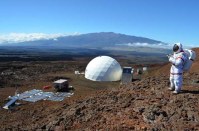
hi_seas_3Zak Wilson is one of the crew on the Mars Habitat experiment last year. He will be here to conduct concurrent sessions, and be our keynote speaker. Zak, who was part of a 6-member crew lived in a Martian habitat (seen on right) for eight months! It was situated on a volcanic terrain that resembled Mars. More about this experience here.

ASU/NASA. And last but not least, we have the team from ASU’s Mars Space Flight Facility conducting hands-on sessions with grades 3,, 4, 5, and 6. This is the fourth year of our collaboration with this group.

Mars Day 2012 - Kody EnsleyHere’s how Mars Day has evolved.

In 2012, we had our students talk to Kody Ensley, a
Native American who interned at NASA, and worked on Robonaut,

In 2013, we featured Commander John Herrington, former Space Shuttle commander,and the first Native American in Space.

In 2014, we had the Hi-SEAS Mission team, and Dr. Jack Farmer from ASU.


An evening of “Crosstalk” reveals how people and text interact

No, this is not about Facebook, and how we seemingly interact with text that sometimes seems like a bunch of posturing and talking at cross purposes!

This is about a performance I went to last Saturday at ASU, brought by the School of Arts, Media and Engineering.

crosstalkThe key ‘performance — a semi-choreographed interaction of two women –was to demonstrate how conversations (and text) can ‘make’ people, and their reality. Meaning, how language doesn’t just represent us, but shapes who we are, even while we use it. Here’s how they describe it. The art form:

interrogates these questions (using) 3D infra-red motion tracking, voice acquisition, speech recognition, multi-screen video projection and multi-channel surround sound to create an immersive multimedia environment.

As the dancers move and speak, speech recognition software reveals sentences (and sentence fragments) on two screens at right angles to each other. Then these texts begin to intersect, and create some interesting visual ‘performances’ – dropping off, angling, growing, and interacting with the other person’s texts.

The event was the work of visual artist, Simon Biggs, and composer, Garth Paine, both of whom dabble in the algorithms that work behind the scenes.

Why I found this fascinating was that it is in an oblique way related to my work in Chat Republic, and how our conversations determine our realities. We are, whether we like it or not, immersed in a digital landscape, and what we say to each other lives in a textual sense out there.

One does not have to be steeped in social media to be part of this Web 2.0 world, where much of what we do is cross-referenced by algorithms –when we sign on to purchase something, do a Google search, or leave a comment –that build profiles of us, and builds identities of us.

Just check what Facebook appears to be doing, sneakily boosting your ‘Likes’ when you message someone.

“Are We Talking Too Much?” – Theme of Tempe launch of book

Thank you everyone who attended the second launch event for my book, Chat Republic.

The topics around the book are many, but we seemed to center on the big question as to whether social media has made us too…chatty. How real are the conversations we have, when few appear to be paying attention?

Thank you to may eminent panel who weighed in on the topic.

  • Gary Campbell, editor of ASU’s web site
  • Prabha Kumarakulasinghe – Microchip
  • Don Wilde – Intel

.Some of the topics that came up: 

  • Gold bar espresso, Tempe - Chat RepublicFace Time, Real Time. What is happening to face-time, with people busily checking their phones for possible interactions with the ‘other’? (If you haven’t seen “I forgot my phone, watch this: a statement of our times.)
  • Do we really need smart phones? Or wouldn’t ‘dumb-‘ (um, feature-) phones be adequate most of the time?
  • Transparency Vs Over-sharing. Is our ability to know so much a blessing? Yes, we want to know minutiae about public officials, but many are pulling back because of surveillance. Gary cited the example of how smart phones could help people do dumb/smart things, as in the case of the NFL Player, Brian Holloway, who tracked down the kids who trashed his home. (This story is still being played out, by the way)
  • Smart devices in the class. I enjoyed this one, for obvious reasons. There were several teachers (one principal) in the room, who face this challenge: Are mobile devices in students’ pockets going to help or hurt them?

A big thank you to Dennis and Karen Miller, owners of Gold Bar Espresso, for letting me use their wonderful coffeehouse for this event. These are the spaces –-the Kaffeehaus culture –where deep conversations have taken place for centuries!

Obama’s ‘Body of work’ speech gags critics

This video is worth watching, if only to see how the president of the United States put an overblown media controversy to rest –giving that phrase a new context, now.

For those not familiar with this flap, ASU had not intended to give the president an honorary degree –an old college custom lavished on commencement speakers. It was a policy that had been in place for years. But a statement by the university raised the ire of some, exacerbated by media chatter. The statement had the phrase “his body of work is yet to come” and attracted headline such as “ASU stiffs Obama.”

ASU didn’t change its policy; it created 2000 ‘Obama Scholarships’ instead.

So it was interesting to see the pres weave in that phrase many times, to take it to a different level. In the vein of any parent, any teacher that tells a young person ‘you never stop learning,’ and ‘don’t sit on your laurels…’ he stressed sacrifice and finding greatness that lies within. “Don’t stop adding to your body of work!”

The entire speech is here.

Take risks, change attitude, rethink your career

Obama4If people though that Obama would trot out the message of Hope, and yes-we-can for an grad audience, they were wrong.

It’s about change, not hope.

“Question conventional wisdom and challenge old dogmas.”

Hard task ahead, not just for people like these 11,000 people entering the work force. I try to put some of this across in my resume-meets-social media seminar, but taking risks is hard, scary at this time. But guess what? I know of two people who are doing just that.

One guy is starting what most people would call crazy –a media company. He happens to be an ex-journalist. The other guy has a great model for mobile marketing, using the phone as a scanning device. I asked the journo, if he has a business plan. He says yes, but it’s not exactly a plan because  he intends to tweak it as he moves ahead. Conventional wisdom tells me this is risky. But that’s exactly what we need in a recession: Unconventional wisdom. He was not forced into a career change. He shifted gears before he was forced to.

As Obama sums up his speech –it’s 8.25 pm Mountain Standard Time– I know that Obama is lighting a fire under an audience beyond this stadium with than formula.

Obama’s visit today begets massive social media coverage

PressBox_0512Happy to note that I am part of the social media ‘swat’ team at today’s commencement at Arizona State University, where president Barack Obama will speak. (Sun Devil Stadium, 7 PM Mountain Time, 63,000 people).
Now unofficially called the ‘Tweam‘ (in the tradition of making horrible words to describe anyone also using Twitter as a communication tool) about 20 of us will provide a different type of coverage from what the major networks will bring: multiple angles, twitpics and more uploaded to Flickr, perspectives and commentary on several blogs, podcasts etc. Befitting, of course Obama’s and the White House’s use of social media.

A few things to get you started:

Watch how ABC15 profiled this social media blitz last night –click on the TV story, top right of page

Be careful about whom you (don’t) follow!

Lame move on my part!

I admit I don’t follow everyone who follows me on Twitter, because it’s just not possible to pay attention to so much chatter.

But today, I realized I had been following the wrong tweet on my mobile. In a real-world event this could have had major repercussions, especially if that person or group was part of a coordinated team.

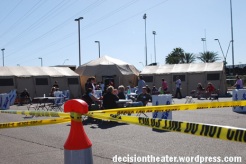
The event I am talking about was a terrorist attack on a football stadium. OK, it was a mock  terrorist attack! The event was an emergency planning exercise at Arizona State University.

I was tweeting, taking photos, and recording audio for a podcast while my communication colleagues were tweeting. But ASU has so many people on Twitter now, it’s possible to not follow the right person! I feel more stupid since it was only last week that two others and I presented to a group about the value of Twitter, where I specifically mentioned how easy it was to send an on or off command via your mobile device to follow or turn off someone!

So the lessons learned:

  • Be careful whom you don’t follow – deliberately or accidentally
  • Think of Twitter as two parts listening post, one part micro-blog
  • Keep a short list of those you really need to follow –in a notebook!
  • Regularly check your account settings –esp ‘Device Updates’

Visual browsing of World News

I have been looking into how a GUI ( geekspeak for ‘graphic user interface’) could enhance a message, and am considering doing some cool interactive, kiosk-type visualizations in our lobby at the Decision Theater. Interactive displays such as the Campus Metabolism project from the Global Institute of Sustainability is one way to do this. It’s a web-based but is much more interesting on a touch-screen in their lobby.

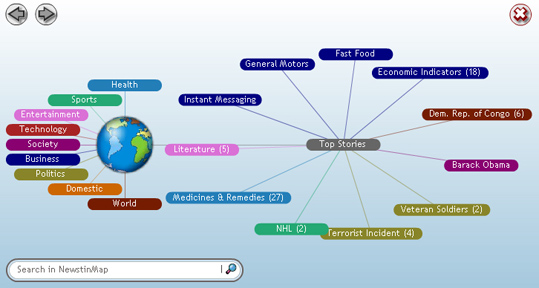
newstinBut apart from aggregating data, a GUI could simplify the user experience, for news, as this site called Newstin demonstrates.

Click on the Newstin map, and it basically organizes world news from 166,000 sources, organized into about 1 million topics. Mind you, Newstin was created before the iPhone, so it’s easy to see how a widget could transfer this kind of experience to a mobile device.

Industrial design could send a message

How could a building or  structural feature send a stronger message about what you stand for than other design elements –web site, brochures, annual reports– you put out on a regular basis?

Not everyone could build a spectacular ‘shrine’ like Apple has, in Manhattan.

At ASU, the Global Institute of Sustainability takes a more pragmatic approach, with wind turbines on the roof generating power, even while solar panels are being installed in other parts of the campuses so as to take care of 20 percent of the total energy.

And speaking of wind power, this story out of London, of designers creating a column of light using wind power is more than a fancy energy project. It demos the capacity of creativity that could be unleashed within the urban planing when you let energy send a message.

jason-brugesIn this ‘tower of power’ as it is being called, there are 120 LED’s being powered by a “gentle” wind. Nothing fancy in the set up. A laptop is the only piece of technology behind it, apart from these 1,200 tiny fans. The designer, Jason Bruges Studio, calls it a wind-light.

Maybe someday outdoor signs will be lit this way.

So that, beyond growing lettuce (watch this video!) on the vertical face of a billboard, as McDonald’s did in this very daring/cool design, existing structures could send a passive message, with some “gentle” asistance from the sun, water and wind.

Hot, Flat and … intolerant (and why it’s going to change)

Yesterday we had a book discussion on Thomas Friedman‘s Hot, Flat and Crowded.  There was a good cross section of people, and I truly enjoyed the student perspective on the key things Friedman diagnoses as the problems in the US (isolationism, infrastructure and nation building) we need to fix.

What timing! This was first of 4 sessions here at the Decision Theater, a place where we look at alternative  scenarios and sustainable futures.

The dominant metaphor in the book is the US consulate in Istanbul that was built so secure, it’s a place where “birds don’t fly.”

Having covered the technology space for awhile, this isolationist metaphor seems at odds with what’s going on in the US with regard to collaboration and connectivity. We build open source platforms for business, gaming, virtual worlds and education. We invented wikis and blogs and send the opposite message outside our borders. Obviously we are not singing from the same song sheet, –as this T-shirt at a rally reflects. (Guess who’s rally that might be?)

As we saw last night, hot, flat and intolerant is a losing proposition.