“Mainstream no more” is tough pill to swallow

As we come to the end of May, two things with huge implications have shown themselves.

THE FIRST was the Wall Street Journal’s faux pas, trying to force a set of rules on their journalists who’ve started adopting social media into their work flow. Just one of the rules, that ‘Business and pleasure should not be mixed on services like Twitter‘ sounds like it was written by someone who woke up yesterday. Or didn’t hear about the ‘95 Theses‘ published ten years ago. Not this one, but in this book!

THE SECOND was the launch of a company called Blink.lk. It’s a new media company in Sri Lanka, launched by a former journalist and longtime friend Tyron Devotta. (Full disclosure: I am partly involved in it, at least in sentiment.)

One of their first posts on the blog –that has fittingly preceded the main web site–was called “Mainstream No More.” It’s written by a staffer, a former reporter. She expresses the struggle this switch involves. Today, anyone in the storytelling business has to get under the hood of social media and see what makes it so compelling to the audience. Or as Jay Rosen aptly called them, “the people formerly known as the audience.”

Quotes for the week ending 30 May, 2009

“He texts during dinner at restaurants and while walking down the street and twitters at red lights while driving.”

Reader at New York Times, commenting on how people who who would never be so rude as to talk on the phone at a restaurant, have different rules for using Twitter

“Britain’s mums told us where to stick the artificial ingredients. And it wasn’t in the bottle.”

Ad for Sunny Delight, running in Britain’s newspapers, as recointed by Jonah Bloom of AdAge, who suggests marketers need to apologize first. To which one reader responded:

“The first financial institution that apologizes will be apologizing for an entire industry for years of greedy pay packages, excessive “innovation”, disregard of risk, tricky offers & excessive political lobbying. Their customers will likely not be so forgiving as the Brits when they chuckle about Marks & Sparks reducing the price of big bras.”

Advertising Age

“It’s hard to understand how Cheney and Kyl could make statements like this with a straight face…”

Steven R Corman, at ASU’s Hugh Downs School of Communication, commenting on the former vice president and the senator from Arizona’s dismissal of Guantanamo prison being a strategic communication tool for Al Qaeda

“We used to call people who embraced this sort of behavior workaholics. Now we call them crackberries.”

Jim Shea, on how Boomers make way  for ‘weisure’ time –fitting fun around work, rather than the other way around.

“…it most definitely wasn’t named for Bing Crosby.”

Fast Company, on Microsoft’s new search engine, Bing, that is positioned as a ‘decision engine’

Lessons from live blogging a social media event

Last evening, I live blogged an event at work, trying out a service called CoverItLive.

Check it here

What was interesting to me was that the event itself was steeped in social media. Basically it was the unveiling of a student-created wiki for sci-fi author, PJ Haarsma, who writes books that are connected online  games, using feedback loops and wiki-interaction to promote better reading habits across America.

To get back to CoverItLive, it’s a great tool, because it lets you update your posts  created on the CoveritLive interface, to any blog. Of course being the first time I used it, I think I messed with the time-zones and as a result, it was not updating. Plan B rolled out! I copied and pasted the posts into the blog. Which defeats the purpose, I know!

But the experience was valuable; it’s only by experimenting with social media tools like this can you get past that learning curve. The very frustration and the mistakes make a lot of other similar social media apps coming after this, easier to master.

Features: What’s neat about CoverItLive is that the audience does not need to refresh the screen — the text keeps streaming onto your blog. Also very valuable, is the ability to conduct a poll while posting.

Recently we looked at using Polldaddy as a sidebar to a live video being streamed via BitGravity, and toyed with the idea of live-blogging and tweeting the event. I love Polldaddy, but application clutter can be distracting. One interface that pulls a lot of other apps together in one box is what I am always looking for.

So the 3 things I learned about live blogging:

  • Always conduct a dry run. It seemed to work in a test, but I never went live. If no time for a dry-run, always have a Plan B.
  • Work as a team. It’s tough to take photos, record audio and live blog! We did this at the Obama visit a few weeks back.
  • Gather media in advance -videos, photos, links etc. Fortunately I had some some homework on this event, so I knew what YouTube video to link to etc

There are two other boxes to check:

  • Make sure of the wi-fi connection
  • Charge your batteries, and/or sit close to a power outlet

Can Google juice contaminate bottled water?

Metro_water_hpEver since I read an article about branding sand — I think it was this one– I have been fascinated with what differentiates a commodity from a brand.

Sand or silica is such an abundant mineral  that it’s amazing how much value it holds. Other commodities such as coffee or wheat seem to pale in comparison with what we do with silica.

But the water business comes close. Branding H20 seems commonplace today, but it is a highly competitive business.

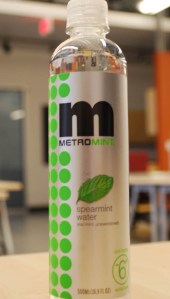
Which is why I found this package for Metromint –a cross between a bottle of shampoo and an energy drink– irresistible when I was in the grocery store the other day.

The company has an interesting tone of voice. It is part of the Soma company, that calls itself  ‘an innovative group of beveragistas.’

The Metromint blog is full of consumer-driven stories, contributed by folks like Chocolate Snob and The Karin.

The packaging is simple on its front end (busy at the back) with something called the Chill Factor. There’s a number for every variant. The bottle I picked up, Spearmint, had a factor or -6. On a day like today that’s inching up to 104 degrees, I long to try it.

But…

Just as I was about to chill and try it out, I stumbled on a piece of news. Damn Google! This particular variant had been subject of a health alert and was recalled late last year. Bummer!

Suddenly all the packaging, online presence, promos and social media-enhanced branding didn’t matter. Here was the prospect of ingesting bacillus cereus staring in my face. It’s one of those food-borne bacteria that probably won’t kill me, but it contradicts everything about bottled water — being safer than the stuff off the tap.

I don’t bring this up to denigrate the Soma brand. It is probably as susceptible as any restaurant or packaged food. But it highlights how branding in today’s world is a completely different task than what it was less than a decade ago. The mere presence of negative ‘Google juice’ –the ability for any and every mention of a brand to be preserved for eternity– is something every brand custodian has to keep in mind.

Outside of bottled water, any service (any ‘branded’ business for that matter) is vulnerable. That’s the reality that I have to face up to as well in my job, using a slew of communication tools to get people to interact with the Decision Theater. I am sure you do too, whether you are nurturing your personal brand or one of your clients.

And it’s not just Google’s memory we have to think about.

Quotes for the week ending 23 May, 2009

“It’s an interesting use of technology, but I can’t help but feel a bit ‘eeewww!’ about this.”

Twitter user on hearing about surgeons in New York tweeting through a kidney surgery

“The word “campaign” has become the pariah of social marketing. Preferred alternatives include terms like “program,” “initiative,” or even “conversation.”

David Berkowitz, in MediaPost, about the word (borrowing from George Carlin) that will “infect your soul, curve your spine, and keep the country from winning the war.”

“Think of it as an early warning system.”

Dan Greenfield on a new tool called Tweet Cloud he has developed for PR and marketing, to make better use of Twitter

“As if there is a lick of difference between those split hairs.”

Arizona Republic editorial on Nancy Pelosi.

“I really hope we don’t get shut down.

Ross Luippold, editor in chief of Texas Travesty, about a fake Twitter Account the student humor magazine had created on behalf of University of Texas at Austin president, William C. Powers Jr.

“1 billion applications served, 35,000 applications available and more than 30 million devices in market.”

Advertising Age on how mobile advertising –app-vertising– is going to change.

“I don’t know if you’re aware of this, but these honorary degrees are apparently pretty hard to come by. So far I’m only 1 for 2 as President.”
President Obama, at his second commencement address this year, at Notre Dame University, with a snide reference to his visit to Arizona State University last week.

Word map your tweets and learn from it!

Did you know you can log in to your Twitter account via Tweetstats, and create a word cloud of just your posts? After this  previous post I wondered. Could a word map be useful, apart from its eye-candy appeal?

WordCloud_Mytweets_3_May09

As those of us who took part in this exercise begin compiling a report of our social media coverage, I realized that this could be another way to create a snapshot of each team member’s activity. But besides that, I can see a few other uses:

  1. It can be used to compare two different events that have something in common –say two consecutive lectures, two conferences, to compare the buzz that speakers generate.
  2. Or to take it to a macro level, we could track  hash tags  in relation to a particular brand attribute, and map it over consecutive weeks. This will give a brand manager better understanding how that attribute is being received 0r rejected in the twittersphere.
  3. We can they overlay it with other analytics using a service such as Buzzgain or Crawdad, and see the effect from multiple angles.
  4. We could the word map from one event to set a target for a similar event. In the above example, the words “thanks” and “news” add not value, and probably were a waste of characters given the 140 limitation.

My old hangout, American Center turns 60

Happy to learn, from the U.S. Embassy blog in Colombo, that the American Center is celebrating its 60th birthday.

In the eighties, the AC was a part of my growing up. I would ride my bike on Sunday afternoons and settle down in the Communications section of the library. This was where I would catch a week’s worth of pre-recorded ABC News with Peter Jennings. I am sure there are thousands of others to whom this was a portal into a variety of interests.

Happy Birthday, American Center! Read the American Center newsletter here.

So what would it have been like when the American Center opened in Colombo 60 years ago? 1949 was a curious year, with these landmark events:

What did Obama’s speech at ASU ‘look’ like?

Think of this as a post about the deeper side of  “just words.”

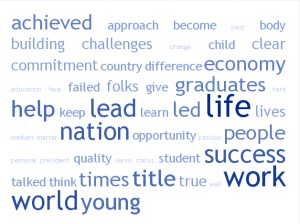
I love tag clouds and word maps. Maybe it is because we deal with visualization quite a bit at the Decision Theater. Last week I ran president Obama’s speech –the one he delivered to Arizona State University graduates– through tagcrowd, and it showed up some interesting emphases. Since we Comms folk at ASU covered the event quite a bit, it threw some new light on the speech.

Check it out here:ObamaSpeech_ASUGrad09_WordCloud

So now, here’s another look at that speech, this time the word cloud is generated through Wordle. The dynamic map is here, too.

ObamaSpeech_ASUGrad09_Wordle

Quotes for the week ending 16 May, 2009

“I’m OK.”

Roxana Saberi, Iranian-American journalist who reported for NPR, who was freed from Iranian prison this week.

“But the president I worked for always wanted it short. He thought about people sitting in the audience on a hot day…”

Mark Salter, who has written commencement speeches for Senator John McCain, commeiting on on what president Obama’s speech at Arizona State University would be like.

“It was a shock … we knew the list was coming, but we didn’t think we would be on it.”

Regina Alexander, whose parents own a Chrysler dealership, on the news of the closure of five Arizona dealerships.

Obama’s ‘Body of work’ speech gags critics

This video is worth watching, if only to see how the president of the United States put an overblown media controversy to rest –giving that phrase a new context, now.

For those not familiar with this flap, ASU had not intended to give the president an honorary degree –an old college custom lavished on commencement speakers. It was a policy that had been in place for years. But a statement by the university raised the ire of some, exacerbated by media chatter. The statement had the phrase “his body of work is yet to come” and attracted headline such as “ASU stiffs Obama.”

ASU didn’t change its policy; it created 2000 ‘Obama Scholarships’ instead.

So it was interesting to see the pres weave in that phrase many times, to take it to a different level. In the vein of any parent, any teacher that tells a young person ‘you never stop learning,’ and ‘don’t sit on your laurels…’ he stressed sacrifice and finding greatness that lies within. “Don’t stop adding to your body of work!”

The entire speech is here.