Meet the panel –for Chat Republic launch

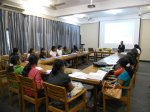
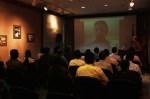
It’s going to be an interesting round of conversations for the launch of Chat Republic in Colombo in a few weeks. The event, on June 18th, will focus on the power of social media across many disciplines.

The ‘knights,’ as Bates Chairman puts it, will include:

Shehara De Silva – GM, Marketing, Janashakthi Insurance

Virginia Sharma – VP of Marketing, Communications and Corporate Citizenship, IBM India/South Asia.

Dinesh Perera -Head of Digital Business / Creative Director, Bates

Nalaka Gunawardena – Citizen Journalist / LIRNEasia

Lakshaman Bandaranayake — Multi-Platform Publisher / Chairman, Vanguard Management

Shamindra Kulamanage – Magazine Editor

Ajitha Kadirgamar — Journalist, Social Media Specialist

Nimal Gunewardena – Moderator / Chairman & CEO at Bates Strategic Alliance

Here’s how the media has reported it, calling this an ‘interrogation’:

The interviewers will each straddle a different facet of the topic raging from social media’s use in marketing, adoption by ad agencies, vital value in PR, impact on mainstream editorial media, its mobilisation by citizen journalists and monitoring and analytics.

Not sure about a round table being interrogation technique. I’m there to learn as much as I could from these eminent folk. More details of the event, here.

Citizens’ voices matter

A few years ago I conducted a series of webinar-style workshops for the U.S. State Department, for content creators, educators, marketers and those in traditional and new media. The workshops were called  “Passport to Digital Citizenship.”

I was convinced that citizen’s voices would be valuable, and –despite technological barriers and people who would try to keep them quiet– they could be heard.

So today, as my book is about to launch, I am thrilled to see this report by CNN on the importance of citizen-driven media.

Journalism has been forever changed — I’d argue for the better — thanks to the fact that people can interact with media organizations and share their opinions, personal stories, and photos and videos of news as it happens. This year’s nominated iReports are prime examples of how participatory storytelling can positively affect the way we cover and understand the news. 

(“36 stories that prove citizen journalism matters.” By Katie Hawkins-Gaar, CNN | Wed April 3, 2013 )

When we talk of  ‘participatory journalism’ we mean that ‘CitJos’ work alongside traditional media. They are not here as a replacement model, but to complement the changing media industry. Of the 100,000 citizen stories submitted to CNNiReport.com in 2012, they used 10,789 –having vetted them first.

I just interviewed the creator of a leading citizen journalist outfit in South Asia, and he stressed the importance of community guidelines, and careful design.

Citizen journalism, and the power of citizen voices is a big section in my book, Chat Republic.

Social Media and innovation surge in Sri Lanka

(This post is being updated)

Today in Colombo the tech and business community attended Social Media Day, a Mashable-coordinated event, worldwide in which 511 cities participated

Two days ago, they held another parallel event known as Refresh Colombo.

One of the organizers noted that the hash-tag #SMDayCMB, which had begun trending regionally (as a ‘tailored trend’) validated the fact that there was a highly engaged community now. Speaking of the community, it’s got the right volatile mix for innovation. One newspaper reported, it was a confluence of “hackers, bloggers, coders, geeks and geek lovers, journalists, techies, entrepreneurs and venture capitalists.” Note: the absence of one group here – politicians. In post-war Sri Lanka, steering clear of politics appears to be a well-honed skill.

One of the highlights was a video-link up with Jehan Ratnatunga in California. Jehan is the person behind the comic YouTube skits. Fittingly (for this social media savvy audience) he explained how he landed a job with YouTube because of his hobby.

Watch this presentation by two of the smartest young entrepreneurs who understand not just technology, but how grass-root change and politics works at a fundamental level.

Watch the whole thing (it’s 25 minutes) because the best discussion is toward the end.

More coverage of event

Dealing with downtime in an always-on world

This is my column in LMD Magazine, published in March.

LMD Magazine - Blog Buzz - Angelo FernandoConsidering all the time we spend online trying to be productive, it maybe a good idea to think about what we might do with our downtime when we are offline – off the grid, so to speak. I come across plenty of discussion on this, where people – especially in HR divisions – wrestle with the concept of that work-life balance.

Some make a case for there not being a work-life balance as such, because work and life have collided and the two aspects of life can’t be easily pried apart. In other words, a work-life imbalance is more the norm!

And if you buy this, you will most likely agree too that there is no difference between online and offline.

You are in a nice quiet restaurant with your family, but pull your Blackberry out every few minutes to check on the incoming stream of emails and texts. Your kid may ask to play with the iPhone… and before you know it, you’re forwarding a YouTube video to a friend.

Or you are relaxing on a towel on the beach, but feel compelled to snap into citizen-journalist mode and take a picture of some dude and upload it on to Facebook. Or if you’re into status updates, you ‘check in’ to a location using Foursquare, even if there’s no apparent benefit.

Faced with this magnetic pull, and the urge to be online while you are offline every moment of the day, where do you find that elusive downtime?

While driving? Forget it! They may have been one of the few insulated spaces in which you could happily be off the grid in the days gone by, but cars are now coming with smart dashboards to help us stay connected.

One company, Hughes Telematics, is working on ‘in-dash applications’ that will keep drivers updated on a slew of communications or travel-related news and issues. These include Twitter integration, iPhone controls for passengers who want to change the music, check the pollution index outside or cite emissions data… and so on!

Another company, Visteon, has the ultimate iPad in-car device. It’s a docking station with Wi-Fi and Bluetooth that turns your iPad into a second dashboard to help you interact with the vehicle’s electronic controls. This could include engine information, GPS directions or the ability to pull in external information such as web radio… and even make phone calls!

This so-called ‘embedded connectivity’ could make for smart driving… or make it highly distracting for the man or woman at the wheel, depending on your perspective.

BRAIN POWER.
Few like to venture into this area for fear of being branded as Luddites. But sometimes it’s good to hit that ‘pause’ button, and wonder just where we are going with so much technology in our lives.

A recent study on downtime by the University of California points to how brains function better when they break away from constant activity. “Almost certainly, downtime lets the brain go over experiences it’s had, solidify them and turn them into permanent long-term memories,” says Loren Frank, Assistant Professor at the university’s Department of Physiology.

Learning, he contends, diminishes as a result of non-stop stimulation. About two decades ago, many spoke of ubiquitous computing as a good thing. Computer devices would become so embedded in human environments that we would not need to enter ‘machine environments’ to engage with them.

CONVERSATIONS
It is very easy to make fun of teenagers who can’t stop texting, even while they are spending time ‘alone’ with a certain someone. But the truth is, adults are getting far more addicted to digital tools, to the point that it’s impossible to get them to pay attention to the real – as opposed to the virtual – situation.

Sometimes, this even distracts us from large physical objects that are in front of us. A hilarious example of this is captured on video, where a girl fell into a fountain at a shopping mall while she was busy texting (if you want to watch this, just Google the words in the previous sentence!).

Texting in church used to be disallowed, since mobile phones were supposed to be turned off anyway. Today, some progressive churches in the US are experimenting with it, asking young people to text a question after the sermon – they’re just trying to be more interactive, I suppose! But whatever happened to asking the congregation to raise their hands?

In our zeal to be interactive, are we going too far by trying to promote conversations and interaction as full-time activities, leaving little room in our lives for offline thinking? At the end of last year, in JWT’s annual list of ‘100 things to watch for in 2011’, the ad agency pointed to digital downtime as being a big trend. This was somewhat related to another trend it called ‘digital interventions’. This refers to friends and family members staging interventions to take a person offline, because they sense it is necessary to help the person log off!

REALITY CHECK
Maybe it’s time for a reality check – even in a column like this, that by definition covers digital communications! I meet with organisations that are looking to find ways to be more digital, and I have to admit that I have advised and coached people on how to be more (and I put this word within quotes for good reason) ‘productive’ by using digital strategies.

But I am acutely aware that there is a downside to all of this, especially if we go headlong into all things digital and ignore the rich analogue, traditional communications opportunities swirling around us. Becoming digital just because we can, and turning everything into a relentless social-media stream is not the answer to our communication problems.

In fact, sometimes the opposite is true. The answer to a particular communications problem might be to get off our digital high horses and tune into the analogue world around us. The customer-service person could assume that there are no complaints this week because no one has emailed a complaint or posted a rant via Twitter.

The truth is that there might be an ugly customer problem out there being passed around word-of-mouth channels in taxi cabs and trains that no one is paying attention to (but you wouldn’t hear it, would you, if you’re in the cab or train with a pair of noise-cancelling headphones?)

Spending a portion of our day offline might be a habit we soon need acquire – or require – our employees to cultivate. Being plugged-in doesn’t mean shutting out the rest of the world. It’s so basic that HR people don’t even think it’s necessary to instruct new recruits to do. But at the rate at which our offline lives are being infiltrated with online tools, digital downtime may be one of the most productive issues today.

Refresh ​Colombo sets stage for startups

Guest post by – ​Indulekha Nanayakkara​

Calling all thought leaders!

Refresh Colombo may be one of the (if not the) fastest growing web/tech communities in Colombo that has a promising future to probably turn Colombo into a Silicon Valley in the next decade or so to come.

The community meets up once a month and share their expertise among the members. And all of this is done free of charge.

Refresh Colombo Intro from Hamid Afzal on Vimeo.

So how did it all start? When Samir and Sukanti Husain attended a TEDx event in Miami, back in early 2010, the two imagined making their motherland, Sri Lanka, the next Silicon Valley after listening to an inspiring speech by Alex de Carvalho – the founder of Refresh Miami, about his own dream for Miami.​

Following Samir’s next trip to Colombo in June last year, Refresh Colombo was born. This was a result of the dedication of three amazing individuals – NazlyAloka and Milad along with a small but enthusiastic ​group of volunteers. The first Refresh Colombo meetup was held at the Chamber of Commerce in Colombo in July.

Although I missed the very first meetup by a matter of days I attended the second Refresh Colombo meetup in August, out of sheer curiosity. I was so taken up by the idea that I made it a point to attend the next meetup… and the next. Now, the monthly meetups are a must attend event for me. The fact that the organizers have made it an every “last Thursday of the month” event as of 2011 (and posted future meetups on the website) has made it much easier to keep the date free. ​

So far, we have been sharing ideas and information on topics such as:

  • Technology
  • Gadgets
  • Start-ups
  • Social media
  • SEO
  • Marketing
  • Social good
  • Web development
  • Web security
  • Gaming

As I see it, the community keeps growing and we’re successfully conquering a few challenges with each meetup. At October’s Refresh, Shazly did a live streaming over his phone as an experiment. Since then, we’ve had a few requests to live-stream the meetup for the benefit of those who are ​both not in the Country and Colombo. After playing around with various methods, we successfully live-streamed December’s Refresh Colombo using just a webcam and a laptop. We had a quite a following with that effort – including questions from the U.S. and Anuradhapura! which were over text, Twitter and call-ins.

In addition, Gihan offered to video record the meetup and now it’s available on the website as well. Meanwhile, there was a request for live-tweeting from the event after I did some live-tweeting for fun, at the October meetup. And for November’s meetup, the organizers asked me if I could do it from the official @RefreshColombo twitter account, instead of my own – to which I happily obliged and we had a lot of feedback from that session as well. And following a few requests from Sukanti and the Refresh Colombo organizers, I had the privilege of delivering a presentation on Social Media at the last meetup in December as the first woman speaker.

The way I see it, Sri Lanka has been amazingly adoptive of latest technologies. We have a wide telecommunication sector consisting of 5 mobile network service providers with and a thriving IT industry​. But to take it to the next level, we need innovative thinkers, thought leaders and the right platform.

And I see, Refresh Colombo provides the perfect platform for anyone to share their knowledge and learn from the experts, which might give rise to some brilliant start-ups very soon – something that Zuckerberg would have probably wished for, when he was in College!

Universities in Sri Lanka Explore Blogging

Guest post by – ​Indulekha Nanayakkara​

When I was invited to conduct a presentation on New Media for a group of students who are studying journalism at a local University, the University of Colombo, I was both flattered and overwhelmed at first.

Yes, it’s true that I’ve been reading a lot and working on social media for the past few years, taken every opportunity that came my way to get deeper into social media. However, the fact that I will be speaking to university students itself was in a way, overwhelming. I was expecting myself to be bombarded with questions after the presentation so I read up on extra areas as well.

At the beginning of the presentation I was curious to find out who was on what social networking sites. So I asked them to raise their hands. Facebook – almost everyone. Twitter – Just one girl and she said she wasn’t that active. Blogs – none.

To be honest, I was a little shocked to see the response with regard to Twitter and Blogging. The presentation being on the importance of blogging, in addition to social media; I had to change my stance a little bit and go slightly more basic.

The response was mixed. Some had a sparkle in their eyes, while others had a blank expression. The majority were curious I guess. The back story here is that, out of the whole group of about thirty or so students that were present at the conference, five of them had been to the U.S. earlier this year for a one-and-a-half month long program called “Global Perspectives on Democracy – New Media” along with some students from India and Bangladesh. This was conducted at the University of Virginia. So, it was the same five students who organized the conference I was speaking at – “Youth Leadership Conference on New Media 2010”.

After the conference however, about seven or eight students stayed back and just chit-chatted with me. I tried my best to make them see the importance of blogging as a tool in citizen journalism, as well as the importance of networking through Twitter. As I was leaving, I promised them that I would follow up and help them to start a blog and I think it was an important start.

From what I gathered from the students that I met that day, they are keen on writing. But they are not quite sure where and how to begin. They also had a vague idea of creating a blog that would act as a bulletin board for the students.

This got me thinking. If the situation in universities is such, what about schools? I know for a fact that at least in international schools, the children know their way around chatting and facebook usage. But what about serious networking? Would they think of chatting with their potential future university lecturers or senior colleagues? Would they like to read blogs of students of their age but from various global communities? Do they know that they can collaborate with their friends on class projects once they go home, in order to complete them? And do they also know that they can do research and not necessarily surfing the web just for fun!

Apart from all of this, the good news is, that the students are geared to do their own blog. Once it is live, I hope to share it with your here.

My graduating Class of ‘digital citizens’

Just got off from the awards ceremony in Colombo, where I spoke, via Skype, from a spare bedroom, to a gathering of 35 attendees who qualified for a certificate.
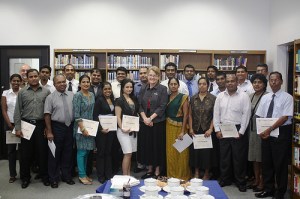
This was the conclusion of a 6-part series of webinars I conducted for the US State Department, at the USIS in Colombo, Sri Lanka. The series was called Passport To Digital Citizenship.

Ambassador Patricia A. Butenis who addressed the group after me spoke of the ‘Republic of the Internet’ –a very fitting reference, considering the times we are in as nations and communities meld together into a global community that is at once powerful and complicated –as Republics are!

Many of the graduating class are already very active members of this diverse, passionate Republic, using  social media that is becoming their glue (to hold things together) and the thread (an infinite, unravelling ball of thread, that is) that binds us all together. See larger picture here.

Some of you in my class are already moving forward, collaborating and connecting across your specializations, ethnic communities, employee networks and global and local communities.

First, to all of you in this graduating ‘class’ of digital citizens, congratulations! But as I mentioned in my address, don’t just hang that certificate on your wall.

Put it to work. Go light a fire under a sleepy old organization that is stuck in ‘anti-social media’! Show people the power of collaboration and digital storytelling through social media.

Because this blog, Hoipolloi Report, is all about those voices out there, I am taking a step to add a few guest bloggers over the next few weeks. The first of them will be two people from the Class of 2010 Digital Citizens. Who will they be?

Stay tuned!

End Note: A big thank you to Steve England, Dan Wool, Gary Campbell, Derrick Mains and Dave Barnhart who were my co-presenters in this series.

Wanted: A new formula for PR!

FT Online, Angelo Fernando writes a Bi-weekly column

FT Online | Bi-weekly column

I don’t think there’s a single waterer-proof formula for PR.

No matter how much we love the Social media Press Release, (basically an enhanced press release, with some great links and embedded media to create a richer story), it seems like too much work for companies to build these.

Then there is the quest for that secret sauce of Public Relations that might involve a more integrated strategy. Translated: the PR agency works with the ad agency which works with the promotions company. Good luck with that!

So in a bid to stir up things I came up with my own formula for PR. Here it is in a nutshell. C + C + E = Tn.

Got it?

You need a decoder ring for this one, so here it is. Context plus Content plus Engagement equals Trust to the nth degree.

Continue reading…

This was the subject of a newspaper column, in a series I have been writing on, published in FT Online. Until the web site has been updated, this is a link to a PDF.

Replace dirty filters! Stop content clogging up your pipes!

On last Friday’s webinar I asked Dave Barnhart to co-present with me on the final in this 6-part series on Passport To Digital Citizenship. Dave is a social media coach who runs a successful business practice around blogging strategy, micro-blogging and web content. Steve England was also on hand with his mobile marketing insight on how all this plays out as we take our tools and our content into a wireless world.

In this session I focused on filters and deep drilling!

We had previously taught attendees how  to create content, leverage the channels, connect and interact with audiences. So in this final seminar, I asked them to consider what it might be to be on the other side of the equation -as recipients. Too Much Information (TMI) is clogging up the arteries, and customers, readers, listeners and viewers may be filtering us out. What do social media filters look like? How do they provide us with deeper insight?

We’re talked about  Tweetdeck, Hootsuite, Bloglines and much more! It was a great rounding off of what we do a both communicators and recipients!

Blogging and micro-blogging, joined at digital hip

I can’t stress enough how easy it is to connect the dots between your communication channels using digital media, if you plan ahead to do so.

Passport To Digital Citizenship
To “Tweet or Not To Tweet?”  |  2nd Webinar in the 6-part series on Social Media

I pointed this out toward the end of the webinar on Monday (it was Sunday night here in Arizona) as Steve England, Gary Campbell and I were presenting at the second webinar on social media.

While Steve was presenting I took this photo of one of our screens (the one bringing in a Skype video feed from the venue in Colombo). Here’s what I did:

Notice the attendees who had logged in –visible on the bottom left of this photo. Also, on the right is Tweetdeck, through which we were monitoring the hash tag #USELK2010 that we were using for the event.

Cross-posting this from the webinar blog.