Explosion of Twitter tools and hacks

Today, I am teaming up with two other ASU communicators to present the business case for using Twitter.

It’s barely two weeks since I checked, but it seems like there’s been an explosion of applications to help consolidate and manage your tweets. I had never heard of Destroy Twitter!

Here are a few:

  • Twitsnip -lets you shorten  URL, but also post a snip from the site at once
  • DestroyTwitter t – A beta application
  • Yakkle – Send tweets, IM, and your voice!
  • Friend Or Follow – keeping track of those who are not following you back
  • Twits Near Me – find tweeps in your neighborhood
  • Snitter – Yet another desktop client for Twitter
  • Twitterific – Yet another desktop client for Twitter

What “Goodbye, Colorado” means to us Tweeps

Whenever I talk to a new media practitioner–ok, cheerleader– I hear something along the lines of  ‘new media does not kill old media –it only complements it.’ I cheer along, being a staunch supporter of the business model that grew out of Strasbourg, Germany, and the one that grew out of Mountain View, California.

So the news that the Rocky Mountain News shuttered last week seems like an unfair blow to the head of this (romantic?) dual-platform idea. One reader comment to the last article on the RMN online site suggested that it was

demonstrating how the market is suposed to run. When a company is mismanaged and refuses to keep up with inovation and the modernation of an industry. When a news outlet makes itself biased and slants stories from a loose dog to elections. Then the outlet goes out of business … There is a differance between op/eds and news.

I have never read the paper, but I can tell you that it’s not only print media that co-mingles news and op-eds, and those darn cat (or dog) stories. But sanwiched between those silly nuggets is real information that you wouldn’t get elsewhere. More so in newspapers. They may not cover it with the speed of, say, The Drudge Report, but print journalists bring in the mind-set and passion to go deep and sideways to inform us, and perhaps connect some dots. Another RMN reader commented that “Your front page was our front door.”

Ironically, today we get news through the back door. I am a huge fan of RSS, for instance. I just got a good summary of news tips from some folk I follow on Twitter, since it is a community –whether they are journalists or not– that keeps watching out for each other. Twitter, to me, is actually the side door, the window left slightly ajar to let some air in. Occasionally someone slides relevant information through the crack. But I also get a huge dose of valuable information from my skinny, but well-put together community newspaper that isn’t being blogged about or conveyed in 140 characters.

We twitterers, voyeurs of Google alerts, and purveyors of the speeded up news cycle ought to not be so quick to write the “I told you so!” piece about the demise of Print.

Quotes for the week ending 27 February, 2009

“Orbiting swarms of junk careen into each other like billiard balls, creating unpredictable sprays of debris, which in turn meld with other space garbage to weave a moving net around the atmosphere.”

The Wall Street Journal‘s Robert Lee Hotz, on the debris of space junk caused by colliding satellites.

“My love of TweetDeck just keeps growing …Love, love, love it.”

IABC Chair, Barbara Gibson, on the new features of Tweetdeck.

“Twitter users may donate their avatar and replace it with an image of the red female sign.”

“NCMFathom, which is asking Twitter users to micro-blog to raise 0.10 a tweet from March 2 – 5 this year.

“After getting a lot of angry calls at my office from frustrated customers, I realized we could do a better job of listening to and supporting you.”

Yahoo’s new CEO Carol Bartz, on her blog, Yodel Anecdotal, about her first one and a half months on the job, and the changes being made.

“Sometimes the face of a brand is a fictional character.”

Chris Brogan, on the Bigelow Tea company’s project, Constant Comments. The company’s president Cindi Bigelow is a prominent figure in its communication.

“There is a differance (sic) between op/eds and news.”

Reader comment on the Rocky Mountain News web site, in response to the last story of the newspaper, “Goodbye, Colorado.” The paper began in 1859. The reader suggested that it demonstrated market forces were doing the right thing.

Webinar on social media measurement

I cannot attend this one but I just heard from Angela Sinickas about a Ragan webinar she is conducting this afternoon on measuring social media.

The idea of knowing and measuring what effect social media has on the business you are in, drives people nuts –sometimes in a good way.

Yesterday I showed a colleague in the office how I track visitors to our blog, Light Bulb Moments, and she wanted to know “where I got those from.” That it was just the built-in dashboard for WordPress blew her away. And that’s not even getting into Google analytics.

Social Media analytics has got a lot more complex, and necessary. Before diving into any social media tool, first think of what results and measures you would like to have. Start with the end in mind, I guess.

Listen to Angela describe it in a much more succing way here.

The “soft-tissue of all our consumers”

There’s an old, but relevant video from BringBackTheLove, about the failing, dysfunctional relation between two people –actually two institutions, Advertisers and Consumers.

More telling than this  story –a messy ‘breakup’– is the sequel where the advertiser, talks to his agency to try to repair the relationship.

At one point, the advertiser takes him to a flip chart and violently circles a messy diagram saying they could  “blitzkrieg the soft tissue of all our consumers!” Funny? Sure. But it’s also a sad statement of how marketers see consumers –as some thin layer of tissue.

Truth is, the consumer ain’t ‘soft’ (insert other 4- and 5-letter words like ‘dumb,’ ‘easy,’ ‘loyal’ etc ) as people think. She makes hard choices, whether wanting to pay $1.75 for a cup of coffee at Starbucks, or $1.07 for a refill (by taking in her own coffee mug) at Einstein Brothers. Empathy, not advertising, intimacy not infiltration will get through the soft tissue.

As the recession deepens, marketers will have to learn how to reconnect with their customers in more intimate ways, minus the lame, expensive blitzkrieg type tactics.

Quotes for the week ending 22 February, 2009

“I would be happy to buy him a cup of coffee –decaf!”

White House Press Secretary, Robert Gibbs, to the press, on the CNBC host Rick Santelli’s rant about Obama’s housing plan. Gibbs suggested Mr. Santelli ‘download, hit print and read the report.’

“It’s a crisis that strikes at the heart of the middle class. It begins with one house at a time in Mesa, Glendale or Tempe…”

President Barack Obama, on his visit to Dobson High School in Mesa, Arizona, where he announced the details of the housing plan that intends to address the key issues at the heart of the financial crisis.

“Thank you all for watching out for my brand, I appreciate each and every message”

Jeremy Owyang, to the many people who have informed hiom about the fake Twitter accounts in his name. Reported by Jacob Morgan.

“Business journalism sources come in all shapes and sizes, and my experience is that the ones who purport to have the most explosive stories are typically exaggerating their claims.”

Chris Roush, blogging at BusinessJournalism.org, on the need to verify a source that claims to be a whistleblower, in relation to a story of one in the Bernie Madoff fraud case

“Micro-payments won’t solve newspapers’ pay-or-perish problem, at least not under current proposals.”

Marshall W. Van Alstyne, associate professor, Boston University joining the debate on how to rescue journalism

“Twitter has a lot of power to, with simple changes like that, change the ecology of the system.”

Leo Laporte, host of the podcast, This Week in tech (TWIT) on the new feature that Twitter adds that gives some users a hugs boost in followers.

Twitter may be the worst way to..

Fill in the blanks here, if you could.
I am sure you’ve heard of some bad etiquette and bad practice when it comes to using Twitter. I am a big fan of the this micro-messaging tool, but I occasionally come across stories where tweets are so inappropriate.

  • There was that incident last year of a journalist tweeting at a funeral of a kid.
  • Recently at the BBC, a possible case of someone being promoted to a top position using a tweet. When will someone get fired via a tweet, one wonders?
  • Using Twitter to push TMDI –too much damn information– that might overwhelm followers. I’ve unsubscribed the right non-word is ‘un-followed’ to one famous person for this reason.
  • A lazy journalist’s use of Twitter as a replacement for vox pops – – excellent analysis here.

Twitter may be a terrible way to tell your boss you are not coming to work (and forgetting to use the direct messaging function), flirt, attack someone, disclose something you should only be doing offline etc. I am sure there are dozens more examples. I like to hear.

(Image above linked to from NewsPhobia)

Audacity of suing ‘Hope’ by the Associated Press

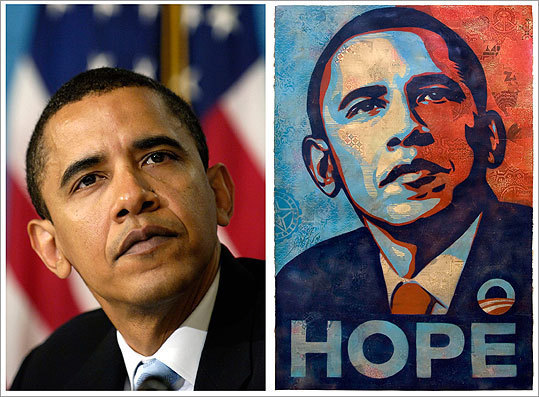
I can assume the Boston Globe will not sue me over linking to this juxtaposed image.

They don’t usually get that silly, as the Associated Press has been when it threatened to sue Shepard Fairey, the street artist who turned the man on the left to the icon on the right.

The HOPE poster is so well known there are ways to render your own mug shot with the same color and brush strokes.

But last week, as the story got more twisted —Fairey got arrested on an unrelated charge in Boston, and then sued the AP — one wonders what kind of image management the venerable Associated Press is going for. Especially since this is not the first time it’s let its lawyers handle its PR.

Last year AP went after bloggers trying to put limits on how much of its content could be considered fair use. It later retreated. Forget the power of mashups for a second. Making a street artist the poster boy of copyright violation doesn’t  score any points for AP.

Valentine’s day activism in a country that gave us Kama Sutra

This sounds like a funny story, but it looks like the activisis in India are mad as hell and have taken to Facebook to air their grievances.

The Pink Chaddi Campaign is their way of tellling local government officials that they cannot be told to curb their romantic behavior. In the lead up to February 13th, the group  began asking women to find pink ‘chaddis’ and send them to Sri Ram Sena. The Facebook site grew quickly and as of Saturday had over 43,00o members.

On their blog, they noted:

From Kabul to Chennai to Guwahati to Singapore to LA women have signed up. It does not matter if you are actually not a pub-goer or not even much of a drinker. Let us raise a toast (it can be juice) to Indian women. Take a photo or video.

You’ve probably guessed what ‘chaddis’ are:  You’re right!

Shri Ram Sena is a fundamentalist Hindu organization (note: They were hugely pro-Obama!) in a city in Karnataka state, that threatened to attack women who celebrated Valentine’s Day.

On Saturday there were some reported arrests of those who did threaten couples.

Activism in India using social media is not new. Groups have lobbied local governments with massive text messaging campaigns, and for other forms of protest and solidarity. Last year there was a temporary ban on the use of SMS in Jammu and Kashmir.