Quotes for the week ending 24 January, 2009

“Citizen participation will be a priority…”

Macon Philips, White House’s director of new media, in a blog post a few seconds after Barack Obama took oath as the nation’s 44th president on Tuesday.

“Communication. Transparency. Participation”

The first message on the WhiteHouse.gov web site that switched over on Tuesday at noon., spelling out the details why ‘change has come to whitehouse.gov’

“an excellent example of witness media and pro media cooperation. It’s not about the ‘versus.'”

Steve Safran, quoted in an article about the evolution of ‘eyewittness journalism’

“Inaugural speeches serve two purposes. They are designed to heal whatever rough roads people had to go down to get elected. The other purpose is to lay out the agenda and the key metaphors for what’s to come-and hopefully to induce people to cooperate.”

John Adams, Colgate Speaking Union @Colgate University, quoted in Ragan.com

“You must find ways to spread – in a new manner – voices and pictures of hope, through the internet, which wraps all of our planet in an increasingly close-knitted way.”

Pope Benedict XVI, on the Vatican’s launch of a channel on YouTube.

“Obama gets a thumbs-up for his Blackberry.”

Headline of a series of articles that celebrated the fact that the ‘tech president’ gets his way in being able to step out of the communications bubble. Only a few people will have his email address, the White House says.

“Twitter IS a massive time drain. It IS yet another way to procrastinate … But it’s also a brilliant channel for breaking news, asking questions, and attaining one step of separation from public figures you admire.”

New York Times Tech columnist, David Pogue about how he’s learning to use Twitter

Will millions of cameras in Washington DC make surveillance easier?

When I wrote about Photosynth in June 2007, I wondered what it might do for crowd-sourcing mega events, even political ones.

That day has come.

Microsoft (which now owns Photosynth) has teamed up with CNN to enable all those snapping up the moment in history, to share those images, and more importantly knit them together as one composite.

It’s not just  the collaborative potential of this technology that’s mind-boggling. It gives new meaning to what we often refer to as the Big Picture, letting you look at a something in fine detail from multiple angles and distances, and in a thousand of different ways. You can zoom, tilt, look at a person or an object from its side, and often get a close-up view.

From a surveillance angle, this could be a great deterrent to anyone planning mischief. After all, any moment during the inauguration will easily be captured not by the surveillance cameras — there are some 5,000 in the area –but by the hoi polloi.

photosynthTake a look at this image of the Capitol (Sorry, but you’ll need to download a small application on your computer first to use Photosynth) and you’ll see what I mean. You could move in so close to the dome, and the windows below, you could spot the surveillance camera looking down at you!

People’s inauguration –and how to contribute to it

As the stage is set for this moment in American history, there’s much work being done to tap into the passion of the country via social media –to make it a ‘for the people, by the people’ event.

Here are a few ways to join the conversation:

  • The New York Times is accepting photos that get published here. Email them to pix@nyt.com
  • National Public Radio has  Twitter two tags if you feel inclined to tweet. Send them to #inaug09 or #dctrip09.
  • Flickr: NPR is also using the same tags, inaug09 or dctrip09, for those wishing to upload pictures to Flickr
  • Text in news to NPR: Send it to short code 66937 (begin your message with #inaug09 or #dctrip09)
  • CurrentTV will blend Twitter comments with the telecast. When you tweet, add #current to your comments and it might get featured.
  • Citizen’s Briefing Book: This is a neat project I wrote about earlier
  • Live Blog by Sam Teller
  • You could be an iReporter on CNN-iReport and send in a reports during the day

inaugurationpix_1Pictures like the one on the left (The New York Times) have already started pouring in, with pictures like this, and this.

PBS is asking for people to call a toll-free number via Gabcast and record an audio segment.

Of course, if you just want to be updated on events there’s an inauguration Twitter feed: obamainaugural

“America needs more reporters, not fewer”

Dana Perino, in her farewell schmooze with the White House Press Corps made a wish that is worth as the next administration moves up behind the podium.

“America needs more reporters, not fewer, so let’s hope someone figures out a business model that will keep you in your seats for a long time to come.”

Her final statements were interrupted by the likes of Helen Thomas –she who grilled any Press Secretarywhom Perino never seemed to like, but is of the journo caliber this country needs more of.

Starbucks-meets-Obama-meets-Digg: crowdsourcing democracy

The president elect is taking a leaf off the social media marketing book to gather ideas from citizens.

StarbucksMyStarbucksIdea has been around for several months, basically asking people to “Help shape the future of Starbucks.”

Now the Obama people have launched the Citizen’s Briefing Book –part of Change.gov. To contribute to the ‘book’ that will be printed using the best ideas and given to Obama, you have to sign in with your full name, email address and zip code.

People are sending up their ideas in droves. More than 9,500 on the Economy, and about half that on Energy and Environment, and a little less than that on Education. Ideas could be voted up or down, like Digg. Gives you –him– and the country a sense of the hot-button issues.

This kind of governance will radically change opinion polls, focus groups and political consultancy forever. And it’s only just begun

Dear Mr. Obama. In case you haven’t read those ‘open letters’…

I have seen many open letters, and wondered, how many of these could Barack really read, if he ever gets to that dossier.

To make it easy, Mr. Obama, here’s a selection you could read at leisure.

2008 in Retrospect: The Good, The Bad, and The Absolutely Hilarious!

We said goodbye to some extraordinary people this year.


PR disasters and signs of the times

  • Bill O’Reilley’s studio performance over a teleprompter
  • Scott McClellan‘s unconvincing tell-all book on his White House years.
  • New York Governor, Eliot Spitzer busted in prostitution scandal
  • Alaska Senator Ted Stevens found guilty of ethics violations
  • Illinois governor Rod Blagojevich charged with corruption
  • Sheriff Joe Arpaio of Arizona launches immigration busts.
  • Sarah Palin ‘pranked’ by two Canadian radio DJs, into believing she was speaking to French president, Nicolas Sarkozy.
  • The Big Three car makers, GM, Ford and Chrysler, arrived in DC to ask for a bailout in their corporate jets. They were sent back and returned, driving hybrid vehicles. One even car-pooled. Honest!
  • The Guardian in London, declares Gillette ad featuring (Roger) Federer, (Tiger) Woods and (Thierry) Henry the worst ad in 2008.

Milestones:

  • The 15th birthday of Hypertext – Tim Berners-Lee
  • Barack Obama elected the 44th president of the U.S.
  • The iPhone cuts its price, and adds a new model
  • The New Yorker‘s controversial cover on the Obamas
  • The 2008 Olympics in China
  • Dipnote celebrates one year as a blog
  • Blackberry introduces Storm, the answer to the iPhone
  • ASU’s Walter Cronkite School of Journalism and Mass Comm celebrates 25 years
  • Saturday Night Live‘s YouTube skit on Sarah Palin
  • Arizona governor, Janet Napolitano, picked to be new Sec. of Homeland Security
  • Christian Science Monitorshifts from daily to Weekly
  • bizAZ Magazine folds due to downturn in economy
  • The horrible Mumbai terrorist attacks, which now have a Wikipedia entry

White House 3.0 groundwork in place

Looks like the Obama team is using Change.gov to take the government into a 3.0 world. That’s right, they may as well skip past 2.0 and push into new territory. When was the last time you heard the government say that during this transition process, we the people could “participate in redefining our government?”

Take a look at their Newsroom and Blog links. Already you see signs that the old news page is merging with the blog, because you get a Newsroom: Blog category when you click on the Blog link.

And they’re quite up to speed on the Creative Commons 3.0 license, talking of a 21st Century government, where content will need attribution, but will be open to ‘remix.’

Would this make the WhiteHouse.gov interface (whose ‘interactive’ page inteprets interactivity as a Q & A exchange) obsolete? I can see it going through a huge overhaul?

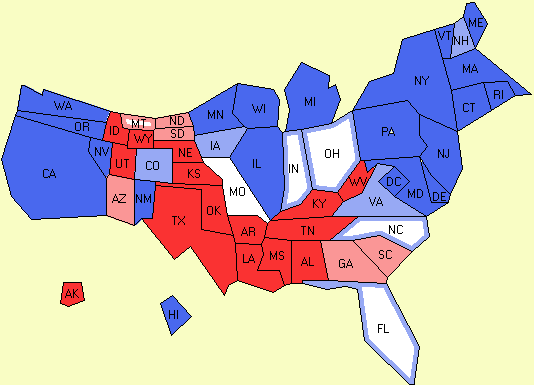
Stunning visualization of red and blue states

A colleague sent me this link from an NPR Science Friday story. It’s a story based on the voting pattern as seen through cartograms -maps that have been ‘density equalized’ by Michael Gastner and Mark Newman at the University of Michigan.

Being in the business of scientific visualization at the Decision Theater it’s fascinating to see science take a crack at politics, and why the red-state, blue-state concept trivializes the voting pattern.

The TV news networks, of course love the red-blue metaphor. We saw CNN‘s use of the ‘magic wall’ which was a recent creation by a company called Perceptive Pixel (it  sold similar walls to ABC and Fox).  MSNBC set up a 3D studio for some similar visual treats. CNN even played with teleporting, having the anchor interview a hologram, pushing visualization up several notches.

But NPR’s story is a great way to do a visual post-mortem of how the country voted. While holograms are just eye-candy, cartograms give a better picture of what happened. Gastner, by the way, lets you use his cartogram code, here, where there are more maps of the voting pattern. Talk about seeing things diffferently!