Cartoonists and bloggers under siege

It’s odd how politicians hold a cartoonist and bloggers up to tough standards once reserved for ‘The Media.’

Political cartoonists in particular, hold a lens up to our world, enabling us to see events in a different perspective. I think of a cartoonist as more than a lens, in fact. A mirror and a lens – a kaleidoscope. You see something new every time you turn your head.

Malaysian cartoonist, ZUNAR, known for his powerful editorial cartoons for 20 years, has been getting under the skin of the ruling class. In 2010 he was arrested just before his book “Cartoon-O-Phobia” was launched. The crime? Sedition! Interestingly sedition laws exist in many countries.

We often hear of France’s Charlie Hebdo being threatened. But cartoonists have been under siege.

  • Likewise, bloggers, especially political writers have been attacked in countries such as Ecuador, South Africa, India, and Sri Lanka.
  • In Bangladesh, four bloggers have been murdered.

Former copyboy, Scott Pelley’s optimism in the face of ‘bad information’

Last week, Scott Pelley, anchor of CBS News made some timely observations about the news business. Which, we should not forget is indeed a business. Pelley was awarded the Walter Cronkite award for Excellence in Journalism by the Cronkite School at ASU.

Now I regularly watch his broadcast, so I admire his candor  when he observed that:

“Never in our history have we had so much bad information.”

Let that sink in, against the other platitudes we hear that ‘never in our history have we had so much information at our fingertips’ etc. In 2013, Pelley warned that the media was getting the Big Stories wrong, over and over again. How prescient, considering most media misread the 2016 electorate. They are, after all our filters, and when their filters get trapped in the same gunk, we lose our faith in them.

At the ASU event he went further to warn, “We’re in our digital citadels, unchallenged by ideas. Biased reporting closes minds. Journalism is meant to open them.” Pelley, kicked off his career at age 15, as a ‘copyboy’ at a newspaper in Lubbock, Texas. If you’ve never heard of the job of ‘copyboy’ this person was, to put it nicely, a delivery boy who was given a sheet of butcher paper (on which stories were then written), to deliver it to the sub-editors’ desk.

Like Kelley, Cronkite was also optimistic about delivering the truth, alluring to the movie Network, when he said:

“We’ve got to throw open our windows and shout out these truths” 

Just for larks, here’s Walter Cronkite, as he signed off on March 6th, 1981.

Filtering the news for our kids

It gushes out of multiple channels, often without any context.

For young people, especially those under 10 years, what passes for news is almost toxic. Our challenge is to find ways to keep them ‘well informed’ and yet not overwhelmed.

And of course, there’s no wonder app for that. Even the ones that promise to filter the crud (so-called ‘news aggregators‘ like FlowReader, Flipboard etc) are often accomplices when it comes to ‘TMI,’ or To Much Information.

But wait, there was once an filter for this which we have put to pasture. We called it ‘conversations.’ The human 1.0 app that helped us sift through day-to-day details, layering over the minutia with ‘big picture’ ideas, and cross-referencing them with stories.

We re-framed topics too ugly to ponder and yet too important to ignore. Children posed questions, and found answers to them at the dinner table. We didn’t need to fact-check everything on the spot because…. yes, you guessed it: Our conversations were not hijacked by a smart device sitting next to the casserole dish.

So I like to pose the question to you readers: ‘How do you filter the news for your kids? Common Sense Media has a useful guide for different age groups of children.

Whether you’re a teacher of a parent, I like to know. How do you filter the fire hose?


What were they thinking? Water cannons used against those defending water rights!

File this under the How Ironic.

Protesters of the Dakota Access Pipeline, trying to draw attention to the tribe’s water rights, were confronted by law enforcement officials using water canons yesterday.

When rubber bullets and tear gas didn’t seem enough, they resorted to H2O.

The pipeline is half a mile from the Standing Rock Sioux Reservation, the sixth-largest reservation in land area in the US. The tribe has said the pipeline threatens ‘their waters and their sacred places.’

The events get more interesting as people like Neil Young, Dave Matthews and others chime in.

The Donald killed a humor column – or two

There’s a great column by Gene Weingarten of the Washington Post magazine section, titled There’s no silver lining to Trump’s win. So here’s my cat.

It is a quick follow-up to make up for a column he wrote in anticipation of Trump losing. Mr. Weingarten explains how he, like so many others in the media got it wrong. It had been written in the form of an obit, celebrating the death of a “Boys-Will-Be-Boys Guy.”
Oddly enough even I made the same mistake. In a column written for a later date.

I asked readers to join me in sending our condolences to the cartoonists of America. They (and the likes of Saturday Night Live) had been given nearly two years of unlimited, unimaginable humor material. From awkward physical gestures at the podia, to content ready-made for speech bubbles.

Weingarten’s replacement column is prefaced by this:

Readers who wish to complain can reach the author through the U.S. Consulate in Amsterdam, where he is seeking asylum.

(Of course, he is kidding.)

My replacement column is about the wall Canada is building on its southern border –financed by us of course.

(And of course, I am ‘serious’.)

What do we tell our children (about dirty politics)?

Did you feel like you needed to take a shower after watching  the recent debates? Or do you feel like you don’t want to mention the word ‘election’ at the dinner table for fear of dredging up unsavory topics?

‘Adults behaving badly’ might sum up what we have been witnessing these past few months.

I’ve tried to explain to young people who ask, that:

  • This is not how most grown-ups behave – you know, hurling around ugly epithets; using vulgarities, slurs…
  • Political campaigns are unfortunate war games people play, hence ‘battleground’ states, attack strategies.
  • In the 4-year gaps between the these ugly wars, try to not do as they do.
  • The phrase ‘anyone can become president’ is something we are no longer proud of.
  • Though Gallup holds that 75% of Americans identify with a Christian religion (Pew Research says 70.6%) there is nothing very Christian about this process

Aren’t you waiting for this spectacle to be over?

A Lesson from the conflicting ‘birthdays’ of the World Wide Web!

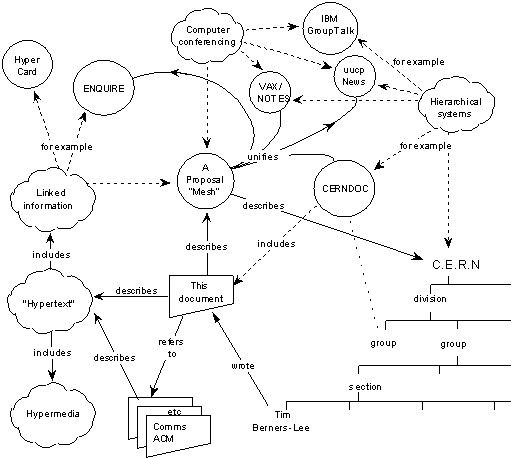
Yesterday, (August 23rd) was one of the birthdays of the Web. At least it is the day when non geeks got access to the ‘global hyperlinked information system’ that Tim Berners-Lee designed.

I began using this 25th Anniversary milestone this week in classes that introduce students to how to find and discern information on the wild and woolly Web.

When I posed this question to my 4th grade students: “What is the Internet? And where could you find out about it?” one of them responded without missing a beat, “On the Internet!”

“But,” I responded, “What if the Internet was wrong about the Internet? How would you know?”

Note I said today was one of the birthdays of the Web. Oddly, while media outlets, including the likes of Huff Post, ran features, claiming Aug 23rd as the date

So if the real birthday August 23rd, August 6th, or March 12th? Should we go to the ‘Mesh‘ to find out? Are our trusted sources wrong? Now there’s a lesson for my students far greater than helping them ‘research’ a few factoids.

From Abraham Zapruder to Diamond Reynolds – Cameras in public life sensitize us

It’s just three months since Facebook Live became a feature that anyone could use. But it took another accidental ‘reporter’ named Diamond Reynolds to put it to use in a way no one ever envisaged.

This came some 52 years after another accidental reporter named Abraham Zapruder captured sniper bullets hitting President John. F. Kennedy in Dallas.

That was a time when cameras were scarce, and there was no such thing as a live citizen journalist broadcast. Now cameras (and all manner of recording devices) are so ubiquitous, we’ve almost come to expect to see the raw footage or listen to soundtracks of terrible events. Technology has given us a way to piece together events. The hope is that events seen through multiple camera angles might help us NOT rush to judgement.

Facebook Live allows 90 minutes of video. Zapruder took just 26.6 seconds of footage.

Salt River Schools named great ‘company’ to work for in Arizona!

Proud to hear that my school district, Salt River Schools, was picked as one of the Top 100 Companies to Work For in Arizona. This is an annual ranking by AZCentral.com.

In the past companies have included companies such as Harley Davidson, banks, and advertising agencies. They are recognized on criteria including inclusiveness, communication, and teamwork, among other indicators. Here’s what our HR director Mike Latko had to say:

“The Salt River Pima-Maricopa Indian Community is a leader in compensation, employee benefits, and support for professional excellence for all its employees, and we are excited it is being recognized today.”

Salt River Schools is the first tribal organization in the history of the Top 100 Companies to Work for In Arizona.

No magic eraser on the Internet. UC Davis learns the hard way

There’s a corollary to that old saw, “On the Internet, information lives forever,” and it’s this: “There’s no such thing as a magic eraser.”

But that doesn’t stop people from trying. Like this case of University of California, Davis and the ‘image scrubbing’ scandal. There are still companies offering services to clean up bad information by some dubious SEO work. But most experts say this isn’t possible. Search engines crawl, index and place information in so many places it’s not possible to delete a bad story once it gets out. Especially something has covered by the media, shared, and posted to several media channels. UC Davis reportedly paid two PR firms $175,000 for this magic eraser.

Is this a good thing that we cannot turn back the clock? It has given rise to a privacy right case known as the ‘Right To Be Forgotten’ right that the European Union fled against Google in 2012. It states that : “Individuals have the right – under certain conditions – to ask search engines to remove links with personal information about them.” A good Fact Sheet is available here. There’s a longer discussion in Stanford Law Review, here.

I feel sorry for US Davis, because the story they tried to bury has given rise to hundreds more – giving the original piece that much more links. SEO companies often advice as much: Instead of trying to delete a story try to generate enough good information that will push down (not take down) the bad.

Oddly enough, while Google has complied, it accidentally revealed data about these requests.

Which brings me to social media literacy and privacy. We ought to be telling young people the ramifications of over sharing, being in pictures –group shots or selfies –that they might regret later.