Plans afoot for Space Day 2017

Just announced plans for Space Day at Salt River Elementary – our 6th year!

  • This year’s focus is on the Moon, rockery and spacesuits.
  • The student competition is to design a future spacesuit 
  • Each class in every grade level will experience one facet of space science
  • When: Oct. 26th, 2017    Time: 8:30 am – 3:00 pm

As the event grows bigger each year, my thanks to those who will be supporting it:

  • Orbital ATK, Arizona
  • Jet Propulsion Lab, California
  • Autonomous Collective Systems Lab, at ASU
  • SpaceTRex, University of Arizona
  • Challenger Space Center, Arizona


Space science is a fascinating field, and gives us who focus on STEM an ability to widen the lens. Consider some of the recent developments


Sneaking in VR to the class

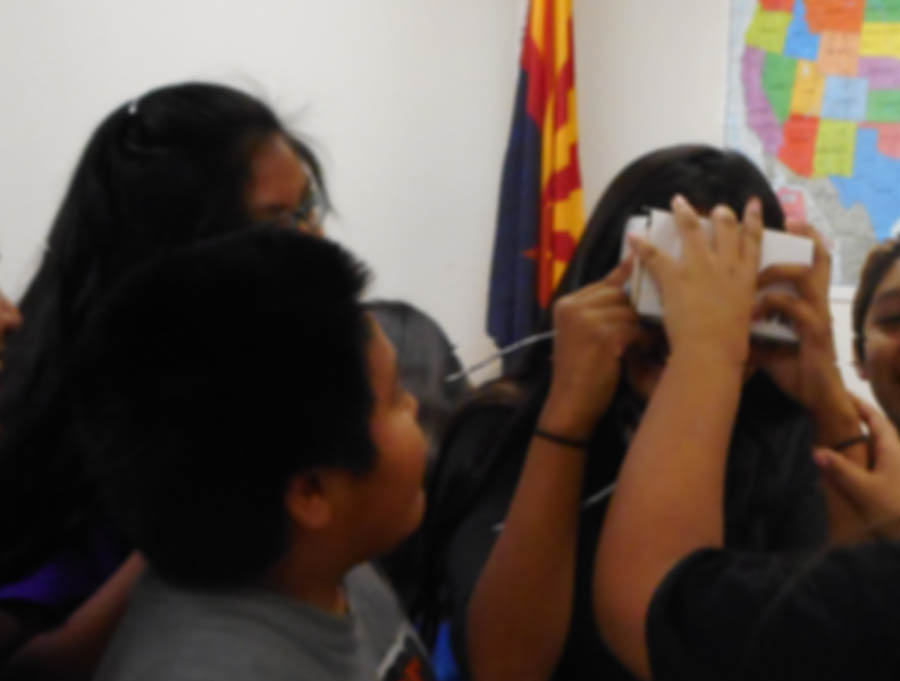
This year I’m using VR both as a project, and as a motivation tool – to create a brochure. My 6th graders understand some editing and formatting skills. So to raise the bar, I got them to research and put together a brochure on Virtual Reality.

Granted it’s a lot of work. Understanding VR itself takes some time. They must create content for the 6-panel document, look up content, find pictures etc. As work progresses, there is a parallel discussion of what VR looks like, using a few cardboard headsets I acquired. One student even brought in two headsets. (One had cost him just five bucks!)

The incentive was that any student who showed me they had three panels formatted, and with required content, would get to experience a VR roller-coaster ride. Didn’t think a 40-minute class could move so fast!

Funny how sneaking in a piece of tech into a lesson can accomplish much more than a hand-out!

Our obsession with data – Symptom or Trap?

It’s hard to pinpoint when the word ‘data’ slipped into everyone’s conversation. Was it around the time we became aware that search engines were using data to understand user behavior? When data became their currency for pricing ads?

Data gathering amounted to accountability. data bestowed scientific accuracy. In some of the industries I used to be in, we had sexier terms: Metrics, and Analytics. (Combine the words to give it an aura of science –call it Data Metrics!) If you want to get more geeky, we also called some data ‘KPIs‘ – Key Performance Indicators. Today, hardly a week goes by when you don’t hear of Source Data, Meta Data..and the mother of all data we know as ‘Big Data’.  And  this spilled over to all other sectors. So it’s no wonder we hear phrases such as:

  • “So where’s the data?” ( “Where’s the evidence”)
  • “This is good data for us.” (Which used to be “this supports our point of view.”)

What happens when there is no data? If a tree falls in the forest, and and there is no data, is it lumber? Just asking!

What happens when you don’t treat people as data? My wife has been teaching Montessori for the past, say, 28 years. The Montessori method does not use report cards. No data files. No spreadsheet to forward to the preschool the student will move to. But on any given day, she has what some might call ‘data’ in her head. Specific ‘performance indicators’ about each student. Montessori teachers know exactly at what development phase a child is, whether he/she is moving from Number Rods to more complex math to grasp the units, tens, hundreds, and thousands. The child is not a piece of data, as there are more holistic considerations.

Which makes we wonder: Are we data driven or just unthinkingly data obsessed? Nicole Laskowski quoting a Gartner study, thinks we are the latter:

 Metrics and innovation don’t always mix. In fact, according to the analysts, having a singular focus on current performance metrics can create what’s known as “analysis paralysis,” where so much time is spent analyzing the data that a decision never gets made and risks are never taken.

It’s not the Tech companies’ fault. We simply assumed we could all run our lives like the Google’s of this world. Speaking of which, few know that Google’s founders, Larry Page and Sergey Brin were Montessori students. I’m willing to bet that their teachers had absolutely no metrics to indicate that they would become the founders of a data-driven culture. Or maybe they did – they just didn’t call it data!


Thanks, Cassini for all your work. And catching our ‘wave’

Cassini, the robotic spacecraft that traveled for nineteen years (and some 948,149,234 miles), came to a sad end today, as it flew into Saturn. It’s demise was planned, however for good reasons.

It was one ambitious mission in 1997. A knowledge excursion to parts of our solar system that were previously beyond our reach. Through Cassini, we learned about and discovered more of Saturn’s moons, we got to see the make up of its spectacular rings, and learned that the gas planet does have its own hurricanes. It carried a probe, which it landed on one of Saturns’ moons using a parachute. It beamed back data through NASA’s Deep Space Network, and as you’d expect from any celebrity now, Cassini had its own Twitter handle, @CassiniSaturn.

Cassini’s full name is Cassini–Huygens, being born of a project collaboration between three space agencies from the US, Italy, and Europe.

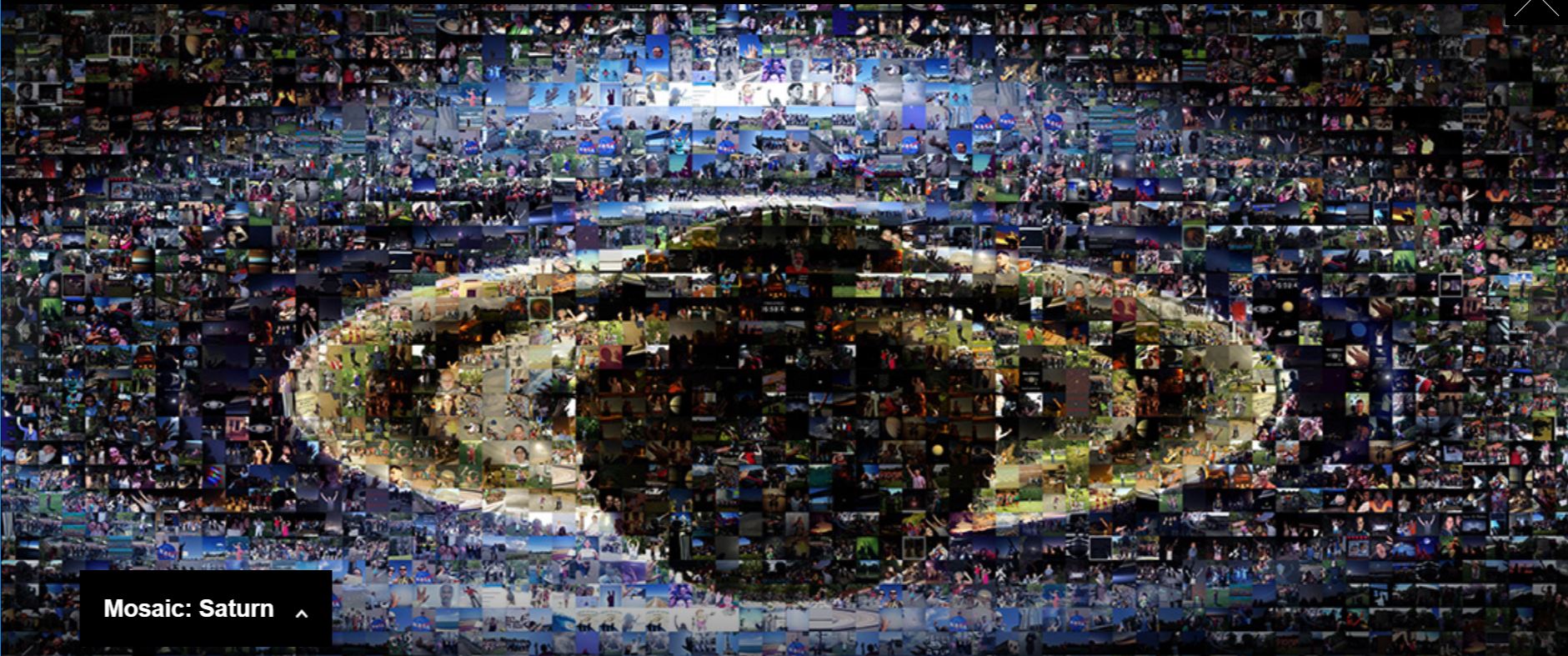
Cassini was used for interesting aerial photo-op. It took place on July 19, 2013. The folks who programmed Cassini turned the spacecraft back toward Earth to take a picture of earthlings waving at it. The images were then beamed back and stitched together in a huge mosaic of the Saturn system, itself! More about that event, here.


Storytelling with Google Earth. Neat multimedia tool!

I found an interesting way to use Google Earth to enhance a lesson. It’s called TourBuilder.  It’s set up like a slide deck, and is quite intuitive. You need to have a Google account to log in and use it.

Ideally you need to have your images and videos ready to use. But you could search and embed them from other image sources – including yours, if your images are searchable. I tried my hand at it, creating a story based on a fascination with geology, and photography of rocks, canyons, geysers, and gorges. The ‘tour’ starts in Arizona at the Grand Canyon, hops across to Wyoming to Yellowstone, and then to Ithaca, NY.

You could check it out here

It’s possible to use this as a way of documenting a road trip, for instance, and attach specific dates to each stop. A great way to supplement journaling, and deeper, and richer than FB posts or tweets.


.

Future Inventors – My LMD article on Team Sri lanka

SRI LANKA AT THE ROBOTICS OLYMPICS

BY Angelo Fernando


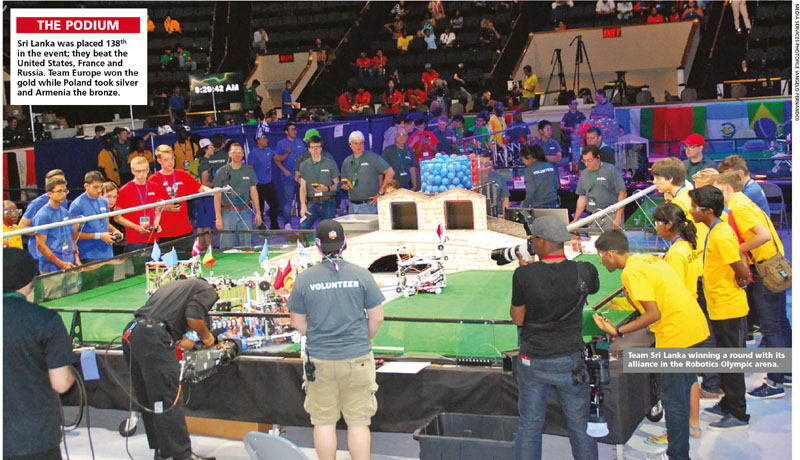
A short walk from the White House, the steps leading up to a neoclassical building where Robin Williams once performed spill over with teenagers in bright yellow and blue T-shirts. Using screwdrivers and wire, they are feverishly fixing their robots. It’s only 15 minutes before Round 1 of the two-day competition held in July – a global event drawing 163 teams from 157 countries.

The humidity in Washington D.C. hovers around 90 percent and Team Sri Lanka’s four students are sweating bullets. Huddled in a basement, and parked between Senegal and Sudan, their 20-wheel steel robot needs some repair work.

Why? The bot they had built in a classroom (so secretive was the project, they called the room ‘Area 52’) arrived with a warped axle and damaged omni wheels. The motor failed too, which is not an uncommon problem among teams here. In a few minutes, they must have their 23-kilogramme robot working. It is the ‘Olympics,’ after all…

Link to full article here.

Published in the Sept issue of LMD Magazine.

Self-driving carts – The downside of robotics

Robots are great until they carry out tasks that take humans out of the equation. Or when they attempt to use ‘data’ as a substitute for insight.

For this reason I am not exactly excited about self-driving cars – and I pass some of these each week in the Gilbert area. (Bummer! Uber’s autonomous vehicle met with a 3-vehicle crash last week) Besides the safety aspect, there’s the real long-term effect of erosion of jobs. Those jobs that involve routine manual tasks. Think of warehouse work, or on-demand ‘runners’ and movers that make a factory work.

As fascinating as this demo below seems, it’s the dark side of what robots could do to the workplace.

If there’s any upside of this, it’s that companies that defining this future are hiring people with emerging engineering and science (STEM) backgrounds. The company who developed this cart says it is hiring a ‘Computer Vision Scientist‘ – someone with math skills, and experience in LIDAR, radar, sonar, GPS etc.

I love it! The smart cart can ‘see’ and find its way through a messy warehouse. But it needs a scientist with ‘computer vision‘ in his/her title to bring such technologies to fruition. At least it’s a raison d’être for STEM education. People who can carry out cognitive, problem-solving tasks that bots cannot. Yet.

Robotics teams immersed in complex (timely) water challenge

So as #Flooding and #StormSurge is on everyone’s mind with havoc from hurricanes Harvey and Irma, it is unhappily timely that robotics in schools and clubs across the country are wrapping their minds around an H2O challenge. Specifically, ‘Hydro Dynamics.’

It’s this year’s theme for the FIRST Lego League that will culminate in tournaments between November and December. (Interestingly, the theme of the FIRST Global ‘Olympics‘ in July was H2O Flow ) Alongside the work on building and programming a bot to run missions, students must work on a research project. How water is sourced, conserved, distributed etc. They must also come up with a solution that ‘adds value to society’.

Right now there are a myriad of issues that experts and government officials are wrestling with. Could students hypothetically solve some of these in the future? Dean Kamen’s FIRST outfit has been doing an amazing job of using robotics to build a new cadre of engineers, designers, and problem-solvers.

As I watch my school team assemble the missions in my lab, it’s evident that each mission (built of Lego pieces) is more complex this year: There’s a ‘Pump addition’ mission, a Water Treatment model involving ‘Big water’, and others involving Pipe Replacement, and Sludge Removal.

Here is what the field mat looks like.

Could Fitbit smartwatch take over iPhone territory?

Though I will never wear an activity tracker. I’ve been very curious about the smart wristband / ‘wearables’ business. Especially the territory Fitbit has been moving into.

Sure, most people will be awed by Fitbit’s ‘SpO2’ sensor, for instance. But despite the clinical USP (to keep tabs of ones oxygenated blood), there are some features that blur the lines between an activity tracker and a smart watch; a wearable that can make contact-less payments via NFC, minus a phone.

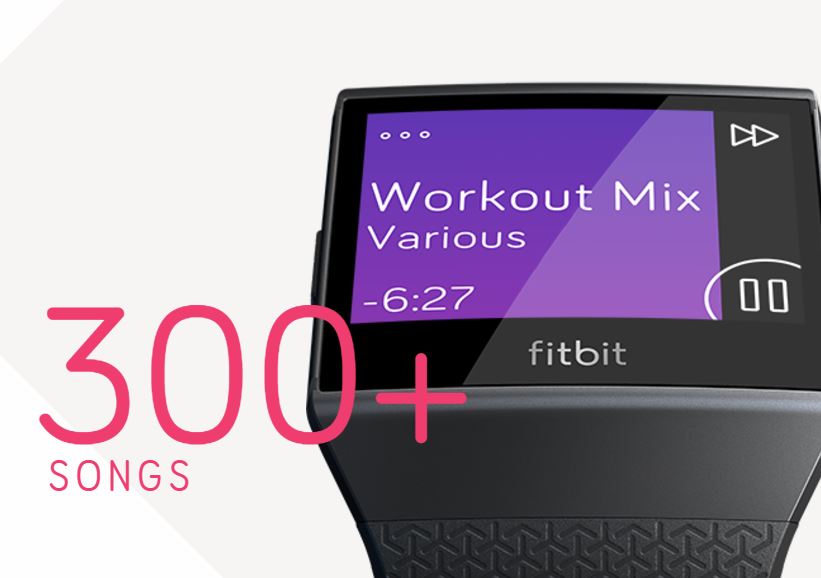
There’s also the music feature. A smart watch that could store music could be a game changer. With Bluetooth and WiFi (and GPS) who knows what territory it might lead this ‘wearable’ into? Will it motivate some to leave their phone behind? Would that mess with the iPhone eco-system?

The other reason I’m curious about this wearable is, I plan to use Fitbit as an example in an upcoming class. It’s a class about the Internet, and the connectivity it provides. And the hardware and software that run on the infrastructure students take so much for granted. Following up on last week’s look at Virtual Reality, nothing like bringing up the much-hyped Internet of Things.

Another eclipse crowd-sourcing project captures sounds, not pictures

My wife and I were discussing the eclipse –her two-and-a-half year old Montessori students had been excited about it!– and wondered if animal behavior was being tracked.

So it was a pleasant surprise when I saw Ruben Gameros’ post today on FB about his participating in the Purdue University ‘sonic effects’ project. Their “huge, continental scale” project was to study how animals will respond to the solar eclipse. Using acoustic sensors (from Alaska to Puerto Rico) they invited citizen scientists to collect data –acoustic behavior of  birds, crickets, cicadas, and frogs.

Why record sounds? Purdue researchers are looking at if animals that are typically active during the day stop making sounds during an eclipse. Among other questions:

  • Are there patterns for birds, insects, mammals, amphibians, and even fish?
  • Are the changes in the circadian cycles different in coniferous forests, temperate deciduous forests, grasslands, and coastal ecosystems?
  • Is there a difference in behavior in the total eclipse zone compared to areas that are in the 90%, 80%, 70% and 60% or less zones?

Caltech had a different crowd-sourced project calling for eclipse-related animal behavior. It called for young scientists to make 3 observations during the event, and record it via a special App. It was supported by a teacher webinar, and a web-chat.

I wish students across the country would have been motivated to do more than look for the umbra and penumbra. Or dodge the event, entirely. (One school I know cancelled the viewing even after they ordered glasses.)