Google’s drag-and-drop ‘Scratch’ doodle

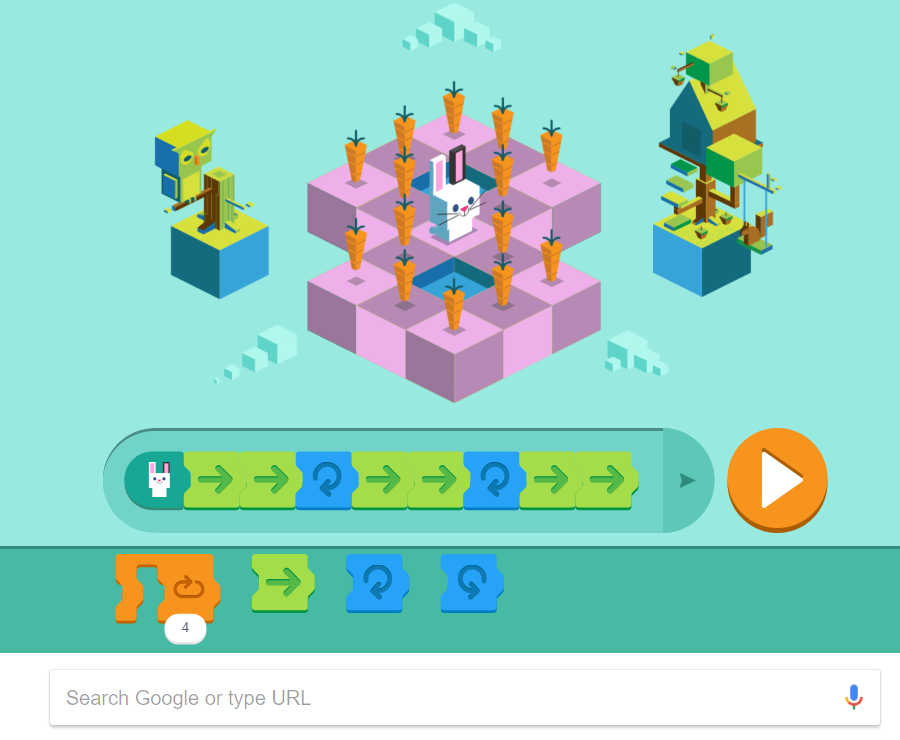
As Google doodles become more interactive it’s fitting to see it launch Hour of Code with a drag-and-drop doodle. It’s their first Coding-based doodle. Have you tried it? It’s on today’s Google landing page.

Worth reading: A description by MIT’s Champika Fernando, who was on one of the 3 teams that built this doodle.

Hour of Code runs through this week, which is also Computer Science Education week, and the anniversary of 50 years of programming languages. Scratch was developed at MIT.

Using robots to teach PowerPoint animation

Around this time of year when I introduce animation in PowerPoint, I try to find something topical to animate.

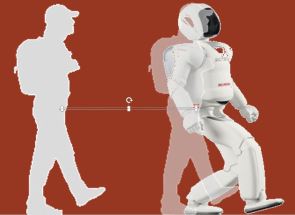
So I’ve got my 4th graders to think about ‘Man and Machine‘ -specifically how a human could evolve into a humanoid. We use the custom animation tool to draw a path to make the human glide across the screen to turn into a robot.

To preface it, I showed them a clip of Asimo, the Honda humanoid project. Asimo is the acronym for Advanced Step in Innovative Mobility. It is a 4-foot 3-inch character that can run, climb steps, and play a bit of football (soccer). Even those who aren’t into robotics get instantly engaged.

I asked the class what they thought of man and machine after watching this; some thought it was a bit weird and creepy, but pretty cool.

Once the unit is completed, I figure this will be a good way to re-introduce Coding for the Hour of Code project. How do they build a set of instructions to make an inanimate object move? Coding and animation have a lot in common!

Trolls, bots, and memes become parents’ new nightmare. So what’s the solution?

A friend recently asked me if someone should be putting together a source for parents who have to address so much in the lives of their digital natives. I have a few go-to websites that we use as teachers, but was struggling to find a good hand book.

First two of the best web-based resources I recommend.

COMMON SENSE MEDIA – This is a wonderful, deep trove of information that is updated with plenty of topics (plus short videos) on such from phone addiction, and fake news, to privacy tips and how to navigate the difficult world of plagiarism, copyright, password protection, oversharing etc.

EDUTOPIAAnother great place for articles on technology skills such as coding, academic skills being taught such as note-taking, problem-solving, state standards, digital citizenship etc.

But the reality is that almost every week, children are bombarded and confused by new issues. One week it’s plagiarism, the next it is memes, and add to that the constant misinformation through bots and trolls, followed by the news related to cyber-bullying or inappropriate behavior that pops up on TV or their social media feeds. The search engines and social media platforms are often gamed by bots, and tricked by pranksters, but who has time to inform the kids about these fast-moving events?

So the sad thing, as I had to tell my friend, was there is no handbook. Just like there was no user-guide when we first got onto the early Internet. However that Internet was a place we went to, consciously logging in to it, or “dialing up” to it. Today, that place isn’t somewhere we visit – it visits us. Students who grow up with it have to navigate it on their own. It’s like giving them the keys to the car, before they go to driving school, expecting things to be alright on the road.

But of course there is one user-guide. It’s unpublished. It’s called Parenting.
Space Day at Salt River Elementary

So today is Space Day! Our 6th year, Space Day is turning out to be quite an event!

This year we have two keynote addresses from NASA scientists:

Dr. Jim Rice,  Co-Investigator on the Mars Exploration Rover Project. His work has involved mission experience working on the Mars Odyssey Orbiter and Lunar Reconnaissance Orbiter Projects, the Mars landing site selection for every NASA Mars Mission since Mars Pathfinder in 1995. he is currently involved in manned missions back to the Moon and Mars.

Dr. Ashwin Vasavada, is the Deputy Project Scientist working on the mission of the Mars Curiosity rover. He helps lead an international team of over 400 scientists. His work has involved geologic studies of Mars with regard to surface properties, volatility, and climate history.

Other sessions will be specific to grade levels:

  • Robots in space
  • Planets & Liquid Nitrogen
  • Food in Space
  • Moon rocks
  • Rockets and launches
  • Satellites Communication in Space
  • Small-scale satellites

We could not have done this without the support of:

  • Challenger Space Center
  • NASA
  • Orbital ATK
  • ASU – School of Earth and Space exploration
  • ASU – Collective Systems Laboratory
  • SpaceTrex


Plans afoot for Space Day 2017

Just announced plans for Space Day at Salt River Elementary – our 6th year!


  • This year’s focus is on the Moon, rockery and spacesuits.
  • The student competition is to design a future spacesuit 
  • Each class in every grade level will experience one facet of space science
  • When: Oct. 26th, 2017    Time: 8:30 am – 3:00 pm

As the event grows bigger each year, my thanks to those who will be supporting it:

  • Orbital ATK, Arizona
  • Jet Propulsion Lab, California
  • Autonomous Collective Systems Lab, at ASU
  • SpaceTRex, University of Arizona
  • Challenger Space Center, Arizona


Space science is a fascinating field, and gives us who focus on STEM an ability to widen the lens. Consider some of the recent developments


Sneaking in VR to the class

This year I’m using VR both as a project, and as a motivation tool – to create a brochure. My 6th graders understand some editing and formatting skills. So to raise the bar, I got them to research and put together a brochure on Virtual Reality.

Granted it’s a lot of work. Understanding VR itself takes some time. They must create content for the 6-panel document, look up content, find pictures etc. As work progresses, there is a parallel discussion of what VR looks like, using a few cardboard headsets I acquired. One student even brought in two headsets. (One had cost him just five bucks!)

The incentive was that any student who showed me they had three panels formatted, and with required content, would get to experience a VR roller-coaster ride. Didn’t think a 40-minute class could move so fast!

Funny how sneaking in a piece of tech into a lesson can accomplish much more than a hand-out!

Storytelling with Google Earth. Neat multimedia tool!

I found an interesting way to use Google Earth to enhance a lesson. It’s called TourBuilder.  It’s set up like a slide deck, and is quite intuitive. You need to have a Google account to log in and use it.

Ideally you need to have your images and videos ready to use. But you could search and embed them from other image sources – including yours, if your images are searchable. I tried my hand at it, creating a story based on a fascination with geology, and photography of rocks, canyons, geysers, and gorges. The ‘tour’ starts in Arizona at the Grand Canyon, hops across to Wyoming to Yellowstone, and then to Ithaca, NY.

You could check it out here

It’s possible to use this as a way of documenting a road trip, for instance, and attach specific dates to each stop. A great way to supplement journaling, and deeper, and richer than FB posts or tweets.


.

Future Inventors – My LMD article on Team Sri lanka

SRI LANKA AT THE ROBOTICS OLYMPICS

BY Angelo Fernando


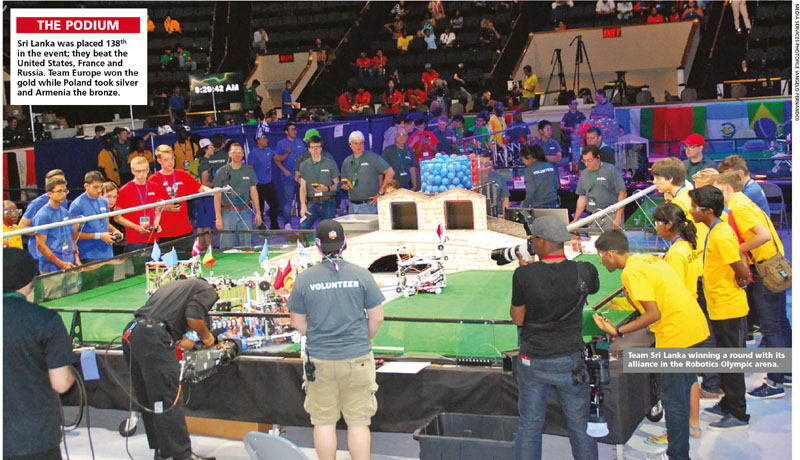
A short walk from the White House, the steps leading up to a neoclassical building where Robin Williams once performed spill over with teenagers in bright yellow and blue T-shirts. Using screwdrivers and wire, they are feverishly fixing their robots. It’s only 15 minutes before Round 1 of the two-day competition held in July – a global event drawing 163 teams from 157 countries.

The humidity in Washington D.C. hovers around 90 percent and Team Sri Lanka’s four students are sweating bullets. Huddled in a basement, and parked between Senegal and Sudan, their 20-wheel steel robot needs some repair work.

Why? The bot they had built in a classroom (so secretive was the project, they called the room ‘Area 52’) arrived with a warped axle and damaged omni wheels. The motor failed too, which is not an uncommon problem among teams here. In a few minutes, they must have their 23-kilogramme robot working. It is the ‘Olympics,’ after all…

Link to full article here.

Published in the Sept issue of LMD Magazine.