Quotes for the week ending 9 May, 2009

“Gaze tracking is well-established … In the future, the whole image could also be panned left or right as the gaze approaches the edge of the screen.”

Gadgets and how we may use them, in BBC story on Science Beyond Fiction conference in Prague.

“The effects of the swine flu epidemic have been felt in Hollywood.”

Access Hollywood on an e-mail spam message that claimed Madonna had caught the virus.

“Moving from the digital world to print as everything else moves in the other direction may seem contrarian. But people want physicality, especially as more and more of our lives are lived virtually.”

Eileen Gittins, CEO of Blurb, a profitable print-on-demand company that has sold $30 million worth of books in 2008.

“Integration has long been talked about as the holy grail of brand communications. Socialization of media warrants finding it, and fast.”

Chris Perry, executive VP at Weber Shandwick. In Advertisng Age.

“…the greatest facilitators of human conversations, its building itself as a brand based on emotional bonds and trust in a shell of social , web 2.0 services.”

johnhorniblow, talking of Facebook, responding to the above article

“Forever is a word people aren’t used to hearing from marketers. But forever is good. If you could keep every customer you get forever, you’ll be in business for just as long.”

Rohit Bhargava, about the United States Postal Service’s use of a ‘forever stamp’ at the current postage rate, and it would be valid many years later, irrespective of price increases.

“Be warned. It’s me uncensored.”

Megan McCain, on her blog about her use of Twitter. Megan, daughter of John McCain is seen as the new voice of the Republican party. She will publish a book on this subject soon.

“They should be the ones writing the tweets – no ‘ghosttweeting’.”

Linda Vandevrede at ValleyPRblog.com, about CEOs use if Twitter. The full report is on Ryan Zuk’s presentation about Twitter.

What if there were no reporters (to cover the swine flu)?

So we all take news for granted. We get annoyed when a story is hyped, we get upset when it is ignored. We complain that it is one-sided, we write angry emails to the editor when the news is opinionated.

But what if –just what if– an editor had to cover a big story, and there was no reporter left (due to a downsized staff) to cover it?

This anecdote, a long piece, is definitely worth a read whether you are on the production of consumption of news. Here’s a glimpse:

Editor-in-chief: Timmy! It’s Bowes down at the Clarion, we need you to do a story for us.

Flannagan: (Moans)

Editor-in-Chief: What’s up? You don’t sound good.

Flannagan: I think I got the Swine Flu

Editor-in-chief: Sheesh, you should go see a doctor.

Flannagan: Freelance. No insurance.

Thanks to Kerry Fehr for the link.

Cross-pollinating content benefits you, me, Mark and Rupert

Two things made me think about how content might begin to flow across networks.

The first was watching Charlene Li at South By Southwest (the video) ask about ‘what will it take Faceboook and MySpace, Google and Yahoo play nice, and allow us to migrate data backa and forth.

The second a news item I heard Shel Holtz and Neville Hobson talk about, where The Guardian is letting developers access its API use its Open Platform to re-purpose content.

This is where all media organizations have been hesitant to go, because they see their content as the crown jewels. I don’t blame them, for now. But what happens when content tends to get created by people outside the organization? By freelancers, by citizen journalists who are so coveted by everyone from the CNNs of this world to local newspapers. Wouldn’t they want to take their content with them, to their Facebook page or blog? Facebook is learning this the hard way –via Facebook protests like this!

It’s coming to a point when cross-pollinated content –for want of a better term– will be more valuable than the original. That’s why the mash-up video is so much more compelling than the original ad, the curated content and the RSS feed more rewarding than a visit to the source.

If you take this blog post and add a new dimension to it, add a few links, sidebars and comments, my readers might find it more interesting than the original piece. Yes, we are going to bump into copyright issues, but along the way we are going to learn to ‘play nice’ as Charlene said.

Speaking of which, just today, the copyright owner Rob Cottingham, emailed me to say how much he loved the use of his cartoon in a post about Twitter on IABC xChange. He asked if I could give him credit, which I promptly did. Just that small gesture of asking and not suing made his cartoon and my post that much more valuable. (The one used above is his as well and perfect for the SXSW conference I referenced.) Who knows, Rob’s cartoons, Noise To Signal, might influence someone to think harder and bring more clarity to a topic becuase he decided to let his content migrate into mine.

Maybe Murdock and Zukerberg could learn something from Cottingham.

Quotes for the week ending 22 February, 2009

“I would be happy to buy him a cup of coffee –decaf!”
White House Press Secretary, Robert Gibbs, to the press, on the CNBC host Rick Santelli’s rant about Obama’s housing plan. Gibbs suggested Mr. Santelli ‘download, hit print and read the report.’

“It’s a crisis that strikes at the heart of the middle class. It begins with one house at a time in Mesa, Glendale or Tempe…”

President Barack Obama, on his visit to Dobson High School in Mesa, Arizona, where he announced the details of the housing plan that intends to address the key issues at the heart of the financial crisis.

“Thank you all for watching out for my brand, I appreciate each and every message”

Jeremy Owyang, to the many people who have informed hiom about the fake Twitter accounts in his name. Reported by Jacob Morgan.

“Business journalism sources come in all shapes and sizes, and my experience is that the ones who purport to have the most explosive stories are typically exaggerating their claims.”

Chris Roush, blogging at BusinessJournalism.org, on the need to verify a source that claims to be a whistleblower, in relation to a story of one in the Bernie Madoff fraud case

“Micro-payments won’t solve newspapers’ pay-or-perish problem, at least not under current proposals.”

Marshall W. Van Alstyne, associate professor, Boston University joining the debate on how to rescue journalism

“Twitter has a lot of power to, with simple changes like that, change the ecology of the system.”

Leo Laporte, host of the podcast, This Week in tech (TWIT) on the new feature that Twitter adds that gives some users a hugs boost in followers.

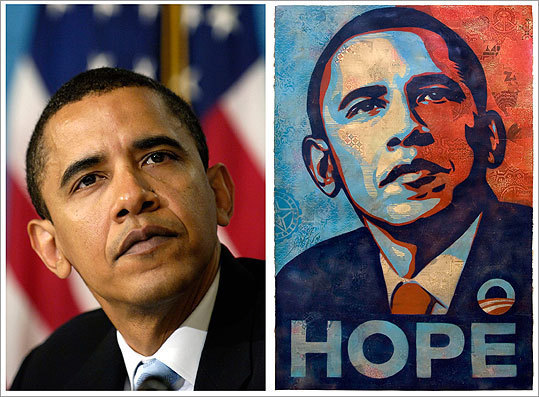
Audacity of suing ‘Hope’ by the Associated Press

I can assume the Boston Globe will not sue me over linking to this juxtaposed image.

They don’t usually get that silly, as the Associated Press has been when it threatened to sue Shepard Fairey, the street artist who turned the man on the left to the icon on the right.

The HOPE poster is so well known there are ways to render your own mug shot with the same color and brush strokes.

But last week, as the story got more twisted —Fairey got arrested on an unrelated charge in Boston, and then sued the AP — one wonders what kind of image management the venerable Associated Press is going for. Especially since this is not the first time it’s let its lawyers handle its PR.

Last year AP went after bloggers trying to put limits on how much of its content could be considered fair use. It later retreated. Forget the power of mashups for a second. Making a street artist the poster boy of copyright violation doesn’t  score any points for AP.

Quotes for the week ending 31 January, 2009

“I’ve got one question: WTF? Where’s the funding?”

Student Tommy Bruce, president of the student-body at the University of Arizona, at the protest this week against state legislators slashing education budgets

“Our model is not for a quick rebound,” he said. “Our model is things go down, and then they reset.”

Steve Ballmer of Microsoft, in The New York Times, about the layoffs at Microsoft

“pop culture and media that’s ripe for parody”

Ralph Podell of Barely Digital, a new tech comedy model that will feature the ‘Obama Girl’

“It kind of smells like Nixon and Watergate.”

Governor Rod Blagojevich, invoking that other scandal of secret taping. The Governor was wire-tapped by the FBI which used it as evidence to bring charges on him.

“He’s all about PR.”

Christine Radongo, Senate Minority Leader of Illinois, commenting on the impeached governor Rod Blagojevich.

“Digging into work. Must turn off Facebook. Too distracting. So why am I now on Twitter? Argh!”

Corrine Heyeck, Tweeting about (what else?) the distraction of social media

Dire warning against dumbing down education in Arizona

As soon as details about budget cuts affecting education in the state (K-12 funding to be cut by $ 900 million, state university funding by $243 million) became known, the voices calling for such short-sighted actions have begun growing.

A few students put together a Facebook group, and an information-rich web site at SpeakUpNow.org

It includes a short video on Vimeo – watch this, links to members of the state legislature, and other ways to get more voices be heard.

I write about this not just to track how social media is being used to bring people together for a common cause. I have a personal stake in this. I work at Arizona State University, one of the three universities that will be forced to take drastic steps (massive layoffs and astronomical tuition increases) if these cuts go through.

Personal stake #2: My  son is a freshman at Northern Arizona University and I would not want to see Arizona dumbing down its education even further.

This is serious stuff folks.

Sidebar:

See how they have responded:


People’s inauguration –and how to contribute to it

As the stage is set for this moment in American history, there’s much work being done to tap into the passion of the country via social media –to make it a ‘for the people, by the people’ event.

Here are a few ways to join the conversation:

  • The New York Times is accepting photos that get published here. Email them to pix@nyt.com
  • National Public Radio has  Twitter two tags if you feel inclined to tweet. Send them to #inaug09 or #dctrip09.
  • Flickr: NPR is also using the same tags, inaug09 or dctrip09, for those wishing to upload pictures to Flickr
  • Text in news to NPR: Send it to short code 66937 (begin your message with #inaug09 or #dctrip09)
  • CurrentTV will blend Twitter comments with the telecast. When you tweet, add #current to your comments and it might get featured.
  • Citizen’s Briefing Book: This is a neat project I wrote about earlier
  • Live Blog by Sam Teller
  • You could be an iReporter on CNN-iReport and send in a reports during the day

inaugurationpix_1Pictures like the one on the left (The New York Times) have already started pouring in, with pictures like this, and this.

PBS is asking for people to call a toll-free number via Gabcast and record an audio segment.

Of course, if you just want to be updated on events there’s an inauguration Twitter feed: obamainaugural

Starbucks-meets-Obama-meets-Digg: crowdsourcing democracy

The president elect is taking a leaf off the social media marketing book to gather ideas from citizens.

StarbucksMyStarbucksIdea has been around for several months, basically asking people to “Help shape the future of Starbucks.”

Now the Obama people have launched the Citizen’s Briefing Book –part of Change.gov. To contribute to the ‘book’ that will be printed using the best ideas and given to Obama, you have to sign in with your full name, email address and zip code.

People are sending up their ideas in droves. More than 9,500 on the Economy, and about half that on Energy and Environment, and a little less than that on Education. Ideas could be voted up or down, like Digg. Gives you –him– and the country a sense of the hot-button issues.

This kind of governance will radically change opinion polls, focus groups and political consultancy forever. And it’s only just begun