Texting Vs Talking – Another View

My son was home for a few days, and his cell phone died.

The world didn’t evaporate into a mushroom cloud. You see, not being connected doesn’t faze him. “My friends all know that I don’t respond to texts immediately,” he replied when I asked him if it found  that not having a phone for a week caused him any problems. It made me wonder if Milennials have reached the turning point of incessant texting.

Just a few years ago, this was what we were hearing about 18 – 24 year olds.

  • 43% of 18-24 year-olds say that texting is just as meaningful as an actual conversation with someone over the phone (2010 eMarketer report)
  • More Millennials (than members of any other generation) use their phone for texting. (Pew Research)

What if people stopped staring at their phones and actually spoke to you? Would that creep you out?

What if people stopped sending you links to stupid cat (or anti-whatever) videos, and actually called you to chat?
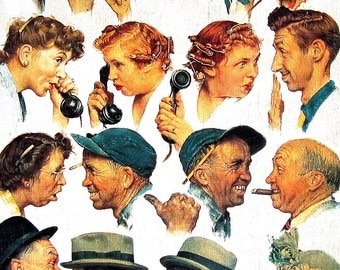
Phone calls are cool, once again

Are phone calls back in business?

After all the texting, WhatsApping and refusing to pick up the phone (because you wanted the caller to not waste your time, when a SMS would suffice), it appears that people are returning to real conversations.

Or am I just being optimistic?

Here’s a shocker: In 2013, Skype carried an estimated 214 billion minutes of international “on-net” calls (that’s defined as calls made from one Skype app to another).

That’s in spite of the rise of Viber and Line, and even Google Hangouts which do the same job, or better. There’s also an emerging standard known as VoLTE, that’s supposedly about to deliver ‘infallible voice service’ that’s different from the VOIP standard. It’s too technical to go into this here. But the big picture is that soon, when voice calls become cheaper, and more high def, it’s going to make us want to return to those conversations.

For my Mum’s 90th birthday, last week, I was able to speak to her, and get some half-decent face-time with cousins, thanks to Skype. To me Skype is the trusty service, in the same way that land-lines were some 20 years ago, never mind the poor quality of the line. I still use these ‘over-the-top (OTT) applications, but whenever I yearn for close encounters, there’s nothing like a phone call!

Lessons from Richard Attenborough

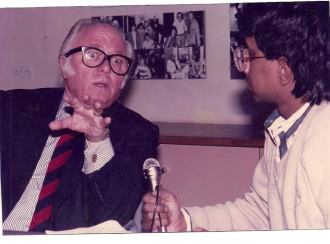
AttenboroughIt was a grey, nondescript September afternoon in London, when we sat down with recording ‘machines’, and microphones, all agog for our victim to walk in.
The victim was Richard Attenborough, someone well known to our class of foreign students at the BBC (whose motto, most appropriately, was/is “Nations shall speak unto Nation“). It was just seven years since Gandhi had been released.

We had practiced the ins and outs of radio production, from managing the heavy tape machine (about as heavy as a small microwave), to splicing, mixing sound effects etc. None of this would have mattered if we didn’t get our interview right. We would have just five minutes of face time.

Mr. Attenborough – I doubt we addressed him as ‘Sir’ Richard– was  extremely gracious, and disarming. This was not what our trainers had prepped us for: the evasive spokespeople, the rude celebrities, and those who intimidate you etc.

What I recall most were two things. Mr. Attenborough patiently listened to my question (about the making of the Gandhi), at times tilting his head to figure out my accent.  Speaking of which, there were no shortage of versions of English and thick accents in that room at the Capital Radio studios, London that day. Before and after me were budding radio hosts from the Seychelles, Malta, Lesotho, and Fiji.

The other thing was how he punctuated each idea with his sweeping arm movements, barely grazing, but totally ignoring the microphone. This is what interviews are supposed to be structured around – conversations, not hardware.He made that easy for us.

Long after the spool tapes gave way to tiny, and barely digital recording devices, it’s still the conversations that matter.

Now that selfies are in, can we start ignoring them?

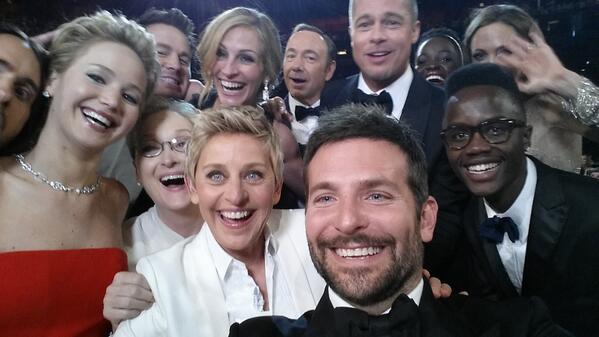
If I see one more selfie on a national awards show, I may gag. It’s getting rather tiresome, seeing grown-ups climb aboard a bandwagon that usually has reserved seating for self-obsessed teenagers.

Sure the made-up word entered the OED last year — but so did jorts and fauxhawk in 2012. It also trumped the word ‘schmeat“, the new word for fake meat. In case you needed to click on the above link, you are probably like me, shaking your head in despair.

But to get back to selfies, yesterday on the Country Music Awards, there was a selfie moment, and we wondered whatever happened to human ingenuity. Didn’t Ellen make it clear that she owned that brightly lit space that celebs inhabit?
Just to cement the fact that we are in that moment in time when this awful word is rushing to meet us, there’s that annoying song. Obnoxious, albeit a wonderful parody of selfie culture. It’s title: “Let Me Get a Selfie.”

To add to this there’s the pres of the United States fawning over a selfie, as if it was the best thing that happened to image management –with a touch of product placement. I understand the man is desperately going after all the Likes and re-tweets he can get.

It’s time for people over 21 to calmly put away their phones and start real conversations.

Win a free copy of Chat Republic. Send your question to @IABCPhoenix

Angelo Fernando - Chat Republic

It’s been just 3 months since my book Chat Republic launched in the U.S., and there are some interesting developments that obviously did not get discussed:

  • The raison d’être and privacy issues over dating games such as Tinder
  • The flurry over crypto-currency‘ (BitCoin)
  • The hashtag ‘noise’ emanating from every possible event (such as the Bieber-crazy #Beliebers)

What burning question do you have about where social media is taking us? I’m speaking at an IABC Phoenix event tomorrow

Post your question to @IABCPhoenix and @heyangelo

If your question is picked, you’ll receive a free copy of Chat Republic. 

(You don’t need to be atending the event to win!)

Why SoundCloud rocks

Whenever I get tired of reading the news, I switch to SoundCloud.

I’m currently doing a series of lessons with my students on audio, and having them experiment with the power of voice. (I know: It fits nicely into the theme I’ve been plugging in my book, Chat Republic.) Truth is, young people are enamored by video, and instinctively see audio as its poor-relation.

But ever so often, one of them says something in a microphone that makes them realize how simple and real an audio experience could be.

Here’s one that is part of an NPR experiment itself. An experiment to study why audio seldom goes viral.

It’s almost impossible to listen to this and not (a) feel close to the event (b) wonder how someone managed to record this near-death experience.

Digital Learning Day, tomorrow: An opportunity to teach and learn

Tomorrow is Digital Learning Day across America. For me it’s an interesting way to focus on the ever-changing landscape of education and knowledge tools; With schools upping the ante on the sciences, and adopting what’s known here in the U.S. as the Common Core Standards, it’s time we experimented with digital learning.

And if you’ve read this blog you’ll know that by Digital Learning I don’t mean thrusting a small screen in front of students and expecting knowledge to automatically be transferred from hyperlinks to neurons.

There’s a lot more about how I’m approaching #DLDay on my school blog. Here’s are three things I will be trying out this week. I bet they could be easily applied to areas outside education.

VOICETHREAD:
https://voicethread.com/share/5326162/

This is an interesting way of allowing a group to collaborate on a topic, using voice or video. The spoken word could be a powerful way to get a team or a class to focus on the content, not the presentation. When I interviewed the CEO of Voicethread last week, Steve Muth used the phrase “No Bling” to describe why Voicethread is powerful.

PADLET
http://padlet.com/wall/m2iy0fn1fy

For some reason the embed code is not working here. Padlet is essentially a way to create a multimedia story on a blank wall, and share that story in a variety of ways. So you could have a small group curate ideas from multiple sources and quickly assemble them in one place. A bit like a wiki, but with a visual look and feel.I like the fact that it also gives you a QR code for each project.

VOKI
http://www.voki.com/
When I first heard that Voki was about creating avatars, I didn’t want to take it seriously. It reminded me of the avatar fetish we once had when Second Life was all the rage. But on second look, Voki is a neat way to get students to engage in digital storytelling, by getting them interested in creating content. The ‘voice’ of the avatar could be created in many ways: by uploading text, uploading a pre-recorded voice recording, or by recording it live. Once again, your avatar generates an embed code.

How will students take to these new ways of engaging? No predictions. But I could tell you that just this week I tested out voice recordings with first graders, and they were beginning to record mini stories in less than 30 minutes of showing them how to use Audacity.

The urge to exit Facebook

I’ve begun running into people in the past few months who are wrestling with the idea of cancelling their Facebook accounts.

Are you one of them?

It’s been some seven years since I signed up, and I have to admit it almost feels like I have to hold my nose when I login, now and then. Now and them, meaning a few times a week -down from a few times a day some years back. Hence that post a few weeks back when I wondered if the social network, was more of a faux community.

There seems to be a bigger picture emerging.

As one person I interviewed noted, the land grab to just be seen on Facebook, and that “me-first’ mentality has worn thin. There is too much chest-thumping, too much ‘thought burps’ for some to want to be part of it.

I like to hear what you think of all this, and how you use or ignore. I don’t want to know the obvious: that it’s easy to find long-lost high school friends, and how it makes you feel connected. There are dozens of ways we could do that now.

I like to know:

  1. Have you changed your Facebook activity?
  2. What makes you wince at what people say/post?
  3. Are you using Facebook in some other interesting way?
  4. Are you (or someone you know) contemplating heading for the exits?

Communicating without words – Goldieblox smashes Princess stereotype

Last week someone sent me a link to a video for GoldieBlox, a toy company, that features toys for kids (and parents) jaded by the Princess theme that has taken over the toy industry in this country for that past few years.

I had never heard of the company before, and it was a serendipitous discovery, because of what I have been working on with my students –a Rube Goldberg idea. More about this in a moment.

While most girl’s toys have been Disney-fied, Goldieblox’s products are engineering-inspired. One of their blog posts (titled “An Apology To My Future Daughter”) gives you the reason d’être:

“I apologize that I’m going to have to lie to you. I’m afraid there is a 99.99% chance you won’t grow up to be a princess. I’m afraid I would rather you become an engineer…”

So back to the video, an advertisement, nonetheless, which communicates sans words why science and engineering could be fun for kids, Levers, pulleys, wheels, ramps..all made from everyday objects to create something fantastic. The storyline is about kids who are bored with Princess-saturated television, and go on to create a contraption that uses everyday objects in the home to… turn off the boring fare on TV! If Disney’s princess-fantasy machine has numbed parents’ toy choices, Goldieblox’s ‘Princess Machines’ tries to reverse the trend.

No voice-overs required.

However, another communication issue flared up. Not about toys or machines, but about copyright. In November Beastie Boy’s filed a lawsuit against the use of its song (parodied), “Girls.” That’s a whole other communication issue worth unpacking since it is involves ‘fair use’.

My guess is that the band would drop the charge, once it realizes the bigger picture –beyond a viral ad -of empowering girls.

It won’t help, once the rest of the media begin to see story angles such as “Why Beastie Boys Isn’t pro Girls.”