Bubble comment lets reader talk back. Scary! Fun!

Have you heard of Bubble Comment? It sounded pretty cheesy at first until I clicked on a link someone had left on this article in Advertising Age.

Some background: Ken Wheaton, who writes a fabulous Adverting Age column, AdAges, wrote a piece poking fun of the whole Web 2.0 thing. Granted Wheaton was merely being funny, (“Web 2.0 Cured My Cancer and Made Me Taller — and Rich!”) but some didn’t get the joke. He also raised a lot of hackles by ending with some hard facts woven into the parody:

“You naysayers can laugh all you want. You’re just troglodytes caught up in old-word illusions like “ROI” and “profit” and “sales.” You probably scoffed at pioneering technologies such as Betamax, CueCat and Friendster, too, didn’t you? You talk trash about Web 2.0 and we’ll use the power of social media to bankrupt you just like we did Pepsi and Motrin”

So the responses have been a mix of furious and this-guy- is-surely-nuts. But the whole point of this is to highlight what one commenter did, rather than said.

Turn up your speaker volume, click on this link, wait a few seconds and you’ll see. I won’t give it away, except say that it takes speech bubbles to a dare-I-say 2.0 dimension.

Are we unready for the mobile interface?

Someday the phone in your pocket will be less and less of a talking instrument, and more and more of a remote, a news conduit, a personal carbon footprint calculator, a gaming device, a…

You get the point.

But the fact is, many of our organizations are lagging in making much of our communication:

(a) Platform agnostic –a fancy way of saying it should be accessible on a Mac, PC, Windows Media device, Blackberry or iPhone

(b) Interactive –letting our visitors and audiences do something with the information, such as tagging, annotating, commenting, forwarding etc

(c) Portable –moving an applet from a web to a phone for instance.

I brought this up at a meeting recently where the topic of social networks came up. I am not a huge fan of creating one more cooler-than-yours social network, because we are all dealing with social network fatigue and it will only get worse. Making content portable to me is one way to solve it.

If we’re all going to gravitate toward “cloud computing” the mobile device might be the cloud’s best friend.

To get back to the ‘other’ functions of our mobile device, I just met with my good friend and marketing thinker, Steve England, who showed me some mind-blowing mobile applications. Granted, his phone is smarter than mine –I caught him ‘following’ Chris Brogan and Guy Kawasaki in a coffee shop! Steve’s working with a company that can print a bar code (like the one on the left) that could be scanned with any camera phone.

From an end-user perspective, these bar-codes are not only for consumer products but can act as visual cues that lead a person (like breadcrumbs?) from offline to online seamlessly, bypassing logins, account verification etc.

From a Communicator’s or Marcom manager’s perspective, these codes/icons could be even used on a touch-screen to deploy timely information to a niche opt-in group. On a wider scale, it’s being touted for emergency –and even ‘minor emergency’ alerts .

Right now, it’s probably a challenge for you to even read a PDF I send you on a phone, right? Coming soon, I may be able to reach you, even if you’ve accidentally left your phone at home, via a digital panel on a bus.

Now that would be  truly ‘mobile!’


Quotes for the week ending 6 December, 2008

“It is no use waiting for a 21st century Gandhi to do it! You and I must do it, if we are to change the world.”

Deepa, a Mumbai blogger at Mumbai Magic, who like many other Mumbaikars, are urging the government and the people to take action, now.

“for every “oh god my sister is in that hotel”, there’s one “Twitter is beating CNN! Yay us!”

Twitter user going by the name ‘naomieve‘ – last week’s tweet.

“Another “Twitterstorm” erupted this week when…”

The stormy clouds rolling in on a discussion at Media Bullseye about the Twitter storm.

“The mouse will no longer be mainstream in three to five years.”

Steve Prentice, analyst artGartner, on the news that Logitech has shipped one billion mice. He predicts the multi-touch device will kill the computer mouse.

“This one was significant, this one got our attention.”

Unnamed spokesperson for the Pentagon, commenting on news that Russian hackers had penetrated Pentagon computers.

“Innovation overhaul”

Peter Daboll, CEO of Bunchball in Advertising Age on the need for advertising innovation.

“dissenters’ voices may add volume to the discussion on international Internet governance and lend it legitimacy.”

From article on the centralization of Internet Governance under the UN

“Now if they can improve their iPhone service and turn it into an application, this will get even more interesting.”

Steve Rubel, on the improvement of Zinio, a digital magazine service for those who don’t want to let trees die to sustain a magazine habit.

White House 3.0 groundwork in place

Looks like the Obama team is using Change.gov to take the government into a 3.0 world. That’s right, they may as well skip past 2.0 and push into new territory. When was the last time you heard the government say that during this transition process, we the people could “participate in redefining our government?”

Take a look at their Newsroom and Blog links. Already you see signs that the old news page is merging with the blog, because you get a Newsroom: Blog category when you click on the Blog link.

And they’re quite up to speed on the Creative Commons 3.0 license, talking of a 21st Century government, where content will need attribution, but will be open to ‘remix.’

Would this make the WhiteHouse.gov interface (whose ‘interactive’ page inteprets interactivity as a Q & A exchange) obsolete? I can see it going through a huge overhaul?

Quotes for the week ending 29 November, 2008

“The impending total collapse of the dollar will render the true value of the average savings account or investment portfolio roughly equal to a bucket of warm piss.”

Thomas J. Wurtz, CFO of Wachovia, quoted in a press release about a new, daring billboard ad campaign

“If wearing your baby hurts your back or neck, you need positioning help, not Motrin”

Josh Bernoff, on the huge headache –um, backlash–Johnson & Johnson got on account of the ad about ‘wearing your baby’ in a sling.”

“Let’s face it: your beautifully lit, ideally scouted, model-perfect spot is likely going to be consumed in a 320×240 window. In that environment, Martin Scorsese would have a difficult time distinguishing between something shot on a Panavision Genesis versus a $150 Flip.”

Lewis Rothkopf, on the need to leverage broadband to narrowcast and target messaging in the way broadcasting has never done.

“Cheer up, it could be worse: it could be flu we’re facing and not merely a once in a 100 year meltdown in the financial system.”

Comment about a six-part drama, Survivors, on BBC1 where the story involves 90% of the population being wiped out in a flu pandemic.

“You get 14-year-old boys yelling out `I love you!’ because they learn these English expressions and try to use them.”

Kathleen Hampton, a teacher, using Skype to teach English to students in Korea in a reverse-outsourcing business from a town in Wyoming with a population of just 350.

“It’s not that we now have a president who’s black. It’s that for the first time we have a president who’s actually green.”

Oakland, Ca-based green-collar evangelist, Van Jones at GreenBuild conference this week.

“It’s a terrorist strike. Not entertainment. So tweeters, please be responsible with your tweets.”

A Twitter messge from Mumbai from primaveron@mumbai as the awful terrorist attack on the city broke out. Bloggers and the media took to new media to report the standoff and rescue operation

Google’s SearchWiki shows where we are headed

If you’ve not heard of SearchWiki, prepare to be amazed. It’s going to change the way you think of Google. Tired of getting some really irrelevant results? Delete the ones you don’t like, add new URLs and markup the ones that you want to come back to later.

Actually it does more than even social bookmarking –a customized Delicious account, for instance — but considering how where Google is going with its new browser (Chrome),  and wiki (Knol), this wikified browser experience could be the way Google learns more about users’ needs.

I can see where this might be going. A search engine meets wiki meets social bookmarking would infect us with the collaboration virus surging through our veins. Soon, we may be able to share our customized search results with a group (a Facebook widget might make sense too) we are collaborating with.

Take a test drive my HoiPolloi Google Search Page at this customized site.

You could switch between HoiPolloiSearch and regular Google search. Even the paid search results change when you toggle between both. The pages could be free of ads for non-profits, government or educationional organizations!

Visual browsing of World News

I have been looking into how a GUI ( geekspeak for ‘graphic user interface’) could enhance a message, and am considering doing some cool interactive, kiosk-type visualizations in our lobby at the Decision Theater. Interactive displays such as the Campus Metabolism project from the Global Institute of Sustainability is one way to do this. It’s a web-based but is much more interesting on a touch-screen in their lobby.

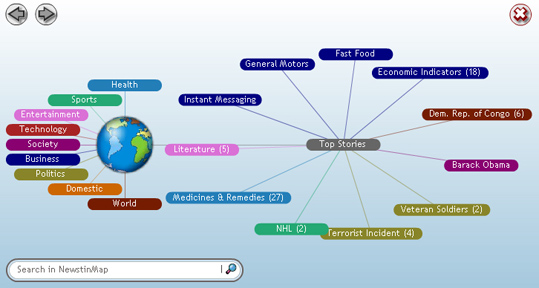
newstinBut apart from aggregating data, a GUI could simplify the user experience, for news, as this site called Newstin demonstrates.

Click on the Newstin map, and it basically organizes world news from 166,000 sources, organized into about 1 million topics. Mind you, Newstin was created before the iPhone, so it’s easy to see how a widget could transfer this kind of experience to a mobile device.

Bernie Goldbach’s vidcast experiments with new format

Bernie Goldbach may not be a household name, but for listeners of the podcast FIR (For Immediate Release) he’s the Irish correspondent who delivers an interesting perspective.

So I was really curious as to what got him started on a format like this, pointing a video camera at a newspaper, flipping the pages, and discussing stories. It reminded me of a radio segment on BBC radio (BBC World Service, if I am not mistaken) where the host/anchor gave listeners a summary of the news every day.

Some podcasts do this, but a video podcast has an additional benefit of pointing to the story itself, and being able to comment on parts of it.