Quotes for the week, ending 25 Sept 2009

“Lots of traffic, lots of talking, lots of everything. But listening to each other…”

Title card in YouTube video aimed at the leaders attending the UN General Assembly in New York this week. The video-as-open letter was by RelaxZen, a mood-altering drink –that was shipped to every world leader.

“We’ve also re-engaged the United Nations. We have paid our bills….”

Barack Obama, in his address to the United Nations General Assembly, on the commitment of the US to change.

“You are only as relevant as their problem, and your pitch has to be empathetic of their situation.”

Nathan Wagner, Relevant Chews,on selling

“But of course we’re meeting all the time. We’re both involved in all the main meetings and talk all the time.”

Prime Minister Gordon Brown, responding to claim that Number 10 was snubbed by the White House, with regard to a personal meeting between the two heads of state.

“LookingGlass automatically rates each posting as positive or negative, so the Zune HD team could rank comments according to sentiment and see how customers are responding to the product and the campaign to sell it.”

Microsoft statement about its new image management tool that lets companies monitor, analyze and engage in social media, via its Silverlight technology

“These Squidoo lenses are for sale.”

Ike Pigott, at Media Bullseye, on Seth Godin’s rebranding Squidoo as a social engine that aggregates online chatter about a brand or company.  Pigott also calls this a sinister act of piracy! Squidoo already has “900,000 hand built lenses.”

“Chiggy-Wiggy.”

Soundtrack from the Bollywood movie, Blue, featuring Kylie Minogue and Oscar-winning composer, A.R. Rahman –he of of Slumdog Millionaire.

Marketing to a community, a powerful brew

In the face of competition from the other coffee house in the same block, on the NE corner of Southern and Mclintock in Tempe,  Gold Bar Expresso seems to have an unique way to keep its customers: Building and nurturing a small, but fiercely loyal community. The coffee is incidental.

Indeed the roasts are excellent, usually served in mugs. But if you ask owners Dennis Miller and his wife Karen who run it in true mom-and-pop style, they’ll tell you the marketing recipe is simple. “If you’re going to build something with a community, it’s very hard to duplicate that. We operate the coffee shop with the same heart that we operated a church for 35 years.” It’s almost as if he had been reading from the ‘Church of the Customer’ and Ben McConnell and Jackie Huba’s Citizen Marketers.

Dennis’ transition from pastor to barista taught him something, and that is simply to be there for his community. In the first year, he decided to keep Gold Bar open on Dec. 25 and didn’t charge anything. He just didn’t want to make any money on Christmas day. He plays jazz at a nearby cigar bar, he chats with his customers as if they were friends (they are!). It’s one big social network, and some happen to be with a mug of coffee.

This is probably the reason why the community comes here not just to enjoy the legendary Granita, or the Red Eye, but to be part of this unique coffee house experience –one that  goes back several hundred years, when people used to talk to each other, and share stories, not tweets.  It’s probably why someone once left a $100 tip in the tip jar!

It’s also why in a recent survey of 104 customers, 80 had been visiting for years. Only four were there for the first time, and 12 had been coming for months. On Friday and Saturday nights. the coffee house is turned into a jazz bar, where Dennis plays.

If Gold Bar is one of Tempe’s best kept secrets, it’s probably a good thing because word of mouth fills in for those spots taken up by expensive marketing. I once overheard a customer ask the owners why she had not seen any advertising. Dennis’ answer (half in jest) was “because we are that good!” There are very few businesses that can say that today. Trouble is, they are marketing to our wallets, not our hearts.

So if you want to get a quick lesson in community marketing, stop by Gold Bar. I guarantee you will not be disappointed. As it says on the web site, the coffee house is “closed 49 hours a week, open 365 Days a Year.”

Quotes for the week, ending 29 Aug 2009

“He took the long view. He never gave up. And though on most issues I very much wished he would give up.”

John McCain, on his friend and Senate adversary, Ted Kennedy who passes away this week.

“IBM is trying to push this debate onto social nets via the most convenient device–the remote you’ve just used to switch channels. “

Fast Company story on the new move to get TV viewers to micro-blog from the couch.

“I would say I’m a different GoDaddy Girl.”

Erin Kalin, a mother and singer who is the latest GoDaddy Girl, who hopes to be a role model for young girls.

“I like to call that person The TMI  Guy.”

A post from CaliberPulse, on how each one of know someone who posts Too Much Information

“a kind of virtual race to get as many people online by the Olympics alongside all the real physical races that will be going on.”

Martha Fox, the British government’s digital champion.

“It’s a balance between the issue and the (one) person …“Pick people who symbolize the issue.”

Kimberly Dozier, on the challenges of being an ’embedded journalist’ in a session (‘Reporting from the frontlines’) at the SPJ Journalism Conference in Indianapolis.

Angry mobs or groundswell? Or just paid marketing?

What do you call a flash mob that has been paid for? Think hard before you answer this.

Now let me complicate it a bit for you:

When connected to a PR campaign, we tend to see it as the evil astro-turfing. Plenty of these examples around us. Those the angry mobs showing up with signs to loudly disrupt town hall meetings as a form of protest against healthcare reform, are suspiciously PR-backed astroturfing practices. TechPresident ‘reveals’ that there is a method behind this madness.

When connected to people protesting against a stolen election, we see it as citizen action —as we saw in Iran. streets

Then there’s the third kind. When connected to marketing, the flash mob could be used to bring attention to a product in a public place. Funny how we have no problem with this, even though it also disrupts civilian life, and appears to be a spontaneous expression of the hoi polloi.


This highly choreographed event earlier this year by Saatchi and Saatchi, for T-mobile at London’s busy Liverpool Street station is a good example of how the lines are being blurred as the radius between sender and receiver gets stretched.

Quotes for the week, ending 08 Aug, 2009

“The narrow prism of terrorism”

John Brennan, President Obama’s new counter-terrorism chief, saying the present administration won’t be looking at allies and other nations this way anymore.

FACT: You do own your brand and brand messaging

FACT: You don’t own relationships customers have with your brand

Beth Harte, at SocialMediaToday.com on Brand Vs Brand Relationships

“Washington Post Magazine ceases its XX Files feature in Sept. Probably cause?…the essays tended to focus on negative experiences with men.”

Tweet by InVocus

“But the pleasure of turning the page! I protested. The feel of something organic, not electronic, in your hands. The crispness…”

Jessica Burnette-Lemon, on looking at the Amazon Kindle

“Scare you away yet?”

Job description for AXIS Inc., for entry-level marketing position that requires knowledge in PR, customer service, sales…

“Successful candidate will have: 1) LinkedIn, MySpace, and/or Facebook account; 2) Twitter account with consistent, frequent updates; 3) Personal blog”

Job description for Social Media Director at ADF

“It’s a big surprise to me that my blog has meant that 250m people have not been able to enter Facebook.”

A blogger names Georgy, on the reason for the denial of service attacks on popular networks Facebook and Twitter.

“Military computers off-limits to tweeting GIs.”

Headline of article about the Marine Corps banning soldiers from using military computer networks to access FAcebook, Myspace and Twitter.

Quotes for the week, ending 1 August, 2009

“One over-riding rule: do not ask how long your episodes should be. Ask yourself hows short you can make them. People have a limited time to watch/listen to content.”

Evo Terra, co-author of Podcasting for Dummies, when I interviewed him for an upcoming article and, podcast.

“It’s at the point where we almost don’t need to use press releases,”

Martin Murray, senior corporate news representative for the Public Service of New Hampshire, on using Twitter as a way to update customers on an power outage due to an ice storm

“With no correspondents allowed on the ground, the BBC, like almost all major news organisations, is forced to rely on the honesty of citizen journalists to provide details from the protests.”

BBC report on how citizen journalism is on the rise in Iran

Media reports speculated that “Bruno” suffered from the “Twitter effect…”

Reuter report on how movie studios are using Twitter, but how it can sometimes backfire. Tweets about Sacha Baron Cohen’s gay-themed comedy, Bruno, created buzz but also scared people away.

“Lifestyle Lift regrets that earlier third-party Web site content did not always properly reflect and acknowledge patient comments or indicate that the content was provided by Lifestyle Lift,”

Press Release by the the company after New York Attorney General Andrew M. Cuomo came to a settlement with cosmetic surgery firm for published fake consumer reviews on the Net.

“Hey, that’s Apple. They do what they do, and they don’t really care what the rest of us think, as long as they make cool products that we’re willing to pay for.”

Shel Holtz, commenting on the problems of how all reviews on iTunes do not show up the same in all countries. On For Immediate Release, episode 468.

Quotes for the week ending 30 May, 2009

“He texts during dinner at restaurants and while walking down the street and twitters at red lights while driving.”
Reader at New York Times, commenting on how people who who would never be so rude as to talk on the phone at a restaurant, have different rules for using Twitter

“Britain’s mums told us where to stick the artificial ingredients. And it wasn’t in the bottle.”

Ad for Sunny Delight, running in Britain’s newspapers, as recointed by Jonah Bloom of AdAge, who suggests marketers need to apologize first. To which one reader responded:

“The first financial institution that apologizes will be apologizing for an entire industry for years of greedy pay packages, excessive “innovation”, disregard of risk, tricky offers & excessive political lobbying. Their customers will likely not be so forgiving as the Brits when they chuckle about Marks & Sparks reducing the price of big bras.”

Advertising Age

“It’s hard to understand how Cheney and Kyl could make statements like this with a straight face…”

Steven R Corman, at ASU’s Hugh Downs School of Communication, commenting on the former vice president and the senator from Arizona’s dismissal of Guantanamo prison being a strategic communication tool for Al Qaeda

“We used to call people who embraced this sort of behavior workaholics. Now we call them crackberries.”

Jim Shea, on how Boomers make way  for ‘weisure’ time –fitting fun around work, rather than the other way around.

“…it most definitely wasn’t named for Bing Crosby.”

Fast Company, on Microsoft’s new search engine, Bing, that is positioned as a ‘decision engine’

Can Google juice contaminate bottled water?

Metro_water_hpEver since I read an article about branding sand — I think it was this one– I have been fascinated with what differentiates a commodity from a brand.

Sand or silica is such an abundant mineral  that it’s amazing how much value it holds. Other commodities such as coffee or wheat seem to pale in comparison with what we do with silica.

But the water business comes close. Branding H20 seems commonplace today, but it is a highly competitive business.

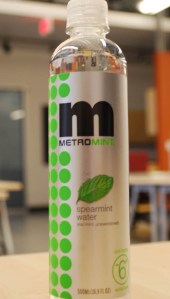
Which is why I found this package for Metromint –a cross between a bottle of shampoo and an energy drink– irresistible when I was in the grocery store the other day.

The company has an interesting tone of voice. It is part of the Soma company, that calls itself  ‘an innovative group of beveragistas.’

The Metromint blog is full of consumer-driven stories, contributed by folks like Chocolate Snob and The Karin.

The packaging is simple on its front end (busy at the back) with something called the Chill Factor. There’s a number for every variant. The bottle I picked up, Spearmint, had a factor or -6. On a day like today that’s inching up to 104 degrees, I long to try it.

But…

Just as I was about to chill and try it out, I stumbled on a piece of news. Damn Google! This particular variant had been subject of a health alert and was recalled late last year. Bummer!

Suddenly all the packaging, online presence, promos and social media-enhanced branding didn’t matter. Here was the prospect of ingesting bacillus cereus staring in my face. It’s one of those food-borne bacteria that probably won’t kill me, but it contradicts everything about bottled water — being safer than the stuff off the tap.

I don’t bring this up to denigrate the Soma brand. It is probably as susceptible as any restaurant or packaged food. But it highlights how branding in today’s world is a completely different task than what it was less than a decade ago. The mere presence of negative ‘Google juice’ –the ability for any and every mention of a brand to be preserved for eternity– is something every brand custodian has to keep in mind.

Outside of bottled water, any service (any ‘branded’ business for that matter) is vulnerable. That’s the reality that I have to face up to as well in my job, using a slew of communication tools to get people to interact with the Decision Theater. I am sure you do too, whether you are nurturing your personal brand or one of your clients.

And it’s not just Google’s memory we have to think about.

Quotes for the week ending 23 May, 2009

“It’s an interesting use of technology, but I can’t help but feel a bit ‘eeewww!’ about this.”

Twitter user on hearing about surgeons in New York tweeting through a kidney surgery

“The word “campaign” has become the pariah of social marketing. Preferred alternatives include terms like “program,” “initiative,” or even “conversation.”

David Berkowitz, in MediaPost, about the word (borrowing from George Carlin) that will “infect your soul, curve your spine, and keep the country from winning the war.”

“Think of it as an early warning system.”

Dan Greenfield on a new tool called Tweet Cloud he has developed for PR and marketing, to make better use of Twitter

“As if there is a lick of difference between those split hairs.”

Arizona Republic editorial on Nancy Pelosi.

“I really hope we don’t get shut down.

Ross Luippold, editor in chief of Texas Travesty, about a fake Twitter Account the student humor magazine had created on behalf of University of Texas at Austin president, William C. Powers Jr.

“1 billion applications served, 35,000 applications available and more than 30 million devices in market.”

Advertising Age on how mobile advertising –app-vertising– is going to change.

“I don’t know if you’re aware of this, but these honorary degrees are apparently pretty hard to come by. So far I’m only 1 for 2 as President.”

President Obama, at his second commencement address this year, at Notre Dame University, with a snide reference to his visit to Arizona State University last week.

Quotes for the week ending 9 May, 2009

“Gaze tracking is well-established … In the future, the whole image could also be panned left or right as the gaze approaches the edge of the screen.”

Gadgets and how we may use them, in BBC story on Science Beyond Fiction conference in Prague.

“The effects of the swine flu epidemic have been felt in Hollywood.”

Access Hollywood on an e-mail spam message that claimed Madonna had caught the virus.

“Moving from the digital world to print as everything else moves in the other direction may seem contrarian. But people want physicality, especially as more and more of our lives are lived virtually.”

Eileen Gittins, CEO of Blurb, a profitable print-on-demand company that has sold $30 million worth of books in 2008.

“Integration has long been talked about as the holy grail of brand communications. Socialization of media warrants finding it, and fast.”

Chris Perry, executive VP at Weber Shandwick. In Advertisng Age.

“…the greatest facilitators of human conversations, its building itself as a brand based on emotional bonds and trust in a shell of social , web 2.0 services.”

johnhorniblow, talking of Facebook, responding to the above article

“Forever is a word people aren’t used to hearing from marketers. But forever is good. If you could keep every customer you get forever, you’ll be in business for just as long.”

Rohit Bhargava, about the United States Postal Service’s use of a ‘forever stamp’ at the current postage rate, and it would be valid many years later, irrespective of price increases.

“Be warned. It’s me uncensored.”

Megan McCain, on her blog about her use of Twitter. Megan, daughter of John McCain is seen as the new voice of the Republican party. She will publish a book on this subject soon.

“They should be the ones writing the tweets – no ‘ghosttweeting’.”

Linda Vandevrede at ValleyPRblog.com, about CEOs use if Twitter. The full report is on Ryan Zuk’s presentation about Twitter.