She worked in the belly of the beast as a reporter— in Washington DC — covering the Trump White House; a short internship that made Theresa Smith, now a teacher, a fly on the wall watching the frenetic competition for stories in the James Brady briefing room.
In this interview, and podcast I asked her what she learned from such an experience — what lessons could I pass on to my students in writing and publishing? What’s a ‘Lede’? How do you get readers to pay attention? Some amazing insights from someone who’s been there, reported that.
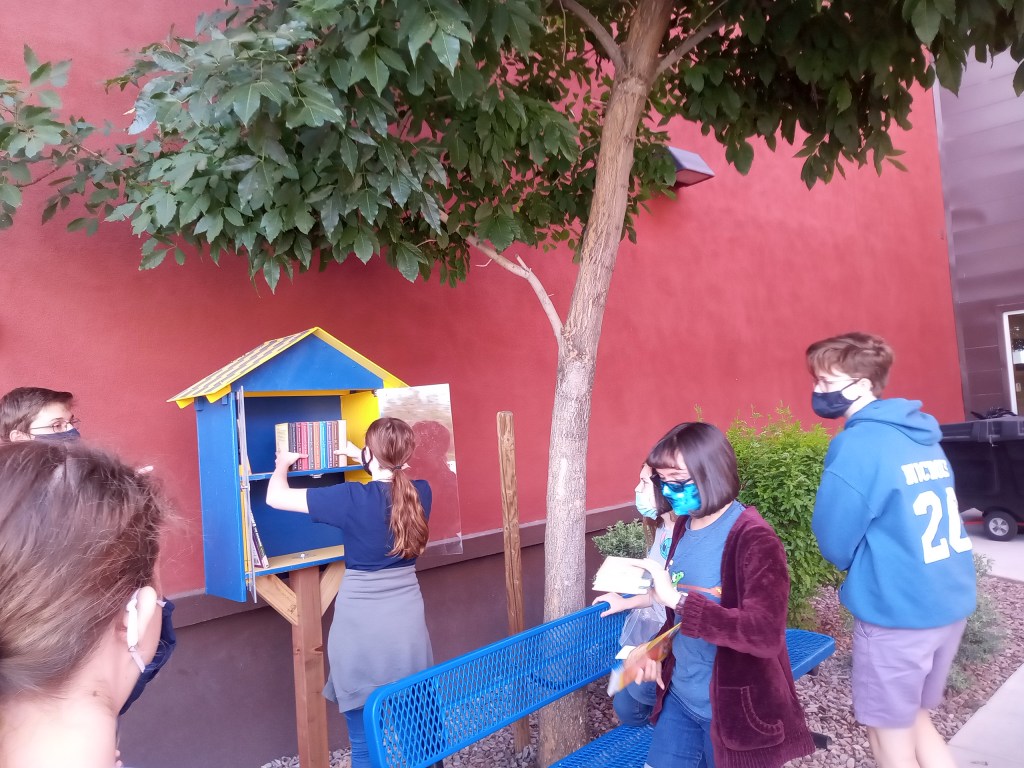
You never know what the unintended consequences might be when you begin a ‘Little Free Library.’ A library in school is not as frequented as, say, the gym or football field. Even a vending machine gets more traffic than a bookshelf. That’s reality.
But hold on – there is a surprise outcome to this story.
After we installed our first Little Free Library unit in 2019 I sensed a slight uptick in reading. Though my classroom is a computer lab, we discuss literature; reading is a given. Books have not been replaced by technology. My shelves are stacked with copies of WIRED, and The New Yorker. (One book on my shelf, “Eats, Shoots and Leaves“ helps start a discussion on good grammar and punctuation. Then there’s no escaping Orwell’s ‘1984‘ when discussing privacy or surveillance. But I digress.)
Today, we launched the outdoor ‘Little Free Library’ with two of my former students who kicked off the project, invited to install the name plate of the library’s Charter number – It’s 111423. Meaning ours is now on the library network map – as you will see here.
The Writer’s Club was on hand. This new club will act as its custodians. It’s another example of the explosion of interest in reading and writing, despite an annus horribilis we went through, which made school so complicated. They kicked off the club in January and they’re already writing and sharing fiction. These kids are now reading like crazy!
The US continues to call the country Burma, even while the Associated Press uses the name Myanmar. Why the hesitance? One theory is that the name change from Burma was a change of the nameplate so-to-speak; a linguistic sleight of hand since internally it means the same thing. The other is that it’s inconvenient to acknowledge the name that was changed by a group that isn’t playing by the rules.
“The United States supports a peaceful, prosperous, and democratic Burma that respects the human rights of all its people. Burma remains a country in transition to democracy….”
“The Burmese military regime has ignored the will of the people of Burma to restore the country’s path toward democracy and has continued to commit lethal attacks against protesters in addition to random attacks on bystanders.”
OK, so extra points for using ‘lethal attacks,’ and ‘will of the people’ when referring to the country by its previous name.
What’s in a name? We don’t refer to “New Holland” when we talk of Australia, or even Bombay these days because Mumbai is the more accurate. Imagine if the United Kingdom refused use the word Mumbai, because the Shiv Sena party, in 1995 changed the name as a thumb in the eye to colonialism.
The US policy on Myanmar is so convoluted that it is no wonder the rest of the world thinks our geography sucks. And this is not new. Hillary Clinton, as secretary of State practically refused to say ‘Burma’ calling the country by other dodgy nouns. Here’s the latest doublespeak from the new White House as quoted on VOA:
“Our official policy is that we say ‘Burma’ but use ‘Myanmar’ as a courtesy in certain communications,” Jen Psaki, the White House spokesperson, said when asked to address the issue during a press conference this week.”
Meaning they apparently like to be courteous, and politically correct while being out of step with reality. So she goes on:
“So, for example, the embassy website refers to Burma — Myanmar because they are by definition dealing with officials and the public. The State Department website uses ‘Burma (Myanmar)’ in some places and ‘Burma’ in others.”
Oh, I get it. Using curly brackets and an m-dash really clarifies matters.
Photo: Nazly Ahmed
While you’re doing that Ms. Psaki, why not rename Sri Lanka as “Ceylon-Sri Lanka” on your official site (this will make the CEYLON Tourist Board thrilled; the CEYLON Tea exporters might do a high-five outside your embassy in Colombo.) You could even call the country “Sri Lanka (Ceylon)-(Serendib)” in other places because it makes the hoi polloi feel like you know your history.
With ZoomH4N recorder that came in this week, we officially began the class podcast.
In reality, we started experimenting with recordings last week with a cheapo mic that I had for the past 10 years. We recorded directly to AnchorFM, and also on my laptop, to Hindenburg.
Recording a podcast at the computer lab
But the ZoomH4N simplifies matters. Slightly bulkier than a T1 calculator, its sleek black form factor has a no-nonsense appeal (some say it looks a bit like a Taser). The pickup from X/Y mics is so good, the interviews my students have conducted, have come off great. In a few days their individual podcasts, submitted as assignments to Google Classroom, will be uploaded to Medium, the publishing platform.
But before that, here’s the introduction to the Podcast series that will incorporate student voices alongside those of my colleagues at Benjamin Franklin High School.
When he’s not teaching Latin, Greg Davis is an agile outfielder at a AZMSBL, an Arizona league. He has a way of making students forget they are learning a language no one speaks.In this podcast I pick his brains on why Latin still survives as a subject in schools, and its connection with classical academies — something that goes back nearly five hundred years. Hosted on Acast. See acast.com/privacy for more information.
As Digital Learning Day came around in February I wondered if the distinction between digital and non-digital even exists.
I am old enough to remember when we actually celebrated an annual event called E-Day here in Phoenix, as part of the IABC. In the early 2000s, Business Communication then was pretty much analog, with smatterings of digital. Soon E-Day became passé.
Just seven years ago –a long time in Internet years! -at Salt River Elementary School, STEM had pushed its way through the door. Ed-Tech was a buzzword, as was digital learning. In my computer lab I was introducing students to Mars exploration, Robotics, VR and 3D Printing. With tremendous support from my colleagues at Salt River Elementary, Mrs. Decker, Mrs. Yurek, and Mr. Filhart –from Music, the Library and PE respectively – we created an entire day for this across K-6.
Today, digital learning encompasses almost every facet of what we do, whether it is in libraries or the gym. Online school has made the digital device a necessity, when it once was a nice-to-have. Platforms evolve, from Quizlet to Khan Academy; Grammarly to Google Classroom; Mindstorms to Scratch and so much more. Students now create podcasts with a simple free AnchorFM app on a phone – intros, outros and all. Screencast-O-matic has taken the pain out of video-supported lessons for teachers like me, furiously posting them to Google Classroom.
The VR glasses of yesterday are gathering dust on my shelf at Benjamin Franklin High school as the pace accelerates. Will Digital Learning Day become an archive of education too?
Podcast listening is rising sharply though many people still find podcasts hard to fathom. On the one hand podcasts’ ‘long form’ story structure doesn’t fit into some people’s social media consumption habit filled with memes and GIFs. Or, they tend to be dismissed as too mundane, given how many ‘vlogs’ (video blogs) bubble over with rants and risqué material guaranteed to harvest clicks. There is, however, a wide chasm between these two. Plenty of gaps being filled by experimental podcasts. Atlantic magazine has ‘The Experiment’ to do a deep dive into the culture and politics. Slate, in 2016 began what it called a ‘rolling podcast’ style of delivering fresh content around the elections, as did the New York Times’ podcast ‘The Daily.’ While these niches await proper nomenclature many podcasts have mined the gaps that the media were once reluctant to invest in.
My hypothesis is that podcasts are lighting a fire under the media, giving rise to a new journalism. The climate couldn’t more right for it, with people cloistered in make-shift home offices, or tired of the formulaic story arc on the evening news. There’s also the smart-speaker set, who can listen to something different while making coffee, or doing laundry.
The term ‘New Journalism’ isn’t a new label. It was used in the Nineteen sixties and seventies when journalism was invigorated by fiction writing techniques.
What differentiates this kind of journalism is that in a podcast, the journalist-as-host brings in a sense of immediacy not possible in print media. The journalist tiptoes in and out of the story to connect the dots.
In December 2019, the Pulitzer Board announced a new category for audio reporting – basically podcasts. It called this an experimental move in recognition of a “renaissance of audio journalism” that opened up “non-fiction storytelling.” I’ve been listening to The Daily for about a year now, alongside This American Life,On the Media andThis Week in Tech. So I was delighted when This American Life, hosted by Ira Glass won the first Pulitzer. This long-running show may have been the spark for many podcasts today.
Even as the pandemic closed many, many doors, podcasting strolled in through the side entrance, let out the stale air of traditional media, and is causing a renaissance in storytelling. Here’s to audio journalism!
So, I’ve been trying to keep up with the words that I run into or overhear, and find it amusing how quickly they appear. It’s been five months since I weighed in on these janky expressions. Someone once told me he accidentally butt-dialed me, and it made sense. But Facepalming took a few more seconds to figure out.
Words like hangry have simply gone to pasture. There seems to be no substitute for unmute. To weaponize is still being hogged by the media, especially the pundits who sit across a table and make awesomesauce statements about those who are not about to cancel their pet political project.
I’ve been curating front pages of the New York Times over the past few months, as a record of how how we are dealing with unfolding events during the pandemic. Some images are so grim that they could have been plucked from a newspaper in another country.
Take this one, for instance. Homeless shelter? Activists? People destroying incriminating evidence? Sadly it’s how people in one of the wealthiest states in the US are keeping warm, after the winter storm crippled its power grid, disrupted its water supply. This is in San Antonio, Texas. Boiling snow for drinking water became the norm.
Then there was this on the same day the winter storm hit – Perseverance of another kind, on a planet 30-plus million miles away. The Mars rover, named Perseverance, landed in the afternoon, Arizona Time. Even the search engine couldn’t resist a bit of exuberance as the page loaded. (that’s a screenshot of my Google search engine results for ‘Mars Rover.’)
COVID has laid bare our split-screen lives. Bitcoin made waves this week, but at the same time economists think the number of unemployed exceeds 10 million in the US. Those hunkering down, and those lifting themselves up are living side by side. The disgruntled and suspicious, and the hopeful move on. Those facing unbearable tragedy, sitting next to those who are building new lives.
Sometimes a lesson plan needs to be revised on the fly. This happened today when one of my students brought in a green screen, so they could do trial runs of their TV news scripts in a Writing & Publishing class. I had planned to use a camera on a tripod and have them simulate a studio setting. I happen to have a 60-inch screen on the opposite wall, so with a bit of tweaking, it could be made to look like a backdrop of a scene for a ‘reporter’ to deliver his/her lines.
And then this happened.
Computer lab at Benjamin Franklin High School
As quickly as it was set up, we dismantled it. But I think it gave students a real world context of what they are actually working on – a story, that is not just an academic exercise but with an audience in mind.
I have to say this is a learning experience for me. [What’s that saying, “He who teaches, learns twice?”] I grew up using what we called a ‘blue screen’ as a chroma-key technique. I practiced this during a training stint in Coventry. My fellow student and I sent up this huge camera that weighed about as much as a microwave, at Coventry cathedral – the bombed out remains from the 1940 German air raids. We then took the ‘film’ to the studio and produced a news show. Now, some 33 years later all it takes is a pop-up screen, and a $300 camera slightly larger than a computer mouse.
This week I’m teaching myself to edit the footage on DaVinci Resolve. It’s not part of the lesson plan, for sure! But who knows. These things are not writ in stone. My elective class that I teach at 6:30 am each week day could evolve. I tell my students this is what a computer and tech lab should be – a place to experiment, to take things apart, and be ready for new ideas that pop-up. It’s one year since COVID made us discover new ways of teaching. It’s a lot of work, but it’s invigorating! Notice how everyone’s wearing a mask. No one’s complaining.
My students are wired. Just like many in their generation, they enjoy reliable Wifi, Bluetooth devices, and of course cell phones. [Now in school, their cell phones are firmly in the off position, in their backpacks. They have no problem with that.] They’re Spotify users, YouTube watchers, dabbling in Discord. Their ticker-tape like TikTok-conversations are no different from other kids their age in any country.
And yet, when asked, they are not exactly impressed with the Internet. In fact some of them are its biggest critics.
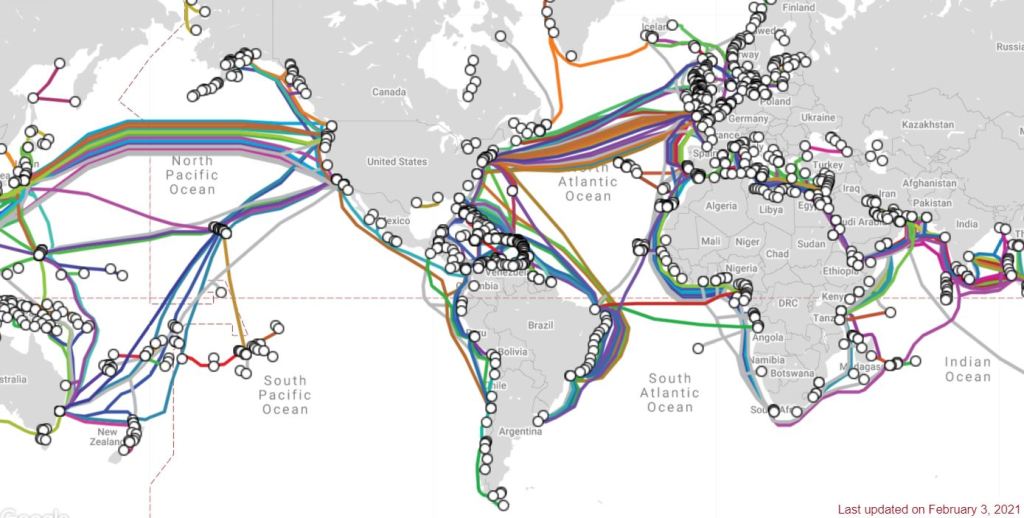
In class this week, they’re learning about the architecture of the Net – from undersea cables to network hubs, to old phone lines and the upcoming constellation of fancy satellites; about the impossible to comprehend system of ‘packet switching‘ and the explosion of networking – social, antisocial and otherwise. They’re stunned that no single person really owns the Internet, and that this space (or place) that was cobbled together in the same year as men walked on the moon, still works 50-plus years later.
But when asked “Does the Internet Unite us or Divide us?” the responses come fast and furious. More lean on the side of the discord (no pun intended), and social upheaval they have seen. Some even went so far as to say that it’s a ‘wasteland‘ and how it is “littered with inappropriate things.” One said it is a place where people “bleed emotionally” with gossip and hate. Many others talked of how it is dividing families, and one talked of how awkward it is to meet people his age to only see them all stare at their phones when he sorely needed to meet and hang out.
It’s almost too sad to process. I’m sure you used to think that this was a grown-up person’s view of young people obsessed with social media, or Candy Crush. I can tell you, reporting from the trenches of a high school, that this is now a young person’s world view. The Internet we adults have laid out for them is traumatic and disappointing.
I will be introducing my classes to Tim Berners-Lee later this week. A great segue after talking of the birth of the Internet. But it is also serendipitous timing. A story just out this week about the ‘inventor’ of the Web who two years ago expressed his also disappointed at what has transpired, has new architecture to hopefully fix it. It’s worth a discussion as to how Inrupt, as his idea is called, will do that.
Tim Berners-Lee is just 65. He made no profit on the Web by deliberately not patenting his software idea. Those who have – Google, Facebook, Microsoft, Apple etc – have polluted the waters with algorithms that float around like weeds, trapping our data that gets instantly sold.
I tell my students that by the time they get to 11th or 12th grade, there just might be a new Web. I want them to be optimistic, and even be part of that movement to make the Internet a more habitable space. Perhaps they would lay a new ethical architecture that’s more resilient than the cables beneath them.