Stuntman in New York targets journalists, us

The stunt by a French daredevil tells us something about how far someone would go to ‘create awareness’ and target the media. Forty-five stories to tell his story.

Alain Roberts climbed the brand new New York Times building right to the top. No harness, no ropes. Just a banner in his hand which he hung out with his message –and a web address — about global warning.

What does it tell us about sending a message? Guerrilla marketing is quite tame compared to ‘culture jammers’ like Mr. Roberts and street artists like Bansky. They have figured out that it doesn’t require a grand media buy to take the message public. Banski’s ‘art’ (left) is stark, much cheaper than a billboard, and always packs a good story.

In Roberts’ case, he was literally taking the message to The New York Times which of course, carried the story. And a video clip. How could they resist? The story was right outside their window! They updated the story online too as a second man attempted to climb the building.

The banner, and the risky act of disobedience was for the audience outside. Two audiences. One guy and a banner. A funky web site. Lots of stories.

How far do you go to tell your story?

Grade your Press Release – if you have the stomach for it

There’s a neat web service for checking to see if your Press Release is full of #!*! or if it carries standard elements such as contact numbers, URL’s and keywords that match up with links.

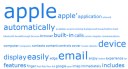
Word Cloud based on iPhone's Press Release in 2007It’s called Press Release Grader. A cut-and-paste site that grades your release instantly.

What I liked most about it was the visual rendering of a Word Cloud, which displays words larger if they are used more often etc. It also points to gobbledygook words –there were 7.

Since Apple’s iPhone 2.0 is all the rage this month, I used one of the first iPhone releases from January 2007 about ‘reinventing the phone.’ It got a grading of 44 out of 100, and had the readability level for a 3-year undergraduate.

You can see the report here.

I don’t think the value of this is to score high, or to gloat, but to get you to understand what you could be missing, or overdoing. What constitutes a perfect press release? No human or piece of software could tell you that. There are guidelines and must-haves that a ‘Grader’ like this will help you remember to use. But as my friend and author Linda VandeVrede reminds us, a press release should serve the one audience it is targeting: the media.

Quotes for the week ending 21 June, 2008

“It’s a push back from the sound-bite culture.”

Lee Rainie, director of the Pew group, on recent findings that 30% of Americans use the web to get more of the story that the media slice up.

“We have a steady, relentless snack-food diet of facts and ‘news briefs’ driven by the mistaken perception that fast is best and better in an RSS alert-enabled world. Unfortunately, with news happenings in constant motion, we never “have time” to “go back” and provide a deeper look for our news consumers.”

Linda Zimmer, on the blog Business Communicators in Second Life.

“A radical suggestion for the Social Media Release: don’t put any Social Media Releases out over the wires.”

Todd Defren, recommending people publish a regular press release on the wires, with a link in it to the Social Media version.

“They’ll get half of it right. We’ll push them to getting all of it right.”

Michael Tippett, co-founder of Now Public, on how bloggers are being trained in Journalism by the Society of Professional Journalists.

“The reality is that they’re tiptoeing in the gray zone between open and traditional media.”

Andrew Keen, commenting on Encyclopedia’s move to expand it’s ‘community of experts.’

“Nope. No fine print here my dear sirs and madams. HONEST. Everything that’s currently free is still free.”

Mike Curtis, on Jing’s blog, about the relationship -and business model– of Screencast and Jing by parent company Techsmith

“it’s a big red flag that the AP is now waving in the blogosphere.”

Neville Hobson, on the Associate Press’ pay-as-you-quote system

Social media minus geek-speak and PowerPoint

I head to the IABC International conference in New York that starts next week. Two things I can expect: To meet a lot of folk interested in social media, and to see see a lot of PowerPoint slides 🙂

But what has left an indelible mark on me is a series of videos created by Lee and Sachi LeFever and his wife at CommonCraft. This one, particularly on social media in plain English.

If you’re interested, CommonCraft says they offer licensed versions to ‘educators and influencers.’

As someone who writes about this stuff, attempting to demystify technology and clear the fog that hovers over technology, I think this work is pure genius.

Device Independent Media is coming

These three words may not mean much today, so save it for later in your brain.

What it means is that a content provider –even your company– could produce media content that is smart enough to know what platform is being used to access that content, and then configuring the story/video/slides etc on the fly to make the experience relevant. It is not simply about resizing the content to fit the screen, but editing the story for your device.

Think about it. If you’re reading a story on Myanmar on your iPhone or via ‘smart goggles‘ you have less tolerance for detail, and may want more images and a high level description that loads fast.

When you access the same story on your laptop, you may have time and screen real estate for larger graphics, more context, maps, and other detail.

And should you be browsing on your 60-inch High def TV, you may appreciate longer length video pieces because your battery life or your broadband signal isn’t something to worry about.

The New York Times is looking into this, as Mike Zimbalist explains, here.

Bloggers and journalists embrace professional motion blur

Another major blur is taking place, as we hear more and more about bloggers and journalists walking in each others’ shoes. We are all passing through what I could best describe as a constant Professional Motion Blur: Marketing and Communication, PR and Advertising, Blogging and Media Relations, Digital Printing and Direct Marketing, Search and Marketing, Journalism and Blogging.

This story and this captures what’s happening as bloggers get to learn the rules of journalism, while ironically journalists are learning to play by the ‘rules’ of the blogosphere, and even learn to use Twitter. The Society of Professional Journalists is conducting a series of seminars in Chicago, Greensboro, and Los Angeles.

Are we muddying the professions? Some will say it’s the death of expertise. I just think we cannot afford to operate in our silos anymore. Faced with our multi-media, highly connected, multi-cultural audiences, we have no other option but to embrace the blur.

Taking risks with popcorn popping cellphone video

“Why would the internet lie?” says someone at the end of a failed attempt to ‘test’ if cellphones could produce enough energy to pop corn kernels.

They were responding to the hilarious video on YouTube that has all the hallmarks of being authentic –poor resolution, shaky camera. The unspoken hypothesis: cell phones could have the same effect as a microwave. And you hold it close to your head?

Not just hilarious, but a wicked -un-marketing speak for strategic- way to send a message without actually issuing a press release that cell phones may fry your brain. Not just wicked, but viral.

Some feel cheated. Some suggest it is sneaky “murketing.” Whaddya expect? This was on YouTube, not the Discovery Channel! “We knew they were fake, the only mysteries were the “how?” and the “why?”” said WIRED’s Charlie Sorrell -who later confirmed that the folks behind the fake popcorn were from By Cardo Systems, maker of bluetooth headsets for motorcycle riders.

So what does this tell us about marketing?

1. Viral marketing doesn’t follow the rules. Does the fact that it is a hoax (disproving the preposterous idea that cell phones are lethal microwaves) take away from the need for Cardo’s products? In the old brand world, the answer would have been yes, so please kill the idea. In a few days, by ignoring these rules Cardo will have the kind of word of mouth advertising many brands would die for.

2. Viral marketing takes risks. Cardo probably knew enough about comparisons that have been made between a bluetooth frequency and cell phones frequency -both operate on the same range as microwave ovens. Bluetooth is just a weaker transmitter.

3. Viral marketing energizes others. People were very anxious to debunk it, but had to upload their videos about it! To borrow a point Charlene Li and Josh Bernoff advocate in their book, Groundswell, the new rules mean you need to ‘energize the groundswell.’

Quotes for the week ending 14 June, 2008

“Today, it has become an economic, environmental and brand liability for the company.”

Advertising Age’s jean Halliday, commenting on Hummer, and GM’s CEO Rick Wagoner suggesting the company may dump the brand.

“Scott McClellan is having a ‘Matrix’ moment.”

Mark Dery, who teaches journalism at NYU, on former White House press secretary’s book, and waking up for the dream made up of a media fiction.

“Prime time is still the right time.”

WIRED article on why broadcast ad sales are strong, in spite of the economic slump and other woes.

“Hi. My name is Steve and I suffer from Shiny Object Syndrome (SOS for short).”

Steve Rubel, on how to sift through shiny objects in social media sites such as FriendFeed, that he is bullish about.

This is more than a facelift.”

Facebook spokesperson, about the new, improved Facebook with added vitamins 🙂

“Britannica goes wiki without actually admitting it.”

One of the many (in my opinion mistaken) responses to the news of Encyclopedia Britannica shifting gears into a more collaborative model.

“One of the premier political journalists and analysts of his time.”

Tom Brokaw on NBC’s Tim Russert who died of a heart attack.