So many (scientific) ways to use a GoPro!

If you saw The Martian, you couldn’t miss the GoPro cameras strategically placed where Mark Watney (Matt Damon) hast to talk to other humans who were mostly absent.

It’s not exactly a webcam, but a powerful tool to ‘journal’ an activity a whether it is extreme sport, or something technical. I’ve started off using a GoPro in robotics, and it was quite revealing how the camera sees a manoeuvre.  I am now considering a class about the camera itself.

For this there will be two three cameras at work, in fact. The first, will be a webcam because of the expert I am going to bring in, via Skype. He will demo a GoPro and ‘teach’ us how to turn a GoPro into a scientific inquiry tool.WE will be using one in class as well.

The GoPro on Mars didn’t seem contrived – or a blatant product placement —  since some have actually been used in Space before. In real space, that is, and not on a movie set. And it has also gone to on some breathtaking missions — in a balloon, for instance.

Here’s one of my favorites. What a great way to demonstrate the surface tension of water, by making the camera a part of the experiment, while acting as a journaling device!


The GoPro is obviously switched on, and what’s really smart is how the editor of this video reverses the perspective. We finally see the scientists (the astronauts) through the scientific object (a submerged camera), and the water bubble acts as another distortion lens!

For Robotics this year we’re re-imagining ‘Trash’

We just kicked off our new Robotics season in my school –my 5th year as coach!

With 26 students signing up, that’s more than twice the number of applications from last year. It’s a ‘good problem’ to have, to see kids become so excited about doing the hard stuff – the building, programming, doing the requisite research, and finally running those complicated missions.

On first glance, this year’s theme, Trash Trek,‘ is much less abstract than last year’s ‘World Class’ (around global education). Lots of big ideas to get our minds around the three R’s that could become a cliche unless we re-interpret RE-ducing, RE-using and RE-cycling . For instance, how about RE-imagining:

  • How far does the trash that gets into our bins has to travel? Could we calculate this (the ‘M’ in STEM) and display it somewhere? Perhaps in our communities — as some sort of a dashboard? If so, who would build the app? What would that display look like?
  • Who decides on the packaging that gets into the products we buy? How much cost will it save if we RE-fuse to ‘pay’ for this (with our landfills?)
  • Could our trash bins earn us money – a la Recyclebank?

I’m talking to all kinds of people – entrepreneurs, engineers,, designers etc who could come in and inspire my students. If you know someone, please call me, email me or send me a tweet at @heyangelo.

Some examples we might use for inspiration this week.


When science works, machines break, and coffee cups burn

In teaching technology we like to say that it’s OK mess up the first time. This is counter to how we like things to run smoothly – neat transitions, good closures etc. A formula, in other words. Even when doing a demo, you probably want your audience to see the end result.

earthquake-simulatorBut I’ve realized that in many lessons – life lessons, not class lessons– the worst thing you could do is to have something perform flawlessly.

Take this ‘Earthquake ‘simulator’ we built here. The plan was to simulate tectonic plate movement that brings down buildings. This was for our STEM Night, which happened on 21st April. A rickety contraption that would shake-rattle-and-roll using a power drill. We quickly ran into a few issues. The wheel you see here was cracking.With two hours to go to the ‘earthquake challenge’ we implemented Plan D – Duct tape. Which looked messy, but it worked. In a sense, I loved that uncertainty; an opportunity to tell students that this ‘problem-solving’ stuff we go on about, is real, even for us.

The next day, FOX 10 News showed up. More issues, with the weather guy and a camera pointing at our ‘machine’.

  • Problem #1: The drill that drove the wheel, had been taken home!
  • Problem #2: Reporter Cory McClousky wanted to repeat the ‘quake’ and of course, it failed. On camera. Nice!
  • Unrelated issue. Behind the earthquake simulator was the solar oven we used the previous day. I had left my coffee cup inside while we were waiting. A solar oven, in case you haven’t heard can reach up to 250 degrees in 30 minutes. So does the plastic cap, as you can see here, which warped out of shape.

You cannot plan these things. What looks bad, actually informs the story. McClusky’s parting line about the solar oven was: “We’re burning coffee cups in here…” Indeed. You can’t touch this.
STEM Night 2nd Red Camera (12) Solar baking After

FOX 10 News | fox10phoenix.com

 Cory Goes Back to School

Messy Learning Labs. Just what our screen-obsessed kids need

If you’ve ever complained about classrooms being stuck in the industrial age, here’s a glimpse of a different kind of class. It’s Hi-Tech space with a factory-floor setting. Perfect for digital natives, huh?

heatsynclabs_tnI took my robotics students here last Tuesday, to a place called HeatSync Labs in Mesa, Arizona. Not the kind of ‘lab’ they had in mind – but in a shocking way! It is what’s known as aMaker Space’ where kids come to ‘learn by doing’. They didn’t want to leave!

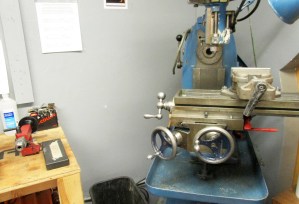
You see, a Maker Space like this is more like a mad scientist’s garage, than a classroom, with a variety of machines, tools and material just begging to be used. If you recall how HP began in a humble garage, you’ll see why a tinkerer’s tool-shed like this is what classrooms ought to be like if we are to motivate the next generation of inventors, astronomers and mad scientists like Bill Hewlett, Dave Packard. Or the next Thomas Edison (who barely went to school, please note).

Having worked with 6-12 year olds for four years now, I know how hungry they are for science. Especially science that comes to them in unexpected packages. OK, so in one corner of the lab there was a 3-D printer, an artifact from our all-too-digital present. But someone had used it to produce intriguing pieces such as this plastic cube (right), with gears!

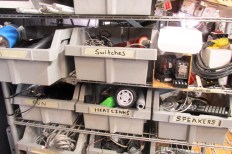
In 75 minutes my students probably got more about science that any slick PowerPoint presentation. This was about experimenting, making mistakes, and asking ‘what-if’ questions. This was about rummaging through bins, and peering through scopes, working with laser-cut stamps they mounted on blocks of wood. And not a tablet in site!

Shelves

Machine


At one point, Eric Ose who works there took me aside and told me, awkwardly, “I am not used to young people here asking permission to do things.” Meaning, this was a space that people came and just tried things out, used material lying around, and worked on their own pace. Of course there are guidelines – especially safety guidelines, as when watching laser cutting, or operating the 3-D printer.

But the real house rules are this: Try something out. Make things. Break things. Revise. Start from scratch. Discover. Build something impossible!

Note: If your students have never been to one I urge you to make it your next field trip. Many cities have these community run spaces. (Map)

HeatSync

Great reporters don’t wither (when temperature rises)

I’m not talking of reporters coming under fire on dangerous missions. I’m talking about keeping up the communication when all hell breaks loose in front of you, and you’re on camera.

Take a look at how Phoenix-based Fox 10 News reporter Cory McCloskey handled an arguably hot situation. Cory is a weather reporter on the field. Apparently, in this instance in-studio, the weather map went berserk. The data on the map I mean. I won’t give it away – watch!

By chance I met Cory last week, when he came to my school to do a live weather report, and yes, the man has a great sense of humor. (It involves coffee and solar energy, if you’re interested.)

The above video clip (viewed more than 4 million times as of today) is the stuff that ought to be used in Journalism school. I’m sure my friends in Ahwatukee might not laugh so hard, because we folk in the Chandler area were not subject to his satire.

Mr. McCloskey: I wish there was a sub-category in the Pulitzers (under ‘Explanatory Reporting’ maybe?) that is awarded for humor, and not missing a beat.

Skype with a rocket scientist – Today’s STEM Talk at Salt River Elementary

It’s funny how an ‘old’ technology comes to the rescue, even in education that’s all about Ed-Tech.

I’ve used Ustream, am experimenting with Stre.am, one of the newest shiny objects for collaboration and live-streaming. WebEx is not feasible for legal reasons, which is why Skype has come to the rescue. Skype – that grandaddy of web conferencing tools– is old in Internet years! Released in 2003, it came in a different era from our one-click chat apps that are morphing into lean, mobile must-haves. It’s still a trusty, if not crusty application.

Anyway, for this ongoing series of STEM Talks, I am pleased to be able to connect my school with an eminent NASA scientist, Dr. Ashwin Vasavada. He is the lead scientist on NASA’s Curiosity Rover mission, and comes to us via the Jet Propulsion Lab in Pasadena, California. For those of us with one-planet experience, know this: Ashwin participated in Galileo mission to Jupiter, and Cassini mission to Saturn.

My students have some background to Curiosity, because of robotics, and some have seen the full-scale model of this Humvee-sized robot at ASU. I’ll be curious (I know, bad pun!) to see how they engage with him.

Place: Computer & Technology Lab

Time
: 4:00 pm

Light refreshments will be served.

Check out previous STEM Talks here, and here.

Is It True? Or Is It Photoshop? Students Tweak TIME Cover

For my Photoshop class last week I tried to bring home to my 6th graders the importance of scrutinizing the media they consume – whether it is a billboard, a news photo in a newspaper, an album cover, celebrity photos, a food label etc.

Time-Magazine-Scott-Kelly-CoverThis is the exercise: Could you put a teacher’s face on the cover of TIME? This recent cover is of one of the twin astronauts, Scott Kelly, (whose brother, Mark is married to former Arizona congresswoman, Gabby Giffords) will be part of a one-year NASA study which I am following.
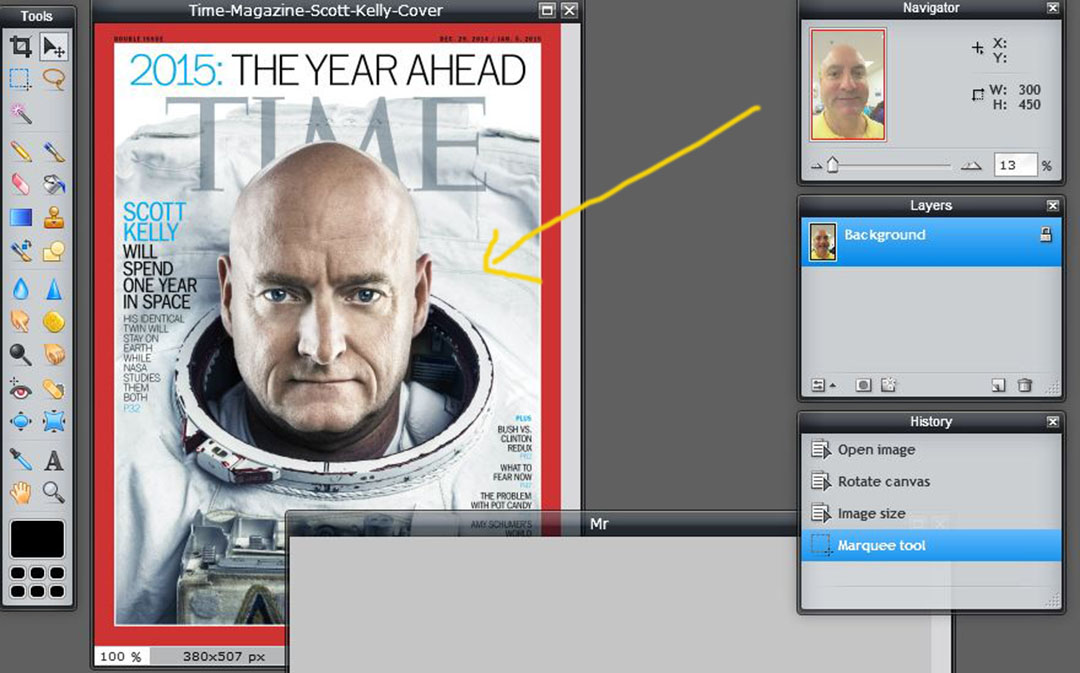
The local connection and space angle  makes it a fascinating topic that will stay relevant until this time next year. The teacher in question is very supportive of this.


This week too, the 6th graders continue to work on their covers. For more details, and to track their progress, check in here…

TruthorPhotoshop

My school profiled on US Dept. of Interior website

When Sec. Sally Jewell visited our school last week, little did we know how it would figure in the grander scheme of things. It was much more than a simple ‘air drop’ of a dignitary.

Turned out it was to kick off something bigger – a Listening Tour, of Native youth.

Yesterday we noticed that apart from the previous media coverage of this visit, the folks managing the communication for Secretary Jewell’s department had featured a lot of great shots of her engaging with our students. Two of the students featured are potential podcasters in my class on audio. Three are in robotics.

Here’s the video:

And below are some of my pictures taken at the event – also covered here on this blog.

This, taken in my class. Student Council president and robotics student explains how they approach a mission, program and document their work.

More pictures from my class blog, here

We often complain that government is tone deaf to much of what goes on in our communities.Speaking to Sec. Jewell, I could tell that this was much more than a token visit so as to report to the boss she’s been on the road.

We spoke of science. A lot! I mentioned that in the midst of so many changes in education, government seems to be not doing enough to promote science and technology.I mentioned that the State of the Union this year barely touched on STEM, despite Obama’s otherwise talking the talk on why we need more investment and more STEM teachers in science in schools. She was a good listener.

Visit by US Secretary of Interior to my class

Exciting morning yesterday with the visit of Secretary of Interior, Sally Jewell to our school.

Sec. Jewell was kicking off to the Obama administration’s ‘Listening Tour’ in Arizona, visiting Native American schools and communities. She devoted a good part of her talk to stress the importance of science, in the four STEM areas. “I am the ‘E’ in STEM,” she said.

As part of her tour she stopped by my class to hear about the robotics program.

One of my students in robotics, who happens to be the president of the student council, explained our program and research projects.

Some media coverage, below.


Cronkite News, ASU

KJZZ Story – Interior Secretary Sally Jewell Begins Native Youth Listening

Podcasting is hot stuff. Again!

There seems to be a growth spurt for podcasting.

I love the fact that the audio format has been on the upswing, even despite the explosion of screen-based communication options. Depending on who you ask, they will tell you video didn’t assassinate the radio star for various reasons. Such as

  • Podcasts is immensely portable, and does is perfect for multi-tasking
  • Podcasts capture the ‘authentic’ voice of the person or the moment being represented – no fake ‘DJ voice’ required
  • Podcasts have in their DNA something akin to long-form journalism – deep dives into content, rather than skimming a topic

  • Podcasts lend themselves to drama, even while being authentic. The nearest thing to the documentary.

My recent favorites are Snap Judgement, Serial, Invisibilia (former radio Lab producers), and Star Talk.

Apart from the usual line up of This American Life, For Immediate Release, and EdReach, an education podcast for Ed-tech matters I now dabble in.


Interestingly this year will be six years since I first got into podcasting. And this year may be the year we begin podcasts at my school. More on this in a later post!