Back To Work and… Chat Republic

It’s been quite summer. Just returned from a one-week break, headlong into school.

While this blog’s been quiet, so much has transpired – controversies, new questions arising about what happens when citizens ‘speak out’ or question governments, and the (expected) paranoia about Chat Apps.

Just came across this post by Groundviews, about my book. It serves as a good backgrounder to some of the topics discussed in Chat Republic.

For those of you who have sent me Q&As about the book, my sincere apologies. Meanwhile there’s a lot happening in eduction that’s equally fascinating, as my school, and my class, specifically gets into a S-T-E-M eduation program this year. You can find out more about my work in this realm at Voices-On.com

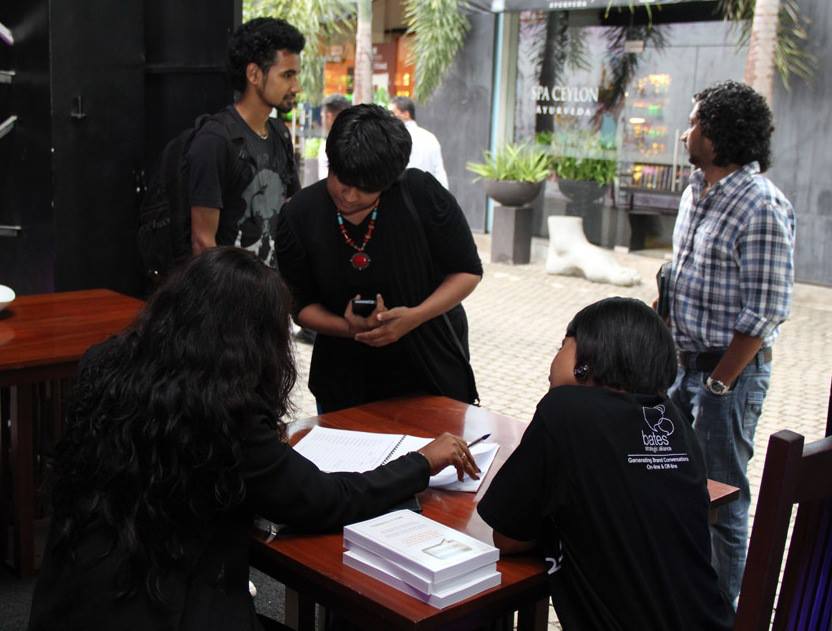
Thanks for supporting the ‘Book Launch’ in Colombo

Just got back, after what seems like a whirlwind book launch.

ParkStreetMews_5I’ve had to use the quote marks around ‘book launch’ because it was not originally planned that way. A series of events, coordinated by some of my friends at the last moment was beyond my expectations.

Those who made this happen included:

ParkStreetMews_3

While I got to talk of some of the most timely topics covered in the book — Transparency, for instance– I got to meet some very smart people changing the game of marketing, media and communications.

Social Media, which has been on the back burner for many in Sri Lanka (some say it still is, but that’s a debatable point) is being embedded in so many places it was hard to keep up. More on this in a post, later.

If you are interested, check for video clips at ChatRepublic.net, and #ChatRepublic hashtag on Twitter.

Microphones or Hash Tags?

Last evening, at the Sri Lanka Institute of Marketing event for Chat Republic, we tried to get the audience to chime in.

Some of the areas covered by the panel, which included representatives from a Leading Ad Agency, a Telco, a Research company, a Digital Media company and a Multi-Media publisher were topics that were outside the comfort zone of marketers. We did have some good questions, especially from someone who represented a startup digital shop, and those that came via Twitter.

But it makes me wonder about what compels someone in the audience to not pick up a microphone and ask a question, but instead do it in 140 characters. There is no right answer. It could be that for Gen Y, a hash tag is a more ‘authentic’ way to ask a question, since it is also in a public space. (We requested the use of the hash tag #ChatRepublic). Or are mics, sort of passe? Too much a left over from old media?

I tried to make my keynote less of a lecture and more as a conversation. In fact, on impulse –believe me, it wasn’t planned — I decided to step down from the stage as I tried to make the point of how social media, just like in education today, is all about getting off our soap boxes: Getting the sage off the stage.

In the end, I would have liked more tough questions. I am sure the panel would have liked to hear contrarian view points. The most contrarian one actually came from the least expected source – the moderator, Nimal Gunewardena.

Unrehearsed Conversations, often most poignant

I just got off a Google Hangout with a group of dynamic new media folk, who interviewed me about Chat Republic.

It’s odd, and so appropriate to have these well moderated chats about a book that makes a big case for  inviting the unscripted, un-fettered conversations.  We had to pause  whenever we ran into a glitch – technical issue, human error etc — but as the moderator, Adnan, told me at the end, he leaves the glitches and silly mistakes.

I try to respond to the famous questions about ‘over use’ or ‘dangers’ of new media by saying that this thing called social media is not one thing, with a handbook. To expect it to have a set of rules is like expecting there to be a set of rules for how to use the telephone or how to speak to your neighbor.

There’s a good column in the New York Times today on the downside of email, and how in interrupting us all day, it interferes with thinking time. It ends with a line that echoes something I touched on a few days ago, when speaking of Content Curation and TMI.

“And let’s never forget the value of face-to-face, or voice-to-voice, communication. An actual un-rehearsed conversation — requiring sustained attention and spontaneous reactions — may be old-fashioned, but it just might turn up something new.”

Indeed!

In a time when we could bypass human interaction with a messaging device, an app, or a process, let’s not forget that it’s the spontaneity of being ‘social’ that makes it such good ‘media.’

Trademark ‘Violators’ in a Connected Era

If someone were to come up with an Encyclopedia of Lessons Learned it would surely run into volumes. I would love to help edit it!

Shel Holtz and Neville Hobson bring up one more case of how companies get it wrong when trying to protect their brand by trying to silence a fan and calling it “infringement.”  (Check out For Immediate Release podcast. Show # 705)

The case involved Nutella, and a fan who started something called World Nutella Day, created by one Sara Rosso. It reminded me of a case involving the line “Eat More Kale,” that was completely different, in terms of not using a brand, but “infringing” on its tagline. (I understand that advertisersconsider taglines as “intellectual property” even when they are really  sharable markers, not some protected species.)

I interviewed Bo Mueller Moore for a section in my book that talks about “speaking out of turn” and why we do it. The reason these cases resonate with me is because I was the recipient of one of these silly, corporate Cease-and-Desist letters myself, way back in 2000. I know first hand, what it means when a fan-boy (or fan girl, in Rosso’s case) is asked to shut up, or face a battery of lawyers.

You could find more about this, in Chat Republic.

But to get back to the podcast, it features an excellent discussion on why, especially (but not exclusively) in an age of social media, companies should strongly think through what they are really trying to lock down: The brand identity, or the conversations arround it? I didn’t know this, but Shel Holtz, who once worked for Mattel, referred to how the company had tried to sue the band Aqua, for a song called “Barbie Girl” –in 1997.

In 2009, Mattel did an about turn. It sanctioned and released a music video with the song.

A sobering thought for anyone considering firing off a cease-and-desist, today.

Meet the panel –for Chat Republic launch

It’s going to be an interesting round of conversations for the launch of Chat Republic in Colombo in a few weeks. The event, on June 18th, will focus on the power of social media across many disciplines.

The ‘knights,’ as Bates Chairman puts it, will include:

Shehara De Silva – GM, Marketing, Janashakthi Insurance

Virginia Sharma – VP of Marketing, Communications and Corporate Citizenship, IBM India/South Asia.

Dinesh Perera -Head of Digital Business / Creative Director, Bates

Nalaka Gunawardena – Citizen Journalist / LIRNEasia

Lakshaman Bandaranayake — Multi-Platform Publisher / Chairman, Vanguard Management

Shamindra Kulamanage – Magazine Editor

Ajitha Kadirgamar — Journalist, Social Media Specialist

Nimal Gunewardena – Moderator / Chairman & CEO at Bates Strategic Alliance

Here’s how the media has reported it, calling this an ‘interrogation’:

The interviewers will each straddle a different facet of the topic raging from social media’s use in marketing, adoption by ad agencies, vital value in PR, impact on mainstream editorial media, its mobilisation by citizen journalists and monitoring and analytics.

Not sure about a round table being interrogation technique. I’m there to learn as much as I could from these eminent folk. More details of the event, here.

The ‘Transmedia’ appproach to finding your voice

Digital storytelling is an area I have been fascinated by, especially since I started writing about the death of attention (and the rise of chatter).

Transmedia has been advocated by some as one solution to the attention-deficit problem that communicators and brand managers face. I’ve interviewed a few people on some ‘secrets’ of digital storytelling in my book, Chat Republic, but this explanation in a just-published article in Communication World magazine clarifies it even further.

Transmedia storytelling, says Alison Norrington, fragments a narrative, defines hotspots within the story(world) and thereby engages different demographics.The fragmented narrative engages the ‘pull’ method to draw people’s voices around a theme or story –as opposed to the old ‘push’ method that didn’t leave space for the audience to talk back.

Want to read the whole article? Its available free here on the spanking new IABC Digital site for CW.

Brand Voices vs Brand Conversations

It’s easy to confuse the power of voice, when discussing ‘brand voice.’

(Don’t bother Gogling it, as there are some 441 million results, some of it with the predictable talk about signage etc.)

The Voice of the Brand belongs to two groups, depending on whom you speak to:

(a) The people who define the brand, and “know” what it stands for, and articulate it in their channels. This is really what I would call Brand Talk. Sometimes I cynically call it Bland Talk.

(b) The folks to buy it or use it, and talk it up in their own communities, and sometimes on the brand-owned channels. These are, arguably, more authentic Brand Voices. They tell you why people are using the product or paying attention.

But let’s cut through all this and look at brand conversations, to figure out what are the most valuable conversations? These are what social media helps us unearth: those incomplete, poorly phrased sentences, the angst-ridden, or cult-like exchanges in a forum, or comments section. Those self-appointed ambassadors and know-it-alls…

Sadly, brand managers are not always up to snuff on handling the latter; this sort of anarchy; of data-mining conversations; of engaging with those the bosses instinctively want to block or ban those outside voices from the website.

ONE OF THE FEW AD-MEN who bucks the trend and critiques one-way Brand Talk, calls for true brand conversations.

Nimal Gunewardena, CEO of Bates Strategic Alliance, happens to be moderating a round table discussion I will be part of, when I launch my book, Chat Republic, in Sri Lanka in a few weeks.

His screed about Brand Conversations, called for an abandonment of ‘sales talk’ and the 30-second-commercial mindset. It seemed akin to 1st century monks arguing against using calligraphy.

“It’s time to start thinking beyond that 30 second commercial. It’s time to combine the power of TV with the connectivity and engagement power of digital and social media. It’s time to explore new formats. Two-way conversations, rather than one-way broadcasts. It’s time to talk to communities who have common interests.

To which one person commented:

“oh how our vocabularies have changed recently! We are all part of a social media revolution and it’s simply not possible to have our heads deep in the sand any more.”

It’s so easy to provide knee-jerk responses to the role of conversations: To engage, to discuss, to share etc. I try to pry these apart in Chat Republic, and encourage readers to think of conversations as the ‘operating system’ for their community (OK, maybe the brand) they manage.

We cannot bury our brand-saturated heads in the bland.
All this “Chatter” (Valuable If You Mine It)

I love the examples many people have pointed me to, when researching my book. It’s easy to dismiss any discussion of Conversation apps as YASMAT – Yet Another Social Media Amplification Tool.

Chatter is not about amplification. It’s about deeper conversations that happen when we meet someone who suggests “Let’s grab a coffee and chat about…” It’s about shared ideas on an Intranet, conversation threads, if you will.

I came across this feature known as Chatter at salesForce.com that is what I might call an industrial strength Chat App. (Not to be confused with Chat Apps.). It’s a tool that could be embedded in organizations to help mine the knowledge out of conversations.

Chatter used by GE Aviation

I thought it was awesome how GE Aviation uses it. More than that, it connects “a machine” (the GEnx engine on its DreamLiner) “to a social network.”

Bits and atoms –not just opinions and marketing blather –are powerful when combined in conversation threads.

Use only as directed 🙂

More about my book, Chat Republic, here