On this 30th anniversary of the Web, some teachers still send lessons on WhatsApp

It’s easy to be so enamored by the shiny objects around us –smart speakers, wi-fi door locks, wireless earbuds– and assume that the whole world is connected.

Yesterday, November 12th was a big anniversary of the World Wide Web. 30 years ago to this day Tim Berners-Lee, the British scientist suggested in a very academic scientific paper “…a space in which everything could be linked to everything.” This was his third proposal – the original was in 1989. It outlined the concept of hyperlinks, and how browsers, servers and terminals could possibly connect everyone.

But there are many parts of the world, including here in the US, where dead zones exist and the web is almost inaccessible. I remind my students of this often, as they sit in a computer lab and sometimes get impatient when the Wifi drops, or a website doesn’t load.

This morning, I was taking them to Pixabay, and open-source website for copyright-free images, but also for music. The site was blocked. No worries, I said. There are worse things that could happen to you. There are schools where students have to depend on lessons sent to them on thumb drives. In Sri Lanka, I know of teachers who send students lessons on WhatsApp, because the homes don’t have Internet (but a serviceable smart phone with a monthly data plan.) See Hakiem Hanif’s story how a 53 year old teacher is doing it.

So while some of you may be contemplating buying a fancy 5G phone for about the price of a plane ticket to Australia, remember that there are parts of the world where being online is still a luxury.
Twitter makes Diplomatic doublespeak so easy to spot.

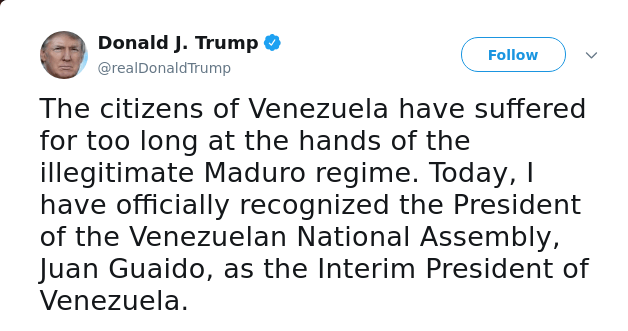
It was not too long ago (Jan 2019) that the Trump administration expressed its shock that the newly elected Juan Guaido in Venezuela was being blocked by incumbent president. In a flurry of tweets (what else?) President Trump threatened Nicolas Maduro, and telegraphed that troops, a naval blockade and embargoes were in the works. He tweeted that its citizens had suffered enough and Guaido would be recognized as the interim president of Venezuela by the US. The State Department too put out this statement. “The United States recognizes Juan Guaido as the new interim President of Venezuela, and strongly supports his courageous decision to assume that role pursuant to Article 233…”

Against such a backdrop of pro-democracy talk that the US hectors the rest the world, what Secretary of State Mike Pompeo said this today, sounds incongruent (the current term ‘janky‘ comes to mind.) Double standards.

The rest of the world recognizes such doublespeak.

Googler speaks to my students

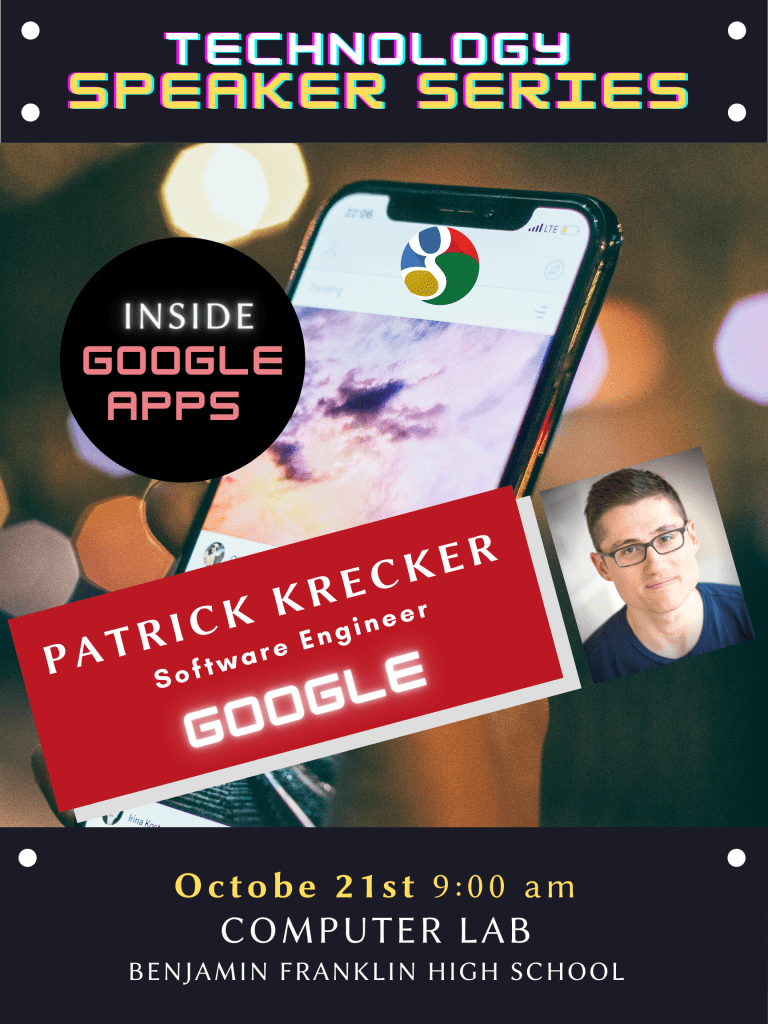
Patrick Krecker, a software engineer at Google spoke to my students last week. This was the start of a series of Technology Speakers this semester at Benjamin Franklin High School.

The goal is to give students a different way of seeing the relevance of a computer class. My hope is that speaking to someone in the real world, at a company they are acutely familiar with, could put many things in context. The previous week, we discussed search engines, and Sergey Brin and Larry Page’s early engine, curiously called Backrub! They also took a deep dive into Google’s Moonshot projects at GoogleX.

Hearing about the Google culture, its pioneering spirit, and the way a Google engineer approaches apps was really enlightening. Even for me. I used to work with Patrick at ASU. I was so impressed to see what he’s doing at one of the most powerful, omnipresent companies today.

Thanks, Patrick! I would certainly want to have to back on Google Meet (what else?) in the future!

Hacks that make you long for un-smart devices again!

Have you heard of the hack that could make your smart watch expose your ATM PIN? Of how a guy with a laptop could hack into a vehicle and turn off the engine on the highway?

This demo of a Jeep’s system being hacked was in 2015. Imagine what’s possible today!

There’s a reason I will never wear a smart watch. Or install a Nest thermostat. Or a Ring smart doorbell.

Indeed 2FA, or two-factor authentication can protect us. But this could mean cyber-security manager would be yet another task we take on in managing and maintaining our appliances, our wearable devices and our vehicles. You probably know that your TV is watching you, right?

Next week, my students are going to talk to a someone who works in cyber-security compliance at Microsoft. I showed them this Jeep-hack video to get them thinking. They got quite spooked! I don’t think they’re going to sleep well. It’s Halloween, too!

Top 5 podcasts teachers should listen to

Why limit yourself to education podcasters? By all means start with one. We teachers can learn a lot about how to present content from journalists, poets, historians and entrepreneurs. Otherwise we risk living in the bubble!

  1. Google Teacher Podcast – Hosted by Matt Miller and Kasey Bell, this seasonal podcast is a huge asset for educators who like to stay aboard the high-speed Google express.

2. Grammar Girl – A fantastic podcast about language hosted by Mignon Fogarty, a former journalism instructor. Even if you’re not an English teacher, her take on how we communicate applies to any field. It was one of the earliest podcasts I listened to about eight years ago.

3. This American Life – One of the most listened to podcasts, hosted by Ira Glass, a radio guy. He chronicles the gritty, real life of average people who just might happen to be our students. Ira won a Pulitzer this year for his show – a first for podcasters! If there is only one podcast you should listen to its’s this one!

4. Invisibilia – A relative new podcast begun in 2015. Extremely well researched, it mines “the intangible forces that shape human behavior.” The true life stories probe the unspoken and unseen forces that shape much around us – a sort of professional Development class that you never signed up for but wish you had!

5. Revisionist History – Remember Malcolm Gladwell? Yes, that guy whose books gave us terms such as ‘Tipping Point’ and ‘Outliers.’ Gladwell’s take on events whether they are related to Hamlet or the FBI, to make your head spin!

Vocabularitis outbreak! Take cover

Twindemic? Janky? Doomsday scrolling? When did these words jump out of the dark shadows and infect us?

I am compiling a list of words that have emerged and are showing up in everyday language, as an experiment on how language changes with circumstance. Also, the hypothesis is that many of these words will become more or less extinct by this time next year. Some of them show up in school, violating the dress code. Others, stick to my rubber earbuds when listening to a podcast.

  • Coronahobby – Means exactly what it describes but, absent the hyphen
  • Doomsscrolling – Obsessive scrolling through bad news
  • Janky – When something is broken or a technology is not working to plan
  • Twindemic – A terrible coined word repeated by the media, ad nauseam
  • Covidiot – Someone who ignores COVID warnings, to his/her misfortune
  • Intubation – When you want to show you know a lot about ventilator use
  • Zoombombing – Uninvited guests during a Zoom call

Not so long ago we had to get used to these words. Remember these?:

  • Deepfake
  • Gig Economy
  • Influencers
  • OK Boomer
  • TextNeck

Voters aren’t that stupid

Dear Political campaign manager,

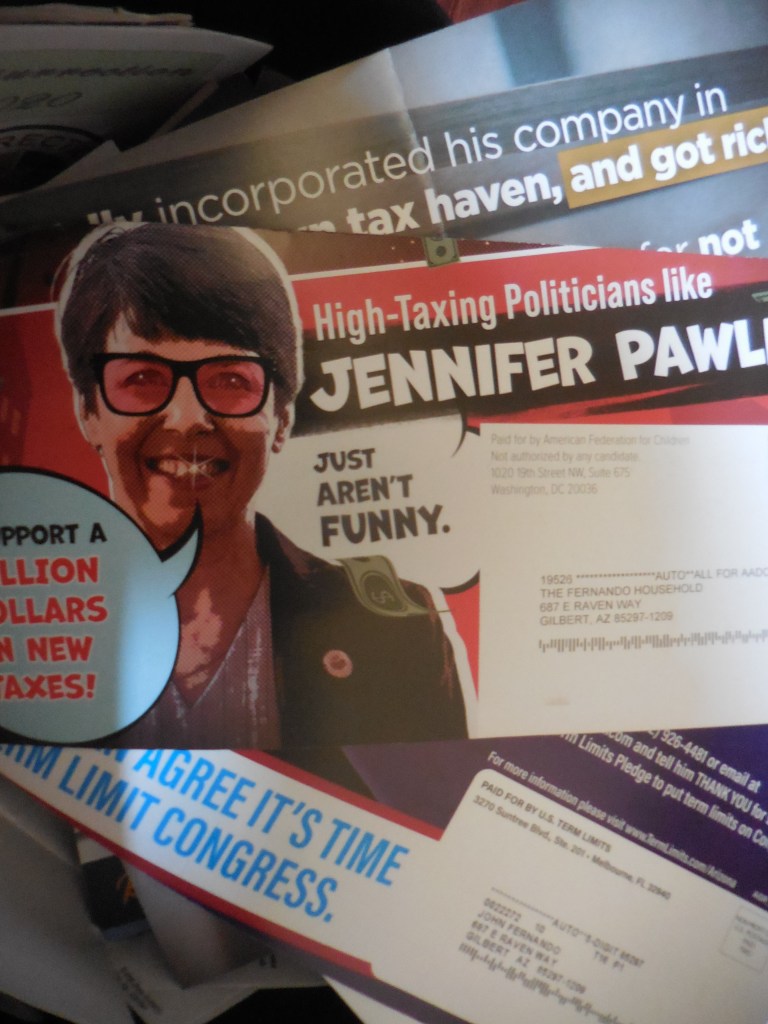
If there’s one certain way to get a voter to disbelieve your candidate, it is the inane, silly postcards like these you send out. Having dumped hundreds of these in the recycling bin without so much as glancing at them, I would like you to know that I will most certainly vote for the person you vilify because (a) Your communication skills and your morals probably line up with your candidate, and (b) If the only thing you want me to remember are the ‘dark secrets’ of others then you do not seem to have a leg to stand on.

Are you in marketing? Or did you just learn Photoshop over the weekend? You do not deserve to represent anyone but the scorpions that occasionally show up during this time of year.

That is why I wanted to shine a black light on your work so that when your candidate loses, you will at least know why.

We voters aren’t that stupid. Grow up and go back to marketing school.

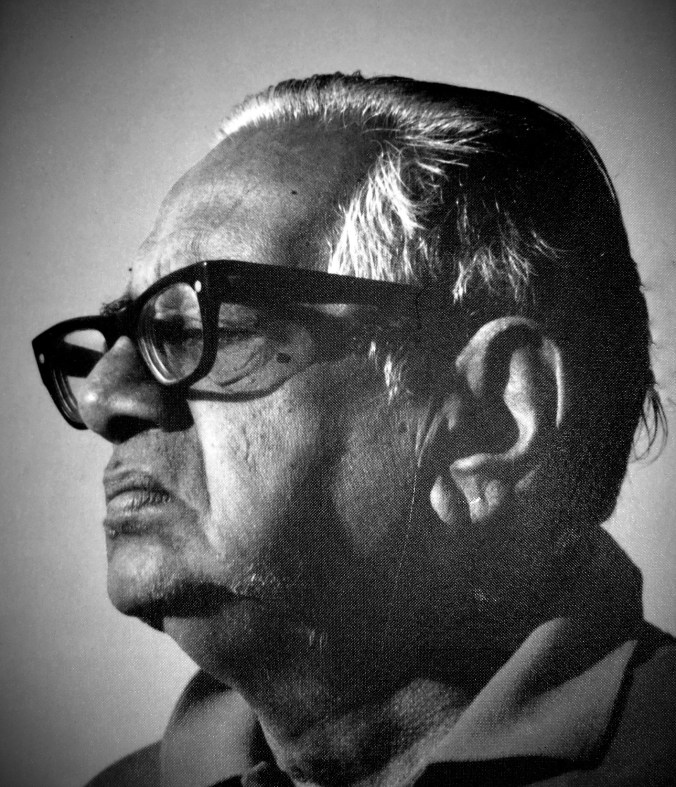
My Dad , the teacher and story-teller. 15 year anniversary.

My dad passed away 15 years ago, today, October 16th, 2005.

Joe Fernando never published a book, was never featured in the media, but he had a knack of infecting everyone around him with ideas. He was my Google, Wikipedia and Amazon; the human search engine when hunting down bits of history, with a library in our ‘office room’ that introduced me to Greek history, Elizabethan poetry, Sri Lankan archeology and more.

His encyclopedic knowledge was legendary. He could quote Thomas Merton, Aristotle, Churchill, Robert Frost, Gerard Manley Hopkins, Senarath Paranavithana, or Shakespeare –sometimes in one sitting! He once won the grand prize in the Maliban “Take it or Leave it” radio show. It is said that the show host, Tim Horshington, leapt into the air when he answered the final history question to win the grand prize, a Philips refrigerator.

In the evenings after school my dad would tutor students, often for free, fluidly switching between English, Sinhalese, and Tamil. Occasionally I would overhear him break out into Latin! He was a teacher at heart. At the height of his career, on humid Sunday afternoons, you would see him walk down Clifford Place, suitcase in hand, along the railway tracks to get to the Wellawatte railway station. Destination: Galle. His last post was vice principal, St. Aloysius College Galle, a Jesuit boy’s school.

I always wondered what kept him going. Much later, when I would talk to him about his work, I came to realize the driving force behind this dedication was his students. Including anyone who turned up at our doorstep with an exercise book and an assignment.

In a larger sense, we all sat in his class. Neighbours, nieces and nephews, my schoolmates, priests, vendors and the odd grownup that had happened to hear of the iskola-mahathaya (that’s ‘school master’ in Sinhalese) down the road. They would breeze in without any forewarning for help with essays and proficiency exams, notes for debates, and coaching for job applications and dissertations. He just loved to have them in his office room, crowded around a Formica table with ginger beer stains. It was Aladdin’s cave, as one cousin described it, stuffed with books and papers. He always knew where to dig out and dust off that biography, anthology or newspaper cutting you were looking for. If you had time for some sidebars, he would invite you to a long walk to Galle Face, and tell you an elaborate yarn or two about British soldiers who got drunk while on duty in Bandarwela during World War II. Or about the time he fell into a river when the boat capsized on his way to a funeral in Galle.

Yes, life was a collection of colourful stories to him, as those who listened to his repertoire of ghost stories, war stories, travel tales and embellished family narratives know.

A simple man, my dad, who impacted so many of us.

Why isn’t encryption used in voting?

One of the long, ridiculous exchanges in the presidential debates last night was on voter fraud, a perpetual conspiracy theory of president Trump. “This is going to be a fraud like you’ve never seen,” he said.

Courtesy, Noah Pederson -Unsplash.com

Whenever I see the word ‘fraud‘ in the same sentence as ‘ballots‘ I wonder why software companies haven’t stepped in to fix this.  With some of the best software companies addressing all kinds of threats, whether it’s banking or homeland security, why has ballot encryption been on the back burner?

It appears that the software solution has been in the make-up room, but has never made a grand appearance on stage. About a decade ago, there was a suggestion that we might have ballots that use invisible ink that ‘code’ a ballot as well.

 “…instead of filling in a bubble next to a candidate’s name, the voter uses a special pen that exposes a code printed inside the bubble in invisible ink. A voter can write down that code, along with the serial number of her ballot, to later verify the results online.” 

Larry Hardesty, MIT News Office

Encryption is all grown up now. There is a product, according to a recent WIRED article, called ‘STAR‘ developed out of an initiative in Travis County, Texas.  Benjamin Wofford’s article traces the path of the development, the ‘secure, transparent, auditable, and reliable encryption solution (hence the STAR acronym) of the software.

To summarize it, STAR converts a person’s vote at the voting machine into a ‘hash code‘ that could be printed out and taken, similar to how we leave a grocery store with a receipt of our transaction.  Voter impersonation with this system is very easily detected. The best part is, votes can go back and check or track if their vote has been cast and counted.

It’s about time. We have turned to encryption for everything from text messages and financial transactions. It’s time we encrypt the vote.


Planning a school podcast, 11 years later

I have been working on material for a podcast at school in the past few weeks. It’s an opportune time to do it, with so much to discuss in education, especially with millions of students rethinking ‘school’ in the middle of a pandemic.

Ever since I re-discovered my 2009 podcasts, I’ve felt pull to get out that microphone and fire up the recording app! The tools make it so much easier. Here are some ideas to start up:

Recording:

  • Audacity, open-source software is free to download. It’s also super intuitive –easy to use.
  • Hindenburg This is professional-grade software. More complex, but serious features!

Now for mics.

  • I have a trusty old mic that does look like it was from the nineties, and it is. Quality is great but not too much base.
  • I am experimenting with a lavelier (clip-on) mic we were  given for our distance learning video recordings. I found an adapter on Amazon, which plugs directly into a PC.
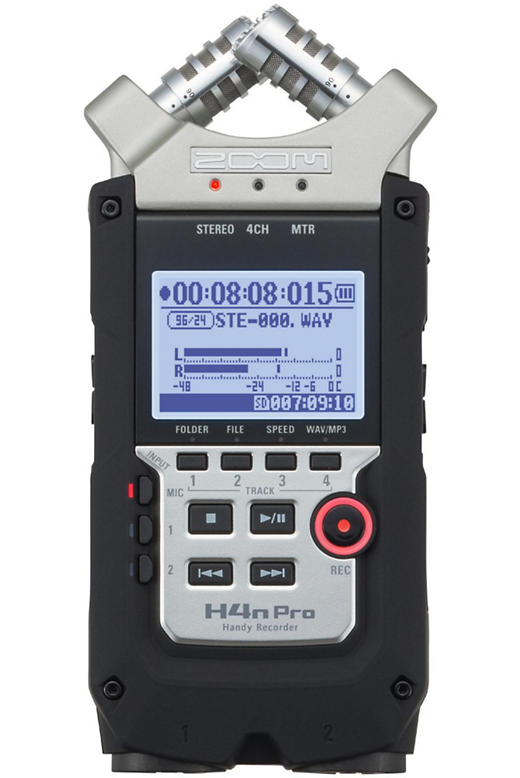
  • Zoom. I consider the ZoomH4N the best. I used to own one. It has a curious shape, but voice quality is terrific with 2 uni-directional mics

Intros/Outros

Unlike in 2009, there is plenty of podsafe –Copyright free–music available. But it is highly recommended you support the artists with a small contribution. Nothing should be free, in this economy!