Oil, tweets, and the gushing blogosphere will drown BP

There is no such thing as a ‘top kill’ procedure (the attempt BP made to put a huge concrete dome on the leak in the Gulf of Mexico) to cap off the gushing anger at BP  in the blogosphere.

Each day brings a new wave of voices –comments, creativity, social media channels –to shame the company that has caused the worst environmental disaster here in the US. Like this logo attack.

This one, a blog called Apologize To BP taps into the collective wisdom of anyone who has a twitter account, or some time to add some content to the site.

A post contributed by one David Diehl, alongside this picture, is titled ‘Sea Of Contrition.’ He apologizes to the captain of BP this way:

“Thanks again for inviting me to the yachting excursion this last weekend. I’m so very sorry I ate up all of your delicious shrimp during the preliminary revelry on Friday. The staff did indicate it was the last of the Gulf shrimp…”

Apologize, is acerbic and funny, obviously, but content like this (and there are hundreds of tweets being fed into the web site every minute) create a virtual gusher that intentionally or not contaminates anything that BP tries to do by way of PR.

I know, most PR people tend to say that it’s inappropriate to even use ‘ BP’ and ‘PR’  in the same sentence; the company has made so many PR blunders it’s not even funny.

The site urges readers to submit  “videos, photos, quotes, whatever you want, as long as you apologize…”

The feed of tweets into the site is a smart way to keep content flowing through the pages, even while it feeds the tweet-hungry searchers who only see it on the micro-blogging platform. The hashtag #ImSorryBP
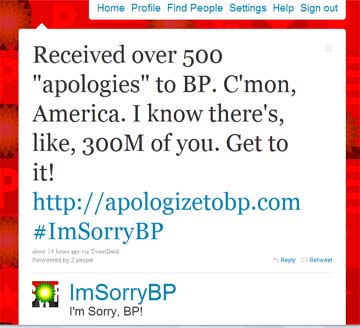
At the time of writing, this Twitter account has had just 213 followers. I’s one more way that people will channel their frustration.

There are more. Check these hash tags that are being used to aggregate the comments and conversations:

#BP (of course, usurping the brand initials)

#oilspill

#gulfoilspill

So, despite the news that BP is trying to clean up its online rankings using SEO tactics such as buying keywords, it’s quite apparent that the groundswell is not going to be more powerful.

Passport to ‘Digital Citizenship’ Webinars next week

Really happy to announce a series of Web conferences that I will be starting next week for the U.S Embassy in Colombo, Sri Lanka.

Webinar on social media - US Embassy, Colombo Sri LankaThis follows a digital video conference I conducted last year for the U.S.E, in association with the US State Department.

These six workshops –Webinars– are designed to be more interactive; the majority of participants will be at one location in Colombo. They were selected based on their application and response to a survey on the state of social media in Sri Lanka.

We are covering the usual suspects: Blogs, social networking, micro-blogging, video sharing and social search.  The attendees are from diverse backgrounds: advertising, corporate communications, government, web-based businesses, management, universities, media and non-profits.

Presenters: To make these sessions more focused and relevant I have brought on board some top practitioners to co-present with me. They are:

Dan Wool, a corporate communications and PR consultant for APS, a large electric utility in Arizona. Dan co-founded one of the world’s top blogs on public relations, marketing and social media.

Steve England, Chief Technology Office of MobileSoft, an advocate of on-demand digital printing who advises large tech companies and international advertising agencies on interactive marketing.

Gary Campbell, a communications manager at Arizona State University, a former print journalist turned digital, who has led numerous university training sessions in social media.

I will also bring in a few ‘surprise’ guests who will pop-in with some real-world examples of how they are using a particular strategy in their communication!

How ‘passive’ networks will make use hyper-active citizens

The explosion of sharing networks and apps are being primed for the mobile experience, anticipating a time when many of us will slip in and out of our roles as employees, Friends (yes, upper-case kind!) and corporate citizens.

These ‘social mapping’ services may seem more like games in their early iterations, rewarding users for certain tasks. But just as how Twitter looked like a status update service in its early days, these mobile-based services will soon let us do more than vainly record our location.

GoWalla, a location mapping app for the Android, iPhone and Blackberry, lets us check-in’ to locations, as does FourSquare., awarding badges and mayor-ships etc.

A term I have come across in some of these networks is that they “are only acting as a passive conduit for online distribution and publication” of user content. In other words, the intent of the application is to tether people and content.

We may be transitioning to that time soon. But we are still toggling between active, in-your-face social networks such as Facebook, and the passive ones. Someday these could be rich social spaces, albeit passive and invisible. Also reward-based.

Like to see where all this is going? Check out these four services:

GoWalla.com ZoomAtlas.com

FourSquare Plazes.com

Not all PR agencies get it wrong

I received one of those dreaded pitches this week from a PR firm in London.

It had the trademarks of having being picked from a list of bloggers and freelance writers: It started Press Release….

But this one was different. It didn’t have “no-reply’ or some garbled name as its sender. It also had a headline that made me want to open it and read. It was about the PR firm’s client, BBC World News.

You might wonder how relevant is that? I could have signed up for all manner of things on the World Service. But the topic was a series of shows Hard Talk On The Road –on Sri Lanka. It may sound dead simple, making sure the subject was in line with the reader. But let me frame it this way. I get so many of these PR pitches that it sometimes makes me wonder where we have taken this form of communication.

This is an industry (PR and Marcom) where everyone is screaming Web 2.0, every consultant, conference presenter and digital marketing agency is throwing out terms such as ‘Social Media Release” and RSS in every slide deck, and every book that has been published on the subject since Cluetrain Manifesto advises that ‘markets are conversations.’  In other words, stop spamming and start talking.

But all my colleagues at ValleyPRBlog, for instance, say the same thing. We are getting drowned in ridiculous PR Spam. We only complain off and on, and that, too when someone really ticks us off, or someone like Chris Anderson issues a fatwa, and everyone nods their heads and says ‘serves them right.’

But in the past 10 days I got two pitches that were spot on! Two! As such, rather than outing the bad ones, I like to hold up the good agencies and the great PR folk who do one simple task -take time to understand their audience.

  • The first was so good, from Gutenberg Communications, I have agreed to interview the CEO of the company –on Monday. If you’re interested, stay tuned!
  • And there was this from Parys Communications whose pitch was so simple, I could have hit the delete button.

As a writer I give every pitch a chance. If you take the time to filter, we will take time to read!

Weary of PowerPoint? Fire your imagination with Prezi

Sure, there are great templates for PowerPoint. But quite frankly I do better when explaining myself on the back of a napkin –with a little help from the book by the same name.

But this week I’ve started teaching myself a great new application for presentations, called Prezi.

Naturally my first one is for Public RadiusTake a first look

Here’s why I love Prezi:

  1. It lets you control the focal points and flow of the presentation -by tilting words, zooming in on words and images etc.
  2. Once you figure out how the striped control icon (the ‘transformation zebra’) works, you could add elements and move them around as you would when brainstorming on a scratch pad
  3. Because you can move laterally or diagonally, you could adjust your story line on the fly as new ideas emerge.
  4. It’s easy to embed other digital content –video, audio etc –something I will get to in the next phase
  5. The best part is your presentation on this platform is designed to be connected to other social media venues. Which is exactly what Public Radius is all about–connecting the dots!

How to track warm bodies flocking to your site

A few days I saw how one organization is using what’s known as a ‘heat map’ to track visitors. It’s called Crazy Egg (a name that gives you no clue about the neat service) and lets you see what links on your web site are glowing, and what parts of the site in general are on fire, so to speak.

The beauty of a heat map is that it shows the intensity of those warm bodies clicking on links in real time!

It sounds more creepy than it really is.

All it does, a bit like Google analytics, only more visually, is to give a communication manager a quick snapshot of what content (links) visitors are attracted to most, the sites referring to this link, the browsers used to get there etc.

So let’s say you create a micro-site for an event or a new program. You could basically beta test a variety of layouts for a few weeks by inviting people and watching the glow in real time. Then you could pick which layout is achieving the desired actions, and adjust the placement of those links.

Because it is a visual thing, this connection between data and navigation makes it is easy for people with different backgrounds –product marketing, e-commerce, web design, content creators – to respond to.

The service can be used on a month-to-month basis. Give it a try!

Do your pictures embed a story?

Last week I had the opportunity of assisting 7th grade students studying photography –Black and White photography. It involved dark-room techniques as well.

Yet, it was not what you might think. The students did not use digital cameras. They were using pin-hole cameras made from … cookie tins!

Analog? Why would this be exciting to a generation we like to typify as digital natives? Why would young people who only know –or so we think –instant gratification give a hoot? Why would a camera with no lens, no aperture setting,  and no buttons appeal to someone who loves iPods and Flip cameras?

I wondered that too. But it turns out that the technique –‘art’– of taking a picture inspires them. They were fascinated with the subject, not the tool aimed at it.

So with a rudimentary, very temperamental camera, they realized that framing the context for that subject was suddenly very valuable. Black and White also forced the picture taker to seriously think about lighting and contrasts . When there is no white-balance adjustment it concentrates the mind! And finally it taught each one of them what they could not learn from the handbook or a how-to YouTube video: patience. Shadows and clouds move, people in the background suddenly dart across, the wind stirs things up …

I like to put it this way. The photographer needs to find his/her ‘story’ within the picture and try to convey it at the moment he/she clicks. In their case, the click involved flipping open the magnet that covered the pin-hole, counting the seconds and replacing the magnet. Tedious? Not for this always-on generation.

And to pull back a bit, I found a great example of how a photographer must have had to frame, study and wait for the moment to get this story. What might otherwise have seemed a very mundane observation of a woman walking on a lonely stretch of road.

‘Print Grows Trees’ debate opens a fresh debate

PrintGrowsTreesPrint has always been dinged hard by those promoting digital communications as the green alternative. And why not? We’ve seen excesses that are so revolting –boxes of glossy annual reports that have to be tossed, multiple-page bank statements etc.

The Print Council has been very sensitive to that in their PR, and has a talking points document called “The fine print” to rebut those arguments.

So this campaign is not surprising. Called Print Grows Trees, it attempts to communicate some aspects of the print industry and its relation to forests. Specifically “to show that print on paper actually helps to grow trees and keep our forests from being sold for development.”

Let’s face it: Many of us who have gone digital are big fans of print; it’s not a simple either/or choice. We buy newspapers and magazines, but avoid picking up brochures and flyers whenever we could download them and read them as a digital file. We encourage people to ‘think before you print’ but we do carry business cards (GreenNurture uses Quick Response tags on business cards to avoid brochures) using recycled paper, printed with vegetable inks.

Print on demand, and Personal URLs (‘those ‘PURLs’) are some of the solutions that almost every printer now offers. PODI, the Print On Demand Initiative, educates members and everyone else about print and social media, QR codes etc. So yes, the print industry has done some good things to erase the dead-tree stigma. This campaign though seems to push the envelope (bad choice of word?) a bit.

It definitely –deliberately–frames the debate as an economic problem-solution and not just an environmental one. Is it a dangerous myth, as Jay Purdue and others suggest, one that “has significant environmental and economic consequences” to say that print kills trees? If you haven’t run into the seemingly oxymoronic term ‘digital deforestation‘ be prepared to hear more about it in the next few months.

Or is Print Grows Trees a symptom of ‘tree guilt’ felt not just the print industry but by all of us when we forget to turn on the double-sided feature before hitting Control-P?

Blocking and tackling social media distractions

I speak to plenty of young people to whom Facebook is like email –something they leave on and check every few minutes. But they are chatting on other channels as well. If you look carefully some folks even check their phones for incoming mail at …church.

So the question I get asked is, whether TMS (too much socialnetworking) is killing our attention. How do you read a 300-page book, how do you watch a 2-hour movie, or listen to a keynote speaker without instinctively reaching out to your laptop or phone to comment/share/snipe?

We adults have a similar problem –TMI (too much incoming). nearly every Blackberry user I speak to complains of being a few hundreds of emails behind. I knew someone who two years ago, would tune out a speaker at a small-group discussion(for 10 – 15 minutes) just to respond to his incoming mail. It was embarrassing to watch!

I’ve been running into many people calling time out, addressing TMS and TMI. Two names you may recognize.

Joel Spolsky, writer for Inc. Magazine. In his last column, he analyzes why Too Much Communication is killing us.

Now, we all know that communication is very important, and that many organizational problems are caused by a failure to communicate. Most people try to solve this problem by increasing the amount of communication: cc’ing everybody on an e-mail, having long meetings and inviting the whole staff, and asking for everyone’s two cents before implementing a decision.

And Seth Godin, railing against Incoming.

That email, Facebook and message queue is a lot longer than it used to be. For some people, it’s now a hundred or even a thousand distinct social electronic interactions a day. It’s as if a genie is whispering in your ear, “I have an envelope, and it might contain really good or really bad news. Want to open it?”

It’s time to stop letting the genie take over our lives. It’s time to put the brakes ion email; to stop taking notes, to pay attention to the speaker. It’s time to join the conversation happening in front of you first.

The other conversations (online) could wait a few minutes couldn’t it?