Technology with a sense of humor (and humanity)

So much of tech in our lives is about inanimate objects that deliver some convenience.

Maybe they animate our lives a bit: Typewriters helped us write better reports. Levers helped us move large rocks. Microphones and memory devices) helped us record and preserve important  moments.

I’m becoming more steeped in the four S-T-E-M areas, because (a) that’s where all education is headed, and (b) I run a computer and tech lab for a school where students from Kindergarten to 6th grade come to experience computers in education.

So it’s always refreshing to be able to focus on technology that is not a computer, or at least one that NOT rectangle-with-screen. I have robots, of course (a big ‘Aha’ for third graders): rectangle with wheels and sensors, and a few other objects.

But where could you take (or hide) a computer, to make our lives more interesting?

I found a great example of a ‘technologist’ who comes from an a non-tech space, and adds a layer of humanity to objects. She’s not from Silicon Valley, and I don’t believe she’s been featured in Fast Company. Bangalore-born Aparna Rao infuses technology with a sense of humor and humanity, letting us find our own meaning in inanimate objects such as a phone, a typewriter etc. The one on the left, for instance, was designed so that her uncle could send email, making him feel he was typing a normal letter on a piece of paper. But it gets funnier, and, deeper, such as when she uses a camera to make people disappear — the reverse of what we do now in our desire to put ourselves into every conceivable screen-captured image of life.

This is probably one of the best reasons why the arts –and the capital ‘A’– cannot ever reside outside the S-T-E-M areas everyone is so focused on.

This is the best example I’ve come across for encouraging schools to add some S-T-E-A-M!

Google Street View in Sri Lanka, timely -as the ‘walls’ come down

I just wrote a bit of a cynical piece about Google Glass, but, as you may know, there is no shortage of parodies about this new, much-talked about product that will help people ‘augment’ the real world.

But my beef is not with Google, per se. It’s those whom I like to call ‘Shiny New OBject Syndrome’ types. You know, S-N-O-B-S 🙂

The point being, I question if we really need everything reduced to data, or meta data –basically data about data. Do we need an appendage that turns our analog lives that are inherently data-rich in human connections, just to bathe in digital?

In one of my presentations (when asked about Big Data in a Web 2.0 era) I referred to a person who told me how he was befriended on LinkedIn by an old school buddy. Great, he thought, and clicked the button! Then he bumped into the chap a day later, and the ‘friend’ ignored him. In other words, flesh-and-blood alums are so boring, huh? The data-based connection was what the person was after.

Oddly enough, I am planning an upcoming trip, and enjoying the data Google delivers – via Street View. It’s truly amazing how one company can basically index the world as we pass through it. One country at a time. So far Google, which began capturing Street Views in 2007, has 50 countries and counting. Included are Hong Kong, Thailand, Romania, Poland…

Sri Lanka will be soon in this group – reliable sources tell me. I could see why the tourism and leisure industry would want this. For businesses too. Imagine being able to drive through a bridge, walk up the steps of a temple, check out the neighborhood in an area you plan to set up a company etc..

Inviting this kind of visibility, also trains citizens to expect greater transparency in surrounding areas. The new data we will have access to would (and should) inform a nation’s business leaders and public officials to plan for providing data beyond the ‘Street’ level.  We should be able to drive by, virtually, and pick up data, and meta-data: forms, policy papers, constitutional amendments, meeting notes, speeches, parliament bills and voting patterns etc. Will these come? Well, look at it this way. In Colombo, the government has been strident in tearing down the physical walls around public places. Cynics see this is as part of the post-war beautification strategy. But even as we will be able to peer into the windows of an un-walled town hall or government institution, (while Google,simultaneously, begins to provide virtual views) the expectation will be for greater access.
It’s an experiment that many will be watching. (No expensive Glasses required)

Thanks for supporting the ‘Book Launch’ in Colombo

Just got back, after what seems like a whirlwind book launch.

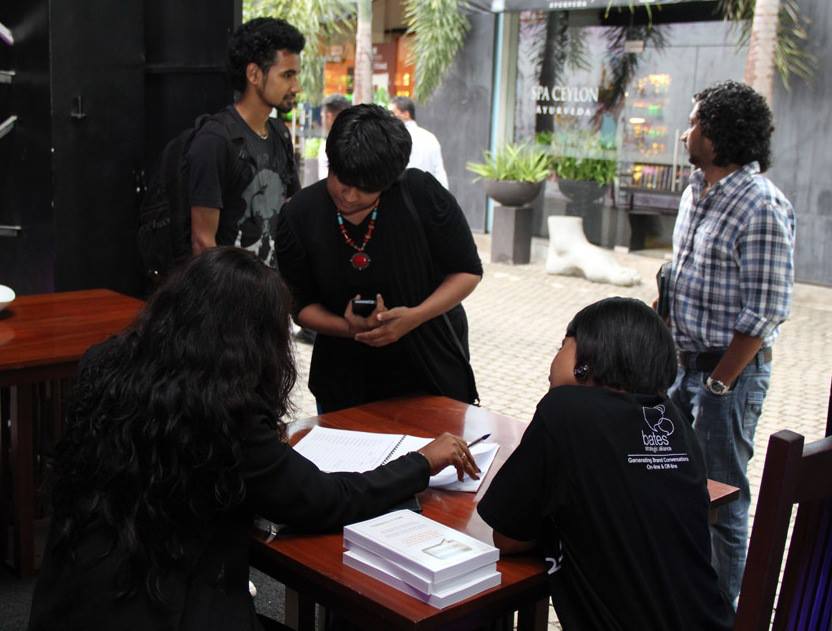
ParkStreetMews_5I’ve had to use the quote marks around ‘book launch’ because it was not originally planned that way. A series of events, coordinated by some of my friends at the last moment was beyond my expectations.

Those who made this happen included:

ParkStreetMews_3

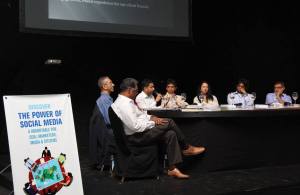
While I got to talk of some of the most timely topics covered in the book — Transparency, for instance– I got to meet some very smart people changing the game of marketing, media and communications.

Social Media, which has been on the back burner for many in Sri Lanka (some say it still is, but that’s a debatable point) is being embedded in so many places it was hard to keep up. More on this in a post, later.

If you are interested, check for video clips at ChatRepublic.net, and #ChatRepublic hashtag on Twitter.

Citizens’ voices matter

A few years ago I conducted a series of webinar-style workshops for the U.S. State Department, for content creators, educators, marketers and those in traditional and new media. The workshops were called  “Passport to Digital Citizenship.”

I was convinced that citizen’s voices would be valuable, and –despite technological barriers and people who would try to keep them quiet– they could be heard.

So today, as my book is about to launch, I am thrilled to see this report by CNN on the importance of citizen-driven media.

Journalism has been forever changed — I’d argue for the better — thanks to the fact that people can interact with media organizations and share their opinions, personal stories, and photos and videos of news as it happens. This year’s nominated iReports are prime examples of how participatory storytelling can positively affect the way we cover and understand the news. 

(“36 stories that prove citizen journalism matters.” By Katie Hawkins-Gaar, CNN | Wed April 3, 2013 )

When we talk of  ‘participatory journalism’ we mean that ‘CitJos’ work alongside traditional media. They are not here as a replacement model, but to complement the changing media industry. Of the 100,000 citizen stories submitted to CNNiReport.com in 2012, they used 10,789 –having vetted them first.

I just interviewed the creator of a leading citizen journalist outfit in South Asia, and he stressed the importance of community guidelines, and careful design.

Citizen journalism, and the power of citizen voices is a big section in my book, Chat Republic.

And then life threw me a lesson plan

For more than a year, I have been making a transition from corporate communications to education. I have been given an opportunity to be a computer teacher at an elementary school in Scottsdale, Arizona.

It’s an amazing time to be joining a profession that’s getting lots of attention. And scrutiny. From the recent schoolteachers’ walkout in Chicago, to the just out Nations Report Card, among others, the story is not exactly cheerful.

Meanwhile, as knowledge acquisition is moving an 120 miles-per-hour, pedagogy is ambling along.  I can see this through the lens of our two children, as new engagement tools emerge, and curricula change. Analog classrooms are trying to adapt to digital natives. Britannica now has an app for the iPad and other tablets. Classrooms are being ‘flipped.’ We can’t continue to do the same old, same old.

If there’s a simple lesson plan for my career, it’s this: push students to the edges. Focusing on ‘core’ areas, but also widen the aperture. Knowledge of ‘computers’ without context of where they are used, is meaningless. Often it’s the topical things we introduce in class that make planned (not canned) lessons relevant. One study last year found that students who did “science-related activities that are not for schoolwork” performed higher.

TO KICK OFF, I re-positioned the computer class as a Technology and Computer Lab, in which students will engage in subjects from space exploration to search engines.

Being the school’s robotics coach helps. This is a program established by the FIRST Lego League. Students can step out of their comfort zone and take risks, even while engaging their math and design skills.

Each day, the lens zooms in and widens…


Social Media and innovation surge in Sri Lanka

(This post is being updated)

Today in Colombo the tech and business community attended Social Media Day, a Mashable-coordinated event, worldwide in which 511 cities participated

Two days ago, they held another parallel event known as Refresh Colombo.

One of the organizers noted that the hash-tag #SMDayCMB, which had begun trending regionally (as a ‘tailored trend’) validated the fact that there was a highly engaged community now. Speaking of the community, it’s got the right volatile mix for innovation. One newspaper reported, it was a confluence of “hackers, bloggers, coders, geeks and geek lovers, journalists, techies, entrepreneurs and venture capitalists.” Note: the absence of one group here – politicians. In post-war Sri Lanka, steering clear of politics appears to be a well-honed skill.

One of the highlights was a video-link up with Jehan Ratnatunga in California. Jehan is the person behind the comic YouTube skits. Fittingly (for this social media savvy audience) he explained how he landed a job with YouTube because of his hobby.

Watch this presentation by two of the smartest young entrepreneurs who understand not just technology, but how grass-root change and politics works at a fundamental level.

Watch the whole thing (it’s 25 minutes) because the best discussion is toward the end.

More coverage of event

Our Web. Our Conversation. Our House Rules

The 'shape' of our Internet

It’s not everyday you get an email from Vnt Cerf, a.k.a. the father of the Internet.

His email yesterday read: “You spoke out and showed that, when we stand together, we can prevent bad policies from hurting the Internet. You proved we can stop something, but now it’s time for us to start something.”

He was probably referring to my joining in on the online petition in January, in support of massive, worldwide protests against SOPA and PIPA. Some 7 million people signed that petition. Apparently such widespread laws could ‘break’ the Internet.

Now, since there is talk of a renewed attempt to get those laws passed (read the recently published White House Intellectual Property Report) Vint is calling for you and me and your next-door who walks around with her face buried in her tablet, to do something about it.

The newly worded act talks, among other things (such as fear of China) that “U S innovation and creativity (needs to be) protected around the world and allow Americans to do what they do best—out-innovate, out-compete, and continue to lead in the global marketplace in this decade..” yada, yada, yada.

We’ve heard this blathering before. Funny how other nations are out-innovating, out-competing, and out-thinking us –sans such laws.

Vint makes a good point. It’s not enough for us to be always reacting  to legislation. We ought to be demonstrating to the people pushing for these laws that the value of openness outweighs  the value of putting handcuffs on every node of the Net.

The call to action is a tad too simple, if you ask me. It is a web site called Start Something. Basically you are asked to complete the sentence “The Internet is the power to…” You could have your say on Twitter, Google or Facebook.

I am not convinced that adding to the noise as to what the Internet is, will make the lawmakers do a double take. The content creators of this world, the thought-leaders, and social media evangelists ought to come up with a deeper, richer conversation.

What would you do? 

Wikipedia’s ‘truth’ formula needs tweaking. But by whom?

There’s has been a great discussion going on about what it takes for someone to edit an article on Wikipedia. I recently received an invitation to a survey of communicators on my experiences with editing wiki entries. Apparently this is connected to a point raised by Phil Gomes of Edelman Digital, who brought this up, creating a Facebook group to think it through. The group is called CREWE —which stands for Corporate Representatives for Ethical Wikipedia Engagement.

The story of who could edit Wikipedia goes back some two years, when Timothy Messer-Kruse tried to edit an article, and was rebuffed –scolded, really — by Wikipedia’s editors.  Read his article here. Messer-Kruse is an author of several books, including one on race relations. In other words, he’s not someone who just popped by Wikipedia and had an ax to grind.

Prior to that, there were more egregious cases where vandals, and  ‘trolls’ changed biographies of people or created conflict within the editors.

Fast forward to what CREWE is proposing. There’s a task force of communicators from IABC and PRSA looking into Wikipedia’s policies. I was asked to join, and gladly agreed.

If you are interested in following this development, join the Facebook group. I also came across this page  that summarizes what Wikipedia expects of editors.

  • Subjects require significant coverage in independent reliable sources.
  • Your role is to inform and reference, not promote or sell.
  • Write without bias, as if you don’t work for the company or personally know the subject.
  • State facts and statistics, don’t be vague or general.
  • Take time to get sources and policy right and your content will last.
  • Be transparent about your conflict of interest
  • Get neutral, uninvolved editors to review your content
  • Work with the community and we’ll work with you.
  • Communicate, communicate, communicate.

It’s more complicated than this, trust me, but it’s a start. There’s a line on this page that states “Be patient and open to cooperation: no one here is out to get you.” But hearing about some folk’s experiences, it sure feels like a tough space to operate in.

There’s also a page on Wikipedia that states Wikipedia is about verifiability, not truth. But there are other nuances, such as NOR – No Original Research– and Be Bold to master if you want to craft Wikipedia article that adheres to its formula for wiki truth. Worth reading, if your organization expects you to monitor and create content.

Slow news costs lives! But does it always inform?

In 1815, more than 2000 people died at the Battle of New Orleans. Two weeks before. a peace treaty had been signed between Great Britain and the United States at the Treaty of Ghent.

But information had not still reached the US –it took two weeks for the news of the treaty to travel from Belgium.

But there’s an interesting counter to why slow news could be good news.  Some trends are not understood by the hourly trickle of news updates, as Alan Durning writes. He cites big issues such as pollution and urban sprawl as examples where slow news provides deeper knowledge of underlying issues. He uses a great quote from Ben Hecht to define this:

“Trying to determine what is going on in the world by reading newspapers is like trying to tell the time by watching the second-hand of a clock.”

A smarter Easy Button called Twine!

John Kestner reminds me of Steve Wozniak. He’s always tinkering with a gizmo that could potentially change lifestyles, even incrementally.

There was the Tableau, a coffee-table-like device that was a connected dashboard for your home. Basically an ‘anti-computer experience’.

There was his digital wallet –not a new idea, but it was packed with easy-to-figure out features. You could see his ideas here.

But this latest one, also developed at the MIT lab with co-inventor David Carr, is called Twine. It is a potential killer app, to use the term a bit loosely. It is, in their words, a way for people who don’t know how to program or solder, to be able to listen in on your (digital and analog) world, and talk to the web.

John and David are looking for funding, and on Kickstarter, have already raised over $556,00. Take a look, listen to the simplicity of how it works. I’m not saying all of us want to be this connected, or need to talk to the web.

BUT, if this is just the first iteration, it could end up simplifying anything from digital due diligence (painstakingly carried out with expensive software), to becoming security sensors (miniaturized and embedded in shipment containers). Or, who knows it could be a plug and play box from Best Buy that makes the average soccer mum –the ones who don’t yet know PHP or HTML5– less complicated.

If only there was an Easy button for raising capital!

Twine : Listen to your world, talk to the Internet from Supermechanical on Vimeo.