Why do carriers still sell locked phones?

Imagine this scenario. You buy a tuxedo online from Kohls for an upcoming event. When it arrives you realize that it still has a security tag you cannot break. You call the store to find a way to remove it and they give you the runaround. Thy say they need to contact manufacturer, Croft and Barrow, to get an unlocked code. Please give them 48-hours until they they hear from the manufacturer, and email you. Meanwhile the event you need to attend comes and goes, but the product you paid for is unusable.

OK, hypothetical situation, but that’s what a locked cell phone represents. A crippled product. Companies such as T-Mobile that sell locked phones are blind to the reality that (a) the device, once paid for does not belong to them or the manufacturer anymore. It should be open by default (b) the world is flat and boundaries have blurred. People should not need customer service intervention to replace a SIM card when roaming.

I had the bad luck to travel to Sri Lanka earlier this month with such a crippled phone — a T-Mobile Dash made by HTC– because I had no time to call to check if it was locked or not. I realized my problem when I tried to swap my SIM card. I got online and found a way to chat with a customer service rep who said it can take up to 48 hours to get the phone unlocked.

I told her they had to be kidding. What kind of unconnected world were they operating in? Two days was a sort of a good turnaround, apparently.

She: When we have to email the manufacture it can take up to 14 days to get a response.

Not good enough, I said.

She: I will inform my supervisor of this issue to see if there is anything that we can do however when we have to e-mail the manufacture we just have to wait for there response as that is out of our hands to get a sooner responses.

Sooner, as in two weeks and counting. I am back in the US. Still no unlocked code. I called twice, checked my email and junk-mail folder. Still no code. That’s why there’s such a thing as text messaging, I tell them –to bypass email.

But the bigger question is not how long it takes to solve a problem, or how to communicate with a customer. The real question is: Why on earth do mobile phone companies sell locked-down smart phones?  I can only imagine three reasons:

  1. Forced loyalty. It makes customers feel they have to grovel to get their basic rights.
  2. Easy revenue: Even if 10 percent of customers get trapped in a situation like this and roam, the money to be made is just too good to forfeit.
  3. Clueless. Carriers don’t take trouble to understand just what usage patterns their customers have. They are still trapped into the old marketing mindset of selling ‘packages’ – few sizes fit all. Customers’ social, professional and economic patterns have changed but carriers have never bothered to find out.

It will take legislation for companies this backward to comply with basic customer rights. It will take a lot of disgruntled customers who say bye-bye to them, for the T-Mobiles of this world to wake up.

Quotes for the week ending 18 April, 2009

“If we’re still in the first inning of social media, we’re clearly at the bottom of the first, with two men out, runners on first and second, and a hitter who routinely hits into double plays at bat.”

Catherine P. Taylor, in MediaPost, on the Dominoes’ viral video fueled by social media

“this lately exploded pustule on the posterior of the British body politic.”

Boris Johnson, Mayor of London, writing in The Telegraph about Damian McBride, the communications strategist at the center of the email scandal in the British Prime Minister’s cabinet.

“The real impact of a blog story happens only when it moves into the traditional media”

Stephen Pollard, Editor of the Jewish Chronicle, on how the scandal surrounding Gordon Brown has shifted and exploded.

“The emails were sent from an official government computer email account, so let’s just assume he was at his desk when he wrote them, shall we?”

Editorial in the Daily Telegraph, saying the Prime Minister cannot excuse his political strategist lightly.

“The online social world is about as two-way, multi-way, any-way…”

Josh Bernoff, in Advertisng Age, on why the term ‘social media’ is fraught with too much baggage to inspire people to participate in it.

“It’s a hostage rescue operation, something like the Entebbe rescue mission …It has to be discreet and surgical.”

Gotabhaya Rajapakse, Defense Minister, on the Sri Lakan government’s decision to reject the UN appeal for hostages held by the terrorists to leave the so-called safe zone.

“We are linked by geography and history”

Secretary of State, Hillary Clinton, on the digital town hall meeting from Santo Domingo, in the Dominican Republic, on the eve of the Summit of the Americas in Trinidad and Tobago.

“@statesman: I see people on Twitter calling this a “hostage situation” at the Apple Bar. We have NOT been told that by police.”

Robert Quigley, a journalist, on how journalists can still play a role in verifying information. The Austin American Statesman was 35 minutes late to the story, but got it right, debunking the story. People had ‘reported’ via Twitter that a man with a gun was threatening guests.

The risk of blogging will only increase

Journalists-turned-bloggers know the risks involved, because they understand the laws of libel and defamation. But there is a wide range of risks involved when it comes to political blogs –from simply getting beaten up, to being on a black list, to a frivolous lawsuit.

I came across two this week — a week that has seen live blogging from the congressional hearings of Bernie Madoff–  that speaks to this risky business.

Last year, we saw a spate of attacks on bloggers aross the world. Iran, China, and whenever one group finds itself under the scrutiny of bloggers. What’s next? Lawsuits filed against Twitter users? Going after people filing video iReports?

Those who cannot easily threaten and muzzle traditional media suddenly find it much easier to bully someone –usually it is an individual, not a syndicated blog — engaged in social media . The laws will have to adapt fast as the lines between old and new media blur.

Quotes for the week ending 17 Jan, 2009

“Steve Jobs a ‘national treasure”

BBC, on the news that Jobs is taking an leave of absence for health reasons.

“We hav 2 prtct R ctzens 2, only way fwd through neogtiations, & left Gaza in 05. y Hamas launch missiles not peace?”

Tweet used by Israel government during press conference

“The blogosphere and new media are another war zone.”

Maj. Avital Leibovich, the head of the Israeli Defense Forces’ foreign press branch.

“Sea of Culture,” Gulf of YouTube,” Bay of Angst”

Areas named on a new map of the world.

“I am not ready to leave journalism; journalism is leaving me”

Former Tribune journalist, Dennis Welch, on starting up a blogger-meets-mainstream journalism site, Arizona Guardian.com, that will fill the gaps in how news is reported,covering more of the ‘why’ not the ‘what’ in news.

“The rebooting of our democracy has begun.”

Andrew Rasiej, founder of Personal Democracy Forum and the TechPresident blog.

“I just watched a plane crash into the hudson rive in manhattan”

Someone Tweeting on Thursday.

“There are people standing on the wings as the plane sits half submerged in the hudson”

His follow up a few seconds later

“True confession but I’m in one of those towns where I scratch my head and say ‘I would die if I had to live here!'”

James Andrews, VP of Ketchum, who tweeted when he got off a plane in Memphis for a presentation. The client he was pitching to, wasn’t absolutely positively happy.

Murdered editor pre-wrote his last editorial

The BBC and other major media have not covered it yet, but they soon will.

The editor of the Sunday Leader in Sri Lanka who was murdered last week wrote his last editorial, which was published yesterday.

In it there’s damning evidence and information, but the editorial reveals his calm acceptance that he will be killed, standing up for the truth.

“I want my murderer to know that I am not a coward like he is, hiding behind human shields while condemning thousands of innocents to death. What am I among so many? It has long been written that my life would be taken, and by whom. All that remains to be written is when.”

He ends with the fitting quote from German theologian, Martin Niemöller that Wickrematunge says inspired him during his youth.

“First they came for the Jews
and I did not speak out because I was not a Jew.
Then they came for the Communists
and I did not speak out because I was not a Communist.
Then they came for the trade unionists
and I did not speak out because I was not a trade unionist.
Then they came for me
and there was no one left to speak out for me.”

Journalists, an endangered species. But do you care?

We pay scant attention to reporters and journalists who fight two survival wars today. The first, which we cover a lot is about job security, as newsrooms shrink and the ‘business’ of news gets downgraded to meet the wave of web 2.0 content creation and consumption.

But methinks we –myself included– focus too much on this.

We celebrate people who blog-slash-report to the point of turning them into celebrities. Robert Scoble with his camera phone in Davos, streaming live ‘news’ and the power of YouTube and Google in news distribution.

But I bet many of the following names mean nothing to my readers. John Ray, J. S. Tissainayagam, Levent Ozturk, Jill Carroll, Hisham Michwit Hamdan, Alan Johnston … Google them and see if you are interested.

Johnston was captured in Gaza, and freed last year. He had a campaign going, and now a Wikipdia entry, but Tissanayagam doesn’t get that kind of attention.

If you want to see what risk means watch this video taken this week as Turkish journalist Ozturk and his crew are fired at covering the Russian invasion of Georgia.

Tissanayagam, a former Sunday Times journalist, is being held on a flimsy ‘prevention of terrorism’ charge by the Sri Lankan government. OK, he has a statutory banner, and a web site; Reporters without borders has been campaigning for his release. But to much of the western media, these journalists are invisible, and those who consume news ignore them in the same way they don’t notice the bylines.

Tissanayagam wasn’t carrying a camera into the warzone. The ‘risky business’ he engaged in? Managing a web site. That’s right, my friends, he is the sort of new media journalist that doesn’t get covered by new media journalism. He’s 161 days in detention, and counting.

And we just go on covering China, and how investigative reporting is so risky in an era of slashed budgets.

Remembering Arthur C. Clarke

We sort of took him for granted in Sri Lanka, his adopted home. At the Otters sports club we frequented, Arthur Clarke was quite a household name.
In 2005, the business magazine (LMD) for which I wrote a technology column, asked me to cover Clarke. I would have liked to have conducted an interview via web cam, if not a Q&A online on a wiki, but the father of the communications satellite made it known that he was past doing interviews. I wrote it anyway, titling the article “From Sarongs to Satellites.

So this week, as the news broke that the sci-fi writer and keen observer of what could be possible had passed on, I wanted to look back and see how I had deciphered the man.

I loved his observation way back before CNN or mobile phones, that satellites would tilt the balance of cultural and political ideas. Anticipating the ‘world is flat theory’ theory by decades, long before networking became an aggressive pass time, Clarke foresaw a hyper-connected global family. He thought the Communications Satellite would be the enabler of what he termed “The United Nations of Earth.”

And the quote I loved most was this: “Swords into plowshares is an obsolete metaphor; we can now turn missiles into blackboards.”

My full article is here.

Media blind eye to media attacks in Sri Lanka

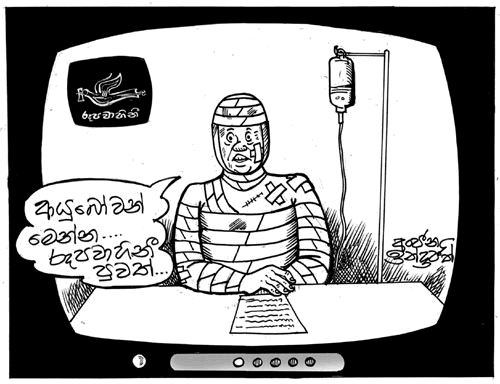
rupavahini.gifWith so much attention to China’s response to Tibetan protesters and the recent repression in Myanmar, there seems to be a blind spot when it comes to the media intimidation story in Sri Lanka. Five workers at the state television station, Rupavahini, have been attacked as the cartoon depicts.

It’s not funny. The methodical attacks follow a situation last December. Separately, journalists have being jailed without trial. Just a handful of organizations like the BBC and Reporters Without Borders are following the story. There are some indications that citizen journalists such as GroundViews will fill the void.

Quotes for the week ending 5 Jan, 2008

“You and I will heal this nation and repair the world and finally have an America that we can believe in again in four days time.”

Barack Obama, in New Hampshire, following his win in Iowa. (Quoted in The New York Times)

“Though it’s tempting to get into a race where your aim becomes to reach 1000 followers on Twitter or and equally high number of Facebook friends, it doesn’t offer anything more than a temporary ego boost. “

Rohit Bhargava of Influential Marketing, on one of the three things he plans to do in 2008, including “making better friends.”

“The key is little ‘m’ media – the information, the experiences, and the stuff that we consume and share every day.”

Brian Reich, on how organizations need to change the way they approach media.

“Make no mistake, the Web is taking over. Applications are moving to browsers en masse…”

Washington Post’s 25 most innovative products of the year.

“I equate social networks to snowflakes, no two are the same.”

Tom Whittaker, responding to post by Krishna De on Facebook (which she calls relaxed and eclectic) and LinkedIn (which she says is used by people in Leadership roles.

“It’s very ‘fudgable’ “

Dan Wool, on the Business Journal’s top 10 list of PR agencies in Phoenix using head count as one of the criteria, being flawed.

“Users can restrict who sees their information, and block users”

“Computing Which?” magazine, quoted in Media Guardian, on why Bebo beat Facebook and MySpace among social networking sites.

“Sack the political thug!”

Editorial in Leader Newspapers on Sri Lankan Cabinet minister Mervyn Silva who stormed a government TV station and had red paint thrown on him as he was ‘rescued’ by police. The station broadcast the embarrassing saga live.