Sweet synchronization for the multi-tasker – convenient but not cheap

Someday we will use our cell phone, I mean mobile device, as a portable hard drive, projector and remote control for a range of communication functions that are still add-ons, not core features. (How many people do you know who carry phones AND Blackberries?)

Until then we are all forced to email files to ourselves, so that these large attachments are floating around between Outlook and Gmail, and are easily accessible from a Mac at home, a PC at work, and a Windows Mobile phone in the airport, say. Damn devices!

So this service called SugarSync is a huge asset. It keeps files freshly updated for people on the run. Basically any file you work on, on one device, is automatically updated on the others. No version control headaches.

You could also create a folder (a “magic briefcase”) and drop any file or photo from one device to have it it accessible from the others.

For now, I use a variety of tools and services including the trusty flash drive, a wiki, a free online file storage service like DropBoks, and of course a shared drive. SugarSync will solve a lot of the runaround. Unfortunately it is not priced for everyone. At $2.49 a month for 10 gigabytes it is a good low-end solution. But if you are shuttling larger files like short videos, a folder of photographs for a presentation, and large documents –basically backing up most of the stuff on your laptop –you could easily be spending $100 a year.

Some employers might ask you to carry one of those small portable hard drives that cost $80 for 160 gigabytes, but it still won’t make every file accessible from your mobile device, and it will mean carrying around another piece of hardware.

I would like to belong to an organization that…

Could you complete the sentence, without a single mean-spirited side-swipe, or making it sound like you were looking for a new job? I had this idea reading a comment from a student in Christopher Sessum‘s class who said:

“I would like to be able to belong to a university network where each course had a socially managed website where students could upload their notes for a particular class, engage in discussions, share resources, collaborate on assignments.”

I also interviewed a few students for an upcoming internship and ask an open-ended question. In an economic downturn, I know a couple of people who are looking for jobs, and while I have heard a lot about what kind of organizations they rather not work for, the “I would like to belong to an organization that…” question helps an employer better understand if there is a match.

Give it a shot. The best answers will be featured in an upcoming article.

Quotes for the week ending 19 April, 2008

“We’ve been waiting for the internet bubble to burst.”

Nick Denton, founder and publisher of Gawker Media, on selling off Wonkette a gossip blog, and two other blogs.

“The Internet, which is shorthand for ‘interconnected network’ …is often broken because applications don’t interact.”

Robert Scoble, in Fast Company

“SugarSync may be just as sweet as you like it.”

Stephen Wildstrom, Tech columnist in BusinessWeek, on a new service that keeps stores the most resent files on a server  and synchronizes them with all devices.

“It’s a good idea to have a chief blogger.”

Mack Collier, social media consultant and blogger at Viral Garden, in a round table conversation hosted by Advertising Age.

“The drug industry appears to treat scientific data as if it were a marketing tool.”

Bruce Psaty, co-author of an article in the Journal of American Medical Association, on Merck & Co’s “studies” on Vioxx.

“Never use an agency to buy mobile media.”

Are Traasdahl, president-CEO of Thumbplay.

“They are being ignored by the Western media.”

Alicia Chen, senior at Arizona State University, on the too much attention in the news to politics, and not enough focus on the sports.

The down side of being a “killer app” like YouTube

There was a sad piece of news yesterday about an accident in Peoria hat involved students trying to “make it” by performing a stunt filmed with the idea of uploading it to YouTube. I can see where the whole concept of user-generated creativity, and the lure of 15-minutes of fame will give sites like YouTube a bad name.

You can’t simply blame the tool. But I think that while everyone (myself included) talks up the value of sites like YouTube as being the killer app (in relation to TV) of media, there has not been enough discussion aimed at young people about the need to steer away from acting stupid.

I thought about this more because I just completed an article on what I call the “Social Media Resume” and how people, starting young, should start thinking less about doing projects and internships because “it would look good on their resume” and start engaging in activity in a way that does not make them look stupid on their social media resume –something that shows up without one authoring it.

Sites like “Commercial Pitch” let a college student pitch an idea via text or video and get rewarded for it. YouTube holds its “awards” for the best user generated material with categories such as Music, Film, Politics etc. Higly attractive to young creatives. Many want to come up with the next “Lonely Girl 15” idea to launch a career. But no one should have to risk his/her life trying to get a Google hit.

Blippr and the ratings business

My former colleague Jonathan Cottrel was featured today in an article about Blippr.com, a ratings site for music, movies, books and games. It promises “radically short ratings and reviews.”

The “ratings’ business is quite a busy area to compete in, with everything from tagging, social bookmarking and all manner of reviews –for books, teachers, technology, consumer products etc. For every Delicious, there is a Furl tempting you to save or share or vote on something. For every Digg, theres a Reddit. There is CiteULike for academic papers… the list goes on.

But Jonathan is a extremely smart guy, and I can’t wait to see the niche they will go after. It debuts on Facebook soon.

Heavy hammer TLC from Microsoft

In the battle for taglines and positioning, organizations spend a lot of time wordsmithing a line or a word they like to own. What they never think about are those words they inherit by their own misstatements, product design and great/horrible customer service.

I could think up a few:

  • “Touch” – practically owned by iPod, without any assistance of its advertising
  • Friendly – Starbucks exudes this, even if you don’t care for the coffee
  • Trapped – my take away from a sour experience with Vonage
  • Fun – Southwest Airlines, of course
  • Un-edgy -the feeling one gets when you see a GoDaddy ad that tries (hard) to be “edgy”

So it was hard to figure the benefit of this Microsoft statement: “The reason we put UAC into the platform was to annoy users. I’m serious.”

It was attributed to David Cross, at a presentation last week. The “UAC’ message in question is one that pops up on Vista, alerting users of a security feature. “We needed to change the ecosystem, and we needed a heavy hammer to do it.”

Aw! How thoughtful: Heavy hammer TLC. Whatever happened to ‘delighting’ customers? Maybe this has been blown out of proportion, but if you Google ‘designed to annoy’ it looks like Microsoft has begun to own that phrase. All that after the effort to own “Wow.”

Quotes for the week ending 12 April, 2008

“Nobody has the right to say ‘shut up’.”

The Dalai Lama in Japan, saying he supports the Olympics in China, but that protesters have their freedom to speak.

“experience great nights out without the fatigue.”

Description of Burn Alter Ego, a Facebook application from energy drink, Burn (a Coca Cola product) that lets people’s avatars go out and mingle with others, and have an automatic blog post about the encounters.

“Geoffrey Moore’s “late majority” and “laggards” have yet to join the party, but they will.”

Shel Holtz, interviewed by ValleyPRBlog, on the adoption of social media and its impact on PR.

“It’s a dreamer’s ad.”

Barb Rechterman, Exec VP at domain registrar GoDaddy, on the un-risque ad, “Kart” featuring (finally) a message about web sites.

“It is depressing that sound bites have replaced sound judgement, and that character assassination of one’s opponent has become expected political strategy.”

Cal Thomas, Tribune Media Services

“I just wonder why the torch was running away from the people.”

Jerry Fowler, president of the Save Darfur Coalition, on the tactics used to protect the Olympic torch in San Francisco.

“That, ladies and gentleman, is what you call your ‘marketing challenge’.”

Bob Garfield, Advertising Age, about an ad by John McCain that makes us forget the Iraq war, but unhelpfully invokes Vietnam.

Digital dashboard serves data right

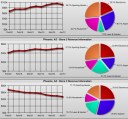
Gone are the PDFs that used to be the static receptacles of data. Now there’s Dashboard. A way to show data as gauges, charts and tables in a more dynamic way

At ASU, we’re moving into this more dynamic format so that a media person, a student or a researcher may be able to get to see the university not as a list of numbers, but by seeing these numbers map out a context.

It’s called ASU Dashboard. Some data like this is public. Other areas require a student/staff/faculty login. The data can be exported to an Excel file, or converted to a PDF.

Visualization and data and using it for decision making has come a long way since PowerPoint. You begin to respect data when you can see business intelligence in a dynamic state. On Corda, the company behind Dashboard, you can track such things as campaign finance by state or zip code, and see up to date results. Or you could see gas prices or unemployment numbers charted out.

How does it work? The application pulls raw data from a variety of public sources, some of which is accurate up to the day.

Cameras kill participation

The pastor at a church in Pinetop, Arizona made a point that got me rethinking the role of photography. “Like the Pueblos and the Navajos ask,” he said, “come in and join us, don’t observe us…please no photography.”

I’ve been into photography for a long time. At conferences, weddings and children’s school events I switch between participation and observation, making an effort to blend in and be as non intrusive as possible. Maybe I’ve been fooling myself that I could make the switch.

Photo journalists face another part of this join-us-don’t-observe-us dilemma when covering events: should they stop what they came to do and get involved, or stand back and be objective? Through their lens, they see monks getting tear gassed, accident victims traumatized, children fleeing attacks, and natural disasters. Often see journalists among the first responders. Minutes after Nik Ut captured the Pulitzer prize winning photograph of children fleeing a North Vietnam attack on a village, he and another journalist poured water from their canteens on the burned child. He then drove her to hospital.

Where does the word “engagement” stack up in this line of work? Read this story and you will realize it’s not a black and white issue. Marc Halevi of the Eagle-Tribune went to cover a rescue on Plum Island. He first saw the took pictures of a woman on a sand bank of the stormy ocean. “Seconds later as he was looking through his viewfinder, he saw a wave crash against the embankment on which she was standing, knocking down the sand and pulling the woman into the water.” So he did what any photographer would do. He clicked. He also shouted to the rescuers on the scene. “Rather than do it myself,” said Halevi, “I just made this immediate decision that (these people) would be better than I (at rescuing her).”

Participation or Observation?

Quotes for the week ending 5 April, 2008

“So why not bridge the gap between reader interest ad reader engagement by adding SMS codes, 2D barcodes, coupon codes and keyword search?”

Copy in Google ad about the value of adding encoded 2D bar codes (left) in newspaper ads that could be photographed with a mobile phone, and link reader to a virtual bookmark.

“During the inadequate training days prior to the opening, any staff questions were bounced back with ‘I don’t know’ “

British Airways baggage handler, quoted on BBC, about the chaos in Heathrow’s Terminal 5.

“Between information overload, globalization, and the sheer complexity of modern business, we’ve got to be more visual and less language dependent in communicating ideas.”

Dan Roam, visual consultant and author of The back of the napkin.

“Virgle”

Google’s April Fool’s joke (complete with maps and a Press Release) about Virgin founder Richard Branson and Google co-founders Larry Page and Sergey Brin enabling users to colonize Mars.

“Simultaneity of input.”

Mark Vacay, director of the architecture firm, SmithGroup, on the need for builders to take into account the Millennial generation’s use of space, and using electronics for multiple inputs and interaction.