Short attention span vs social media

Multi-tasking could be a terrible thing for our social life. For all our talk of interactive and conversations, we’re quietly downgrading our brains to Short Attention Span Interaction mode.

The long conversations we used to have on the phone and the face time we give our colleagues and friends are being overtaken by our capacity for IM, to micro-chat, and replace a lot of real conversations with virtual reality formats. We embrace social media, but it has a way of making us un-sociable as well. You may be doing some of this multi-tasking already; I am guilty of many as well.

  • Glancing at Blackberry during a business lunch or date, with the occasional “I have to take this…”
  • Scheduling conversations during commute, creating an elegant way to abruptly end a conversation with “you’re breaking. Let’s talk later.”
  • Chatting on IM when a phone call will work better -so that you can browse the web at the same time without getting caught.
  • Getting distracted while talking to your spouse on the phone because of a super urgent email you’re responding to.
  • Complaining that someone (usually a family member) was dumb enough to write you a real letter that she could have easily condensed it into an email.
  • Cutting off an employee interview in 20 minutes because of a ‘Blackberry urgency’ even though the candidate just started opening up.

My IABC Tech Talk Column for September

For those who are interested in my recent column for IABC’s Communication World magazine, it’s about the rewiring of Encyclopedia Britannica –a topic I have previously blogged about.

Article from IABC here. If you’re not a member, get the PDF here. In keeping with the open-source theme of the article, I even found it has been featured here!

Excerpt: “Would you allow someone to add comments to documents on your web site or post an entry to your corporate blog? Britannica’s stand forces us to look at the backroom edit wars that go on in Wikipedia (which Wikipedia calls a “breach of wikiquette”) and the vitriolic rants on your unmoderated blog as confrontation, not collaboration.”

Negative ads taint McCain’s character

He shouldn’t have gone there, but he did. John McCain stood out as a different breed among the presidential hopefuls on the Republican side, watching as contenders like Rudi Giuliani and Mike Huckabee imploded. He displayed an unusual trait in politics: Presidential.

But the Karl Rovian attack ads unleashed by the McCain campaign are showing a new trait in McCain. Desperate. Heck, you don’t have to believe me. Even Karl Rove thinks they are going too far.

“I regret, and am sometimes offended by some of the negative aspects of this campaign,” he recently remarked in an ad released on YouTube. It’s as if he’s saying “I’m John McCain; I’m not sure what I was thinking when I approved this message.”

I guess being found out (even as far back as January this year) is also regrettable.

McCain’s campaign, seduced by the capacity to launch inexpensive ads via YouTube, will soon find it is backfiring. There’s too little thought put into these pictures + sound bites + title card videos that are caricatures of ads. They taint his political stance by naively allowing the “..and I approve this message” sound clip to be added to the video.

Will negative ads backfire for Obama? Absolutely! But McCain ought to know better, having being the target of such tactics in the previous election.

Quotes for the week ending 20 Sept, 2008

“The red phone is ringing at 3 a.m.”

Senator Charles E. Schumer, on the U.S. financial crisis unfolding that has become the deciding factor between Obama and McCain. He was alluding to the phone in the Clinton ad attacking Obama about responding to a  crisis.

“Make an impact. Engage your passion. Realize your potential”

Copy on the careers page of Lehman Brothers we site.

“As communic8ters ar we boun 2 stik by thee rools?”

Rob Briggs, with a post at the Melcrum blog, on the disappearance of grammar and writing skills, thanks to texting and Twitter.

“When you have loss of life, spinning is unacceptable.”

Denise Tyrell, spokesperson for Metrolink, the company at the cross-hairs of the train crash in Chatsworth California, who resigned after she was accused of criticized for her candor at a press conference.

“Public Relations used to be about Publicity … PR pros are now much more focused on the ‘Relations’ side of ‘Public Relations.”

Todd Defren with one of his takes (he has three) on the elevator pitch for Public Relations.

“Where once there was but an ocean filled with a certain type of fish, today there are channels leading to different bodies of water, where the fish exhibit unusual behaviors and don’t respond to the old bait. It’s PR’s job to find out what these new fish in these unusual waters like to eat – before ever casting the first line.”

Parry Headrick’s response to the above.

“That would buy about 50,000 cans of Red Bull …”

News in Wired Campus, that a professor of informatics at UC Irvine has won a National Science Foundation award for $100,000 to study World of Warcraft.

“Multiply my arrogance by 1000x and you get Carly Fiorina. Wow is she clueless.”

Robert Scoble, on Twitter, commenting on Fiorina’s comments about Fiorina, once described as McCain’s economic brain.

The SEC badly needs media monitoring

Just from a media monitoring perspective, I wonder who in the Feds, if at all, is monitoring statements and warning signs in the way marketers do.

Take this quote from Alan Greenspan, made in August this year:

“There may be numbers of banks and other financial institutions that, at the edge of defaulting, will end up being bailed out by governments.”

And this, in March, Yoshimi Watanabe, Japan’s financial services minister said this:

“It is essential [for the US] to understand that given Japan’s lesson, public fund injection is unavoidable.” Watanabe called on the US to “fix the hole in the bathtub.”

That same month, Greenspan said this:

“The current financial crisis in the US is likely to be judged as the most wrenching since the end of the second world war.”

And last September, NYU economics professor Nouriel Roubini made a dire warning of a ‘hard landing‘ of the US economy

Was the SEC walking around with noise-canceling headphones?

Just wondering.

US diplomacy via blogosphere could respond faster

Amid the doom and gloom on Wall Street, another tragedy was somewhat overshadowed –the bombing of the US embassy in Yemen. I turned to at Dipnote, the official blog of the US dept of State (that I have covered here before) but there was just a passing mention, by James Glassman, the undersecretary for public diplomacy.

These are the moments for social media to provide context and value. If you’re tapping into the nodes and feedback of social media, you know that speed has a bearing on influence. It’s not always about the pictures, and good PR. An outfit like this could probably leverage enough citizen journalists when needed –to cover other stories too as they break.

It’s not that they don’t get it the engagement thing. Glassman’s conference call talks of how the US is finding its footing in the untested middle ground of diplomacy. (Do we begin to call this social media diplomacy? ) He speaks of a digital outreach team that engaged, via blog posts, the media adviser to Iranian President Ahmadinejad.

But what about the rest of the world through the lens of Dipnote? Coverage of India, and China are very slim. What’s its view of civil rights in Myanmar or Sri Lanka, for instance? Not one entry there. I’m curious to see how these new tools of diplomacy will better connect us to the big picture — the developments outside the usual (media-led) discussions of conflict, terrorism and oil.

OverlayTV: television you can mashup

I find the whole concept of OverlayTV game-changing, not just for the television industry that packages and pipes content, but to anyone looking far out enough to see where interactive media is headed.

What’s OverlayTV? It’s basically a media player that embeds video, on top of which you can add layers of product, text, a URL, coupon or graphics. Even another piece of video that works like picture-in-picture.
Sure OverlayTV is a tool, but in a malleable way that allows the end user to think of it, as the name suggests, as a layer not a piece of technology. Though initially intended for ecommerce folks, musicians, agencies and publishers, people could use it to create interesting interactive spaces.

Check this out.

Lehman Brothers’ bad news feeds

Page views up, share price down.

That’s the effect on the BBC web site, seeing a bump in traffic even as the Lehman Brothers‘ stock dropped to mere pennies, as the financial market woes play out across the US.

Just another example of how on-demand news becomes vital in a crisis.

You could almost here the sound of bad news fleeting –I mean tweeting — by.

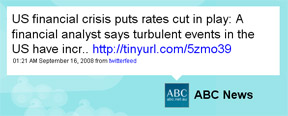
There’s the BBC’s BBCBreaking tweet, and ABC News is tweeting that investors are flocking to commodities on Wall Street.

Communicating sustainability in a turbulent economy

Close on the heels of the Green Summit, a Phoenix-based event that we backed, comes another one.

This is the Sustainability Summit in Washington DC. The panel discussion tomorrow will be moderated by Aaron Brown, former CNN news anchor who is now professor or journalism at ASU’s Walter Cronkite School of Journalism and Mass Communication.

It’s going to be an animated panel, that includes John Hofmeister (formerly the pres of of Shell, Rob Walton, chairman of Walmart, William Ford, exec chairman of Ford and others.

My guess: there will be a lot of context thrown in with relation to this week’s turbulence in the financial markets and Wall Street. Environmental challenges and the resources big corporations throw at them are not isolated from the financial turmoil we are witnessing. Besides the role that government and industry plays in all this, I am interested to see what Aaron Brown says about the role the media.

My take: Journalism needs to ramp up fast and invest more in covering sustainability –going beyond the slick headlines, and feel-good stories about recycling and changing light bulbs. This will be the topic for my next post.

Tomorrow’s live webcast here.

Time: 9 am Eastern

Tweets, shock and awe from Wall Street

With news and commentary on the financial crisis in the US, there’s no such thing as a slow news day. Or slow news week/month. Not this week for sure, with a hurricane (the storm, not the Alaskan governor) and a financial crisis.

For those who can wait, there’s pointed analysis in The Wall Street Journal which is quite a feat, considering the tight deadlines it would have had for getting these stories together.

But for those who can’t, The Economist is using Twitter as is the WSJ tweet with headlines, and links to stories of the crisis as it plays out.