Not all PR agencies get it wrong

I received one of those dreaded pitches this week from a PR firm in London.

It had the trademarks of having being picked from a list of bloggers and freelance writers: It started Press Release….

But this one was different. It didn’t have “no-reply’ or some garbled name as its sender. It also had a headline that made me want to open it and read. It was about the PR firm’s client, BBC World News.

You might wonder how relevant is that? I could have signed up for all manner of things on the World Service. But the topic was a series of shows Hard Talk On The Road –on Sri Lanka. It may sound dead simple, making sure the subject was in line with the reader. But let me frame it this way. I get so many of these PR pitches that it sometimes makes me wonder where we have taken this form of communication.

This is an industry (PR and Marcom) where everyone is screaming Web 2.0, every consultant, conference presenter and digital marketing agency is throwing out terms such as ‘Social Media Release” and RSS in every slide deck, and every book that has been published on the subject since Cluetrain Manifesto advises that ‘markets are conversations.’  In other words, stop spamming and start talking.

But all my colleagues at ValleyPRBlog, for instance, say the same thing. We are getting drowned in ridiculous PR Spam. We only complain off and on, and that, too when someone really ticks us off, or someone like Chris Anderson issues a fatwa, and everyone nods their heads and says ‘serves them right.’

But in the past 10 days I got two pitches that were spot on! Two! As such, rather than outing the bad ones, I like to hold up the good agencies and the great PR folk who do one simple task -take time to understand their audience.

  • The first was so good, from Gutenberg Communications, I have agreed to interview the CEO of the company –on Monday. If you’re interested, stay tuned!
  • And there was this from Parys Communications whose pitch was so simple, I could have hit the delete button.

As a writer I give every pitch a chance. If you take the time to filter, we will take time to read!

Pure Fitness hides billing mistake behind small print. What’s the goal here?

Ever tried to discontinue a service only to be given the run around by folks and billing bureaucracies that attempt to wear your resistance down?

It happens with big corporations, right? The ones with call centers in places like Scroungeistan…

I didn’t think my local health club would stoop so low. After all it’s more community-based. My contract with Pure Fitness ended in March 2010. It explicitly stated it was a 23 month term. I went over to tell them I would not be continuing. That was April 17th, before the next charge hit. No problem  the guy said. He’s leave a note for the admissions director. She will call me if there was a problem.

No call.

By the end of the month I got my credit card statement that, lo and behold, showed not only another charge –the 24th payment — but an inexplicable bill for $173.52.  I went over again to the location at Elliott and Alma School, and the guy tells me it must be a mistake. The person who took down the details probably didn’t communicate my cancellation info to the billing dept., so would I call the membership director. There was a new membership director, he noted. The former gal was not there anymore.

I did and the new gal gives me this spiel on why 23 months actually could mean 24 months since the account rolls into a month-to-month cycle.

Even though I asked to cancel? Even through it explicitly defines the term in the contract?

Yes. Apparently, as she noted, one should notify them 60 days prior to cancellation. As for that mysterious charge would I come in ans show my credit card statement? I said I would.

Just to be sure I got my facts straight I switched on my recorder on my mobile “for quality and training purposes” as I informed her when I called.

Today, my 4th visit, counting previous attempt months ago, I went in to get that explanation and refund for that mystery charge. I switched on my recorder this time too. For quality and transparency purposes. To  paraphrase the unhappy conversation, here’s how it went:

She: This charge (the mystery $173.52) was for your wife’s account.

Me: Huh?

She: Apparently you joined together

Me: You can’t bill me for someone else? I didn’t sign for her. She didn’t sign for me…

Me: Could you refund that then?

She: No, you will have to take that up with your credit  card company and ask them to dispute it.

Me: Ridiculous. That is a third party. I am here at this location, in first person. I want it refunded. This is your mistake!

She: We can’t do that. Your credit card company can do it.

Me: Huh? You would take their word, but I am here in person with a document to prove it is your mistake, but you want me to ask them to ask you to fix it?

She: Let me ask my boss (exit stage left)

Me: (To customer who’s also come to cancel) These Romans are crazy!

By now I get that creepy recollection of the back-and-forth we all went through when trying to buy a used car in the old days.  Is this worth my time? Is it worth the time and angst of a million dollar company? What’s the strategy here? Wear the customer down till he breaks out to a sweat without use of the treadmill?

She: (returning after meeting the hidden boss) My boss says we could cut you a check for that amount. We will get back to you…

Me: Whew! And about that 24th payment? Will that be refunded too?

She: No. The terms say you have to inform us within 60 days.

Me: (to myself) So 23 payments could really meant 25 payments. How cool is that! Someone’s gonna have a few nice corporate lunches on my account!)

Me: Show me where it says this.

(We both look over the fine print. No such thing in original contract. I agree to come back the 5th time to get most of my money refunded.)

Me: worn down, sort of. OK, You keep your $19.99. Just cancel my account.

The odd lessons about this encounter:

  • No apologies from the boss for taking so long to resolve this, for mistakenly billing me
  • Sneaky contracts. The attempt to hit the customer with sneaky fine print, and a relentlessness to attempt to prove –albeit ineffectively — that the company is right.

Oddly enough, this morning, I interviewed someone for an upcoming article about the concept of ‘markets are conversations,’ the central thesis of the Cluetrain Manifesto) where we talked of Thesis #13 and the need for a human side of business communication. The authors put it this way:

Corporations do not speak in the same voice as these new networked conversations. To their intended online audiences, companies sound hollow, flat, literally inhuman.

That was 10 years ago! Today, it’s sure easy to launch a Facebook page, and a Twitter account and pretend that you have solved the problem of corporate c0mms, while being so far removed from the conversations going on outside your walls.

There’s a lot of work to be done. Or to invoke AsterixThese Romans are crazy!

End Note: Pure Fitness, could I give you a copy of Cluetrain? Gratis! No fine print. I won’t ask for a refund. Promise!

What’s a Press Conference?

I like to link to a post I wrote at ValleyPRblog last week that received some good comments. I was curious to know who in the media had attended Sheriff Joe Arpaio’s press conference.

“I always thought a press conference was called when you had something of value to offer to the media. So when I received a text alert yesterday to say that Arpaio won’t run for governor, I was tempted to wonder what other bits of non-news might get the media to come over with cameras and notepads.” Read the rest and the commments here

It opened up a great discussion of what is a press conference. Is it an event? One reader suggested the act of announcing something to a targeted audience –via email — is no different.  Another reader pointed us to a marvelous exchange between Robert Gibbs, White House press secretary and the press corps. Apart from exploring the definition of a press conference, it shows us how a great host can disagree with the audience and still get the feedback that serves everyone, and doesn’t waste their time.

View the video here.

How to fly (through social media turbulence)

Airlines frequently fly into turbulence –not always the kind they are used to.  Just ask United. Better still, just ask Southwest Airlines. Over the years since they began embracing a slew of social media tools, Southwest has done a grand job of listening and responding. Sure, they’ve made their mistakes, fixed them fast, and moved on.

There may be a huge difference between an airline and an airplane, but I thought of juxtaposing them because of some common lessons they have for all of us –not just people who communicate about objects with wings.

If you missed this case involving Boeing, it’s worth a second look. The setup:

  • Child draws lots of pictures of airplanes.
  • Child sends one drawing to Boeing.
  • Corporate office sends him a standard letter saying it does not accept unsolicited designs, and has destroyed the letter.

Sad? Legal? Damaging to brand? All of the above?

The boys father was crushed/confused. He writes a blog so he asked his readers what to do.  Word got out. People came up with creative answers (including one that suggested writing the letter Boeing should have sent his son!) Boeing was forced to join the conversation at the late stage, and respond.

There are many lessons here. The first is about a canned response and a genuine response. So easy to do the former. But it’s out-of-place in a world where we make a huge din about being better at communications, great at listening yada yada.

To cut to the chase, Boeing Corporate (which uses this Twitter account that’s different from the one that talks of its engineering stuff) responded with aplomb, and thanked everyone for ‘supporting’ Harry Windsor, the child artist/airplane designer. “Supporting Harry,” as you might suspect is code for Punishing Boeing. Loosening them up. Humanizing them…

But we all live and learn. Boeing is a great company. They may have never in their wildest dreams of crisis planning imagined an eight year old would teach them a rapid lesson in communications. Neither do many organizations. So here are my takeaways from these two examples:

  • Plan  for the unplanned: Social media adds a lot more turbulence, often the kind that cannot be anticipated by the most sophisticated ‘tracking’ tools on board.
  • Know your audience’s audience: No matter who your end-users or customers are, your audience –and your ‘followers’ are always larger than you thought.
  • Put humans in charge. A professional response is not as good as a human response. Many of us/you are trained in the former. Don’t check your humanity at the door when you walk into your office.

Social media is nothing special. It has no secret ingredient. It is nothing more than humanized communications, for a world that has done an awful job at it.

Quotes for the week ending 30 April, 2010

The press release is dead, whether or not it’s optimized for social media. When was the last time you sent a release to a reporter who then replied with enthusiasm about covering your story?

Len Gutman, at ValleyPRBlog

Maybe it’s the term press release that is antiquated. Perhaps it should be called a fact sheet or project overview.

Holly Harmon, a reader commenting on the above.

“We are Wall Street. It’s our job to make money. Whether it’s a commodity, stock, bond, or some hypothetical piece of fake paper, it doesn’t matter. We would trade baseball cards if it were profitable. I didn’t hear America complaining when the market was roaring to 14,000 and everyone’s 401k doubled every 3 years. Just like gambling, its not a problem until you lose. I’ve never heard of anyone going to Gamblers Anonymous because they won too much in Vegas.”

An email circulating this week, written by someone supposedly form Wall Street

“An enraging piece of utter nonsense”

Huffington Post, commenting on the “We aren’t dinosaurs” email above

‘Print Grows Trees’ debate opens a fresh debate

PrintGrowsTreesPrint has always been dinged hard by those promoting digital communications as the green alternative. And why not? We’ve seen excesses that are so revolting –boxes of glossy annual reports that have to be tossed, multiple-page bank statements etc.

The Print Council has been very sensitive to that in their PR, and has a talking points document called “The fine print” to rebut those arguments.

So this campaign is not surprising. Called Print Grows Trees, it attempts to communicate some aspects of the print industry and its relation to forests. Specifically “to show that print on paper actually helps to grow trees and keep our forests from being sold for development.”

Let’s face it: Many of us who have gone digital are big fans of print; it’s not a simple either/or choice. We buy newspapers and magazines, but avoid picking up brochures and flyers whenever we could download them and read them as a digital file. We encourage people to ‘think before you print’ but we do carry business cards (GreenNurture uses Quick Response tags on business cards to avoid brochures) using recycled paper, printed with vegetable inks.

Print on demand, and Personal URLs (‘those ‘PURLs’) are some of the solutions that almost every printer now offers. PODI, the Print On Demand Initiative, educates members and everyone else about print and social media, QR codes etc. So yes, the print industry has done some good things to erase the dead-tree stigma. This campaign though seems to push the envelope (bad choice of word?) a bit.

It definitely –deliberately–frames the debate as an economic problem-solution and not just an environmental one. Is it a dangerous myth, as Jay Purdue and others suggest, one that “has significant environmental and economic consequences” to say that print kills trees? If you haven’t run into the seemingly oxymoronic term ‘digital deforestation‘ be prepared to hear more about it in the next few months.

Or is Print Grows Trees a symptom of ‘tree guilt’ felt not just the print industry but by all of us when we forget to turn on the double-sided feature before hitting Control-P?

Social media’s dark side – badmouthing just because you can

Heard about Unvarnished?

Tech Crunch’s Evelyn Rusli has a great analysis of taking our ability to trash anyone online to a logical conclusion. I thought this was a very powerful statement about a new

“My guess is that many will be seduced by the dark powers of the internet (the power to hammer an adversary under the guise of anonymity).”

Unvarnished is still in Beta so unless we try out the service we won’t know what it entails. Maybe it is not another site that attracts dirty linen basket cases. Maybe they do have a great idea, based on their description: That it is going to be “community-contributed, business-focused assessments” about “building, managing, and researching professional reputation” and “professional reviews.” They do advice being fair and balanced.
“However, with the right to share candid opinions comes the responsibility to do so in a balanced way. Be honest, but be fair. Only review people you have a professional relationship with. Only discuss business-related topics. And remember, reviewers earn an authority rating over time, based on how others rate their reviews, so it is in the best interest of reviewers and the community to leave helpful reviews.”

But it brings up a point I have always wanted to talk about. Beside the power to say things under a false identity, the ‘dark side’ to me is how easy it is to use (misuse) our channels and our tools to say things just because we can.

  • It’s so easy to trash a brand because we have a network
  • It’s way too easy to make our bad experience with a product seem like it is an universal problem, when the truth is we may have bought a lemon, which yes, needs to be replaced
  • It’s easy to spread an idea we didn’t originate when the premise may be flawed

As you can see, I am not prepared to support Techcrunch’s view of Unvarnished, until I have tried it out.

Have to say I have, in the past, often used a social platform as a soap box. Now I think thrice before I do so. Often it is only after repeated attempts to use the traditional fix-it channels.

On the other hand, I know of plenty of examples where someone using a tweet has had a better, immediate response than a call to the 1-800 number. Maybe Twitter is the new 1800 customer complaint number staffed by real people. I know of someone who now has what amounts his own ‘concierge service’ and a good friend at a service company only because he used Twitter to not just bitterly complain but to start a conversation.

It’s darn too easy to stack your dirty linen baskets, rather than do a bit of work, turn a few knobs and engage the ‘machine’ to clean them up.

Whatever happened to positive feedback?

Quotes for the week ending 20 March, 2010

“We subscribe to the Woody Allen theory of social media — 90 percent of social media is just showing up.”

Scot Monty, Ford, on NPR’s Marketplace

“If you look position descriptions for companies that are hiring in their communications department, their marketing department. They’re all looking for social skills.”

Shel Holtz, in the same interview

“If your brainwave is picked as the ultimate green idea …you could win £100,000 for your favourite organisation to spend on its green initiative.”

Marks & Spencer, launching a campaign called ‘Plan A’ that seeks consumer-generated ideas as it seeks to be the ‘most sustainable retailer’ by 2015.

When you have to explain “it’s company policy” you’re in damage control

I am a big fan of Southwest Airlines, have talked-up and written about them before. So it’s confusing why this incident had to happen. (Variously referred to as the ‘too fat to fly’ snafu).

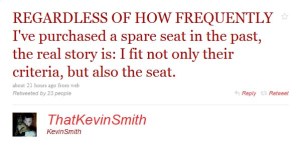
So while it was time Southwest explained what the policy was –a so-called ‘Customer Size Policy that they explained here — it was not winning anything. After-the-fact PR and damage control is not going to clean up the mess.  United Airlines learned it very recently.  Sure Mr. Smith has great tweets and some 1.6 million followers.

But you have to assume every passenger is a Kevin Smith with a network, and a voice, and an audience, even if it is an audience of a few dozen followers.

Quotes for the week ending 12 Dec, 09

“However Mr. Jobs, now that you got into this mess …You are the only person who can get our APPS ‘everywhere.’ despite the fact that their MAPS have blanketed the country.

Commenter named Gary of Chicago, on the Advertising Age story on how Verizon Wireless created buzz for the Droid phone –a distinct shift in the way a carrier is advancing the popularity of a handset.

“And, the warning? Don’t read too many blog posts like this.”

43 Folders, on NaNoWriMo

“Living Stories,”

Google’s experimental project to save newspapers, featuring content from New York Times and the Washington Post

“Our role is actually stronger than ever, because we are more than  just a magazine … to promote travel around the state.”

Robert Stieve, editor of Arizona Highways magazine

“When you’re using search engines, you’ve got to be diligent. You can’t trust that just because it’s Number 2 or Number 1, it really is…”

Jim Stickey, on how fake web sites trick search engines which become ‘unwitting accomplices’ of Google, Yahoo and Microsoft.

“Industry Listening Program”

One of the four recommendations by Rohit Bhargava, who advises companies on easing into listening via social media by keeping an eye on keywords rather than brand mentions