The scarlet letter in PR: B for bias

Let’s talk bias. Who deems something one-sided, slanted, and sometimes even libelous?

How about your press release? What’s that you just said about your CEO? Is your product really a “the world’s most advanced…?” (insert “battery,” “fiber optic solution,” “online file-sharing…”) Is your corporate blog verging on spin, and do you let people join the conversation?

And then there’s what you’d like to maintain on Wikipedia, if not for those pesky editors.

Solomon Trujillo’s PR people are not happy. You probably may not have heard of Mr. Trujillo, unless you were in the telecom space, or peeked behind the curtain on Wikipedia now and then. On the Wikipedia entry for the new Telstra boss, there is what we now call an ‘edit war’. Someone seems to have an axe to grind about Trujillo, going back a year. “It’s hard not to have a NPOV when he has not done nothing positive,” the person says. NPOV refers to Wikipedia’s ‘Neutral Point of View’ policy. Meaning, you cannot slip in hyperbolic statements or snide attacks. If they find out you get called out. In Wikipedia’s terms, the statement:

“This article may require cleanup to meet Wikipedia’s quality standards.”

It’s the equivalent of the scarlet letter that screams “Bias!” I have found many Wikipedia entries with these stamps of disapproval.

Two weeks ago Tarnya Dunning, a senior PR person at Telstra tried to fix the mess, staying away from the edit war mentality saying: “I’m here to contribute information that will improve the quality of Telstra-related pages. I am aware of Wikipedia’s policies and guidelines and I will abide by them. My edits will be restricted to talk pages, and I will not engage in editing directly any Telstra-related page. Instead, I would volunteer information on the talk pages, and ask for Wikipedians’ help.”

So far no one in Wikipedia has responded. Is Wikipedia the ultimate arbiter of what’s neutral, and what’s biased?

On the other side of the coin, Telstra has had its share of social media criticism. Its blog, Nowwearetalking, which encourages a “lively informed debate” is a moderated blog. They do have a wikipedia-like policy, though which says.

“If you object to a moderator modifying your posting then it may be rejected.”

Which sound a lot like “your post may need some cleanup to meet our quality standards.”

Quotes for the week ending 12 April, 2008

“Nobody has the right to say ‘shut up’.”

The Dalai Lama in Japan, saying he supports the Olympics in China, but that protesters have their freedom to speak.

“experience great nights out without the fatigue.”

Description of Burn Alter Ego, a Facebook application from energy drink, Burn (a Coca Cola product) that lets people’s avatars go out and mingle with others, and have an automatic blog post about the encounters.

“Geoffrey Moore’s “late majority” and “laggards” have yet to join the party, but they will.”

Shel Holtz, interviewed by ValleyPRBlog, on the adoption of social media and its impact on PR.

“It’s a dreamer’s ad.”

Barb Rechterman, Exec VP at domain registrar GoDaddy, on the un-risque ad, “Kart” featuring (finally) a message about web sites.

“It is depressing that sound bites have replaced sound judgement, and that character assassination of one’s opponent has become expected political strategy.”

Cal Thomas, Tribune Media Services

“I just wonder why the torch was running away from the people.”

Jerry Fowler, president of the Save Darfur Coalition, on the tactics used to protect the Olympic torch in San Francisco.

“That, ladies and gentleman, is what you call your ‘marketing challenge’.”

Bob Garfield, Advertising Age, about an ad by John McCain that makes us forget the Iraq war, but unhelpfully invokes Vietnam.

Quotes for the week ending 22 March, 2008

“Arthur C. Clarke dies at 90.”

News that sci-fi writer and author of 2001: A Space Odyssey, promoter of the communications satellite, died in Colombo, Sri Lanka on Wednesday 19 March, 2008.

I’m as delighted as anyone that Starbucks joined in the “conversation” this week.”

Sarah Wurrey of Custom Scoop’s online magazine Media Bullseye.


“One of the unintended consequences of my dad becoming the presumptive Republican nominee is the increased level of public scrutiny on him and our family.”

Meghan McCain, daughter of John McCain, who blogs at McCainBlogette.com

“Barack Obama is three things you want in a brand … New, different, and attractive.”

Keith Reinhard, chairman emeritus of DDB Worldwide in a Fast Company article on “The Brand called Obama.”

“Financial woes overshadow all other concerns for journalists.”

Headline of a report by Pew Internet, on the positive response many journalists give new media.

“PR stunts can definitely be a great way to make a splash and get some attention — but you’ve really got to know where to draw the line.”

Len Gutman, at ValleyPRBlog, commenting on giant fetuses displayed by ASU students supporting right to life.

“The Internet feels like Dubai.”

Steve Rubel, on why the future of the web is web services not web sites –a combination of big ambitious projects and small initiatives.

Southwest Airline keeps up the conversation

With apologies to T.S. Eliot, March is the cruelest month of the year.

One week before the other Eliot stepped down in the middle of a scandal, and Geraldine Ferraro played an “accidental” race card,” Southwest Airlines put three employees on paid leave and grounded 41 planes. With such an inspired management team, it has never needed to get to this level of damage control. At the Southwest blog, Nuts About Southwest, they have done an admirable job of addressing unflattering issues in the past. They are one of the few companies that allow employees and not just the marketing or PR types to be the voice of the organization. But on this issue, the lawyers seem to have been dragged in and scuttled the bloggers to the back of the plane.

Last week’s post “We take safety seriously” (about a voluntary disclosure by the airline of cracks in 2007) began with “Friends…” but had language that was more lawyered than the usual blog talk from pilots, ground staff and flight crew. This week the blog was a cut-and-paste outlet for its press releases.

Through all this, one thing they are doing a great job of is allowing readers/passengers to leave comments, many of them unflattering. Some readers have challenged the critics, but at least there is a conversation going on.

Should Obama brush off plagiarism, or “turn the page?”

Maybe Barack Obama did “borrow” words from Massachusetts governor. It brings up two interesting questions:

  1. How much of what we use in communication should we attribute?
  2. How fast should we come back and apologize?

He called it “too big of a deal,” but as recent history has shown us, plagiarism has been quite a deal. From Dan Brown (Da Vinci Code) to Kaavya Viswanathan (How Opal Mehtha got kissed…) to journalists who inadvertently use material without attribution.

“Certainly plagiarism can have degrees,” notes Steve Buttry. And in case you’re looking for attribution,it’s a quote from the American Press Institutes‘s web site, in an article “When does sloppy attribution become plagiarism.” He goes on to say, “For the most part, sloppy attribution is to plagiarism as manslaughter is to murder.

As Plagiarism.org suggests, it’s good to attribute:

  • whenever you use quotes
  • whenever you paraphrase
  • whenever you use an idea that someone else has already expressed
  • whenever you make specific reference to the work of another
  • whenever someone else’s work has been critical in developing your own ideas.

That the accusation comes from the Clinton campaign, makes sense. She is running out of brand differentiation, and will turn to the department of dirty tricks –even though she has lifted lines from Obama such as “Yes we will!” that echoes his “Yes we can!“The ‘academic’ rebuttal -explaining the circumstances of the borrowed words– is never good enough. Considering how anything you say in an election campaign can and will be mashed up, Youtubed and turned into a Swiftboat attack, this could be grave stuff.

Just apologize, and let’s “turn the page,” no matter who strung those three words first!

Quotes for the week ending 16 Feb, 2008

“I frankly don’t care who just wrote what on someone else’s Wall or who just joined the Carbon Foot Print Group.”

George Simpson, at OnlineMediaDaily, about Bill Gates turning off his FaceBook page, and the need to ‘Unplug. Delist. Erase. Take down,’ and get a life off-line.

“It’s 1980 in my office — I can’t get on the internet, but I hear it’s just great.”

Brian Williams, talking about the computers being down at NBC, and having to fly blind in prep for the evening news.

“Sure, Wikipedia can and should be “used for research”, in the same way a classroom might use a cadaver for research. The class shouldn’t take the cadaver home to meet Mother, nor should it use the cadaver to co-sign for a loan.”

Comment by reader at The Chronicle of Higher Education, responding to the news that a professor at the University of Texas encourages his students to read Wikipedia –the discussion and history pages, specifically.

“A case study (is) really a story about a hero, a dragon and a damsel in distress. The dragon is the business problem-for example, a project badly behind schedule and over budget. Your company is the hero. The client is the damsel in distress.”

Gail Z. Martin, on identifying your customer’s story, at Marketing Turnaround Blog.

“As writers and directors, we have our nose in the tent for real for the first time.”

Tony Gilroy, writer and director, on the value of the Writer’s Strike that ended this week.

“Whatever one calls it, the Council/Bulldog project has a foul odor.”

Ray Kotcher, Council chair of the ethics committee of the Society of Professional Journalists (and Ketchum CEO) on the shady alliance of the Council of PR Firms’ and the Bulldog Reporter.

Social Media Release, a work in progress

David Fleet started an interesting discussion, based on a problem he ran into with the Social Media Release.

The problem, as he explains in the structure of his post, is one of bullet points, embedded links and sections, rather than the conventional narrative structure.  Meaning, the press release doesn’t pretend to be a pre-fabricated story for lazy editors.

With some compromises, it had a happy ending s he noted on For Immediate Release (Show # 319,) but it re-opens the topic of whether the SMR is ready for prime time.

There were big objective: to increase access, provide context, make it seo friendly, and the big one, to leave out the spin.  The last is a big one, since most editors don’t want a PR department to write their stories, but give them the hook. Big difference. Then there’s the convenience factor of the embedded links, one-click image downloads and the delicious and technorati tags.

Getting all these in one place, for many organizations is a work in progress. We love our ‘shared folders’ and our media pages, but they’re not exactly accessible and journo-friendly.

Just saying “No” – two ways to advertise

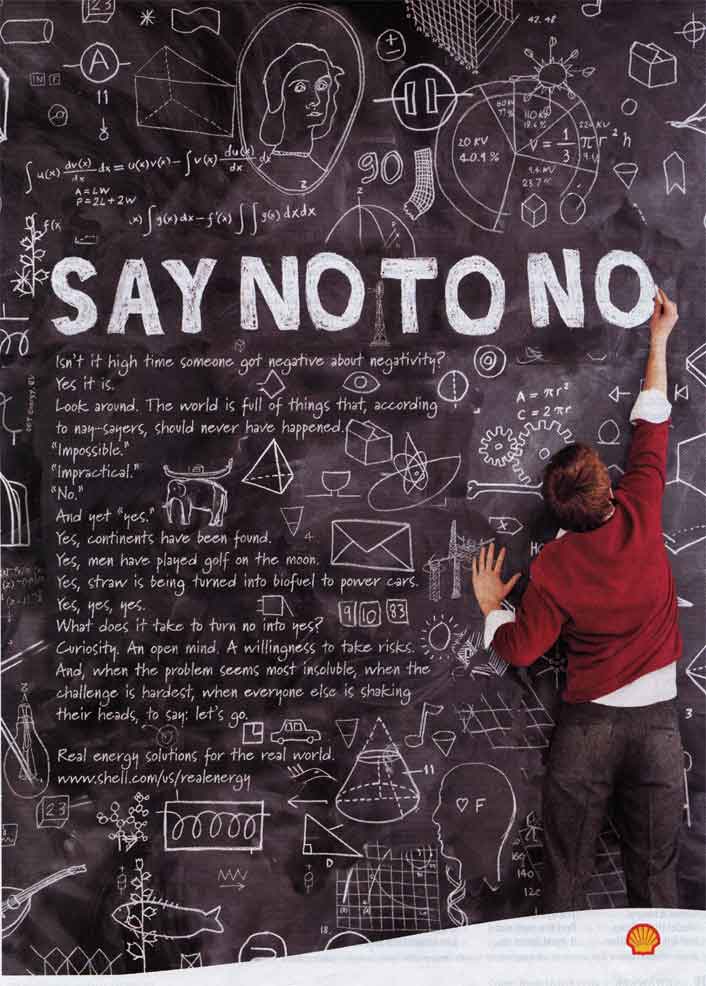
shellad_tn2.jpgHave you noticed how the word “No” has gained currency in advertising?

This ad from Shell has been running in some magazines and tells of how the world is full of nay-sayers and those who put down ideas as impractica.l “What does it take to turn no into yes?” it asks. “Curiosity. An open mind. A willingness to take risks.” Somewhat buried in the copy is a link to Shell’s microsite.

But close upon the heels of celebrating “No” is another great execution by BMW, featuring an ad and an insert in WIRED. This time it takes the opposite side, celebrating the word No. “No closes doors… but when used to break convention, it opens more,” the copy reads. As in: “No, we will not compromise ideas. No, we will not do it the way everyone else does it …the ability to say No for all the right reasons.”

To Shell’s credit, it’s not all ad copy. In a report last year, president John Hofmeister blames the oil and gas industry for the “public policy deficit” with regards to energy. “I do not blame the elected officials. I do not blame the American people. I blame the industry for not having spoken of this issue…” he says. At the site, they talk about the energy crisis as a “crisis of inertia.”

Say what you will about Shell, but at least its marketing is in sync with its president.

Quotes for the week ending 2 Feb, 2008

“Microsoft and Yahoo: The Bid Heard ‘Round the Web.”

Story in Fast Company about the hostile bid by Microsoft to acquire Yahoo for $44.6 billion.

Well then, I’m outta here!”

Flickr user in protest of the Microsoft bid. Flickr, a Yahoo property, features images like this one

“This will be the first year that viewers will have two remote controls… the one in their hand, and the one in their pocket.”

Nihal Mehta, CEO of ipsh, a mobile marketing agency, on the use of short codes for voting on advertising during the Super Bowl.

“Citizen journalism is a new way to provide content to readers. That’s where the truth ends and the snarkiness begins. “

Paul Maryniak, Southeast Valley GM for The Arizona Republic, on the value of its “News By You” option for readers.

“The only Republican who promises to end the George Bush style of governing from and on behalf of a small, angry fringe.”

New York Times endorsement of Senator John McCain.

“Oh, by the way, I think there’s also a football game on Sunday.”

Shel Holtz on the news that a new website called Firebrand will feature television commercials