If civic journalism is hard to accept, how about traditional journalism?
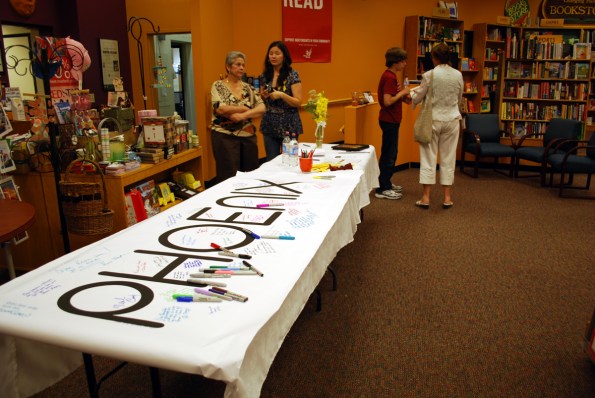 As a writer I felt compelled to stop by a favorite hangout in Tempe, Arizona last week for the vigil for Laura Ling and Euna Lee. Who are they? Two journalists facing a 12-year sentence in North Korea –whose plight was buried by media obsession with the gloved one.
There were similar vigils in San Francisco, Sacramento, Washington and Paris. The goal was to collect one million signatures to petition their release. I was somewhat disappointed in the turnout.
The goal was to collect one million signatures to petition their release. I was somewhat disappointed in the turnout.
Other than the vigil here, there were vigils in San Francisco, Sacramento, Washington and Paris.
But beyond their plight, as the attack on journalists goes on, it begs a larger question: do citizens really care if the media is muzzled, punished, expelled? Whenever I speak to people about this, I get the feeling that the answer is sadly, no. Or (long pause) ‘maybe.’
It amazes me how many enthuse over how anyone with a Twitter account or camera phone could report on a breaking event, but give scant attention to others who stand in front of the line, taking the hits. Maybe it’s because we still see the media in a “Them” vs “Us” dichotomy.
You want to see real blur? The blur between the Pro (professional) and the Am (amateur) is happening before our eyes. Take a look at what a news station in the Philippines is doing. ABS-CBN is holding a series of workshops on citizen journalism that will arm Filipinos with the knowledge and skills to report on events and incidents concerning the 2010 elections. Already 13,000 Filipinos have signed up.
Here’s another eye-opener. A list of countries ranked by degrees of media freedom. Only 70 countries are ranked ‘Free’ while 61 are ‘Partly Free’ and 64 are ‘Not Free.’ Check the list here. It’s an eye-opener for many here because freedom of the press, something we take for granted, is not exactly universal, and varies in degree.
- Egypt, for instance is ‘partly free’
- Sri Lanka is ‘not free’ –no different from the likes of North Korea, and Saudi Arabia
- Only 70 countries are ranked ‘Free’ while 61 are ‘Partly Free’ and 64 are ‘Not Free’
It’s not just about two TV journalists is it? It’s much larger than that.
On a positive note, there appears to be some hope of a release, if Washington and Pyongyang held talks. Check this site, lauraandeuna.com for updates, and sign a petition here.

 E.J. Montini, another wonderful writer here in the Valley is right now going through a similar process. In last week’s Republic
  Talk about mixed signals!
 “Authentic communication is the new requirement, a paradigm shift has already happened, and most companies and communicators haven’t made the shift.”
 A note about Light Bulb Moments. It’s a sort of a peek behind the curtain, if you will, at what goes on here at the
 Hoipolloireport