The ‘news we choose’ won’t land on our doorstep

Long post alert!

As is patently obvious from this blog and my other work, I’m a big supporter of crowdsourcing and citizen journalism, wikis and collaboration.  Not just a cheerleader, but a practitioner. But I’m also a concerned citizen looking beyond the cool factor Digg, and the amazing possibilities of ‘knowledge’ aggregators, and the Twitter stream of consciousness.  I am awed by the new trends in journalism such as spot.us, yet I can’t resist picking up a newspaper.

The big question I ask myself, and am asked by others, is if our addiction to instant gratification, and near-ubiquitous access to content is making us more informed, and … more shallow? Is the blogosphere accelerating a trend where consumers grow up on a diet of context-free data, pinging on the walls of  interconnected echo-chambers? What’s that Eliot quote? “Where is the knowledge we have lost in information?”

Less than two years ago, Pew Research published findings from a study it conducted to see how crowd-sourced news differs from the news that editors of media organizations put together.

It found that:

  • There was a big difference –that “many of the stories users selected did not appear anywhere among the top stories in the mainstream media coverage.”
  • 70% of the stories users selected, came from blogs or Web sites such as YouTube and WebMd.
  • Recommended stories focused more on “news you can use” (such as advice from the WHO health advice etc)

Most concerning was this. It found that “Despite claims that the Web would internationalize consumers’ news diets, coverage across the three user-news sites focused more on domestic events and less on news from abroad than the mainstream media that week.”

When people do make choices of what news to stay on top of, they found that:

  • They seek it form sites that do not focus on ‘news’ per se.
  • Most stories they chose had very little follow up, and appeared only once, never to be repeated
  • They tended to choose news that was more sensational in nature, with a heavy dose of crime and celebrity

But having said that, citizen-based media is not the end of newspapers –and good journalism– as we know it.  A more recent study by Pew (the Project for excellence in Journalism) on the state of the media in 2008  found that citizens are playing a bigger part in news produced by ‘legacy media’ but citizen sites were few. Rather, citizens are being used more as sources than reporters.

What does this all mean? To me it’s not all that discouraging.

  1. Legacy media is just sampling what it means to empower the hoi polloi to fill the news hole; this tricky experiment is ongoing. Citizen sites are providing the kick in the butt for this trend, even through they aren’t kicking too hard.
  2. The news we choose may land in our RSS reader, not on our doorstep, but not in the way we can taste it now. Very soon some smart media organization is going to learn how to package legacy content and citizen content, blend the ‘Dugg’ stories with those reported by solid journalists, and deliver both.
  3. Unless a new type of journalism is taught in schools, the new journalism (content and delivery systems) will be a long time coming. The good news: Digital journalism is being taught in many places. Editors and publishers are taking on issues such as hyperlocal news, free vs fee, the semantic web

Rupert Murdock’s attempt to charge for online content, including content from NewsCorp’s newspapers and TV channels may be a flawed move, but it has woken everyone up.

(Incidentally, that story was also reported by Newser, an  “online news service that adds human intelligence to machine-driven aggregation”)

Ouch!

The best news this week, release of Ling and Lee

Back at work after being off the grid for four days, it was great to see the news of the release of Laura Ling and Euna Lee.

The photos from Clinton’s visit struck me as being one of the most ridiculous photo-ops (since George Bush on the deck of an aircraft carrier).
Eight people looking shell shocked on the green rug, the wave mural in the background… Sheer political theater, with bad stage management.

How could this photo save face for a government that held two journalists captive? Everything about it reveals how tense, and cold the situation is. Why bother even taking this photo?

Incidentally the photo comes via the Korean News Agency which ran a story on ‘Trial of American Journalists” reporting their ‘crimes.’ I wonder if the State Department comments on, and the local media questions how KCNA frames the visit:

Clinton expressed words of sincere apology to Kim Jong Il for the hostile acts committed by the two American journalists against the DPRK after illegally intruding into it. Clinton courteously conveyed to Kim Jong Il an earnest request of the U.S. government to leniently pardon them and send them back home from a humanitarian point of view.

Of course, we know this is the stuff of propaganda.

Quotes for the week ending 18 July, 2009

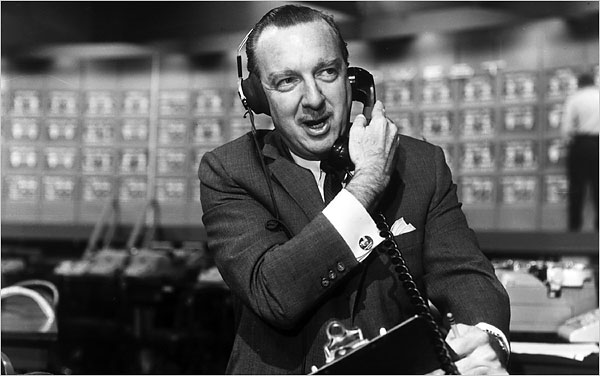
As we say farewell to ‘the most trusted man in America, I wanted to dedicate this week’s Quotes of the Week to Uncle Walter, a role model for me, and for many in journalism, and storytelling.

In seeking truth you have to get both sides of a story.”

“Everything is being compressed into tiny tablets. You take a little pill of news every day – 23 minutes – and that’s supposed to be enough.”

“Television [is] a high-impact medium. It does some things no other force can do-transmitting electronic pictures through the air. Still, as an explored, comprehensive medium, it is not a substitute for print.”

“Objective journalism and an opinion column are about as similar as the Bible and Playboy magazine”

“It wasn’t just that he narrated the spikes in modern history …Mr. Cronkite’s air of authority, lightly worn and unquestioned, was unusual even then.”

Allesandra Stanley, in The New York Times, about Walter Cronkite, who died on Friday.

“And that’s the way it is.”

Great summaries of his life here:

CBS News

Walter Cronkite School of Journalism and Mass Communication

Arizona vigil for Laura Ling and Euna Lee opens larger question

If civic journalism is hard to accept, how about traditional journalism?

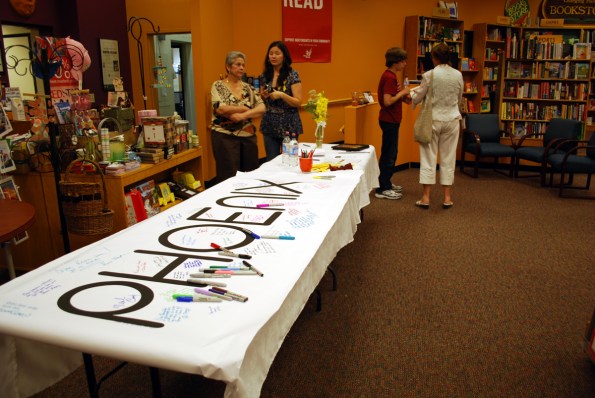
As a writer I felt compelled to stop by a favorite hangout in Tempe, Arizona last week for the vigil for Laura Ling and Euna Lee. Who are they? Two journalists facing a 12-year sentence in North Korea –whose plight was buried by media obsession with the gloved one.

There were similar vigils in San Francisco, Sacramento, Washington and Paris. The goal was to collect one million signatures to petition their release. I was somewhat disappointed in the turnout.

The goal was to collect one million signatures to petition their release. I was somewhat disappointed in the turnout.

Other than the vigil here, there were vigils in San Francisco, Sacramento, Washington and Paris.

But beyond their plight, as the attack on journalists goes on, it begs a larger question: do citizens really care if the media is muzzled, punished, expelled? Whenever I speak to people about this, I get the feeling that the answer is sadly, no. Or (long pause) ‘maybe.’

It amazes me how many enthuse over how anyone with a Twitter account or camera phone could report on a breaking event, but give scant attention to others who stand in front of the line, taking the hits. Maybe it’s because we still see the media in a “Them” vs “Us” dichotomy.

You want to see real blur? The blur between the Pro (professional) and the Am (amateur) is happening before our eyes. Take a look at what a news station in the Philippines is doing. ABS-CBN is holding a series of workshops on citizen journalism that will arm Filipinos with the knowledge and skills to report on events and incidents concerning the 2010 elections. Already 13,000 Filipinos have signed up.

Here’s another eye-opener. A list of countries ranked by degrees of media freedom. Only 70 countries are ranked ‘Free’ while 61 are ‘Partly Free’ and 64 are ‘Not Free.’ Check the list here. It’s an eye-opener for many here because freedom of the press, something we take for granted, is not exactly universal, and varies in degree.

  • Egypt, for instance is ‘partly free’
  • Sri Lanka is ‘not free’ –no different from the likes of North Korea, and Saudi Arabia
  • Only 70 countries are ranked ‘Free’ while 61 are ‘Partly Free’ and 64 are ‘Not Free’

It’s not just about two TV journalists is it? It’s much larger than that.

On a positive note, there appears to be some hope of a release, if Washington and Pyongyang held talks. Check this site, lauraandeuna.com for updates, and sign a petition here.

Civic journalism is coming. Get over it!

This story gives a new meaning to the term muck raking.

I like the idea of citizen journalism, and have written a lot about it in the past. I even try to practice it a bit, because there are some stories the media will never get to.

Civic journalism is even more interesting, basically community-funded journalism.

So it was interesting to see how the Director of Spot.us have to defend one such project. The site lets people submit ideas for stories and have media companies bid on them –basically fund the reporter. Lindsey Hoshaw, had suggested she could report on the Great Pacific Garbage Patch, a large amount of garbage that supposedly twice the size of Texas, floating around in the Pacific Ocean.

One reader sniped about the fact that someone was being paid for this, and Cohn had to come back and defend the fact that Hoshaw was being funded.

“The money we are raising is just for travel. That is a real and high expense for this story (it is in the middle of the ocean) – so that is where ALL the money is going. The reporter here isn’t going to pocket it.”

As Cohn rightly observed, such mean-spirited attacks serve no one.

But beyond this, the real issue is the public perception of -indeed, public appetite for —  what big media ought to be covering. After seeing the OJ-like dragging on of the Michael Jackson story, my cynical side tells me that people need to wallow in this stuff. But I tend to be more of an optimist. I’ve met journalists who go for the bigger things.

I think we are at a moment where people will support stories not connected to celebrity and partisan politics. Is it better to spend $6k on a story about garbage than a story on a goofy governor? Is it worth our time, their airtime and all those satellite trucks to chase after Jon and Kate? Let’s do a survey on this.  I am willing to bet we’ll see a lot more thumbs up.

People will consume what is served up (hence the formulaic stories on ‘Dirty restaurants,’  and ‘scams on Craigs List’) but they are also tuning out, Tivoing past, and canceling their subscriptions for a good reason.

Civic journalism will take time, but it is coming. We better get used to it.

If Henninger can do it, so can Montini

I love Don Henninger’s column in the Phoenix Business Journal. He comes across as the neighbor you always bump into when you mow your lawn –and happily gets in the way of that awful chore.

A few weeks back, when he wrote about ‘Seeing a Tweetie bird‘ I knew this was the moment I was expecting. “I’m a Twit” he opened with, admitting he was late in arriving, but inviting us to interact –minus the what-we-have-for-breakfast stuff. (Find him here on Twitter.)

E.J. Montini, another wonderful writer here in the Valley is right now going through a similar process. In last week’s Republic he’s all Facebooky but not all atwitter, he says.  Montini already maintains a blog. My guess is that it won’t be long before he’s carving out 140-character column-like posts. Any bets?

I’ve seen news people I would least expect take on parts of social networking and blogging that must have gone against the grain of what they were taught at J-school.

You can do it Montini!

Some useful links:

Bad week for blogger & radio hosts, mixed week for txt & tweets

Talk about mixed signals!

I came across two SMS stories that left me feeling that we are still getting our minds and lives around the potential of one-to-one communication and what social media has delivered.

Seven building blocks for a good story

We all tell stories, in some shape or form. They could start off with something like “Happy families are all alike; every unhappy family is unhappy in its own way” (Anna Karenina). For the rest of us –even as we question the established technique— there are several ways to go after and craft a good story.

Tom Hallman, in last month’s Quill the magazine of the Society for Professional Journalists wrote a great piece on what separates a good story from a great one.

  1. Distance – a story is more than a bunch of quotes, he says.
  2. Stories are about things People, not ‘things’ give people a chance to identify with the story
  3. Direction – take the reader someplace
  4. Pacing – Vary lengths of paragraphs
  5. Theme – the best stories have an universal theme
  6. Voice – this speaks for itself. You need to find your voice
  7. Strong middle and powerful endings  – pay attention to the entire story, not just the beginning

From: Building Blocks to a good story.

Hallman is a Pulitzer prize winner and features writer for the Oregonian.

New news reporting style emerges

In case you’ve been following the thread about a new attitude toward reporting and some of the trends we occasionally highlight, you may want to check how some parts of the media is covering the Iran elections.

The New York Times, which is as mainstream as you can get, is unleashing its full force of new media smarts in the online section called The Lede. Check how they are updating, aggregating reports from a variety of sources, and keeping the story alive.

Follow it here.

Here is how they describe the new experiment:

“The Lede is a news blog that remixes the day’s top stories, adding information gleaned from Web sites around the world or gathered through original reporting by writers, editors and readers of The New York Times, to provide fresh perspectives on events and to draw readers in to the world-wide conversation about the news taking place online.”

Quotes for the week ending June 13, 2009

“Authentic communication is the new requirement, a paradigm shift has already happened, and most companies and communicators haven’t made the shift.”

Barbara Gibson, in her last post (The Last Hurrah) as outgoing IABC chair.

“that onerous system of checks and rewrites and hand wringing where legions of non-writers add their personal stamp to a piece of communication … to the point of unreadability.”

Steve Crescenzo, citing one of the two biggest obstacles to effective internal comms. The other is an overzealous IT Team.

“Twitter Tees brings community-powered t-shirt design to Twitter.

Threadless, which launched a way for Twitter users to vote on 4 T shirts with tweets that include “in space, no one can hear you tweeet” and “140 is the new 420”

“He’s the most … trollish person I’ve ever worked with!”

Leo Laporte, after cutting off Tech Crunch’s Mike Arrington, who suggested that Laporte had received a free Palm Pre.

“Did I really want to tell the world that I was out of town? Because the card in my camera automatically added location data to my photos, anyone who cared to look at my Flickr page could see my computers, my spendy bicycle, and my large flatscreen TV all pinpointed on an online photo map.”

Israel Hyman of Arizona, who claims his house may have been robbed because of his Twitter updates.

“We got the cure for Search Overload Syndrome.”

Microsoft Bing copy, on Facebook

“Every three years, the world completely changes, which makes strategic planning difficult. But while you can’t predict a future, you can prepare yourself for multiple futures.”

Mike Curran, the unofficial jobs guru of Silicon Calley, who is retiring after 23 years as director of NOVA

“we forgot the relationship part of public relations”

Lee Hopkins (@leehopkins) tweeting at the #IABC09 conference in San Francisco this week

“Although the pandemic appears to have moderate severity in comparatively well-off countries, it is prudent to anticipate a bleaker picture…”

Dr Margaret Chan, Dir Gen of World Health Organization, on raising the global pandemic level to Level 6

“a high-stakes poker game”

Former U.N. Ambassador Bill Richardson, on North Korea sentencing of two US journalists, Laura Ling and Euna Lee