Robotics 2016 challenge guessing game begins

Each year, as we wait for details of the FLL Robotics challenge, some teams begin speculating what the specific challenges might be on the tournament table.

FLL had announced the theme, ANIMAL ALLIES. If we were to look into the crystal ball, there could be ‘missions’ around animal rescues, conservation and human-animal bonding.

Previous themes have been: Conservation, Education, Health, Ageing populations, Food, and Catastrophic Events.

Animals will certainly fire up elementary school students, especially in the research project. As for the missions, here is how one team speculates what the table-top missions could be, with detailed builds!

AS the FLL puts it, ANIMAL ALLIES season will be all about young people collaborating to solve a real-world problems. That’s the part I like about the FLL. It creates a rich, evolving context for students who could see bots as part of society they inherit and –most importantly, will influence.

What’s a humanoid robot doing in a STEM class?

Intrigued by robots that look less like appliances and more like humans?  Even I sometimes get a bit creeped out.

But this little guy, NAO, changed my perspective. It is a learning tool, no different from any other bot, such as a spherical bot, a drone, or an Lego NXT brick. It’s got a friendlier interface, too.

I met the company that showcased it, RobotLAB, and this week spoke to their team members about how it can help students learn programming. It’s possible to even incorporate it into some aspects of a STEAM program.

ISTE 2016 Denver (17)I found out that some schools in the San Francisco Bay area are using this NAO to support reading and writing modules. As you might imagine, the program – a software and hardware package- is a bit pricey. But they are big on year-round support for teachers. Meaning it’s not like buying some hardware and being left to figure things out, or fix something that breaks.

Fours years ago, I spoke to someone who worked on the first humanized a robot to be sent up to the International Space Station. It was clear even then that such a humanoid  ‘device’ (which could be folded into a suitcase!) was designed to work alongside a real engineer or scientist –rather than make humans redundant.

Cooking with sunshine in Arizona

We took out the solar oven again this week, and it was amazing what a ‘black box’ could do, unsupervised.

My wife has become quite an expert – and experimenter. This was the latest. Stuffed bell peppers, with rosemary. Previously it was roast beef. Before that egg plant, and spaghetti squash…
The oven we use the Solavore Sport. It comes with two black pots that perfectly fit in the oven space even with the lids. This week, with temps hovering in the 108 degree range, it didn’t take long to get up to 250 degrees in the oven.

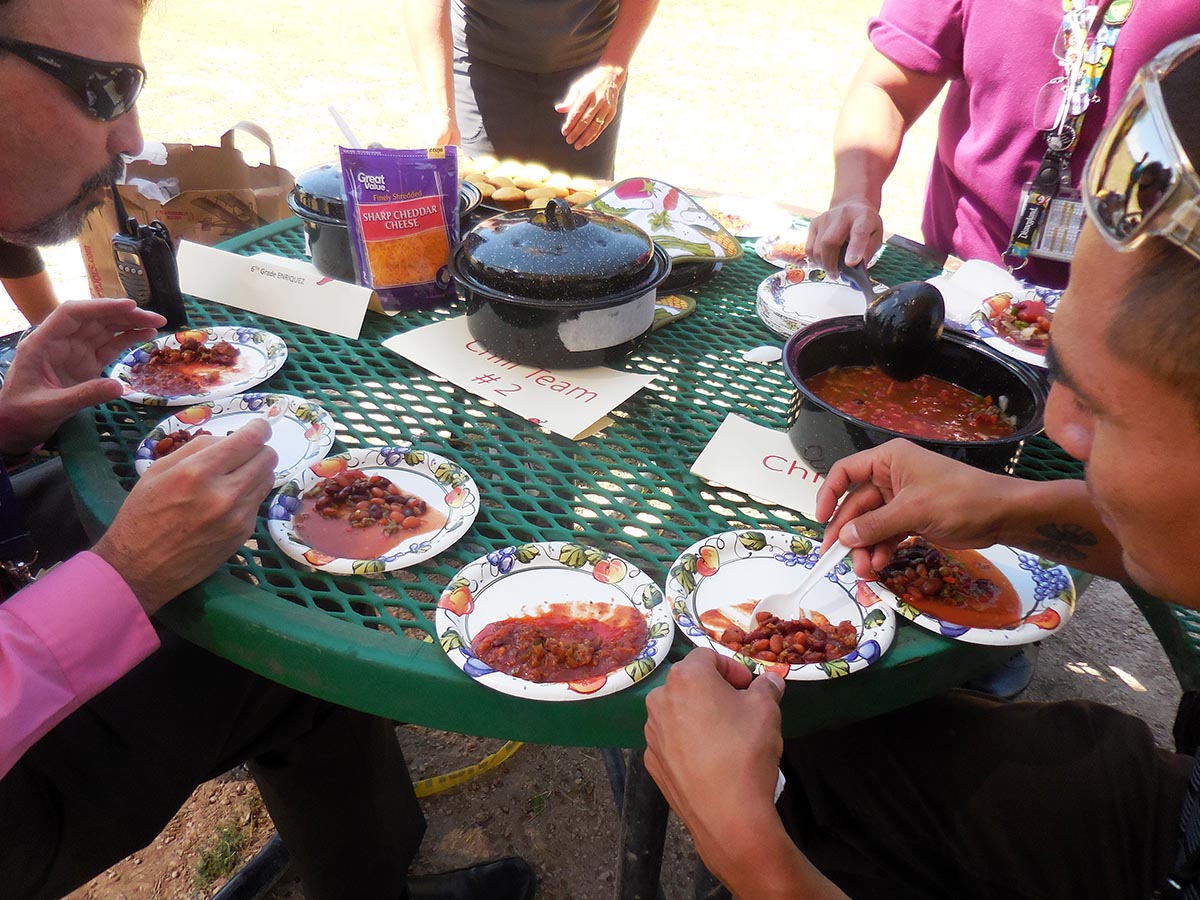
In May, I conducted a Chili Cook-Off at Salt River Elementary, as part of a year-end STEM project for 6th graders. May was a ‘cooler’ month (if you could call 98 degrees cool – a sarcastic Arizona joke of sorts). And yet we had chili cooking at 275 degrees within 20 minutes. 


ISTE Ed-Tech Conference Wrap-up: Part 1

Just got back from the ISTE 2016 conference in Denver, and it’s hard to decide what stood out more: The technology, or the practices.

HARDWARE: Being a tech teacher, indeed the tools were mind-blowing. From the simple Digital Storytelling hacks, and wide range ofgaming technologies, to Makerspace ideas such as conductive material, to Virtual Reality, and Robotics. (More on robotics in a later post.) VR seems to have matured since 2014, and mini robots –like the Sphero, here — were practically running over our feet. OK, I actually took the challenge and drove one of these across the floor. They’re practically unbreakable, too!

SOFTWAREThe software definitely made me do a double take, when it came to programming languages, and ‘kits’ to simplify the learning curve. It’s finally come to this: software doesn’t exist in some abstract dimension, but comes coupled with devices that a student could learn to program – and see the effects in real-time. Google and Microsoft appeared to be fighting for attention. If you had the stamina and enough coffee, you could go through an entire day toggling between a Google classroom and that of Microsoft’s. Both have well defined Education divisions. (The former made 5 education product announcements at the conference.)

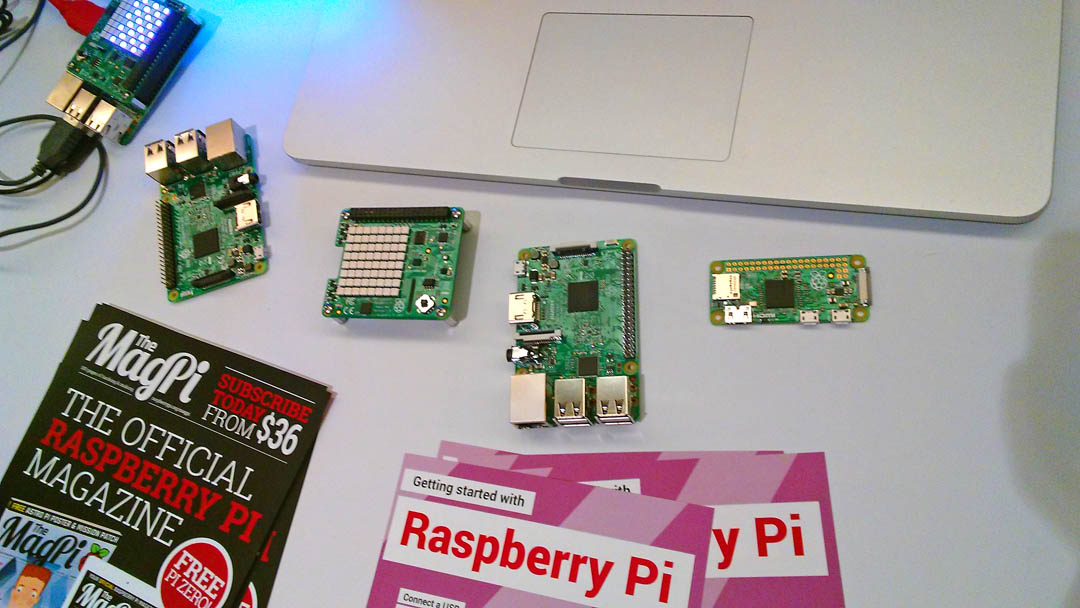
The sessions I liked most, were the Education Playgrounds. These were informal on-on-one or group sessions. I picked several that combined hardware and software. I met with a few Raspberry pi experts, basically teachers who worked with kits that were built around this mini computer.

I was fascinated by the no-frills entry-level kits (starting at the princely sum of $35 an unit!). Why?

RaspberryPi-tn

First because this hardware was not housed in some beautiful laminated case but was transparent enough or a 3rd grader to understand what a computer was all about. I often need to remind students that ‘computing’ is not some mysterious art form.

Second, computer literacy and digital literacy are joined at the hip today, in the same way that Robotics and the Maker movement can be two sides of the same coin. We need to merge our lesson plans, and get our young Digital Citizens to be Makers, engineers, designers, tinkerers, problem solvers and storytellers to recognize they can each take a piece of this action, and run with it.

FINALLY: I attended a few mind-expanding poster sessions, where the presenters were students. I’ve said it before that no teacher conference would be complete until you have met with students who are after all the reason our schools go to great lengths to send us out to these professional development events. It’s inspiring to see the end product of great teaching, and how underpaid teachers in bootstrapped school districts get students to soar. Many takeaways from these sessions.

Solar Chili cook-off continues today at Salt River Elementary

Thanks to Anne Patterson of Solavore, for helping me host the solar oven event in my class yesterday and today. I put together this STEM event for 5th and 6th graders as a final year STEM module.

AnneP1A great way to end the year on a high note – focusing on concepts such as insulation, radiation and the greenhouse effect, and letting students taste the end product! I liked how she compared different feeding habits of living creatures – carnivores, herbivores and ‘solavores‘ – to bring home the point about how we consume energy in one form or another. The sun, however is not a ‘consumable’Top 10 Sunnest Countries in that sense since we have an infinite supply of it.

Anne then compared the Top 10 Sunniest Countries, showing how the US has the most number of sunny days, and Arizona tops the list of States as well, with 4015 hours of sunshine a year!

Which is why, within 20 minutes of placing our ovens outside, they reached 250 degrees. One even topped 300 degrees!


Judges_1_SolarSRE

Ovens1

Thank you to my judges on both days, Annette Williams, Chris McIntire, Erik Haarstad, Joni Andreas and Wayne Sekaquaptewa who braved the chili recipes and the near double-digit heat outside. Today’s judges got to taste some of my Sri Lankan Chili as well.

Finally a big thank you to my colleagues. 6th Grade teachers: Erlinda Allen, Donna Horn, David Crebs, John Emmons. 5th Grade teachers: Maria Enriquez, Bernadette Spencer, Valencia Gorman, and Ashlee Chee for supporting this crazy idea.

Sri Lankan students shine at Intel Science and Engineering Fair

Lochana1

Lochana Fernando

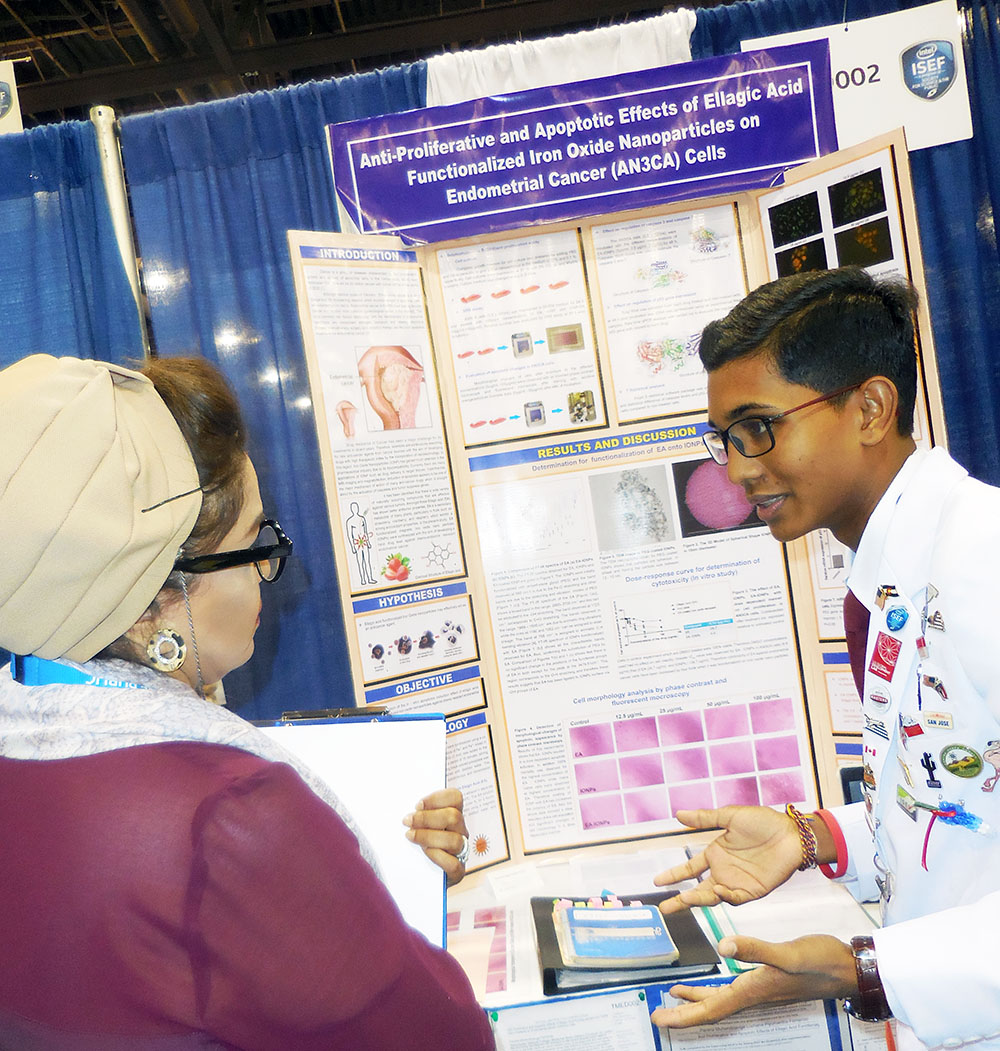
I volunteered at the Intel Science and Engineering Fair in Phoenix yesterday as a translator for Sri Lanka competing at the international event.There were thousands of students from Azerbaijan to the Ukraine –and 24 from Arizona. There were outstanding inventions and research across the board. These three students’ work were very impressive!

  • 17-year-old Lochana Fernando had breakthrough research on cancer. His board was titled “Anti-proliferative and Apoptotic Effects of Ellagic Acid Functionalized iron Oxide Nanoparticles on Endometrial Cancer Cells.” In plan English it was looking at a way to use nano-technology to fight uterine cancer.
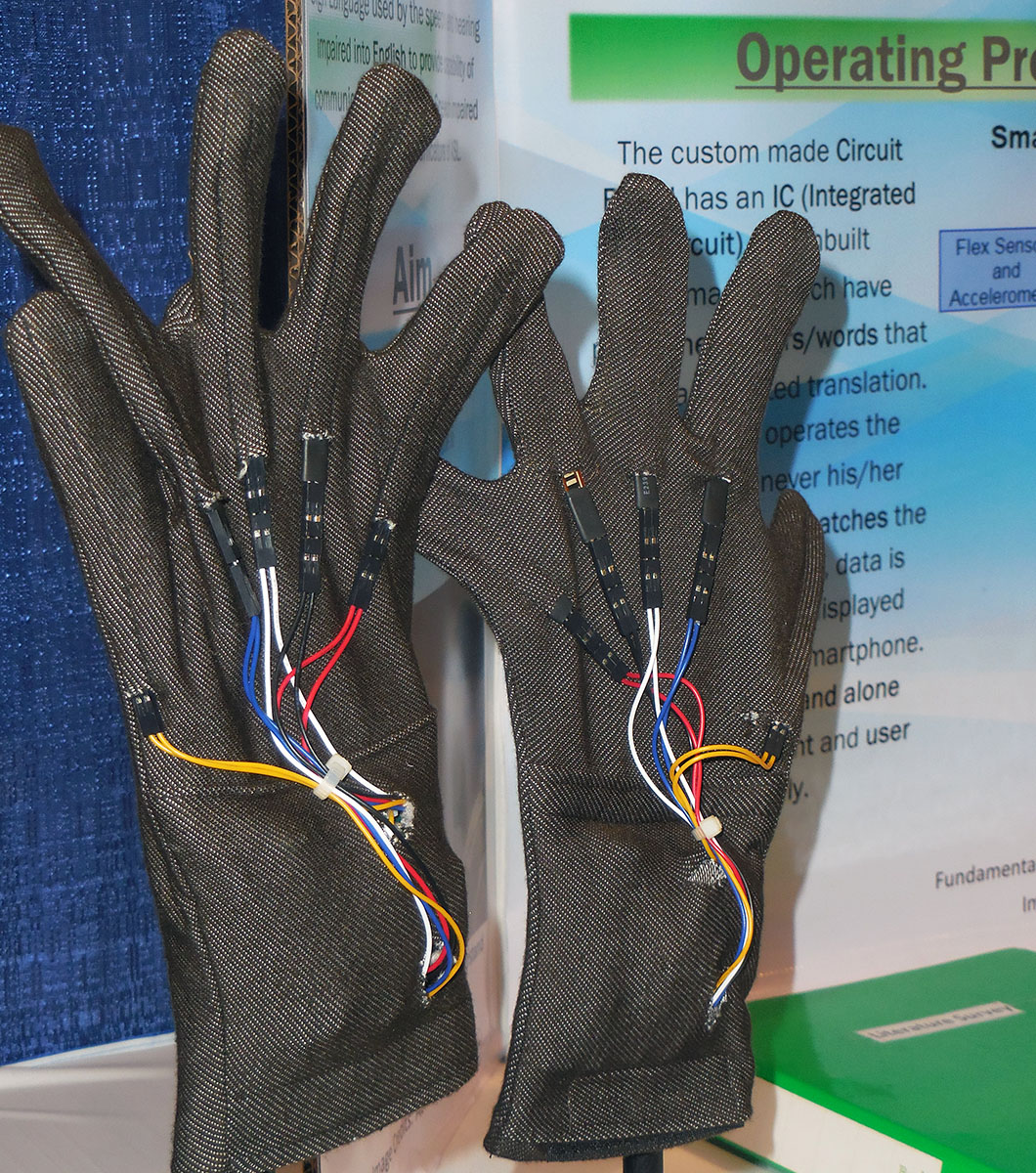
  • 16-year-old Abishek Gomes had a product, a smart glove, that would convert sign language to English. His board was titled “Wearable Device to Translate American Sign Language (ASL) into English.”
  • 14-year-old Chamindu Jayasanka displayed a pair of “Modified Adjustable Crutches” he had invented to help amputees in particular. It is easily adjusted, but the neat part is that it also serves as a foldable seat!
Abishek1

Abishek Gomes

Chamindu

Chamindu Jayasanka


Lochana is from Senanayake National College, Madampe. Abishek is from Belvoir International School, Colombo. Chamindu is from Rajasinhe Central College, Hanwella.

SmartGlovesTo make the pair of smart gloves, Abishek explained how he had to teach himself programming, and learn how to modify a 3-D printer (among other things) in order to give precision to the flexible connectors inside the gloves. This was crucial  to precisely convert finger movements to  the alphabet in real-time.

The stakes are high. Three first place winners are awarded $150,000 each!


Solar Oven STEM project – Chili Cook-Off!

As temps rise, I’m bringing out my solar oven for an engineering & science class. It will be a ‘maker’ type session that will culminate in a Chili Cook-Off for 5th and 6th grades. Students of each grade have been asked to come up with their own class Chili recipe and put it to the test. Outside judges will decide on the best Chili

To get started, I’m introducing them to topics such as insulation, radiation and the greenhouse effect.

  • Next a session on designing and building a Solar Oven from a Pizza Box.
  • Finally, Ann Patterson from Solavore will be here to teach a class on Solar Cookers and the engineering principles behind it.

If you’re looking for solar oven recipes, here are some. I’m a big Chili Concarne fan. Solavore has some here, too.


Chilli CookOff - CHILLI & STEAM - May 2016

Creating an eBook from a PDF – Cool tool!

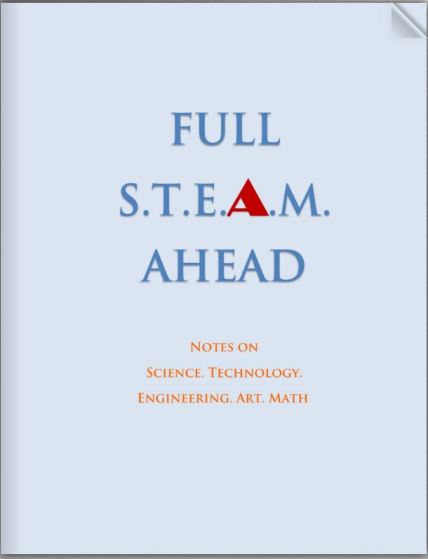
I am testing a book creation tool called YouBlisher. The goal is to learn how it works so I could teach my students next year how to ‘publish’ in more ways than one! Test it out and let me know what you think.

Click on the icon to view a digital book that lets you flip pages. Then read below the pros and cons:

eBook Experiment - YouBlisher


What’s good about Youblisher:

  1. It’s free, so I don’t have to download any software.
  2. The content has to be created on a local computer, and not on the provider’s website.
  3. You need to convert your document into a PDF to upload it. Which means you create your book as a Microsoft Word doc, or Publisher. Alternatively, you could create a photo book using Photoshop or Powerpoint. As long as you save it as a PDF.
  4. The pages flip like a professional ebook.
  5. YouBlisher gives you a link to embed (which is not what I did here – I just linked an image of the cover, back to the site.) They also give you a Facebook embed code.

What I wish was possible:

  • A way to download the entire ebook, and save it on any device
  • A custom URL would be terrific! Right now it’s www.youblisher.com/p/1391665-Full-STEAM-Ahead. But hey!
  • I wish the links within the content worked. There may be a way to fix this…

Note: The content for this eBook was culled from several posts on this blog. It took me just 20 minutes.

Baxter, Sawyer, Tina, SIRI. Is this our future?

Baxter and Sawyer are brothers in arms, so to speak. They are collaborative, follow instructions, and adaptable to their surroundings.

They also happen to be robots. I find it interesting that they have human names, although they are industrial bots. No mistake they are meant for the factory floor, and not cute or friendly robots that are also coming of age elsewhere. Rethink Robotics, which manufactured them says they are “trained not programmed.” It quotes a professor who says his “long range aim is to try to achieve human level artificial intelligence. So the Baxter would be like a person, maybe not a full-fledged adult.”

  • Baxter is a 2-armed bot, and is described as “the safe, flexible, affordable alternative to outsourced labor and fixed automation.”  It weighs 165 pounds.
  • Sawyer is a one-armed fellow, and is called a “collaborative robot designed to execute machine tending, circuit board testing and other precise tasks.” It weighs just 42 pounds

Why I find this interesting is that we have begun to look at robots in humanistic terms, and this paves the way for them to be ‘invited’ into our homes some day soon. If you don’t believe me ask those who love their Roomba, the robotic vacuum cleaner.

How long will it be before we have a Homework robot, and an automated, (two-armed, hopefully) Personal Assistant? Low maintenance, too –no need for company benefits. Some people who use SIRI may say they already have one of those! Chat bots are also in the news now – like the Iranian bot, endearingly known as Tina.

Humanoid devices are also the stuff I have begun writing about elsewhere.

Technology lessons – No books required!

Sometimes you don’t need text books to learn a skill.I don’t usually advise young people to skip university, but I know of many folks who have learned incredible skills, never having stepped into a classroom for the past 20 years. One friend fixes BMWs as a hobby (sometimes has about 10 in his driveway). Another runs a mid-sized marketing communications agency, but has built and operates an eco-resort. The former never went to engineering school. The latter never took a class in architectural design or management.

And my point is, we often hone our skills in our garages, and our basements.These are our ‘labs.’ No one gives us a certificate for these long hours of professional development.

Here’s a related example: Children learning about science and tech on a farm. Think of it as a STEM lab in Nebraska.

Cows. BMWs. Conservation. Plenty of knowledge out there, not found in books and lectures.