Robots that could run farms? Should bots do that?

Have you seen this concept video? Robots that perform farming. It’s disturbing to say the least, to think that the field of robotics is being applied to areas we never used to anticipate. No longer ‘programmed’ robots, these are machines that learn and apply what we now call machine learning, to the environment they are placed in. For instance could a robot learn about —and work in consort with — other devices on the so-called farm. (It’s actually a greenhouse.).

To put it in context, if robots could shuttle between products on a shelves in an Amazon warehouse, this is just an extension of that – an industrial application. We are at the starting blocks of the Fourth Industrial Revolution, so these upheavals – technological, economic, environmental, social etc— are just beginning to show up. I’ve been critical of the rush to apply AI into everything, holding out some optimism that these players and industries might still need some humans, while replacing others.

It has been featured in Wired, and CNBC.

Also there’s another video worth watching.

Could MIT reinvent itself with an ‘ethical’ approach to AI?

Just in time, as the field of AI ramps up. (Also by some coincidence, a week after the cover story in LMD.)

MIT has just announced it will add a new college, the Stephen A. Schwarzman College of Computing, dedicated to world-changing breakthroughs in AI, and their ethical application. The college will “reorient MIT” to add 50 new faculty positions, and give  students in every discipline an opportunity to develop and apply AI and computing technologies.

The term ‘ethical’ keeps popping up these days in relation to Artificial Intelligence. MIT expands on this, saying it will “examine the anticipated outcomes of advances in AI and machine learning, and to shape policies around the ethics of AI.” As I have mentioned elsewhere, most experts (from Elon Musk, to Bill Gates to Berners-Lee aside) agree that we are just at the tadpole stage of the life-cycle of AI.

However, some, such as sci-fi writer, Isaac Asimov and even Stephen Hawking have had concerns. Hawking, for instance remarked that “we all have a role to play in ensuring that we and the next generation have the determination to engage with science … and create a better world for the whole human race.” MIT seems to be the first large institution to take up this mantle, and in the process, redefine and re-invent its role in education.

AI is here – should we prepare or panic? – LMD cover story

Linked from the Futureoflife Institute

A few weeks back I featured an ominous exercise, conducted seven years ago by the Navy Research Lab.Today Artificial Intelligence is taking us into a new machine age, with devices, and not just robots, being able to grow ‘intelligent’ with data they glean from other machines we use.

Big players are developing capabilities in AI –from PwC and IBM, to Tesla and Alibaba!

For the October issue of LMD I was commissioned to write the cover story on AI. You can access it here


When humans shut down Robots

I found this demo quite creepy, but intriguing. It was a video created by a team at the Navy Research Lab in 2011 but is relevant today. A test to figure out how AI could be used to improve “sensor-based” activity between humans and robots.

It’s a plot twist with echoes of “2001 Space Odyssey” in which ‘HAL’ turns off the human life support system, and the human later returns the favor by shutting off the mainframe.

The human here shuts down the robots, Octavia and George – just in case the robot rebellion is pending! The robot uses what is called a ‘multi bio-metrics classifier’ for facial recognition. Maybe I’ve been reading too much of Isaac Asimov lately, so this is quite chilling.

‘Energy Impact’ challenge at First Global Robotics

The biggest international robotics event starts this week in Mexico City, and will run from the 16th to the 18th August. Sri Lanka’s team was featured on the home page of First Global this week.

This year’s theme for 2018 is “Energy Impact. This means the robots must work in collaboration, working in three teams (three random nations are picked for each round) to create environmentally friendly solutions in the contest environment.

The larger purpose is to let students from countries with different world views, understand what it takes to work together as alliances.

When I spoke to the team a few days ago they seemed very confident of the maneuvers and demands for this year’s challenge, involving fuel cubes, power lines, solar arrays, and wind turbines. It’s been months or preparation, though each match is just two and a half minutes long!

Inside the Classical Education model. Latin, robotics, and…podcasting

In our middle-school years at St. Peter’s College, Latin was a subject. We didn’t know why we had to study a ‘dead language’ or how it fit alongside biology and geometry. But it later transpired when the seeds of a classical language began to sprout. Our love for theater (whether it was Oliver Twist, or Hamlet), our appetite for reading, debating, linguistics, and history could be traced back to learning what seemed like tedious (read: boring) declensions and the likes.

This school year I joined a classical High School, and now see the internal architecture of a classical education. The three-part structure of ‘grammar, rhetoric, and dialectics’ is just the start. Music and the fine arts, science and athletics are key elements. And of course technology.

A few months ago in teaching communication to my college level students, we looked at how rhetoric mattered; the underpinning of public speaking, ‘Ethos, Pathos, and Logos.’ So I was delighted to see how my High School’s monthly themes are structured on classical Roman virtues such as Gravitas, Humanitas, and Comitas.

You’re probably wondering what does this do for learning, and students’ character? I can only say this. After a month of teaching with this model in place (teaching computers and tech, mind you!), students come to class eager and prepped to learn; respectful, inquisitive, thoughtful.  This week, looking at inventors and inventions we did thought experiments (a.k.a. Bell work) on social norms and expectations when Thomas Edison messed around with filaments and early audio. Next week they will see parallels with someone like Douglas Engelbart, the prolific Edison-like chap who gave us the mouse, among other things. They were philosophers in their own time, who embodied, and fit, the classical model.

At the end of the week two students approached me to sponsor clubs. One was a Robotics club, and the other was for Podcasting. I had to catch my breath – podcasting! What would 12-year olds want to do with podcasts? It comes down to the classical model which feeds the need for young people to engage in much, much more than Fortnite, or memes. If we only let them.
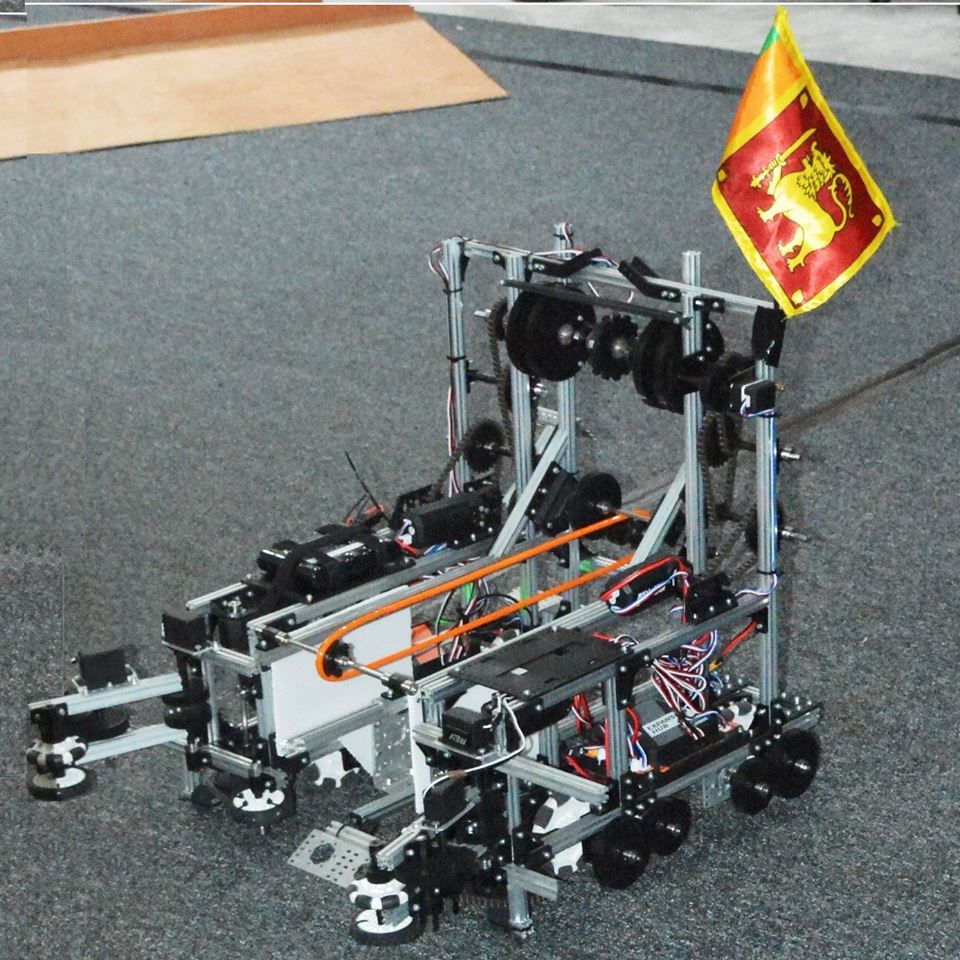
Team Lanka at Robotics Olympics in Mexico this week

Last July, our team went to to the kickoff  Robotics tournament in DC.

This year, the team’s expanded to include students from other schools in the country.

  • Students: Cong, Daniel, Felix, Hamza, Lasith, Navod, Sachin, Sherwin, and Syanthan.
  • Coaches: Shankar, Jekhan, Dilum, and Srimali

This is one impressive gathering of 170 nations. It is hosted by the ‘FIRST’ organization, which is the umbrella organization that holds 5 other robotics tournaments around the country, such as FIRST Lego League Jr., FIRST Lego League, FIRST Tech Challenge, and FIRST Robotics for grades K-4, 4-8, 7 – 9, and 9-12 respectively.

I’ve worked with FIRST for the past 6 years, and met Dean Kamen, the founder, who’s one of the biggest STEM promoters I’ve ever known. He puts his money where his mouth is, a serial entrepreneur and educator who inspires youth across all ages. If you like to know how to get your school involved in robotics, or STEM, let me know.


Robotics Team to represent Sri Lanka in Mexico

If you’ve been following my robotics coverage here, I am happy to report on this year’s Team Sri Lanka, who will represent the country at the second Robotics Olympics. The event will be in August, in Mexico City.

I met with the team coaches in Colombo in mid June to find out how they have been progressing. They have been building the robot from the kit they received from First Global, under guidance of a engineer and IT teacher, Shankar. His expertise is in CAD design and he seems excited –though unfazed! — about his students who must build a robust competition-worthy robot.

At the time of writing they are working on a lift mechanism –a so-called ‘cantilever lift’ mechanism — that will allow the bot to move objects to the area that earns them maximum points.

In case you’re wondering, here’s what last years Robotics Team looked like.