US diplomacy via blogosphere could respond faster

Amid the doom and gloom on Wall Street, another tragedy was somewhat overshadowed –the bombing of the US embassy in Yemen. I turned to at Dipnote, the official blog of the US dept of State (that I have covered here before) but there was just a passing mention, by James Glassman, the undersecretary for public diplomacy.

These are the moments for social media to provide context and value. If you’re tapping into the nodes and feedback of social media, you know that speed has a bearing on influence. It’s not always about the pictures, and good PR. An outfit like this could probably leverage enough citizen journalists when needed –to cover other stories too as they break.

It’s not that they don’t get it the engagement thing. Glassman’s conference call talks of how the US is finding its footing in the untested middle ground of diplomacy. (Do we begin to call this social media diplomacy? ) He speaks of a digital outreach team that engaged, via blog posts, the media adviser to Iranian President Ahmadinejad.

But what about the rest of the world through the lens of Dipnote? Coverage of India, and China are very slim. What’s its view of civil rights in Myanmar or Sri Lanka, for instance? Not one entry there. I’m curious to see how these new tools of diplomacy will better connect us to the big picture — the developments outside the usual (media-led) discussions of conflict, terrorism and oil.

Cut to the chase with visualization

Despite what your position may be on Shell, you have to admit it invests a lot on visualizing the energy future –“more energy, less carbon dioxide”–it is grappling with, for good or ill. This is the stuff that gets churned out in white papers, and high-brow academic gatherings, but doesn’t often trickle down to the hoi polloi. We know by now that spreadsheets and PPT decks make people’s eyes glaze over..

In Shell’s 2050, post-Kyoto energy scenario, the visualization lets you pick a year from 2015 through 2050, and look at several factors that come into play in a planet that will be home to 9.5 billion in 2050; the ‘picture’ looks grim/complicated, even from within the cheerful graphics. It makes you want to do something whether it is to invest in fuel cells or reduce your carbon footprint.

Visualization is that great lens that puts data in context, and moves us to take action, even if it starts off with clicking a button. It can be as simple as being a dynamic feed. Check WorldoMeters.info. The speed at which you ‘see’ top-soil erosion taking place, and ‘dollars spent on dieting in the USA’ will give you a jolt!

We use similar, but more complex visualization tools to create scenarios like this at the Decision Theater. The most interesting one, WaterSim, lets people simulate a drought and see the effects on agriculture and lifestyle choices. The challenge is to take this complexity that works well in our immersive environment (the ‘drum’) and render it in a webified environment.

Looking around at so many data-rich web sites, I could see why many sites are begging to be rendered with more visualization. Those of us writing or designing data sheets and white papers will have to recognize some hard realities:

  • New platforms. People will use new devices and platforms to interact with our information via small screens, on high-res devices, and those capable of and hungry for animation.
  • Audience habits: Readers will demand to ‘snack’ on information, before they dig deep. Will our web pages and PDF’s cut to the chase? What’s a ‘media snack?” Check this out.
  • Time shifting. Information might be accessed (downloaded, snacked on) via one platform, consumed on another. Will the visual appeal transfer? Quality isn’t the issue, but compatibility. CNN stories watched on a high-def monitor still transfer to grainy formats on YouTube.

Visualization poses many challenges, but they are grood ones, because they force us to distil information, and give it more context.

How to make a ‘green’ message stick

After you spend some time at a conference on sustainable practices and products, (titled ‘Green Summit’) the 5-letter word GREEN becomes wallpaper. How to break through the clutter? Here are two examples of people who go to great lengths to tell their story.

I admire the man, John Schaar, dressed up in scuba-diving gear (outside temp in Phoenix: 107 degrees) to promote what is basically a filtration system that produces drinking water out of the humidity in the room. (It tasted just like any other bottled water product.) The company, Xziex International, was situated in an aisle with a slew of green products, from drinks to cleaning products that are available today. A scuba diver who gives you a great elevator pitch is hard to forget.

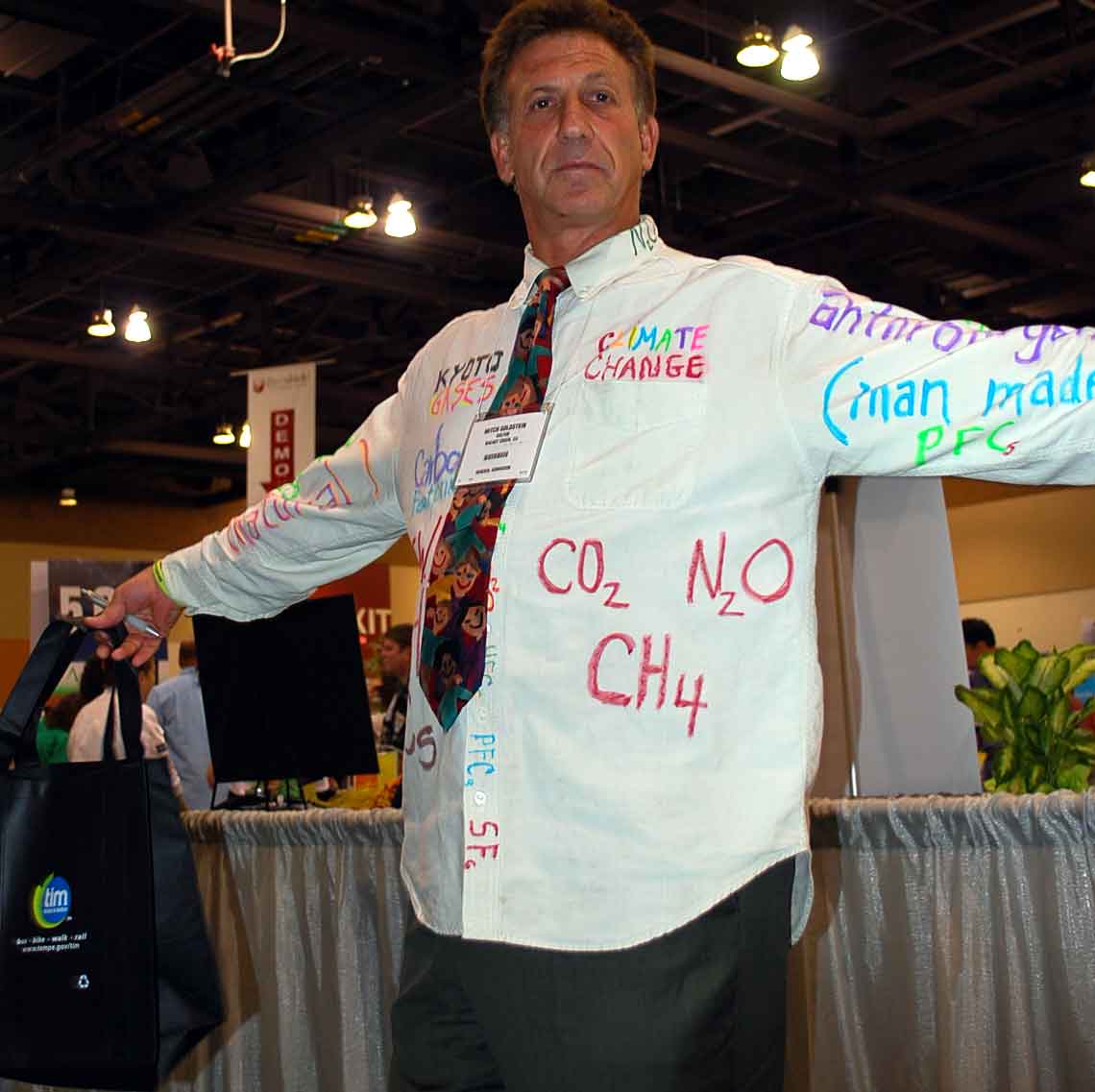
Then, there was this guy Mitch Goldstein, with no product to sell but a message writ large. He’s a teacher from San Francisco, attending the conference to check the pulse, but also to tell his story that I will go into in another post. What I wanted to focus on is how he’s using a white shirt as you would a white board with the bullet points. The elements on his left and right sleeve are the two parts of his message that he says people need to know more about.

Quotes for the week ending 6 September, 2008

“Most people know the staff at the local Starbucks better than McCain knows Palin”

David Mark and Fred Barbash, of Politico, about John McCain’s Vice Presidential pick.

“It won’t work. This is a nation that elected men with such middle names as Gamaliel, Milhous and Rudolph. This also is the home of Elvis, Madonna, Oprah and Rush. We love unusual names.”

David Walters, at the Washington Post, commenting on Ann Coulter’s attempt to make Barack Obama look dangerous by calling him B. Husein Obama.

“Apparently tweeting, friending and linking have not infiltrated popular culture as much as one might think.”

Tanya Irwin, of Online Media Daily, commenting on a global study by Synovate that found that 58% of people aren’t familiar with social networking.

“You actually spend more time in your browser than you do in your car.”

Brian Rakowski, a Google group product manager, commenting on its new browser, Chrome.

“fashion is no longer a rich man’s privilege”.

Priya Tanna, editor of Vogue India, who draped flashy fashion accessories on ordinary Indians for a photo shoot for the August issue, responding to New York Times, which criticized the effort.

“Standing on that stage, I saw past the balloons, confetti and cheers. I was left with a singular image. One of a man who will take his improbable journey and draw from it at every turn to change our country and our world for the better.”

Meghan McCain, daughter of John McCain, on her blog that chronicles the presidential campaign from the inside.


Community uses social media to prepare for Gustav

As the hurricane heads toward New Orleans and mandatory evacuation orders were made, there’s plenty of emergency news and help coming through on social media channels.

Craig Newmark posed a question as to how his site, Cragslist, might help, noting now users are taking over and  ‘repurposing’ the New Orleans portion of the Craigslist site.

“Is something happening now I’m missing?” he asked?

The site looks like it is shaping up to be a bulletin board and clearing house of helpful information. One person posted this offer for accommodation for the displaced, today, even adding a phone number:

“WANT TO HELP A FAMILY or persons needing a SAFE PLACE DURING GUSTAV. WILMINGTON, NC been through hurricane andrew – Have spare bedroom / bath king size bed. Pet ok too. call my toll free # 1-877-269-2784.”

Another offered shelter in New Hampsire.

On Twitter, there’s a feed called NOLANews those in the area can subscribe to., with lots of tips and links for truckers, and others fleeing the city. CNN’s Twitter posts also carry good breaking news

Quotes for the week ending 30 August, 2008

“Wiping away natural forests.”

Banner hung on a parking garage near Kimberly-Clark’s offices in Knoxville, Tennessee.

“At first, users were upset. They formed groups on Facebook to protest the feed. Then they became addicted to it.”

Eric Eldon, at Venture Beat, on the response to Facebook’s new design.

“People the world over have always been more impressed by the power of our example, than by the example of our power.”

President Bill Clinton, in his speech at the Democratic National Convention in Denver.

“To criticize China … is highly hypocritical. These Olympics were staged mostly for the benefit of the elite, massive corporations who wanted greater exposure and a greater market share inside this country of 1.5 billion people.”

“You may never know who got your postcard, and they may never know you, but you have the ability to influence a heart with your note, delivered right to someone’s mailbox!”

Message at web site ObamaEurope.org, run by a grassroots organization of Obama supporters in Europe who invite people outside the U.S. to write a message to Barack Obama. The site will then put stamps on the postcard and forward it to Obama –or his campaign.

Dan Bickley, sports reporter for the Arizona Republic

“You might be shaking your head at this point thinking this is all a little too much “kumbaya” for your liking, but trust me: unconferences will change the way you think about business.”

Mitch Joel, blogger, podcaster and columnist for the Montreal Gazette and Vancouver Sun, on how un-conferences helps grow a business, learn and connect.

“People want to see it, so we shoot it.”

Austin Raishrook, who with his brother Howard chase car chases and ambulances to get footage for RMG News, which they sell to TV stations.

“When it comes to viral video, you need to make sure 1) you create something people will spread and 2) that the video carries a payload — a message about your product. Fail on point 1 and your video won’t spread. Fail on point 2 and you’ll be a hit — but it won’t help your company.”

Forrester researcher Josh Bernoff, author of Groundswell, the book and the blog, on Will it Blend, the company he visited to create a viral video about social technologies.

“If Skype hadn’t been around when we started FIR, I very much doubt we would have started at all.”

Nevile Hobson, co-host of For Immediate Release, wishing Skype on its fifth birthday.

Meatball Sundae revisited?

“Social technology smoke -don’t breathe it,” says the Will it blend guy Tom Dickson in a conversation with Josh Bernoff, author of Groundswell.

The two throw in a handful of ‘technologies’ including flash drives, toothpicks, video camera etc and blend them. The smoke and dust left behind become a perfect backdrop for Bernoff’s line about picking just one objective and choosing your technologies carefully.

Where did we come across this message –with a kitchen metaphor –before? It’s a more dramatic version of Seth Godin’s Meatball Sundae, which essentially cautioned folks about the unappetizing results of badly mixing social media.

Obama’s counter-smear machine

Nothing beats a simple, well updated web site. And nothing beats a smear campaign than a counter-smear paint brush that fills in the details of a blurred picture created by smear artists.

The Obama campaign has found a great way of not just correcting the distortions about him, but to expose the names and history behind those who it claims are behind the smears.

Running off the main My.BarackOmama.com site, the Fight the Smears page is filled with the scurrilous emails, and sentences quoted out of context or distorted, with the correction or proof. No wonder he’s often called the Web 2.0 candidate, with a range of new media channels, including a well fed blog, Twittering and a text-message option for those who want to be the first to know his VP pick.

Web sites like AgainstObama.com (like AgainstHillary.com) crop up every few weeks, as do negative ads from McCain. But a YouTube video slam and a web site isn’t half as effective as the cumulative force of the web 2.0 counter smear machine –powered by facts.

Image is everything –until you tick off the media

This is the flip side of my last post on image management –the futility of trying to control things.

The British journalist removed from the scene of a protest in Beijing on Wednesday can undo much of gains China has been making in the first few days of the Olympics.

The hand-covering-camera-lens tactic worked in times gone by. Today there are too many cameras that don’t look like cameras. There’s audio. There’s Twitter. And as we have seen only too well, reporters don’t have to be credentialed to cover a story. Images like this will gain more currency when mainstream people are ticked off.

As I more or less predicted last month, media rights mean nothing if someone has a story to tell and an audience.

Addendum:

This comment from David Wolf, on a post on Digital Watch, a blog out of Ogilvy China sums it up well:

“the IOC has yet to come to terms with the Internet and what it means to the way people enjoy – or at least “consume” – the Games.”

Analog to digital highlighted at Olympics opening ceremony

Thousands of years ago, our ancestors communicated across vast distances by beating out messages on drums. Today we relay messages across the world on Twitter, using our thumbs.

The 2008 Beijing Olympics combines both these communication impulses in a country that is seeing this dramatic shift from the analog and digital. The balance and alternation of signals is a powerful metaphor for much of what we do, no matter where we live.

The visually lavish opening ceremony with its human tableau set on a digitally created scroll was just the start. Bamboo scrolls gave way to print; and in a striking opposite effect, 2008 drummers played out a digital spectacle with their choreographed beats made to look like a LED screen which spelled out the count down. That too in Roman and Chinese numerals. How much richer could we get?

One Daily Mail journalist summed it up this way: “This was a feast for the eyes cooked not from the books of ancient culture so much as the latest Microsoft manuals.” I don’t think this is accurate. It was a feast for all our senses, cooked from a user manual that’s a mashup of the Little Red Book and Microsoft manual.

A few millenia after the drum and the torch, here’s how we send and receive information:

  • There’s a Twitter tag 080808 set up by three Chinese to connect everyone’s tweets.
  • Watch cell-phones streaming live video on Qik, a service also used by the Sacramento Bee to cover the torch protests.
  • Newspaper and TV journalists are blogging to give us expanded, less time-delayed coverage.
  • Text alerts (and video) on your phone is available at NBC at NBColympics.com
  • Several Facebook groups in support of, and as a protest to the Olympics.
  • NBC has a widget you could add to your blog or social network.
  • The Voices of the Olympic Games, courtesy Lenovo provides great back stories from the athletes themselves.