Blocking and tackling social media distractions

I speak to plenty of young people to whom Facebook is like email –something they leave on and check every few minutes. But they are chatting on other channels as well. If you look carefully some folks even check their phones for incoming mail at …church.

So the question I get asked is, whether TMS (too much socialnetworking) is killing our attention. How do you read a 300-page book, how do you watch a 2-hour movie, or listen to a keynote speaker without instinctively reaching out to your laptop or phone to comment/share/snipe?

We adults have a similar problem –TMI (too much incoming). nearly every Blackberry user I speak to complains of being a few hundreds of emails behind. I knew someone who two years ago, would tune out a speaker at a small-group discussion(for 10 – 15 minutes) just to respond to his incoming mail. It was embarrassing to watch!

I’ve been running into many people calling time out, addressing TMS and TMI. Two names you may recognize.

Joel Spolsky, writer for Inc. Magazine. In his last column, he analyzes why Too Much Communication is killing us.

Now, we all know that communication is very important, and that many organizational problems are caused by a failure to communicate. Most people try to solve this problem by increasing the amount of communication: cc’ing everybody on an e-mail, having long meetings and inviting the whole staff, and asking for everyone’s two cents before implementing a decision.

And Seth Godin, railing against Incoming.

That email, Facebook and message queue is a lot longer than it used to be. For some people, it’s now a hundred or even a thousand distinct social electronic interactions a day. It’s as if a genie is whispering in your ear, “I have an envelope, and it might contain really good or really bad news. Want to open it?”

It’s time to stop letting the genie take over our lives. It’s time to put the brakes ion email; to stop taking notes, to pay attention to the speaker. It’s time to join the conversation happening in front of you first.

The other conversations (online) could wait a few minutes couldn’t it?
Podcasts and Slideshare – a cool way to distribute ideas

I’ve been dabbling with Slideshare and love how it lets you create and embed content.

So when my friends at GreenNurture began creating a series of presentations, we experimented with not just regular presos, but wondered what if we package a media kit as a SlideShare? What if we published a Press Release in this rich format? What if…..

We tried a few, and guess what? Our presentations were so popular that SlideShare contacted us to say that they were featuring GreenNurture on the home page.

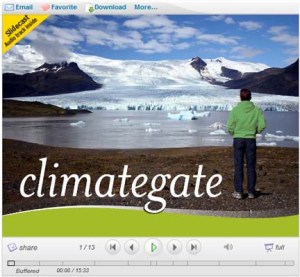
Today we have moved beyond that, and turned podcasts into a presentation. See below. I think it’s neat not because it pulls the format into a new skin, so to speak, but for anyone who does not want to download it to an MP3 player, but likes to listen to it on a computer, it adds a new experience. The forward buttons help you get back to a part of you missed.

And yes, there’s a word for this hybrid format –it’s called Slidecasting!

How Climate Gate is Leading Us to True Sustainability

View more presentations from GreenNurture.

GreenNurture podcast with Jay Baer

In my podcast series with GreenNurture, I often feature people with disruptive perspectives, from companies that are redefining business as usual in their segments.

So it was an honor to have Jason Baer, fellow Arizonan and someone I have been following (check his blog Convince And Convert) for as long as I’ve been working as a mashup of writer, marketer, communicator.

For those of you who don’t know him Jay has founded five companies, consulted for more than 700 companies and brands worldwide. But he’s best known for three words: Social Media Strategy. Just Google those words and see what I mean!

Enjoy!

Crowd-sourcing as internal communication tool

Smart mobs, crowd-sourcing, citizen journalism –have you noticed how these waves of outside influence keep crashing on our shores?

Howard Rheingold, in Smart Mobs, uses a powerful analogy of human intelligence and computers. If you consider thousands of computers in a building as heaters running at full capacity, he says, only a small part of the heat generated is being used to warm the building. The rest of the energy leaks outside. It could easily be distriuted to other parts of the enterprise.

Now consider the ‘leakage’ of intellectual capital in your office every day. Employees arrive at the workplace, power-up, and are left to run, but vast amounts of  knowledge and ideas are untapped. The occasional survey, the large meetings where no one wants to raise their hand only scratch the surface.

Crowd-sourcing (despite books like this on the future of business) as a driver of big ideas, or as an  internal communications / HR function has not taken off. When it has been attempted –in a controlled environment such as focus groups — the costs and time involved make it a very expensive nice-to-have.

So how do you connect the internal circuits of your human resource that occupy the building? I’ve come across voting tools, idea-generation apps and feedback systems. Here are a three:

  • IdeaScale – for community-level conversation tracking
  • ConceptShare – for teams of designers and Creatives to collaborate and generate ideas
  • GetSatisfaction -a tool for customers and employees to gather ‘social knowledge’

Feedback widgets are here –and coming soon to a mobile device near you. Many of them only go so far. Some experts even warn of getting entangled in intellectual property problems. But the big hurdle to consider is motivation. Engagement goes hand in hand with incentives -the old WIFM concept.

My client, Arizona-based GreenNurture has takes the concept of feedback and employee engagement further. Deeper! 

Here’s how it works: In a company that wants to deploy a sustainability program, employees login to a social media-like app, come up with ideas, start comment or conversation threads, make pledges and vote on each others ideas. When hundreds of them start talking to each other, some idea gets refined, tossed out or voted up. The cream rises to the top, so to speak. There’s more granular information, including an assessment tool, deep reports etc –making sure no ‘heat’ is lost.

If you are interested, check the demo here!

GreenNurture debuts social media app at DEMO this week!

Happy to be associated –embedded?– with a company like this. As some of you know, I manage the social media for GreenNurture.

GreenNurture logoThis was under wraps until today. We were selected to be at DEMO — a premier tech conference known as ‘the launchpad for emerging technologies.’  Take a look at the very cool company we are in.

Later tomorrow (Monday) I will be updating this blog and GreenNurture’s blog with more details.

For now, here’s the official statement from DEMO

Quotes for the week ending 20 March, 2010

“We subscribe to the Woody Allen theory of social media — 90 percent of social media is just showing up.”

Scot Monty, Ford, on NPR’s Marketplace

“If you look position descriptions for companies that are hiring in their communications department, their marketing department. They’re all looking for social skills.”

Shel Holtz, in the same interview

“If your brainwave is picked as the ultimate green idea …you could win £100,000 for your favourite organisation to spend on its green initiative.”

Marks & Spencer, launching a campaign called ‘Plan A’ that seeks consumer-generated ideas as it seeks to be the ‘most sustainable retailer’ by 2015.

“Open exchange” on Twitter gets boost, but will we tweet not talk?

I was on the phone with my sister-in-law, a teacher in Sri Lanka, who complained that many young people are losing their ability to hold conversations, just while I was reading something at BBC, where the co-founder of Twitter, Evan Williams states that Twitter intends it to facilitate an “open exchange of information.” I take it he means more dialog, better communication.

She: These people have way too much information in their heads and on their phones that they don’t communicate.

He: “Our goal at Twitter is to be a force for good”

She: “They don’t know how to write anymore, ..all this texting.”

He: “I think it will be how you get personal, customised information from every entity you care about, from your local café to your government, from your politician to your friends and family.”

I know we all see different parts of the anatomy of this elephant in the room. I promote micro-blogging as a way to connect the dots, and integrate with other forms of communication. But not at the expense of analog or ‘old media’ tools. Sometimes, the best way to chat is to pick up the phone, or walk over to the person in the next room or cubicle.

My eternal challenge to communicators is: When was the last time you wrote a letter?

Writing fires up different circuits in the brain. I subscribe to the idea that ‘writing is decision-making‘ with a specific person or narrow audience in mind. Not just sending off random thoughts in 140 characters. I love what Mr. Williams’ company has opened up. I just hope it makes people better communicators, not  message generators.

Podcast: All waste equals lost profit

As most of you readers know, I’ve started podcasting at GreenNurture, where I handle social media strategy.

In this podcast I asked Derrick Mains to talk about something that we don’t think too much about –how waste that literally ‘travels through the supply chain’ can be eliminated. In fact many businesses that are now monetizing it. I came across a statement that inspired this conversation, that there is no such thing as trash, just misappropriated resources.’

No doubt, these images of a temple in Bangkok (built with one million empty bottles) are an extreme example of that, but on a micro level using things ready for the trash or recycle bin have value, and work like currency. I am a big fan/customer of Bookmans, and have saved hundreds of dollars on books, magazines, software and music by ‘exchanging’ unused resources.

Get more details here.

Download the podcast here.

Community as fire pit?

So what’s your definition of a community?

Members of your Facebok fan page? Those hundred-something peeps who follow you on Twitter? How about the ex colleagues of a former workplace in a large, unwieldly Google Group?  You probably have a stake in all or most of these right?

Building a community is one part of the equation. Nurturing one –being the ‘community organizer’ — is something else.  My latest column in CW, the magazine of IABC talks of some easy ways to build an online community.

I think we often get distracted by the word media, and pay lip service to the word social. My definition of a community is a fire pit. It can be small, it is noisy, always generates some sparks, but it draws people together.

Enjoy!