The ‘Transmedia’ appproach to finding your voice

Digital storytelling is an area I have been fascinated by, especially since I started writing about the death of attention (and the rise of chatter).

Transmedia has been advocated by some as one solution to the attention-deficit problem that communicators and brand managers face. I’ve interviewed a few people on some ‘secrets’ of digital storytelling in my book, Chat Republic, but this explanation in a just-published article in Communication World magazine clarifies it even further.

Transmedia storytelling, says Alison Norrington, fragments a narrative, defines hotspots within the story(world) and thereby engages different demographics.The fragmented narrative engages the ‘pull’ method to draw people’s voices around a theme or story –as opposed to the old ‘push’ method that didn’t leave space for the audience to talk back.

Want to read the whole article? Its available free here on the spanking new IABC Digital site for CW.

Brand Voices vs Brand Conversations

It’s easy to confuse the power of voice, when discussing ‘brand voice.’

(Don’t bother Gogling it, as there are some 441 million results, some of it with the predictable talk about signage etc.)

The Voice of the Brand belongs to two groups, depending on whom you speak to:

(a) The people who define the brand, and “know” what it stands for, and articulate it in their channels. This is really what I would call Brand Talk. Sometimes I cynically call it Bland Talk.

(b) The folks to buy it or use it, and talk it up in their own communities, and sometimes on the brand-owned channels. These are, arguably, more authentic Brand Voices. They tell you why people are using the product or paying attention.

But let’s cut through all this and look at brand conversations, to figure out what are the most valuable conversations? These are what social media helps us unearth: those incomplete, poorly phrased sentences, the angst-ridden, or cult-like exchanges in a forum, or comments section. Those self-appointed ambassadors and know-it-alls…

Sadly, brand managers are not always up to snuff on handling the latter; this sort of anarchy; of data-mining conversations; of engaging with those the bosses instinctively want to block or ban those outside voices from the website.

ONE OF THE FEW AD-MEN who bucks the trend and critiques one-way Brand Talk, calls for true brand conversations.

Nimal Gunewardena, CEO of Bates Strategic Alliance, happens to be moderating a round table discussion I will be part of, when I launch my book, Chat Republic, in Sri Lanka in a few weeks.

His screed about Brand Conversations, called for an abandonment of ‘sales talk’ and the 30-second-commercial mindset. It seemed akin to 1st century monks arguing against using calligraphy.

“It’s time to start thinking beyond that 30 second commercial. It’s time to combine the power of TV with the connectivity and engagement power of digital and social media. It’s time to explore new formats. Two-way conversations, rather than one-way broadcasts. It’s time to talk to communities who have common interests.

To which one person commented:

“oh how our vocabularies have changed recently! We are all part of a social media revolution and it’s simply not possible to have our heads deep in the sand any more.”

It’s so easy to provide knee-jerk responses to the role of conversations: To engage, to discuss, to share etc. I try to pry these apart in Chat Republic, and encourage readers to think of conversations as the ‘operating system’ for their community (OK, maybe the brand) they manage.

We cannot bury our brand-saturated heads in the bland.

All this “Chatter” (Valuable If You Mine It)

I love the examples many people have pointed me to, when researching my book. It’s easy to dismiss any discussion of Conversation apps as YASMAT – Yet Another Social Media Amplification Tool.

Chatter is not about amplification. It’s about deeper conversations that happen when we meet someone who suggests “Let’s grab a coffee and chat about…” It’s about shared ideas on an Intranet, conversation threads, if you will.

I came across this feature known as Chatter at salesForce.com that is what I might call an industrial strength Chat App. (Not to be confused with Chat Apps.). It’s a tool that could be embedded in organizations to help mine the knowledge out of conversations.

Chatter used by GE Aviation

I thought it was awesome how GE Aviation uses it. More than that, it connects “a machine” (the GEnx engine on its DreamLiner) “to a social network.”

Bits and atoms –not just opinions and marketing blather –are powerful when combined in conversation threads.

Use only as directed 🙂

More about my book, Chat Republic, here

Chat Republic – Galley Proofs today!

The metaphors for describing what one goes through when writing a book are inadequate.

Suffice to say it’s been a breathtaking learning process.

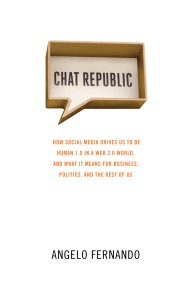
Chat Republic (Cover)_APR252013

But it’s finally coming down to the moment of truth. Here’s what the cover looks like. I wanted it to be minimalistic, but communicate in an instant what it’s about.

Chat Republic, though a crowded place, is also about a call for more space – space between the noise, space between the rapid, vapid statements we send out and are inundated by.

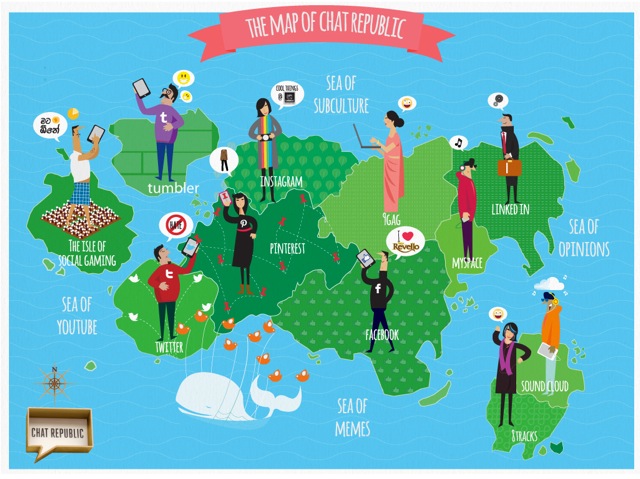
Some see this is as a ‘country’ –a map– populated by loud mouths. I see it as this giant speech bubble, we could all be sucked into (if we don’t make some sensible choices).

Let me know what you think of the cover!

“Sending a message,” in a post-Bansky era

In my book, Chat Republic,  I feature a few examples of how ‘street talk’ has been effective, even sans the Internet.

“Banksymus Maximus”

This old, classic tactic from guerilla artist Bansky could take us into a whole new discussion of how to create buzz, often without words.

Here’s the set-up: In 2005, Bansky managed to place a fake “rock painting” in the British Museum. As you could see, it shows a caveman as a different kind of hunter and gatherer. The rock was stuck onto a wall in a ‘Roman Britain’ section.

Just plain ‘art-jacking’ or is Bansky an ingenious, much-ignored communicator? In a world empowering us to ‘speak out of turn’ do tactics like this feel relevant? Or are they too edgy for you?

Before you come to a conclusion, take a look at the modern version of this phenomenon, known as Culture Jacking.

I would love to hear your comments.

Update on my book: “Chat Republic”

It’s official, and I’m now ready to announce the title of my book, which is in its final stages.

It’s called Chat Republic.

Angelo Fernando, Chat RepublicI’ve been covering the intersection of technology and business; technology and culture for more than 18 years. More recently, I’ve focused on digital media and our social media-centric lives, and I wanted to put my ideas into perspective.

Chat Republic is more than a fictional country. It’s about the spaces you inhabit.  Those online and offline communities you move in and out of: conference rooms, Google Circles, IM lists, Facebook, online forums. I think of it as a ‘country’ whose fluid borders take the shape of a giant, invisible speech bubble.

The conversations and opinions pouring in and out of our republic, in real-time, are what make our communities more civil, more vibrant. Our chats are certainly not friction-free! But absent these conversations we would be one dimensional citizens, won’t we?

As of today, I am planning to launch the book in two time zones, in June.

Some specs:

  • 25 Chapters – Divided into 3 sections
  • Case Studies from the U.S. and Asia
  • Interviews with non-profits, tech companies, activists, chief execs, editors, citizen journalists, PR consultants, podcasters, government officials

More information here at ChatRepublic.net

My upcoming book – about our ‘Republic of Chatter’

It’s time to break some news. I am at the final stages of a book about the power of conversations.

While it does analyze why audiences are more engaged (the stuff I’ve covered as a technology columnist for six years),  this is an attempt to peel back the layers of hype about social this and social that, and look at the operating system that lies at its core –human chatter.

As so many other ‘republics’ –Facebook and Pinterest, for instance– are being overrun by the masses, I have felt the need to look at why we can’t stop blabbing. The Republic of Chatter (a working title) also addresses another passion of mine, about the power of ordinary people to speak out, to rise above the chatter.

Stay tuned!