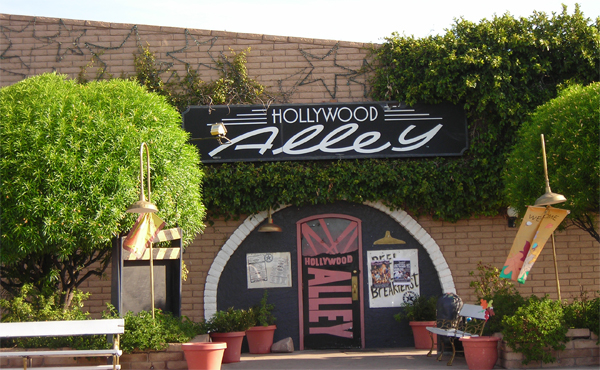
Hollywood Alley’s advertising: no agency required

Advertising is much more than a clever slogan tacked to the back of your truck. Branding is certainly more than a logo. I’ve regularly discussed this here and in my other writing –about experiential branding, and grass-roots marketing.

So I was glad to hear back from a company I had written about here on the blog. It’s a long comment, but fully worth a read. It’s about a form of “advertising” – a simple $12 dollar sign printed at Staples — people normally might dismiss as pre-Web 2.0.

Hollywood Alley is a family-owned restaurant in Mesa, (NE corner of Baseline Road and 101)  For weeks I had noticed the signs were getting really creative –or at least intriguing. Yesterday I heard from John Wincek, who gave me the scoop about how a restaurant with “a kitschy style, and an off-kilter outlook on life-but other than that, we’re actually totally and completely normal!” created its own brand personality. He doesn’t use ad jargon like that, but that’s just what it is: DIY branding. No agency required.
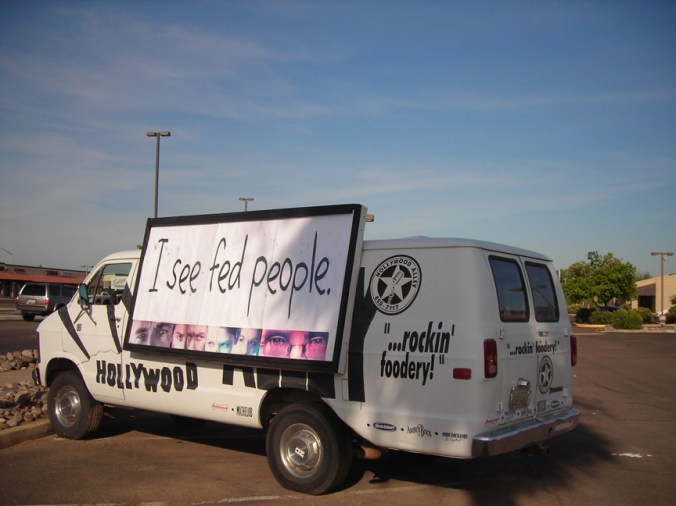
The restaurant’s sign connects with customers, flagging them down, getting them to even come up with ideas for the outdoor signature. “We were suggesting food, but without screaming it at them. better yet, we were connecting through a common interest,” said John. It was not just a sign, but a game, something that made people think about the  movie, the pun, and keep the restaurant in their minds.

But the sign can only get people in. The people and the product had better deliver. It is working. Check his story. It’s a great example of how to be creative to keep business humming in spite of the recession.
Quotes for the week ending 25 October, 2008

“YouTube is a clip culture … But we saw that there was a demand for longer form.”

YouTube’s director of content partnerships, Jordan Hoffner, on its move to allow videos longer than  10-minutes.

“Start iterating– fast.”

Robert Scoble on what newspapers can learn from the technology industry.

“he displayed … intellectual vigor”

Colin Powell, on endorsing Barack Obama.

“What reality are you in?”

Alec Baldwin, responding to those who thought it was a mistake to put Sarah Palin on Saturday Night Live, because it might sway voters.

“It is an acceptance mark.”

Antonio Lucio, the new CMO of Visa, on what the brand stands for, and his plans for moving a piece of plastic into the digital age. Quoted in Advertising Age.

“… we see that technology allows for new kinds of connectedness built around cell phones and the internet.”

Tracy Kennedy of the University of Toronto, commenting on the Pew Internet and American Life study on Networked Families, just out.

Wal-Mart is not afraid of negative reviews from customers.”

Josh Bernoff, on how Walmart has turned the supertanker around and is embracing social media.

“Be flexible, consider part-time work, take a paycut, work hard”

Annie Waite, at Internal Comms Hub, the Melcrum blog, quoting Lynn Hazan, about strategies for communicators to survive the down turn.

Concepting: Amusing look at agency ideation

In a discussion with Rohit Bhargava last evening, the conversation turned to how everyone is an expert when it comes to design. I couldn’t help thinking back to the old agency days I left behind, when there was no shortage of experts on the client side when it came to typography, white space, logos and even media buys.

If you’ve ever watched a client excuse himself from the room to ask the rest of the office what they thought of a concept, you’ll know what I mean. The copy and the layout come back with all kinds of inane comments that makes you want to jump out of the window and do a George Lois. (“You make the Matzo. I’m make the ads.”)

So this vignette of the creative process by “Dave” and his team at an agency is hilarious but telling. Dave’s ‘baby’ is subject to all kinds of tweaks.

Don’t laugh too hard. You may catch yourself saying some of these things:

  • “Let’s get this idea cleaned up and ready” – code for, ‘this is embarrassing, let’s dress it up a bit.”
  • “Make it more edgy” – as in, “it should offend someone, dude!”
  • “You don’t mind (that we mangled the original idea) do you?”

Meanwhile, Creatives are supposed to keep compromising, bite their tongue and move on to the next big idea. So watch this video one more time and think twice before bullying your creative talent into  concept-producing machines.

Quotes for the week ending 11 October, 2008

“We have not had this much FUD – fear, uncertainty and doubt – since 9/11.”

Dean Freeman, analyst at Gartner, on why technology stocks are being hit so hard.

“Humour and juxtaposition.”

Vancouver agency, Offsetters, commenting on the two tactics they use to get people to rethink the concept of global warming. They hung two inflatable lifeboats from a skyscraper, and placed a ‘lifeguard’ on the streets as part of the campaign.

“I don’t write for FOX viewers.”

Heather Mallick, on being criticized for likening Sarah Palin to a porn actress, in her column for the Canadian Broadcasting Corporation.

“Every time so-called citizen journalism muffs one, I get such calls, as if to say, look what your bratty kid is up to now. Funny, I don’t get them – as a journalist – every time a reporter messes up.”

Jeff Jarvis, on being called upon by journalists, on the rumor that spread about Steve Jobs having a heart attack.

“I was just trying to keep Tina Fey in business.”

Sarah Palin, responding with a great sense of humor to the Saturday Night Live parody of her gaffe-ridden media interviews.

“Our intention here is not to repeat the metaphors about the glass being half full or half empty. It can’t be…”

Ad copy for Groupo Artplan, a Brazilian communication company, in a full page ‘open letter to Wall Street ad’ in the New York Times, saying “our democracy is consolidated, our economy is strong.” Sao Paulo suspended trading in its stock market twice that same day.

“Multitasking causes a kind of brownout in the brain. … all the lights go dim because there just isn’t enough power to go around.”

David Meyer, at the University of Michigan, quoted in a story on NPR, about how multitasking is ultimately unproductive.

“It links everybody together in this unholy chain.”

Interviewee on This American Life, a radio show by Ira Glass, explaining why the ‘credit default swap‘, a dubious financial instrument, made the financial crisis global and scary.

Poorly timed ad for Merrill Lynch

No amount of advertising can repair the damage for some financial institutions.

In this week’s The Economist magazine, the powerful cover image (left) shows the cyclone sucking up brand names like Fannie Mae, AIG, Morgan Stanley, Washington Mutual, Lehman Brothers and … Merill Lynch.

But the bull got sucked into the swirl by another means. Its full page ad inside (probably scheduled and printed before the news stories were laid out) ran with this copy:

“Merrill Lynch connects capital to opportunity…”Our 94-year history of leadership in the financial industry has been a source of confidence for our clients in both good and challenging markets.”

How to make a ‘green’ message stick

After you spend some time at a conference on sustainable practices and products, (titled ‘Green Summit’) the 5-letter word GREEN becomes wallpaper. How to break through the clutter? Here are two examples of people who go to great lengths to tell their story.

I admire the man, John Schaar, dressed up in scuba-diving gear (outside temp in Phoenix: 107 degrees) to promote what is basically a filtration system that produces drinking water out of the humidity in the room. (It tasted just like any other bottled water product.) The company, Xziex International, was situated in an aisle with a slew of green products, from drinks to cleaning products that are available today. A scuba diver who gives you a great elevator pitch is hard to forget.

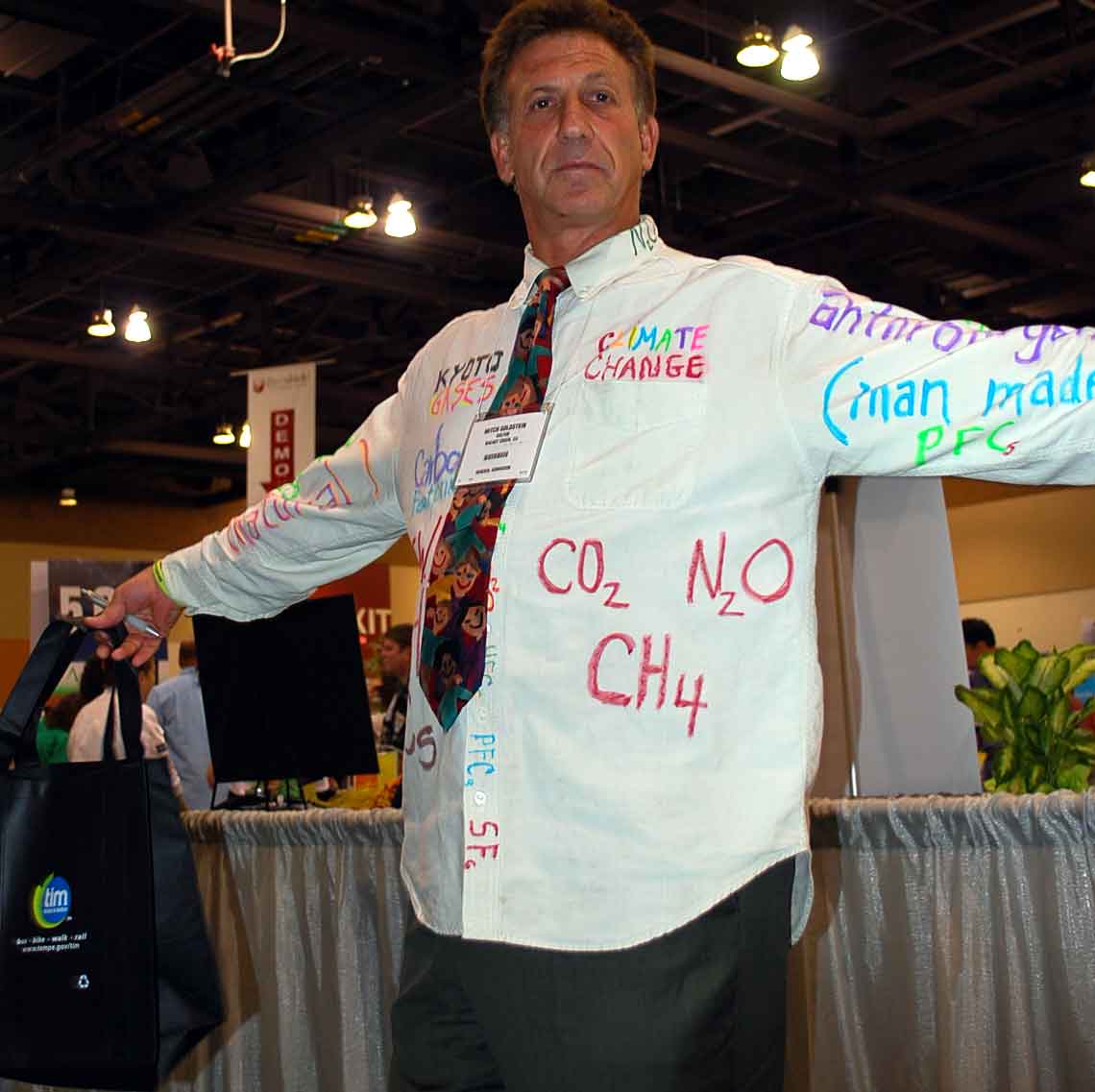
Then, there was this guy Mitch Goldstein, with no product to sell but a message writ large. He’s a teacher from San Francisco, attending the conference to check the pulse, but also to tell his story that I will go into in another post. What I wanted to focus on is how he’s using a white shirt as you would a white board with the bullet points. The elements on his left and right sleeve are the two parts of his message that he says people need to know more about.