This is my first article in Financial Times. I will be writing a bi-weekly column on Social Media.
Author: Angelo Fernando
Oil, tweets, and the gushing blogosphere will drown BP
There is no such thing as a ‘top kill’ procedure (the attempt BP made to put a huge concrete dome on the leak in the Gulf of Mexico) to cap off the gushing anger at BP in the blogosphere.
Each day brings a new wave of voices –comments, creativity, social media channels –to shame the company that has caused the worst environmental disaster here in the US. Like this logo attack.
 This one, a blog called Apologize To BP taps into the collective wisdom of anyone who has a twitter account, or some time to add some content to the site.
A post contributed by one David Diehl, alongside this picture, is titled ‘Sea Of Contrition.’ He apologizes to the captain of BP this way:
“Thanks again for inviting me to the yachting excursion this last weekend. I’m so very sorry I ate up all of your delicious shrimp during the preliminary revelry on Friday. The staff did indicate it was the last of the Gulf shrimp…”
 Apologize, is acerbic and funny, obviously, but content like this (and there are hundreds of tweets being fed into the web site every minute) create a virtual gusher that intentionally or not contaminates anything that BP tries to do by way of PR.
I know, most PR people tend to say that it’s inappropriate to even use ‘ BP’ and ‘PR’ in the same sentence; the company has made so many PR blunders it’s not even funny.
The site urges readers to submit “videos, photos, quotes, whatever you want, as long as you apologize…”
The feed of tweets into the site is a smart way to keep content flowing through the pages, even while it feeds the tweet-hungry searchers who only see it on the micro-blogging platform. The hashtag #ImSorryBP
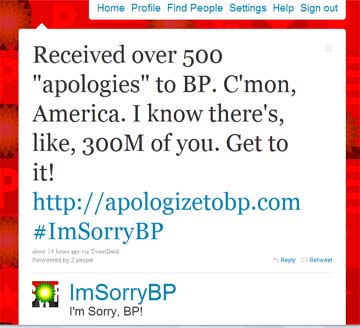 At the time of writing, this Twitter account has had just 213 followers. I’s one more way that people will channel their frustration.
There are more. Check these hash tags that are being used to aggregate the comments and conversations:
#BP (of course, usurping the brand initials)
#oilspill
#gulfoilspill
So, despite the news that BP is trying to clean up its online rankings using SEO tactics such as buying keywords, it’s quite apparent that the groundswell is not going to be more powerful.
Thanks for attending the webinar!
 Quick note of thanks to all the attendees at the webinar on blogging, yesterday. (Sunday night here, although it was still the 21st in Sri Lanka.)
Dan Wool Steve England, and I enjoyed being able to share our ideas, and answer your questions.
The application, DimDim, did cause us a hiccup for the audio at the second location, but we know exactly what the problem is and how to fix it in the next sessions.
Since this was a session on blogging 101, I created a basic blog for the attendees, on the fly. I will be using it to update content for the next few sessions on the other key elements on social media.
Webinar on Blogging kicks off social media series
I’ve been blogging for some time now here and at some other venues. One of them is ValleyPRBlog that Dan Wool co-founded with Len Gutman.
So I am really happy to have Dan join me as a co-presenter in the first of a series of webinars, starting next week.
Here’s a link to the video is you do not see it displayed above.
Passport to ‘Digital Citizenship’ Webinars next week
Really happy to announce a series of Web conferences that I will be starting next week for the U.S Embassy in Colombo, Sri Lanka.
This follows a digital video conference I conducted last year for the U.S.E, in association with the US State Department.
These six workshops –Webinars– are designed to be more interactive; the majority of participants will be at one location in Colombo. They were selected based on their application and response to a survey on the state of social media in Sri Lanka.
We are covering the usual suspects: Blogs, social networking, micro-blogging, video sharing and social search. The attendees are from diverse backgrounds: advertising, corporate communications, government, web-based businesses, management, universities, media and non-profits.
Presenters: To make these sessions more focused and relevant I have brought on board some top practitioners to co-present with me. They are:
Dan Wool, a corporate communications and PR consultant for APS, a large electric utility in Arizona. Dan co-founded one of the world’s top blogs on public relations, marketing and social media.
Steve England, Chief Technology Office of MobileSoft, an advocate of on-demand digital printing who advises large tech companies and international advertising agencies on interactive marketing.
Gary Campbell, a communications manager at Arizona State University, a former print journalist turned digital, who has led numerous university training sessions in social media.
I will also bring in a few ‘surprise’ guests who will pop-in with some real-world examples of how they are using a particular strategy in their communication!
How ‘passive’ networks will make use hyper-active citizens
The explosion of sharing networks and apps are being primed for the mobile experience, anticipating a time when many of us will slip in and out of our roles as employees, Friends (yes, upper-case kind!) and corporate citizens.
These ‘social mapping’ services may seem more like games in their early iterations, rewarding users for certain tasks. But just as how Twitter looked like a status update service in its early days, these mobile-based services will soon let us do more than vainly record our location.

 GoWalla, a location mapping app for the Android, iPhone and Blackberry, lets us check-in’ to locations, as does FourSquare., awarding badges and mayor-ships etc.
A term I have come across in some of these networks is that they “are only acting as a passive conduit for online distribution and publication” of user content. In other words, the intent of the application is to tether people and content.
We may be transitioning to that time soon. But we are still toggling between active, in-your-face social networks such as Facebook, and the passive ones. Someday these could be rich social spaces, albeit passive and invisible. Also reward-based.
Like to see where all this is going? Check out these four services:
Does your company have an idea funnel?
 Everyone has ideas, right? You hear them in the most unexpected places. In the gym, waiting in line for check-in at the gate, and at places like …Quirky.
Quirky?
It’s one of the latest in the batch of idea generating sites, where the wisdom of the crowds reigns. Runs riot, really. A wide open pasture, with the two ingredients ideas thrive on –rewards and recognition. OK, make that three things. Add ‘Community’ too.
Quirky.com is a fast-paced idea hub, where people come up with sensible, practical solutions that may not be as quirky. It urges the community with this:
The horses are at the gate, the gun’s about to fire… ladies and gents, step right up and place your bets. We have a bunch of new product ideas for your perusing pleasure.
 The “Foolproof Patio Composting Bin” had this detailed sketch. (Enlarge it by clicking on image.) Another stylish spatula set was on sale, because it went from idea to market because enough people voted on it!
How it works is Quirky’s product development team takes an idea and lets the community vote on it. They ‘pre-sell’ the product and then manufacture it. Revenues are shared with the inventor/idea generator.
So what if companies could take this process and let it loose among employees? What would it take to create an idea funnel that taps the passions and ideas that arrive with us at work?
Managers who are receptive to feedback and product development suggestions tend to open the funnel at formal brainstorming sessions. These are not exactly the moments when the most crazy (or should I say ‘quirky’) ideas hit us. Quirky.com is just one of the ways to get your employees’ creative juices flowing. A few others are beginning to try their hand at funneling.
- Check out what Best Buy is doing at BestBuyIdeaX.
And you thought that My Starbucks Idea was just a bunch of over-caffeinated people with light bulbs going off in their heads…
Google’s Caffeine rocks, but don’t shut your eyes to offline information
I’ve been waiting for Caffeine for a long time, since I heard it being mentioned at SMAZ last year. So this week we get a taste of what a caffeinated search looks like.
It’s Caffeine, and it’s finally a way to see real-time information (not archived results).
If you’re concerned about page ranking, keywords, meta-tags and most importantly rich content, it’s worth trying to understand how the complex Google search algorithm works. Not that even the so-called experts know, because there is the secret-sauce factor that Google will not disclose.
However, this video from Google is as far as they will go. serving as a refresher course in search:
But is it that all?
Now while I find Caffeine a terrific improvement, I don’t only rely on (or recommend) Google to deep dive for all information. It’s easy assume that ‘everything’ is out there online, having been spidered and indexed online, when the fact is there are stacks of information you may never see or know exists.
Unless you make a trip to a library! Or visit bookstores, read journal abstracts –the ones that have not gone digital yet — or scale the walled gardens of subscription-only sites.
So I have two questions to the search experts:
- Do real-time search results change how archived content shows up? All those white papers, videos, sample book chapters, podcasts etc. Do they get buried and pushed down away from the main results page?
- Is Caffeine –the real-time engine — trying to be Bing –the relevance engine? Or is it the other way around?
I took a screen shot of similar searches for the keywords “Gulf of Mexico” on Google and Bing today. Big differences!
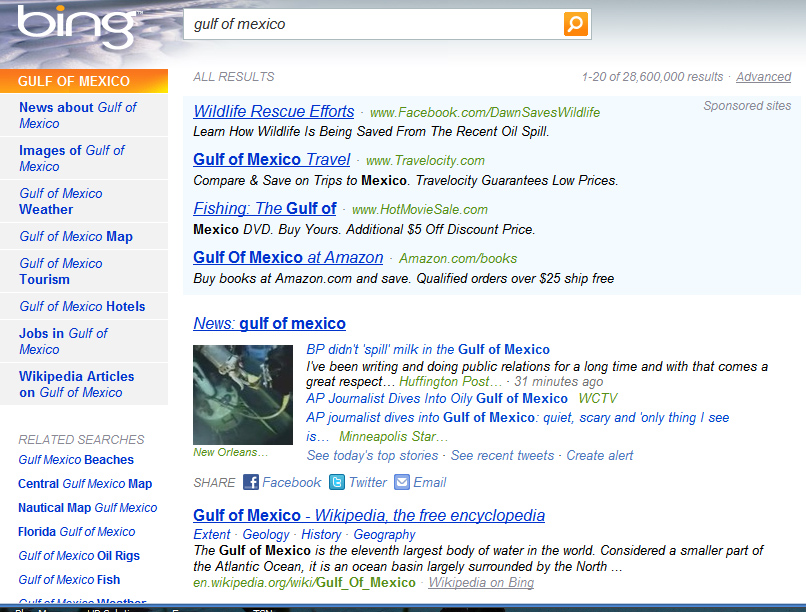
Take this one from the Associated Press. A story about a reporter who dived into the oily waters in the Gulf. It’s up there on Bing, but not on Google.
The story is probably a good metaphor of how murky it is when you dive into search as well. “I open my eyes and realize my mask is already smeared,” the unnamed reporter says.
Should BP spin its wheels on its pesky little PR problem?
I bet this will be question that many presenters on crisis communications and PR turn to –at the IABC World Conference in Toronto this week, and many other events.
Variations of this question could come range from “can social media rescue a company’s reputation,” to “Is this a warning shot for corporations dabbling in social media?”
You could say BP which has the nation’s largest environmental crisis on its hands should ignore the PR disaster they have inherited (as Len Gutman at ValleyPRBlog noted, “There are some things PR can’t fix”) and stick to fixing what it has wrought. It’s near impossible for them to address the ‘wisdom’ of the passionate crowd leveraging new media.
Take these responses to the oil spill:

- The BP Logo Redesign Contest. I’ll don’t need to tell you what this means in a Web 2.0 world where images are shared, commented on and archived forever.
- Fake Twitter Account for ‘BPGlobalPR’: With 129,000 followers and counting, it shows how seemingly powerless Goliath is when David’s got the slingshot. The tweets themselves are entertaining.
- Facebook Protests, including this one calling for a Worldwide BP Protest Day in the coming week -12 June 2010
- More logo attacks on Flickr – Behind the logo group
- Wikipedia edits. Lots of activity on the discussion pages of BP’s Wikipedia page, where editors this week seem to be dredging up –still unpublished– unsavory details of cancer etc.
In the face of all this, what in the name of crisis communications is the value of the full page ad in the New York Times, and some of those TV spots? Is there any value in using old media Tylenol-type tactics to fix the situation BP is in? I recall BP used to run a great series of ads, when it was re-branding, that said things like “It’s time to go on a low carbon diet.”
I think its time for BP to go on a low PR diet!
Not all PR agencies get it wrong
I received one of those dreaded pitches this week from a PR firm in London.
 It had the trademarks of having being picked from a list of bloggers and freelance writers: It started Press Release….
But this one was different. It didn’t have “no-reply’ or some garbled name as its sender. It also had a headline that made me want to open it and read. It was about the PR firm’s client, BBC World News.
You might wonder how relevant is that? I could have signed up for all manner of things on the World Service. But the topic was a series of shows Hard Talk On The Road –on Sri Lanka. It may sound dead simple, making sure the subject was in line with the reader. But let me frame it this way. I get so many of these PR pitches that it sometimes makes me wonder where we have taken this form of communication.
This is an industry (PR and Marcom) where everyone is screaming Web 2.0, every consultant, conference presenter and digital marketing agency is throwing out terms such as ‘Social Media Release” and RSS in every slide deck, and every book that has been published on the subject since Cluetrain Manifesto advises that ‘markets are conversations.’ In other words, stop spamming and start talking.
But all my colleagues at ValleyPRBlog, for instance, say the same thing. We are getting drowned in ridiculous PR Spam. We only complain off and on, and that, too when someone really ticks us off, or someone like Chris Anderson issues a fatwa, and everyone nods their heads and says ‘serves them right.’
But in the past 10 days I got two pitches that were spot on! Two! As such, rather than outing the bad ones, I like to hold up the good agencies and the great PR folk who do one simple task -take time to understand their audience.
- The first was so good, from Gutenberg Communications, I have agreed to interview the CEO of the company –on Monday. If you’re interested, stay tuned!
- And there was this from Parys Communications whose pitch was so simple, I could have hit the delete button.
As a writer I give every pitch a chance. If you take the time to filter, we will take time to read!
 Hoipolloireport