US diplomacy via blogosphere could respond faster

Amid the doom and gloom on Wall Street, another tragedy was somewhat overshadowed –the bombing of the US embassy in Yemen. I turned to at Dipnote, the official blog of the US dept of State (that I have covered here before) but there was just a passing mention, by James Glassman, the undersecretary for public diplomacy.

These are the moments for social media to provide context and value. If you’re tapping into the nodes and feedback of social media, you know that speed has a bearing on influence. It’s not always about the pictures, and good PR. An outfit like this could probably leverage enough citizen journalists when needed –to cover other stories too as they break.

It’s not that they don’t get it the engagement thing. Glassman’s conference call talks of how the US is finding its footing in the untested middle ground of diplomacy. (Do we begin to call this social media diplomacy? ) He speaks of a digital outreach team that engaged, via blog posts, the media adviser to Iranian President Ahmadinejad.

But what about the rest of the world through the lens of Dipnote? Coverage of India, and China are very slim. What’s its view of civil rights in Myanmar or Sri Lanka, for instance? Not one entry there. I’m curious to see how these new tools of diplomacy will better connect us to the big picture — the developments outside the usual (media-led) discussions of conflict, terrorism and oil.

OverlayTV: television you can mashup

I find the whole concept of OverlayTV game-changing, not just for the television industry that packages and pipes content, but to anyone looking far out enough to see where interactive media is headed.

What’s OverlayTV? It’s basically a media player that embeds video, on top of which you can add layers of product, text, a URL, coupon or graphics. Even another piece of video that works like picture-in-picture.
Sure OverlayTV is a tool, but in a malleable way that allows the end user to think of it, as the name suggests, as a layer not a piece of technology. Though initially intended for ecommerce folks, musicians, agencies and publishers, people could use it to create interesting interactive spaces.

Check this out.

Lehman Brothers’ bad news feeds

Page views up, share price down.

That’s the effect on the BBC web site, seeing a bump in traffic even as the Lehman Brothers‘ stock dropped to mere pennies, as the financial market woes play out across the US.

Just another example of how on-demand news becomes vital in a crisis.

You could almost here the sound of bad news fleeting –I mean tweeting — by.

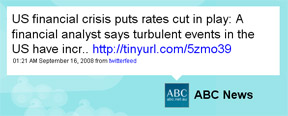
There’s the BBC’s BBCBreaking tweet, and ABC News is tweeting that investors are flocking to commodities on Wall Street.

Tipping points, “drill baby drill,” and journalism

At the Sustainability Summit today, outside of the lofty discussions around  tipping points (are we there yet?), coalitions (enough tossing bombs at each other), and sustainability was the need for leadership.

As I speculated yesterday, there was an open call for those in the media to drive this train. To up the ante in a different way –explaining to consumers what the policy alternatives mean to them. To bring some clarity. Ah! Media leadership. Not exactly out of the ambit of an industry previously accused of ‘agenda setting.’

A telling quote from the session about the message we need to spread:

“Drill, baby drill” should include “change, baby change!”

Communicating sustainability in a turbulent economy

Close on the heels of the Green Summit, a Phoenix-based event that we backed, comes another one.

This is the Sustainability Summit in Washington DC. The panel discussion tomorrow will be moderated by Aaron Brown, former CNN news anchor who is now professor or journalism at ASU’s Walter Cronkite School of Journalism and Mass Communication.

It’s going to be an animated panel, that includes John Hofmeister (formerly the pres of of Shell, Rob Walton, chairman of Walmart, William Ford, exec chairman of Ford and others.

My guess: there will be a lot of context thrown in with relation to this week’s turbulence in the financial markets and Wall Street. Environmental challenges and the resources big corporations throw at them are not isolated from the financial turmoil we are witnessing. Besides the role that government and industry plays in all this, I am interested to see what Aaron Brown says about the role the media.

My take: Journalism needs to ramp up fast and invest more in covering sustainability –going beyond the slick headlines, and feel-good stories about recycling and changing light bulbs. This will be the topic for my next post.

Tomorrow’s live webcast here.

Time: 9 am Eastern

Tweets, shock and awe from Wall Street

With news and commentary on the financial crisis in the US, there’s no such thing as a slow news day. Or slow news week/month. Not this week for sure, with a hurricane (the storm, not the Alaskan governor) and a financial crisis.

For those who can wait, there’s pointed analysis in The Wall Street Journal which is quite a feat, considering the tight deadlines it would have had for getting these stories together.

But for those who can’t, The Economist is using Twitter as is the WSJ tweet with headlines, and links to stories of the crisis as it plays out.

Copyright discussion through blatant copying

This video about ‘fair use’ using the most copyrighted characters in the world, is remarkable.

There are visible traces of Lawrence Lessig (who appears in the credits.)

The whole fair use debate is something that needs to be kept alive. Based on the original Fair Use Doctrine, various interpretations have been made on the four pillars of that doctrine: the intent, nature, ‘substantiality‘ (a terrible word that describes how much of content is used) and  the commercial impact of copying/use.

Not too long ago the Associated Press roiled up a lot of people when it declared fair use meant  the right to use just four words, beyond which they had to pay them! After much criticism, AP came to a setlement with the Drudge Report, and bloggers in general.

But as Clarlotte-Anne Lucas, a former journalist, noted, (See no AP, speak no AP, link no AP) there is a double standard, in that the AP can quote a blogger without making a payment for content pulled off a blog, but it wants bloggers to pay them for using AP content.

These issues will keep coming back, whether it is the intellectual property grandstanding of music companies, media companies, or … who knows, blog aggregator companies who could soon realize that there is gold in them posts. That’s why ongoing discourses like the video above matter.

Crowdsourcing a textbook, Wikinomics experiment in the making

This is not the textbook approach to writing a textbook.  But then again, it’s a book on the topic of ‘Management through collaboration‘ so it would be a missed opportunity -dumb, almost– not to tap into the collaborative potential of social media.

Charles Wankel, calling himself ‘author and organizer’ describes this task as “a new authoring structure,” a 640-page book that will be “produced using an immense network of coauthors” –926 co-authors to be precise.

The web site, features a deep list of academics from all corners of the world (Botswana, Bangladesh, , Greece, India, Turkey, Slovak Republic etc)

It’s a social media experiment on a grand scale. The authors are supposed to contribute via an invitation-only wiki. They were sourced via LinkedIn. The book has an accompanying blog that for the moment, however, is not well updated. But it is indeed a demonstration of the principle of Wikinomics. The idea that mass collaboration will become the new normal, where ‘static, immovable, noneditable items will be anathema…”

Quotes for the week ending 13 Sept, 2008

“Google is the oxygen in this ecosystem”

John Battelle, journalist and author, commenting on the company called Google that started out in this garage on 7 September, 2008.

“I had thought 51 years of rough-and-tumble journalism in Washington made me more enemies than friends, but my recent experience suggests the opposite may be the case.”

Robert Novak, longtime journalist, columnist for the Chicago Sun-Times who was disgnosed with brain cancer.

“In an age when politics is choreographed, voters watch out for the moments when the public-relations facade breaks down and venom pours through the cracks.”

Nick Cohen, The observer, UK

“Colgate University Has an Official Twitterer. World Yawns.”

Headline for article in the Chronicle of Higher Education, about how the university is using micro-blogging.

“The reports of my death are greatly exaggerated.”

Steve Jobs, using the Mark Twain line to open his address at a Mac event.

“It works like predictive texting. You start to type in a word…it suggests what you might mean to say. Like….you start to type in “stre”, and it might suggest “street view” or “utter lack of privacy” or “you only need to sign off 3,793 papers to get your face off our program”

Jodie Andrefsky, with a cynical take on Google’s claim to ‘anonymize’ people’s searches on the new web browser, Chrome.

“Houston, we have a PR problem! I’d offer the McCain campaign some PR advice, but I can’t seem to stop laughing…”

Len Gutman, at ValleyPRBlog, a on Saragh Palin’s PR nightmares.

“Good journalism is essential to democracy. With good journalism, you have good government.”

Calvin Trillin, hournalist, poet and author (A Heckuva Job: More of the Bush Administration in Rhyme), who will speak at ASU on 30 September, 2008

“We become the proverbial, ‘just stopping in for a cup of coffee don’t have time to chat social network user’.”

Mark Meyer, Director of e-commerce and interactive marketing for Emerson Direct, a fellow blogger at SocialMediaToday.com

Cut to the chase with visualization

Despite what your position may be on Shell, you have to admit it invests a lot on visualizing the energy future –“more energy, less carbon dioxide”–it is grappling with, for good or ill. This is the stuff that gets churned out in white papers, and high-brow academic gatherings, but doesn’t often trickle down to the hoi polloi. We know by now that spreadsheets and PPT decks make people’s eyes glaze over..

In Shell’s 2050, post-Kyoto energy scenario, the visualization lets you pick a year from 2015 through 2050, and look at several factors that come into play in a planet that will be home to 9.5 billion in 2050; the ‘picture’ looks grim/complicated, even from within the cheerful graphics. It makes you want to do something whether it is to invest in fuel cells or reduce your carbon footprint.

Visualization is that great lens that puts data in context, and moves us to take action, even if it starts off with clicking a button. It can be as simple as being a dynamic feed. Check WorldoMeters.info. The speed at which you ‘see’ top-soil erosion taking place, and ‘dollars spent on dieting in the USA’ will give you a jolt!

We use similar, but more complex visualization tools to create scenarios like this at the Decision Theater. The most interesting one, WaterSim, lets people simulate a drought and see the effects on agriculture and lifestyle choices. The challenge is to take this complexity that works well in our immersive environment (the ‘drum’) and render it in a webified environment.

Looking around at so many data-rich web sites, I could see why many sites are begging to be rendered with more visualization. Those of us writing or designing data sheets and white papers will have to recognize some hard realities:

  • New platforms. People will use new devices and platforms to interact with our information via small screens, on high-res devices, and those capable of and hungry for animation.
  • Audience habits: Readers will demand to ‘snack’ on information, before they dig deep. Will our web pages and PDF’s cut to the chase? What’s a ‘media snack?” Check this out.
  • Time shifting. Information might be accessed (downloaded, snacked on) via one platform, consumed on another. Will the visual appeal transfer? Quality isn’t the issue, but compatibility. CNN stories watched on a high-def monitor still transfer to grainy formats on YouTube.

Visualization poses many challenges, but they are grood ones, because they force us to distil information, and give it more context.