High budget attack ads feign amateur look

Attack ads and negative ads are not the same. However, they grew out of the same gene pool of political campaign strategy, attempting to annoy, cause fear, and basically present a slice of the ‘truth’ in 30 seconds.

Most ads, ‘scheduled’ to run on YouTube, MetaCafe and similar video sites for long tail value, are created fast, with no time for the finer points for which video production housed charge an arm and a leg. In fact, the more amateurish the video is, the more street cred (and YouTube hits) it gets. No wonder some well-funded organizations are tapping into this high-budget, low tech formula.

This ad, (by NFIB) a slam against Tom Allen, is fairly well produced, even if it is in poor taste. Actors play government snoops, there’s the use of an eighties (Mission Impossible?) split-screen technique, the grainy black & white consciously done. It’s not the kind of low-budget ad made by a bunch of amateurs one evening over beers. Someone had a storyboard, paid attention to detail here.

Unfortunately for the NFIB, this ad has been viewed fewer than 150 times on YouTube. Maybe YouTube audiences have higher standards!

Media skepticism much needed

Jeff Jarvis isn’t simply being a cheerleader of citizen journalism because of the new media edge (and hip factor) it lends to a profession being slashed (by bean-counters) and burned (by the digital-rules crowd.) More than two years ago, he redefined it as ‘networked journalism’ which removed the dichotomy between Pros and Ams. But how to deal with the credibility factor, or lack thereof?

Responding to how another recent Apple rumor (remember the first one?) piped through an unverified iReport portal on CNN, was being framed as the downside of citizen journalism, Jarvis used this as a ‘teaching moment’ to remind us of the need for media skepticism.

“Mistakes – let alone rumors and lies – go out live and the public has to learn to judge the news more skeptically. The truth is, they always have. But now rather than ignoring their skepticism, we need to encourage it and educate people to think this way. Call it media literacy.”

Truth is, most people expect the media to be fact-checked and error free. They don’t buy into the definition that the media is ‘the first rough draft of history’ and all that.

People often complain about the typos and non-adherence to the style-guide, but don’t always howl about the skewered facts. I find the absence of ‘absolute truth’ across the board, in The Economist and NPR, Drudge and talk radio. That’s the bargain I make when I subscribe to them.

At best the journalists (professional, amateur, networked or otherwise) can only give you one version of the truth. They may be our filters, but we need to also install our own.

Farmer in the DELL no joke: milk, beef gets labeled, tracked

The COOL standard is here. A short press release from the USDA announced that as of September 30th this year, all “covered commodities” involving beef, pork, lamb, goat, chicken, fresh and frozen fruit and vegetable, peanut, pecan, ginseng and macadamia nut) will need to have Country of Origin Labeling.

The idea is to provide us consumers with more information, so we know exactly where the lettuce and the meat on a hamburger came from. Will this be TMI? Apparently 92  percent of consumers wanted this. Might customers adjust their consumption patterns because they would be armed with this information? I think it could lead to new trends in branding, where some smart farms could create the equivalent of an ‘Intel Inside’ signature for making certain menu items more desirable at certain restaurants.

Speaking of smart farms, farming went high tech many years ago, but this story is far out! A cow with an embedded chip, a programmable robotic arm that gets to the udder, and lasers used to test the milk. And you thought a refrigerator that sends you a text message when it senses you have run out of milk, is a crazy concept!

Global warming, visualised, dramatized

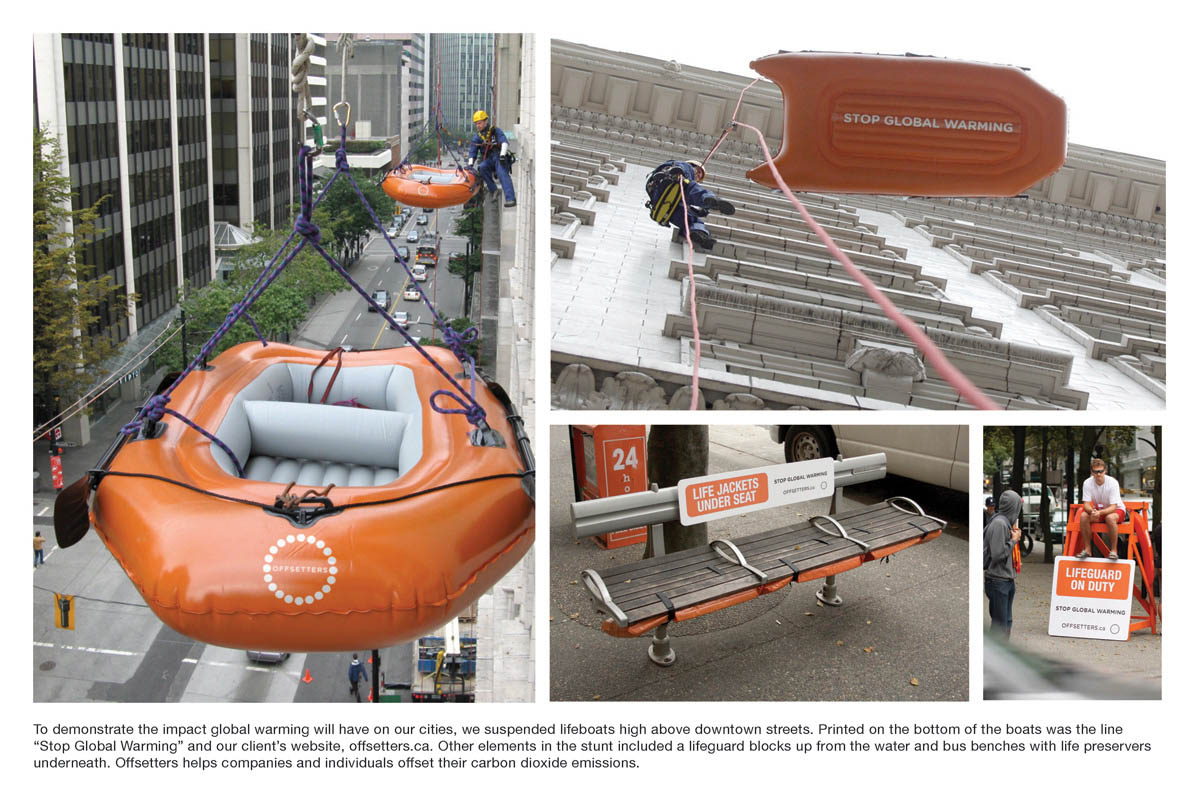
Offsetters, a Vancouver organization used an interesting guerrilla marketing tactic to make people rethink what global warming will include.

Including: a live ‘lifeguard on duty’ and lifejackets under benches on the street.

Guerrilla marketing doesn’t only depend on controversy and surprise to be effective.

Jay Conrad Levinson (who wrote the books on Guerrilla Marketing) talks of commitment and patience, among other factors. Offsetters does have a few tools to help people calculate their carbon footprint, but how many organizations will add those tools to the mix? Even the ‘Climate Friendly’ link on its site with the option to book a climate friendly flight via Air France and WestJet, has a dubious explanation of why it makes the flight so good for the planet:

“…when the customer books their flight, the contribution made to Offsetters from participating airlines makes their flight “climate friendly”.

Meaning just contributing to Offsetters makes it a good thing in and of itself?  For all the drama created by the life saving metaphor, this is pretty lame. Levinson might be shocked!

Arizona PR practitioner ‘leases’ the sun

Fellow IABC member and PR professional, Len Gutman, is one of the first people in the Valley of the Sun  to install solar panels on his roof. It’s an interesting tale of a PR practitioner getting involved in a word-of-mouth campaign with a sustainability edge to it.

SolarCity, the company with whom the Gutman family signed up, had suggested they hold a ‘solar party’ to tell friends and neighbors about the decision. “We thought that was a great idea and so we held one a few weeks ago and more than 50 people showed up,” says Len.

Sort of like a Tupperware party for the planet.

The investment was hard to beat – zero down!  Basically the panels are leased –the Gutman’s monthly lease payment practically offsets the cost they save on their electric bill.

And here’s the kicker. So far, seven of those who attended the party have also signed with SolarCity and the hosts will get a referral fee. Is this great PR for SolarCity, or what?

What happens when the 15-year lease is up? “We have several options – we can have them removed at no cost, we can re-lease them for five more years, we can upgrade to new technology and start a new lease, or we can buy them for the residual value,” says Len. “Just like leasing a car!”

Quotes for the week ending 4 October, 2008

“Washington Mutual went from “Whoo hoo” to “uh-oh.”

Mike Cassidy at San Jose Mercury News, in a column about the financial crisis and how angry we all are.

“Digital Marketing could well be one of the main industries that will benefit from this downturn, and when things turnaround (they always do), we can all be hopeful that Digital Marketing will lead the brand and advertising strategy.”

Mitch Joel, podcaster, marketer and soon-to-be-author, with his characteristic glass-is-half-full view of the world.

“We also believe that Americans … should be able to ‘debate the debates’ using all available tools on the internet and elsewhere, including blogs, web video services, and other means.”

John McCain campaign’s general counsel, Trevor Potter in a letter to Lawrence Lessig‘s call for open debates.

“Connected real estate.”

Padma Worrier, Chief Technology Officer at Cisco talking about its vision of smart, connected buildings that monitor themselves.

“If this thing follows the normal course, there would be calls for boycotts, protests and so on.”

Greg Sandoval or CNet on the news that the Copyright Royalty Board, and the Digital Music Association have called for a rate increase per music track.

“If there’s one sports league that could and should capitalize on social media marketing, it’s the NHL. It’s downright cultish.”

Jason Baer, on the poor use of social media by the National Hockey League.

“The stories should contain a story.”

Sarah Wurrey, or Media Bullseye, quoting Marta Karlqvist, on advice for Sarah Palin who is facing a lot of press this week.

“If you’d been blogging in 1932, would you have told people to put down the phone and pointed them to that typewriter thingy on their desks.”

Shel Holtz, to blogger Jeremy Pepper on the latter’s suggestion that PR people get off email and get on the phone.

“Having your friends sorted by battleground states is something I haven’t seen any other politician come up with before. This is a glimpse of the future of high-tech politicking.”

Declan McCullagh, chief political correspondent, CNet, on the Obama campaign using the iPhone into a recruiting tool.

Big picture thinking, why is it so hard?

I was at a meeting yesterday morning where the discussion soon turned to how easy it is to look at a report or a set of charts and come to a ‘small picture’ conclusion.

We create models –the mathematical, 2D and 3D kind– here at the Decision Theater for clients that project out 20 or 30 years. But even as ‘big’ as this is in the big picture scheme of things, people easily run off with slices of this information just because it suits their agenda or world view. Water scarcity, a big picture scenario, doesn’t look so bad if you make certain small picture assumptions.

To come at this from a completely different angle,  Al Ries put it bluntly saying “No computer is as smart as a human being with a holistic point of view.” Ries, a marketing expert, was talking about “holism” and applying the need for holistic marketing thinking.

He asks why mathematicians and scientists “who developed the art and science of risk management” built models that could “comb through complicated mortgage portfolios to analyze everything,” and still been so off the mark. (A number that involves 7 and 11 zeroes, to wit!)

The answer, of course, is that they looked at risk up close, but not from a holistic, interconnected perspective.

The same goes for water, transportation, education, health. I like to tell people when presenting big picture concepts in the Drum, that even though we put things into nice buckets, we need to pay attention to the connections. Education planning involves transportation and urban growth –where would teachers live, how far will students travel, how many buses need to be in the school system?

Yes we do zoom in, move slider bars, tweak demand and supply. But we make sure people don’t undervalue the need to zoom out.