Carbon Credits as an impulse buy

So you’re quietly sipping your gin and tonic before dinner is served, and the inflight crew comes by rolling the duty free cart with overpriced items.

You tend to ignore these as silly impulse purchases until… you hear the two key words: “carbon credits.”

This purchase is not for your significant other for whom you forgot to get a gift , but for your significant ego. If you fly, you’ll be happy to know that you’re one of those contributing to 8 million tonnes of CO2 a year.  So, for much less than a Rolex (about $50 dollars) you could buy yourself a carbon offset to make up for the carbon your Sydney-London flight dumps on the planet. Visa o Amex? Would you like a receipt printed on the remains of a rain forest with that?

Where? On Virgin Atlantic.

Of course this carbon offset marketing plan has some unflattering background. Airlines like Virgin Atlantic have been lobbying hard to stop an aviation environmental tax! So instead of passing on the tax you, and having to call it a carbon tax (hey, you already pay a hefty airport tax) calling it a ‘credit’ has a better ring to it.

Kaching!

Are we unready for the mobile interface?

Someday the phone in your pocket will be less and less of a talking instrument, and more and more of a remote, a news conduit, a personal carbon footprint calculator, a gaming device, a…

You get the point.

But the fact is, many of our organizations are lagging in making much of our communication:

(a) Platform agnostic –a fancy way of saying it should be accessible on a Mac, PC, Windows Media device, Blackberry or iPhone

(b) Interactive –letting our visitors and audiences do something with the information, such as tagging, annotating, commenting, forwarding etc

(c) Portable –moving an applet from a web to a phone for instance.

I brought this up at a meeting recently where the topic of social networks came up. I am not a huge fan of creating one more cooler-than-yours social network, because we are all dealing with social network fatigue and it will only get worse. Making content portable to me is one way to solve it.

If we’re all going to gravitate toward “cloud computing” the mobile device might be the cloud’s best friend.

To get back to the ‘other’ functions of our mobile device, I just met with my good friend and marketing thinker, Steve England, who showed me some mind-blowing mobile applications. Granted, his phone is smarter than mine –I caught him ‘following’ Chris Brogan and Guy Kawasaki in a coffee shop! Steve’s working with a company that can print a bar code (like the one on the left) that could be scanned with any camera phone.

From an end-user perspective, these bar-codes are not only for consumer products but can act as visual cues that lead a person (like breadcrumbs?) from offline to online seamlessly, bypassing logins, account verification etc.

From a Communicator’s or Marcom manager’s perspective, these codes/icons could be even used on a touch-screen to deploy timely information to a niche opt-in group. On a wider scale, it’s being touted for emergency –and even ‘minor emergency’ alerts .

Right now, it’s probably a challenge for you to even read a PDF I send you on a phone, right? Coming soon, I may be able to reach you, even if you’ve accidentally left your phone at home, via a digital panel on a bus.

Now that would be  truly ‘mobile!’


Social media’s role in crisis, a learning curve

Given that social media are always on, how should you exploit it for a breaking event?

If you’re in an incident command center, then you have powerful channel –more ears to the ground, more lenses, more raw “intelligence.”

If you’re a news organization, you have a potentially dangerous weapon. Meaning, you could easily abuse it and have hell to pay. CNN’s iReporters are citizen journalists, rated by visitors and viewers to the iReport site. How? “It’s all in the math,” they say. The rating system assigns  Superstar status to those with more reports.
I’ve heard a lot recently about how social media played a important part in Mumbai attacks, in communicating and updating ongoing messages of distress, mainstream reporting and even some forms of citizen journalism. Often, we could not believe what we were seeing and reading about.

But we cheerleaders of new media tools need to be careful and also admit to the potential downsides of such raw, real-time communication.

On that note, it is heartening to see that the BBC is also admitting to some of the risks it should not have taken, such as being careless about fact checking: “simply monitoring, selecting and passing on the information we are getting as quickly as we can.” In other words, just because we do have access to more eyes and years and thumb typers, doesn’t mean we should compromise on what the media does best –act as a filter, and put things in context.

Takeaways:

1. Adaptation: The use of the microblogging format as a news medium is still a work in progress. As someone commenting on this story said, the Beeb should adapt its journalism to the new tools “instead of dropping Twitter with burnt fingers.”

If we look back at how television blundered and blundered when covering major events in its early days, (look how they still do even now!) social media channels like Twitter have a long ways to go.

2. Naivete. Just because technology is used ro do bad things doesn’t mean it should be off limits. There’s anxiety that Google Earth is dangerous because one of the Mumbai terrorists used it in the plot. As one person commented, “Did they use any sort of shoes or boots? What about rope? Let’s ban everything….” !

3. Collaboration. Twitter and Flickr played a big part in providing rich information. But it did not prove that new media was better than old media. As Gaurav Mishra notes, “Twitter, and new media and mainstream media complemented each other in covering this story.”

Tweets on foreign policy

This piece of news could not have better timing, following my previous one about the questions arising about Twitter use.

The State Department‘s Deputy Assistant Secretary of State for Public Diplomacy, Colleen Graffy is a Twitter user, and is microblogging during her three nation trip this week. Her posts are also linked to a Flickr account. Not many pictures so far, but hey!

Graffy (who once said that the government needed to move away from being so print focused and get into one-on-one media channels) appears to be quite comfortable with the format, with posts that include tinyURls, quick corrections and even complicated foreign names. (How many of you would be brave enough to  squeeze a name like  “Jolatonlistarhatio Hallgrimskirkju” into the 140-character tweet?)

Twitter is just one more way the State Dept has begun communicating using social media.

Unfortunately, the innovative use of social media comes pretty late for the Bush government. But at least it is laying the groundwork for the new government (whose insiders are anyway vastly more familiar with new media) and senior officials who will have to step up to the plate.

Let’s just hope Hillary (she who experimented with Yahoo answers, lest we forget) is practicing with some of these tools, considering that her campaign blog was given a “B” grade by Search Marketing Gurus that thought it to be a tad “uptight.”

Twitter questioning begins

I thought Kathleen Parker‘s column slamming –OK, questioning– the validity of Twitter was much. Followers, she describes as “a live self-selecting audience of brain voyeurs.”

And:  “the impulse to stay incessantly in touch can be viewed either as gregarious or as a sign of consuming anxiety …the opiate of the obsessively compulsively disordered.

Indeed, Parker also raises some good questions, such as whether we might find some value is all public officials practiced some form of instant communication.

But Jerry Bowles‘ post that I missed last week goes further, with the provocative “Twittering is for Birdbrains” headline. His point?  That far to many people communicate the minutiae of their lives in this microblogging format and few communicate real ideas. Now I don’t entirely agree, but let’s be honest. Don’t many people’s tweets make us cringe?  That shouldn’t cripple the medium altogether.

You bet I am monitoring the comments that ensue –even those in the twittersphere!

Quotes for the week ending 6 December, 2008

“It is no use waiting for a 21st century Gandhi to do it! You and I must do it, if we are to change the world.”

Deepa, a Mumbai blogger at Mumbai Magic, who like many other Mumbaikars, are urging the government and the people to take action, now.

“for every “oh god my sister is in that hotel”, there’s one “Twitter is beating CNN! Yay us!”

Twitter user going by the name ‘naomieve‘ – last week’s tweet.

“Another “Twitterstorm” erupted this week when…”

The stormy clouds rolling in on a discussion at Media Bullseye about the Twitter storm.

“The mouse will no longer be mainstream in three to five years.”

Steve Prentice, analyst artGartner, on the news that Logitech has shipped one billion mice. He predicts the multi-touch device will kill the computer mouse.

“This one was significant, this one got our attention.”

Unnamed spokesperson for the Pentagon, commenting on news that Russian hackers had penetrated Pentagon computers.

“Innovation overhaul”

Peter Daboll, CEO of Bunchball in Advertising Age on the need for advertising innovation.

“dissenters’ voices may add volume to the discussion on international Internet governance and lend it legitimacy.”

From article on the centralization of Internet Governance under the UN

“Now if they can improve their iPhone service and turn it into an application, this will get even more interesting.”

Steve Rubel, on the improvement of Zinio, a digital magazine service for those who don’t want to let trees die to sustain a magazine habit.

Football in 3D, if you miss the real life version

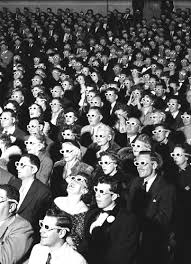
I am not sure what the purpose of thi is, to take a Real Life event like American football, and turn it into a 3D experience so people can watch it –live– in a theater. But I like the idea of experimenting wth the live broadcast format. It’s a merging of digital TV and the theater experience, with polarized glases for added impact.

The game wil take place between the Oakland Raiders and San Diego Chargers so that people in Los Angeles, New York and Boston can watch it at a theater.

TV going digital is one thing. Taking a live event into a live theater experience is quite something else. I wonder how the Raiders and Chargers fans will respond. Imagine the shouting matches, the flag waving… Will they let people take pictures?

Activists rap global warmers

A great way to gain attention is to stage a guerrilla event, and have a great pitch. But yellow crime scene tape never fails to get attention, as in this case of activists who “took over” the Washington DC office of Environmental Defense.

They taped off the entrance with yellow tape that read “global warming crime scene” for added effect. The tape has been used before, against BofA and ExxonMobil. The latter’s headquarters were declared a ‘crime scene’ by protesters who also used a truck. More commonly, activits have appropriated advertising tactics such as billboards and posters. This one by an animal rights group took that even further.

Oh, my!

Analog-is-dead talk ignores hybrid experience

Forget the analog is dead predictions about books and newspapers. There’s a new one being resurrected, about the death of the computer mouse. Yes, indeed, touchpads have eroded the usage of mice. Pen devices and laser mice have emerged, too. But I don’t believe the mouse will “die” anytime soon, just as much as I don’t believe that analog and digital will be an either/or option. (I say this having written two letters on real paper yesterday, in addition to sending of some outstanding emails.)

It’s not just the digital versus the analog options we need to consider, but the hybrid form that might emerge. The Amazon Kindle may not replace my book – yet-  but someday something like this eTouchBook application could make its way into my life. What’s the eTouchBook? It basically in the lab stage, where a book could be printed in a way that certain elements on the page could bridge into a digital environment. Imagine being able to move from a magazine article to an online video on your mobile device, or being able to “save” a short story you just read in an airport lounge as a text-to-speech podcast? I could visualize a time when we would enhance, not kill off our analog devices.

FREE IDEA: And here’s a mouse-based throwaway idea. Rather than bury my cordless computer mouse, I would be in the market for someone who could turn it into an MP3 player that downloads content direct to it. That way, when I shut down my laptop, I can still carry my reading material and listen to it offline.