Quotes for the week ending 24 January, 2009

“Citizen participation will be a priority…”

Macon Philips, White House’s director of new media, in a blog post a few seconds after Barack Obama took oath as the nation’s 44th president on Tuesday.

“Communication. Transparency. Participation”

The first message on the WhiteHouse.gov web site that switched over on Tuesday at noon., spelling out the details why ‘change has come to whitehouse.gov’

“an excellent example of witness media and pro media cooperation. It’s not about the ‘versus.'”

Steve Safran, quoted in an article about the evolution of ‘eyewittness journalism’

“Inaugural speeches serve two purposes. They are designed to heal whatever rough roads people had to go down to get elected. The other purpose is to lay out the agenda and the key metaphors for what’s to come-and hopefully to induce people to cooperate.”

John Adams, Colgate Speaking Union @Colgate University, quoted in Ragan.com

“You must find ways to spread – in a new manner – voices and pictures of hope, through the internet, which wraps all of our planet in an increasingly close-knitted way.”

Pope Benedict XVI, on the Vatican’s launch of a channel on YouTube.

“Obama gets a thumbs-up for his Blackberry.”

Headline of a series of articles that celebrated the fact that the ‘tech president’ gets his way in being able to step out of the communications bubble. Only a few people will have his email address, the White House says.

“Twitter IS a massive time drain. It IS yet another way to procrastinate … But it’s also a brilliant channel for breaking news, asking questions, and attaining one step of separation from public figures you admire.”
New York Times Tech columnist, David Pogue about how he’s learning to use Twitter

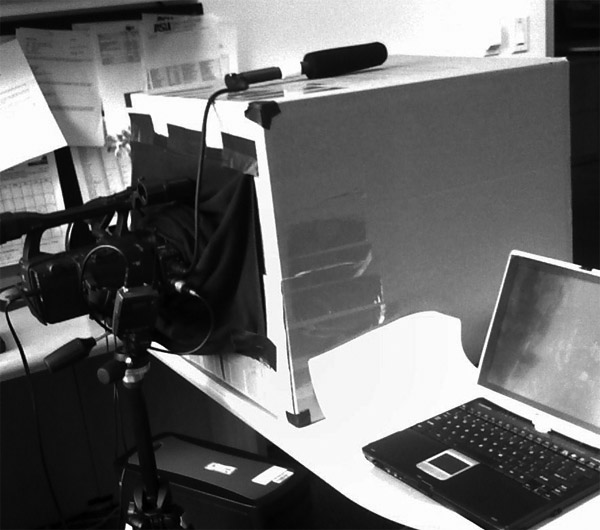
Faced with budget cuts, duct tape and cardboard box works!

Since it’s Friday, thought I’d share something far removed from the social media and marketing stuff you see here. Call it my glass-is-half-full story.

I work with people with an unusual skills at the Decision Theater. But how often do you find someone who could put together a home-made teleprompter? With nothing more than a cardboard box, a sheet of glass he pilfered from me, some buggy freeware, and a bit of duct tape, my colleague Dustin Hampton is ready to shoot a series of videos featuring simulated news reports.

panflu_2

The laptop makes the mirrored text scroll onto the flat screen monitor taped down at a 45-degree angle. It is then reflected up at the sheet of glass –on the other side of the camera you see here!

Yes, like everyone else in the state, the universities are facing budget cuts. But there’s work to be done. This project involves pandemic flu planning. I like to think of this as our way of not sitting back and waiting for the sun to rise.

(cross posting from LightBulb Moments)

Will Clinton’s push for ‘smart power’ bring networked diplomacy?

At the heart of diplomacy, says incoming Secretary of State Hillary Clinton (speaking at her visit to the State Department yesterday) is smart power. I trust this is not as something analogous to ‘soft power.’  To me smart power would be all about taking diplomacy into a 3.0 world. We all understand what 2.0 stands for, since this thinking debuted three years ago.

Like web 3.0 thinking (see Google’s Eric Schmidt take a crack at it), the folks looking at how to engage in diplomacy 3.0 would do well to understand how information, ideas, even value systems move virally across networks. They would do well to look at a paper that was written by the Carnegie Endowment for International Peace, titled ‘Network Diplomacy.” Amazingly, it was written in 2001! It’s about networked intelligence, dialogues, listening, sharing and trust.

Much of what it talked about is more or less accepted now in business and public relations –and only grudgingly in diplomacy. I say this because I asked a friend at a State Dept agency about networking and he said they were disallowed from joining networks for security reasons. That didn”t seem right since I know from closely tracking Dipnote, how engaged and networked some of them were.

Rules against networking existed in the murky 1.0 world. Where we locked down our employees, and monitored what links they clicked on, and then blamed them for not sharing knowledge or having rotten data. Or as they called it in the intelligence 1.0 era, for having ‘faulty intelligence.’

Back to the Carnegie paper, it observes that networks trump hierarchies, and that foreign policy is not just a sum-total of discrete events but an ongoing global engagement. To this end,

“networks are able to bring together much broader communities to flexibly address problems in ways that hierarchies often cannot.”

Let’s hope we see ‘smart power’ grids roll out fast!

Dire warning against dumbing down education in Arizona

As soon as details about budget cuts affecting education in the state (K-12 funding to be cut by $ 900 million, state university funding by $243 million) became known, the voices calling for such short-sighted actions have begun growing.

A few students put together a Facebook group, and an information-rich web site at SpeakUpNow.org

It includes a short video on Vimeo – watch this, links to members of the state legislature, and other ways to get more voices be heard.

I write about this not just to track how social media is being used to bring people together for a common cause. I have a personal stake in this. I work at Arizona State University, one of the three universities that will be forced to take drastic steps (massive layoffs and astronomical tuition increases) if these cuts go through.

Personal stake #2: My  son is a freshman at Northern Arizona University and I would not want to see Arizona dumbing down its education even further.

This is serious stuff folks.

Sidebar:

See how they have responded:


How fast should you update history?

OK, so the headline was a bit provocative. Maybe we don’t update history when we update a wiki. But in the case of the newly minted president of the US, changing his profile meant turning the page of history.

Not many people look at Wikipedia the way I sometimes do –at the Discussion pages –but on the night before the inauguration (Jan 19th) I learned some unusual things about how information gets written, edited, and in many cases fought over.

The Wikipedians managing Obama’s profile faced one nagging question –apart from the expected edit wars over how to describe his African-American heritage: At what point should the word ‘elect’ be dropped? At the oath, or at noon?

We saw how in other quarters, particularly on the White House web site (and blog) and the State Department’s blog, Dipnote, how timing was everything. On WhiteHouse.gov on Tuesday, a few seconds after noon, there was a message from Macon Philips the new media person behind the web site. He announced that ‘change has come’ to the official web site.

Back to Wikipedia, the question arose if a ‘bot’ ought to be assigned to do change Obama’s information, saying the official time he would assume presidency was 11.56 am. One said his photo was creepy and needed to be changed. While the debate raged, it was agreed that “If stuff starts to get out of hand requests for page protection” would be made.

Meanwhile, Wikipedians wait, fingers poised over keyboards, for Hillary Clinton to be approved by the Senate. As of this morning there’s the word ‘designate‘ after her Secretary of State title’ waiting to be scrubbed, among other things!

Will millions of cameras in Washington DC make surveillance easier?

When I wrote about Photosynth in June 2007, I wondered what it might do for crowd-sourcing mega events, even political ones.

That day has come.

Microsoft (which now owns Photosynth) has teamed up with CNN to enable all those snapping up the moment in history, to share those images, and more importantly knit them together as one composite.

It’s not just  the collaborative potential of this technology that’s mind-boggling. It gives new meaning to what we often refer to as the Big Picture, letting you look at a something in fine detail from multiple angles and distances, and in a thousand of different ways. You can zoom, tilt, look at a person or an object from its side, and often get a close-up view.

From a surveillance angle, this could be a great deterrent to anyone planning mischief. After all, any moment during the inauguration will easily be captured not by the surveillance cameras — there are some 5,000 in the area –but by the hoi polloi.

photosynthTake a look at this image of the Capitol (Sorry, but you’ll need to download a small application on your computer first to use Photosynth) and you’ll see what I mean. You could move in so close to the dome, and the windows below, you could spot the surveillance camera looking down at you!

People’s inauguration –and how to contribute to it

As the stage is set for this moment in American history, there’s much work being done to tap into the passion of the country via social media –to make it a ‘for the people, by the people’ event.

Here are a few ways to join the conversation:

  • The New York Times is accepting photos that get published here. Email them to pix@nyt.com
  • National Public Radio has  Twitter two tags if you feel inclined to tweet. Send them to #inaug09 or #dctrip09.
  • Flickr: NPR is also using the same tags, inaug09 or dctrip09, for those wishing to upload pictures to Flickr
  • Text in news to NPR: Send it to short code 66937 (begin your message with #inaug09 or #dctrip09)
  • CurrentTV will blend Twitter comments with the telecast. When you tweet, add #current to your comments and it might get featured.
  • Citizen’s Briefing Book: This is a neat project I wrote about earlier
  • Live Blog by Sam Teller
  • You could be an iReporter on CNN-iReport and send in a reports during the day

inaugurationpix_1Pictures like the one on the left (The New York Times) have already started pouring in, with pictures like this, and this.

PBS is asking for people to call a toll-free number via Gabcast and record an audio segment.

Of course, if you just want to be updated on events there’s an inauguration Twitter feed: obamainaugural

Could a community effort save podcasting?

Chicago Public Radio has put out the word that it needs additional community support to keep podcasting free. FACT: The ‘free’ podcasts (such as This American Life) that we listen to via NPR, really cost them some $150,000 a year. “That’s not staff. Not computers. Just the bandwidth.,” they say.

WBEZ Chicago saw some recent layoffs, wants to avoid more, and is asking for small contributions.

But it’s not just podcasts that may be cut at the knees. There’s good radio journalism. Last December a reporter Ketzel Levine, began working in a story -actually a series of stories– about layoffs. While doing it she was laid off by NPR as well.

End of story.

“America needs more reporters, not fewer”

Dana Perino, in her farewell schmooze with the White House Press Corps made a wish that is worth as the next administration moves up behind the podium.

“America needs more reporters, not fewer, so let’s hope someone figures out a business model that will keep you in your seats for a long time to come.”

Her final statements were interrupted by the likes of Helen Thomas –she who grilled any Press Secretarywhom Perino never seemed to like, but is of the journo caliber this country needs more of.

Starbucks-meets-Obama-meets-Digg: crowdsourcing democracy

The president elect is taking a leaf off the social media marketing book to gather ideas from citizens.

StarbucksMyStarbucksIdea has been around for several months, basically asking people to “Help shape the future of Starbucks.”

Now the Obama people have launched the Citizen’s Briefing Book –part of Change.gov. To contribute to the ‘book’ that will be printed using the best ideas and given to Obama, you have to sign in with your full name, email address and zip code.

People are sending up their ideas in droves. More than 9,500 on the Economy, and about half that on Energy and Environment, and a little less than that on Education. Ideas could be voted up or down, like Digg. Gives you –him– and the country a sense of the hot-button issues.

This kind of governance will radically change opinion polls, focus groups and political consultancy forever. And it’s only just begun