Messy Learning Labs. Just what our screen-obsessed kids need

If you’ve ever complained about classrooms being stuck in the industrial age, here’s a glimpse of a different kind of class. It’s Hi-Tech space with a factory-floor setting. Perfect for digital natives, huh?

heatsynclabs_tnI took my robotics students here last Tuesday, to a place called HeatSync Labs in Mesa, Arizona. Not the kind of ‘lab’ they had in mind – but in a shocking way! It is what’s known as aMaker Space’ where kids come to ‘learn by doing’. They didn’t want to leave!

You see, a Maker Space like this is more like a mad scientist’s garage, than a classroom, with a variety of machines, tools and material just begging to be used. If you recall how HP began in a humble garage, you’ll see why a tinkerer’s tool-shed like this is what classrooms ought to be like if we are to motivate the next generation of inventors, astronomers and mad scientists like Bill Hewlett, Dave Packard. Or the next Thomas Edison (who barely went to school, please note).

Having worked with 6-12 year olds for four years now, I know how hungry they are for science. Especially science that comes to them in unexpected packages. OK, so in one corner of the lab there was a 3-D printer, an artifact from our all-too-digital present. But someone had used it to produce intriguing pieces such as this plastic cube (right), with gears!

In 75 minutes my students probably got more about science that any slick PowerPoint presentation. This was about experimenting, making mistakes, and asking ‘what-if’ questions. This was about rummaging through bins, and peering through scopes, working with laser-cut stamps they mounted on blocks of wood. And not a tablet in site!
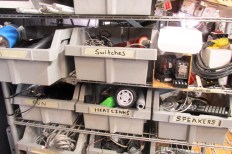
Shelves

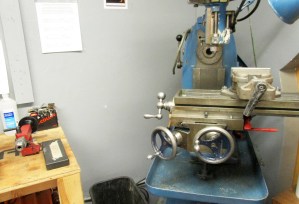
Machine


At one point, Eric Ose who works there took me aside and told me, awkwardly, “I am not used to young people here asking permission to do things.” Meaning, this was a space that people came and just tried things out, used material lying around, and worked on their own pace. Of course there are guidelines – especially safety guidelines, as when watching laser cutting, or operating the 3-D printer.

But the real house rules are this: Try something out. Make things. Break things. Revise. Start from scratch. Discover. Build something impossible!

Note: If your students have never been to one I urge you to make it your next field trip. Many cities have these community run spaces. (Map)

HeatSync

Skype with a rocket scientist – Today’s STEM Talk at Salt River Elementary

It’s funny how an ‘old’ technology comes to the rescue, even in education that’s all about Ed-Tech.

I’ve used Ustream, am experimenting with Stre.am, one of the newest shiny objects for collaboration and live-streaming. WebEx is not feasible for legal reasons, which is why Skype has come to the rescue. Skype – that grandaddy of web conferencing tools– is old in Internet years! Released in 2003, it came in a different era from our one-click chat apps that are morphing into lean, mobile must-haves. It’s still a trusty, if not crusty application.

Anyway, for this ongoing series of STEM Talks, I am pleased to be able to connect my school with an eminent NASA scientist, Dr. Ashwin Vasavada. He is the lead scientist on NASA’s Curiosity Rover mission, and comes to us via the Jet Propulsion Lab in Pasadena, California. For those of us with one-planet experience, know this: Ashwin participated in Galileo mission to Jupiter, and Cassini mission to Saturn.

My students have some background to Curiosity, because of robotics, and some have seen the full-scale model of this Humvee-sized robot at ASU. I’ll be curious (I know, bad pun!) to see how they engage with him.

Place: Computer & Technology Lab

Time
: 4:00 pm

Light refreshments will be served.

Check out previous STEM Talks here, and here.

Visit by US Secretary of Interior to my class

Exciting morning yesterday with the visit of Secretary of Interior, Sally Jewell to our school.

Sec. Jewell was kicking off to the Obama administration’s ‘Listening Tour’ in Arizona, visiting Native American schools and communities. She devoted a good part of her talk to stress the importance of science, in the four STEM areas. “I am the ‘E’ in STEM,” she said.

As part of her tour she stopped by my class to hear about the robotics program.

One of my students in robotics, who happens to be the president of the student council, explained our program and research projects.

Some media coverage, below.


Cronkite News, ASU

KJZZ Story – Interior Secretary Sally Jewell Begins Native Youth Listening

Technology with a sense of humor (and humanity)

So much of tech in our lives is about inanimate objects that deliver some convenience.

Maybe they animate our lives a bit: Typewriters helped us write better reports. Levers helped us move large rocks. Microphones and memory devices) helped us record and preserve important  moments.

I’m becoming more steeped in the four S-T-E-M areas, because (a) that’s where all education is headed, and (b) I run a computer and tech lab for a school where students from Kindergarten to 6th grade come to experience computers in education.

So it’s always refreshing to be able to focus on technology that is not a computer, or at least one that NOT rectangle-with-screen. I have robots, of course (a big ‘Aha’ for third graders): rectangle with wheels and sensors, and a few other objects.

But where could you take (or hide) a computer, to make our lives more interesting?

I found a great example of a ‘technologist’ who comes from an a non-tech space, and adds a layer of humanity to objects. She’s not from Silicon Valley, and I don’t believe she’s been featured in Fast Company. Bangalore-born Aparna Rao infuses technology with a sense of humor and humanity, letting us find our own meaning in inanimate objects such as a phone, a typewriter etc. The one on the left, for instance, was designed so that her uncle could send email, making him feel he was typing a normal letter on a piece of paper. But it gets funnier, and, deeper, such as when she uses a camera to make people disappear — the reverse of what we do now in our desire to put ourselves into every conceivable screen-captured image of life.

This is probably one of the best reasons why the arts –and the capital ‘A’– cannot ever reside outside the S-T-E-M areas everyone is so focused on.

This is the best example I’ve come across for encouraging schools to add some S-T-E-A-M!

Back To Work and… Chat Republic

It’s been quite summer. Just returned from a one-week break, headlong into school.

While this blog’s been quiet, so much has transpired – controversies, new questions arising about what happens when citizens ‘speak out’ or question governments, and the (expected) paranoia about Chat Apps.

Just came across this post by Groundviews, about my book. It serves as a good backgrounder to some of the topics discussed in Chat Republic.

For those of you who have sent me Q&As about the book, my sincere apologies. Meanwhile there’s a lot happening in eduction that’s equally fascinating, as my school, and my class, specifically gets into a S-T-E-M eduation program this year. You can find out more about my work in this realm at Voices-On.com

And then life threw me a lesson plan

For more than a year, I have been making a transition from corporate communications to education. I have been given an opportunity to be a computer teacher at an elementary school in Scottsdale, Arizona.

It’s an amazing time to be joining a profession that’s getting lots of attention. And scrutiny. From the recent schoolteachers’ walkout in Chicago, to the just out Nations Report Card, among others, the story is not exactly cheerful.

Meanwhile, as knowledge acquisition is moving an 120 miles-per-hour, pedagogy is ambling along.  I can see this through the lens of our two children, as new engagement tools emerge, and curricula change. Analog classrooms are trying to adapt to digital natives. Britannica now has an app for the iPad and other tablets. Classrooms are being ‘flipped.’ We can’t continue to do the same old, same old.

If there’s a simple lesson plan for my career, it’s this: push students to the edges. Focusing on ‘core’ areas, but also widen the aperture. Knowledge of ‘computers’ without context of where they are used, is meaningless. Often it’s the topical things we introduce in class that make planned (not canned) lessons relevant. One study last year found that students who did “science-related activities that are not for schoolwork” performed higher.

TO KICK OFF, I re-positioned the computer class as a Technology and Computer Lab, in which students will engage in subjects from space exploration to search engines.

Being the school’s robotics coach helps. This is a program established by the FIRST Lego League. Students can step out of their comfort zone and take risks, even while engaging their math and design skills.

Each day, the lens zooms in and widens…