IABC members speak up on the financial crisis

Happy to note, following my post last Friday, that IABC members have been blogging this very subject, making themselves heard. Maybe I missed some of these in by newsreader, but ideas have been coming in.

Fabio Betti Salgado -from Brazil

Chris Grossgart at IABC International

Natasha Nicholson –my editor at Communication World

Shel Holtz – his blog, and also in episode # 388 of For Immediate Release

Wilma Matthews –in Phoenix calls for a teleseminar on the crisis

I just heard from Barbara Gibson, the IABC chair that a webcast and teleseminar will be soon announced, among other initiatives.

Bracing for hard times. How could Communicators help?

Communicators, marketers, media folks and anyone in related industries reading this blog: I may an incurable optimist, and focus on a lot of positive strategies. But it’s time to return our seats to an upright position and prepare fora bumpy ride.

But it’s going to be a long, hard slog –to borrow a phrase from the good folks who brought us to this precipice. And it’s time for us communicators to start banding together, to find ways to use networks and tools like these to help each other out. Why do I say this?

  • Just this week I heard of two experienced colleagues still looking for work; I don’t envy being in that spot at this time.
  • The US treasury secretary is still warning of dire times, more bank failures etc.
  • Advertising budgets are evaporating. Have been, even before the crash.
  • One newspaper here in Arizona, the East Valley Tribune is cutting back circulation (and jobs). In some local areas it will be down to four days a week next year.
  • “”We’re in this together and we’ll come through this together” says President Bush. Translated: Please help us!
  • The cut back on business trips will mean trade events will lose attendees, airlines will get hit, etc

How could communicators be of help?

I get a lot of requests and helpful suggestions via social networks. For now it has been those needing insights on vendors, job openings and recommendations, pricing and marketing tactics.

I wish IABC, PRSA, the AMA and other associations will use this time as a way to deliver more value to members. Heck, even to non-members who would be potential members down the road. PRSA ran a very good piece on the role of the Communicator in an unfolding crisis. It’s still about communicating.

My short list of what we could do:

  1. Make an even bigger case for putting an end to spin. It may not seem like a huge thing at the time to call a modest improvement  “a revolution in…” but when companies fail, or fail to deliver, people’s jobs and lives are affected. We communicators are therefore culpable.
  2. Educate people on the value of social media in letting the sunlight in. Not every CEO could blog, but when we make our intranets and wikis and podcasts more blog-like, that transparency virus creeps into everything.
  3. Empower the bottom-up movement. I am a big fan of media training, but not for the typical reasons (of staying on message etc). I want to see those who are not confident with speaking to the media have the ability to convey the rich nuances of the organizations. I had a very bad experience with a bank recently that illustrates why it is dangerous and counter-productive to throw employees under the bus.

Jeremiah Owyang had some great tips on the questions we need to be asking at this time of doom and gloom.

Arizona PR practitioner ‘leases’ the sun

Fellow IABC member and PR professional, Len Gutman, is one of the first people in the Valley of the Sun  to install solar panels on his roof. It’s an interesting tale of a PR practitioner getting involved in a word-of-mouth campaign with a sustainability edge to it.

SolarCity, the company with whom the Gutman family signed up, had suggested they hold a ‘solar party’ to tell friends and neighbors about the decision. “We thought that was a great idea and so we held one a few weeks ago and more than 50 people showed up,” says Len.

Sort of like a Tupperware party for the planet.

The investment was hard to beat – zero down!  Basically the panels are leased –the Gutman’s monthly lease payment practically offsets the cost they save on their electric bill.

And here’s the kicker. So far, seven of those who attended the party have also signed with SolarCity and the hosts will get a referral fee. Is this great PR for SolarCity, or what?

What happens when the 15-year lease is up? “We have several options – we can have them removed at no cost, we can re-lease them for five more years, we can upgrade to new technology and start a new lease, or we can buy them for the residual value,” says Len. “Just like leasing a car!”

Three Gold Quills for Arizona

Congratulations to Rachel Pearson, Mary Ehlert, ABC; and BDN Aerospace who brought home Gold. The Gold Quill awards were made at the IABC international conference in New York last week.

  • Rachel won a merit award for the Scottsdale Convention and Visitors Bureau‘s 2007 Annual Meeting in the category of Special Events – Internal or External.
  • Mary won a merit award for the Arizona Department of Health Bureau of Tobacco Education and Prevention. The category was for Economic, Social and Environmental Development.
  • The BDN Aerospace marketing team won a merit award for the MD Helicopters Ad Campaign. The category was for advertising using conventional media.

IABC Gold QuillsGold Quills recognize best practice in areas such as marketing communications, corporate communications, benefits communication, digital communication, branding, special events, podcasts, publications, annual reports, recruitment and writing. Not surprisingly, the Gold Quills attract local and international entries from agencies, photographers, graphic designers, strategic planners, creatives and even students.

Seth Godin spreads stories, wears them.

Seth Godin plays with words. He practically owns the phrase “permission marketing” but now has a better way of describing the lack of it – “TV thinking.” He makes fun of YAA (yet another acronym), but isn’t averse to throwing in his own: BA, DA and AA. They stand for Before Advertising, During .. you get the idea.

But it’s not just his words and his books –with funky titles (Purple Cow, Meatball Sundae) — that etch their way into the marketing lexicon, but his delivery and style.

So when Seth told a packed room of communicators at the IABC conference last week to pull up their socks to face ‘the new industrial revolution,’ he got their attention. He put it bluntly that “communicators have trained people to ignore their message,” and “no one built the internet for you!” You can’t fight clutter by adding more of it. It’s more important to be storytellers, not messengers or interrupters he says.

You can’t bend the internet to suit your story, he went on. You have to play to a different set of rules –the rules set by Google, and bloggers, and ordinary people uploading videos like that of a Comcast technician who fell asleep on a customer’s couch. It means building something remarkable, and finding a way to get others to spread your stories.

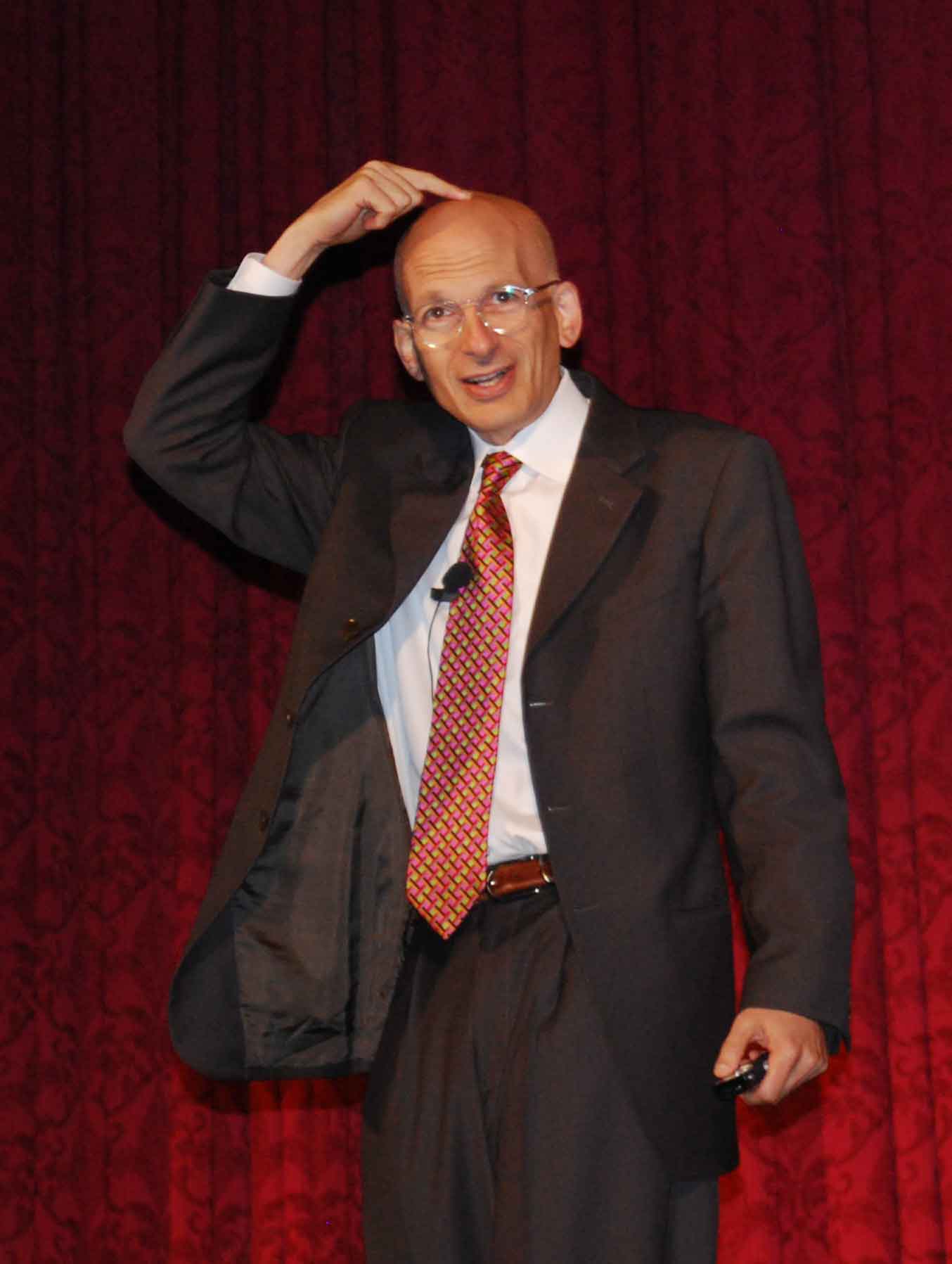
To illustrate, Seth pulled up the cuffs of his pants to reveal his brightly colored socks that happened to be mismatched. They are from a company called Little Missmatched that gives kids –and keynote speakers — permission to express themselves and thereby spread the story. We didn’t get a chance to ask any questions because he was off and running. But it’s safe to assume Seth is telling their story over and over again, on his dime, to his audience.

As a backgrounder to his presentation, you could listen to a pre-conference podcast of Seth interviewed by John C. Havens on BlogTalkRadio.

Blogging with an audio recorder

Follow up to my post about Bill Marriott’s blog, Marriott on the move, I find it interesting that he does not type his posts but dictates it to his communications manager using a digital recorder. It retains an essential conversational element that tends to get edited out when some people put pen to paper.

Many were impressed at the 75-year old CEO embracing the blogosphere, as was seen on the tweets and other conversations I had at the conference. Steve Crescenzo and others suggest that the lowly digital recorder is a great way to dive into the social media, especially for people who are bad at typing, or don’t have the time.

What’s interesting about Marriott’s blog is that his folks have not only transcribed the dictation into text, but post the audio file on the blog. It adds one more level of authenticity, because you now know that some scribe in the back room is not tweaking the sentences for the blog.

IABC Conference, the classic ‘meat space’

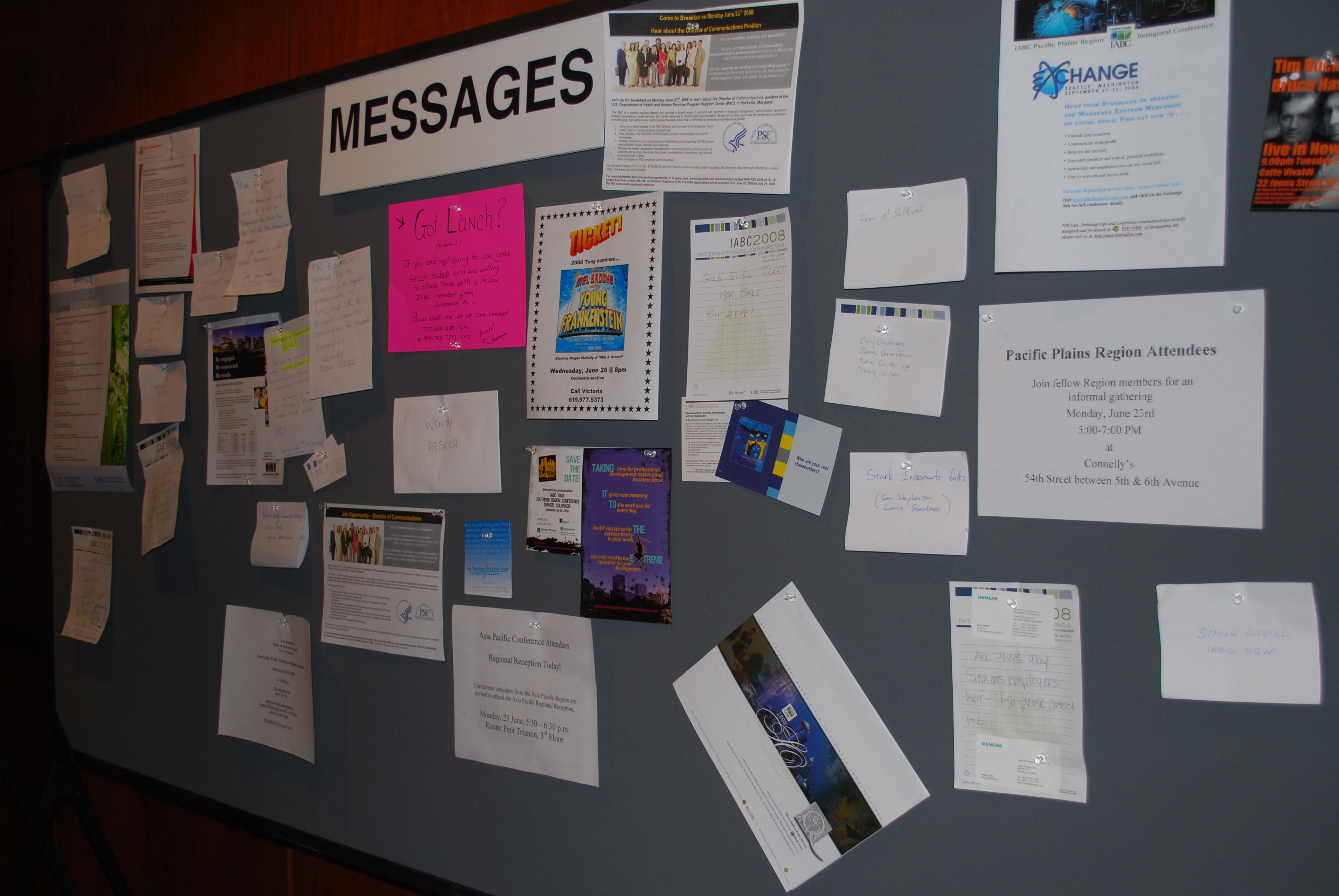
Meeting board outside the networking areaThe term ‘meat space’ may be an awful way of describing why conferences like this –where the focus is on faces, not Blackberries– matter. But it’s true. We have come here to escape the digital world and connect back in analog fashion. IABC tells me that are attendees from nearly 50 countries.

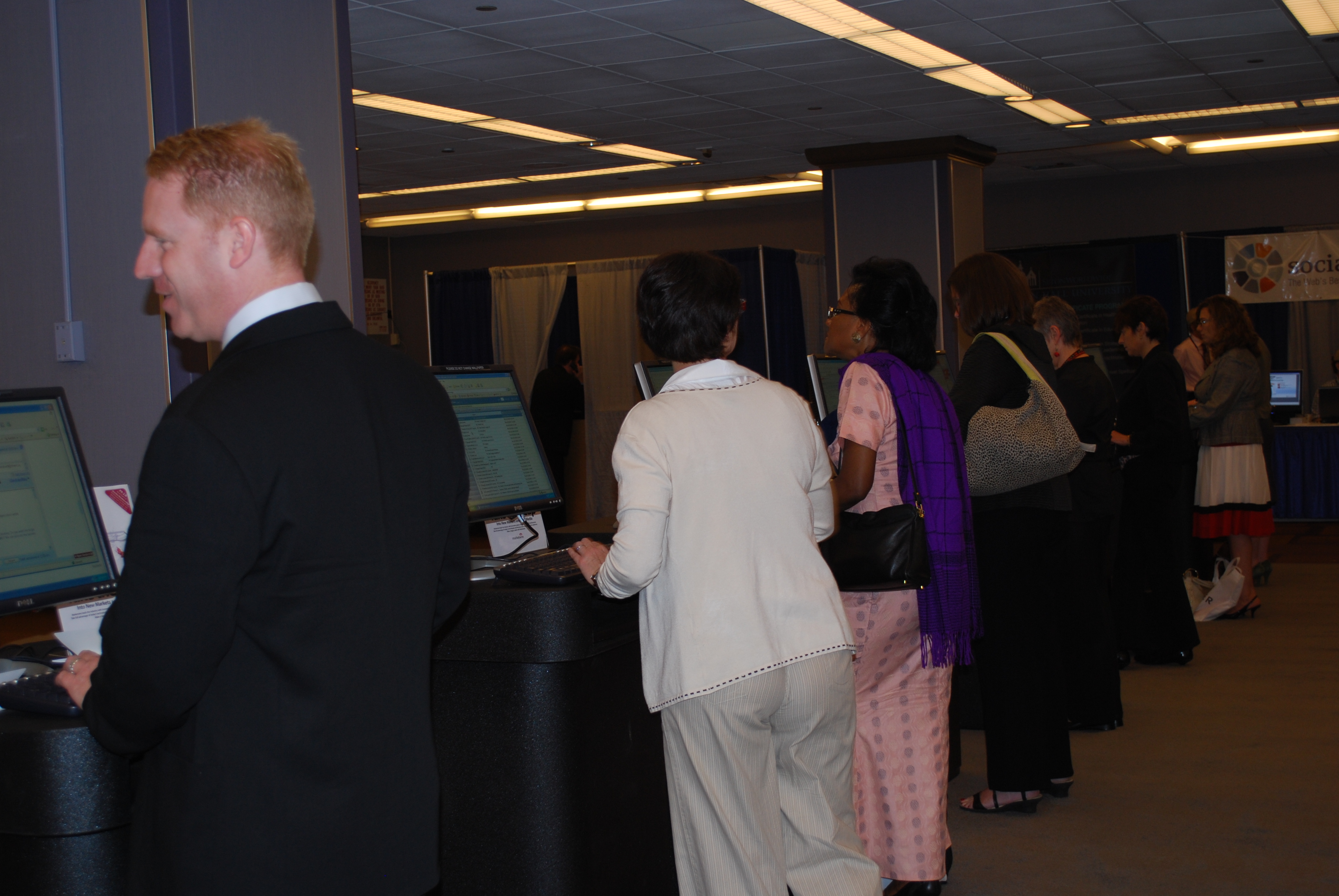
The sheer density of people, back-to-back-to-back sessions, keynotes and dinners force you to realize that sitting at a computer and sucking at an RSS feed does not compare (If you’re reading this via RSS, sorry!) Having said that, there are lines at the computer terminals. Long lines. People multi-tasking, big time. Two other prominent people are blogging the conference: Shel Holtz, and the CEO of Social Media Today, Robin Carey, whom I met for the first time. Delightful team at SMT. They aptly serve the content curation role that Steve Rubel talked about yesterday.

They did what with my story?

Role playing in \I attended an amazing session yesterday titled “A day in the life of a TV reporter” that may have seemed like it was about news, but was really about PR. Specifically about pitching your story to a TV news team,

Gerard Braud who ran the session is a been-there-done-that kind of guy. It was not the usual how to, with five golden rules, etc. It was an exercise in every sense of the word –one of the most fast paced sessions I’ve ever attended– to put us in the hot seat of the news team.

I guess you never realize the “if it bleeds it leads” imperative in a newsroom until you work in one. Attendees were divided into four news stations, KSUK, KRUD, KNTS and KRAP (no shortage of acronym fun!) given the same stories, and asked to produce three news bulletins -an A.M. newscast, an afternoon, and the big enchilada, the evening news. But it wasn’t just that. We were assigned to roles of egocentric, tired, underpaid, ambitious and reclusive individuals who put it all together. But if they were caricatures, Braud assured us he had worked with precisely these types.

That was the whole point of this. To see how stories, pitched to a news organization made up of dysfunctional (read: human) individuals dealing with the pressures of advertising, sweeps, budget constraints and deadlines ever make it.

The day’s story line-up included murder, corruption, a weather related car wreck, a local government story and a technology piece among others. As we set off to report and package the stories for the bulletin, a story of a blogger (posing as a child to lure a pedophile) was dropped by most teams, never mind the social media hook. (Please don’t tell Shel Holtz that!) The zoo story about a giraffe giving birth, survived. But you knew that, didn’t you? Even though it meant sending a cameraman in two different directions, it was in keeping with the silly convention of a cute story wrapping up a bulletin stacked with very depressing stories..

Just when we began to get the hang of things, Braud threw a curve at all four teams. I won’t spoil it for any other group who might attend this session some day, but just say this. Hard exposive stories are the sexiest -with the exception of the giraffe.

There were some great lessons. Pitching lessons, empathy lessons, and sensitivity to the news cycle. “We tend to treat them news people as special, don’t we?” remarked Braud. “We put them on a pedestal, but don’t recognize they are human, just like us.”

Marriott CEO Blog: “A cool way to tell stories”

Marriott CEO, J.W. Marriott told a shocked audience this morning that he never knew what a blog was when he started, but now finds it a way to listen to others, and communicate better with the thousands of employees and customers around 68 countries.

Marriott spoke at the opening session of the IABC International conference in New York, where he was named the 2008 Excel Award winner. Like a few CEOs today, he stumbled onto blogging thanks to his communications director, but now finds it “a cool way to tell stories.” His advice to other CEOs:

  • Make it personal
  • Stay away from out and out advertising
  • Talk about what you are passionate about

Obviously he was mildly grilled about the value of the blog. Alluding to the ROI of the blog he said it translated ino thousands of dollars in room sales. “I would recommend it to any CEO. It’s worth it,” he said.


7 things in 2007 that changed the way I think

This year was a game changer. I got to work alongside some extremely creative people, on projects that involved new media, old media, networking, and lots of social media learning. The highlights:

  1. Attended a one-day AMA Phoenix workshop on mobile marketing.
  2. Started using Wikis for project management, article interviews, what-if projects, a rich-media resume, etc.
  3. Rediscovered the value of online surveys as due diligence for strat planning, marketing, and a tool for tapping into emerging trends.
  4. Attended the IABC International conference in New Orleans.
  5. Visited Pike Place Market in Seattle, Washington. A multi-sensory offline marketing eye-opener!
  6. Added Facebook and MyRagan to my social networks, that connect the dots between professional colleagues, knowledge, and work.
  7. Read Wikinomics. I couldn’t give a glib one-line explanation here about this amazing book.