Here’s a quick update for all my friends, family and colleagues who have asked.
Chat Republic is now listed on Amazon. A Kindle version will follow in a week.
Amazon link: http://bit.ly/ChatRep
Book website: www.chatrepublic.net
Here’s a quick update for all my friends, family and colleagues who have asked.
Chat Republic is now listed on Amazon. A Kindle version will follow in a week.
In June I’ll be travelling to Sri Lanka, and am planning to travel light (translated: no laptop.) I wish Ideo would design one of these for a backback.
Called TEDx In a Box, by TEDX and Ideo, it’s obviously for the event organizers, but it could easily be emulated to be a kind of survival kit for a writer, podcaster, or speaker.
The metaphors for describing what one goes through when writing a book are inadequate.
Suffice to say it’s been a breathtaking learning process.
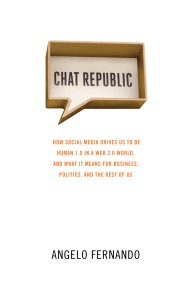
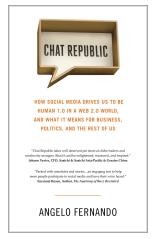
But it’s finally coming down to the moment of truth. Here’s what the cover looks like. I wanted it to be minimalistic, but communicate in an instant what it’s about.
Chat Republic, though a crowded place, is also about a call for more space – space between the noise, space between the rapid, vapid statements we send out and are inundated by.
Some see this is as a ‘country’ –a map– populated by loud mouths. I see it as this giant speech bubble, we could all be sucked into (if we don’t make some sensible choices).
Let me know what you think of the cover!
In my book, Chat Republic, I feature a few examples of how ‘street talk’ has been effective, even sans the Internet.

“Banksymus Maximus”
This old, classic tactic from guerilla artist Bansky could take us into a whole new discussion of how to create buzz, often without words.
Here’s the set-up: In 2005, Bansky managed to place a fake “rock painting” in the British Museum. As you could see, it shows a caveman as a different kind of hunter and gatherer. The rock was stuck onto a wall in a ‘Roman Britain’ section.
Just plain ‘art-jacking’ or is Bansky an ingenious, much-ignored communicator? In a world empowering us to ‘speak out of turn’ do tactics like this feel relevant? Or are they too edgy for you?
Before you come to a conclusion, take a look at the modern version of this phenomenon, known as Culture Jacking.
I would love to hear your comments.
A few years ago I conducted a series of webinar-style workshops for the U.S. State Department, for content creators, educators, marketers and those in traditional and new media. The workshops were called “Passport to Digital Citizenship.”
I was convinced that citizen’s voices would be valuable, and –despite technological barriers and people who would try to keep them quiet– they could be heard.
So today, as my book is about to launch, I am thrilled to see this report by CNN on the importance of citizen-driven media.
Journalism has been forever changed — I’d argue for the better — thanks to the fact that people can interact with media organizations and share their opinions, personal stories, and photos and videos of news as it happens. This year’s nominated iReports are prime examples of how participatory storytelling can positively affect the way we cover and understand the news.
(“36 stories that prove citizen journalism matters.” By Katie Hawkins-Gaar, CNN | Wed April 3, 2013 )
When we talk of ‘participatory journalism’ we mean that ‘CitJos’ work alongside traditional media. They are not here as a replacement model, but to complement the changing media industry. Of the 100,000 citizen stories submitted to CNNiReport.com in 2012, they used 10,789 –having vetted them first.
I just interviewed the creator of a leading citizen journalist outfit in South Asia, and he stressed the importance of community guidelines, and careful design.
Citizen journalism, and the power of citizen voices is a big section in my book, Chat Republic.
It’s official, and I’m now ready to announce the title of my book, which is in its final stages.
It’s called Chat Republic.
 I’ve been covering the intersection of technology and business; technology and culture for more than 18 years. More recently, I’ve focused on digital media and our social media-centric lives, and I wanted to put my ideas into perspective.
Chat Republic is more than a fictional country. It’s about the spaces you inhabit. Those online and offline communities you move in and out of: conference rooms, Google Circles, IM lists, Facebook, online forums. I think of it as a ‘country’ whose fluid borders take the shape of a giant, invisible speech bubble.
The conversations and opinions pouring in and out of our republic, in real-time, are what make our communities more civil, more vibrant. Our chats are certainly not friction-free! But absent these conversations we would be one dimensional citizens, won’t we?
As of today, I am planning to launch the book in two time zones, in June.
Some specs:
More information here at ChatRepublic.net
 Hoipolloireport