It’s not a Budweiser ad, but it riffs on that ‘Whassup‘ phrase in a twisted way.
But humor apart, it is a great example of resurrecting an expired concept, skirting copyright, and making a statement.
It’s not a Budweiser ad, but it riffs on that ‘Whassup‘ phrase in a twisted way.
But humor apart, it is a great example of resurrecting an expired concept, skirting copyright, and making a statement.
Advertising is much more than a clever slogan tacked to the back of your truck. Branding is certainly more than a logo. I’ve regularly discussed this here and in my other writing –about experiential branding, and grass-roots marketing.
So I was glad to hear back from a company I had written about here on the blog. It’s a long comment, but fully worth a read. It’s about a form of “advertising” – a simple $12 dollar sign printed at Staples — people normally might dismiss as pre-Web 2.0.
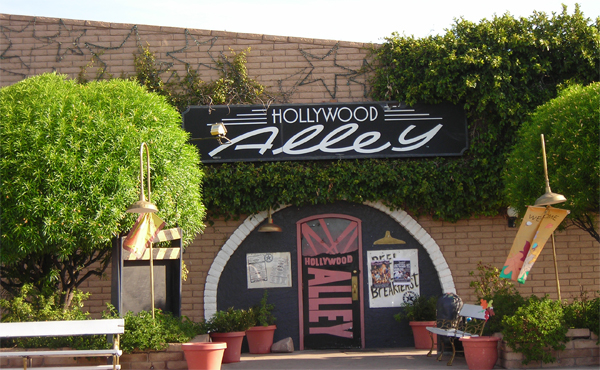 Hollywood Alley is a family-owned restaurant in Mesa, (NE corner of Baseline Road and 101) For weeks I had noticed the signs were getting really creative –or at least intriguing. Yesterday I heard from John Wincek, who gave me the scoop about how a restaurant with “a kitschy style, and an off-kilter outlook on life-but other than that, we’re actually totally and completely normal!” created its own brand personality. He doesn’t use ad jargon like that, but that’s just what it is: DIY branding. No agency required.
 The restaurant’s sign connects with customers, flagging them down, getting them to even come up with ideas for the outdoor signature. “We were suggesting food, but without screaming it at them. better yet, we were connecting through a common interest,” said John. It was not just a sign, but a game, something that made people think about the movie, the pun, and keep the restaurant in their minds.
But the sign can only get people in. The people and the product had better deliver. It is working. Check his story. It’s a great example of how to be creative to keep business humming in spite of the recession.
One more follow up to my post about what communicators could do during these tough economic times.
Annie Waite at Melcrum has an excellent post on how to look for interim positions during the downturn. The key seems to be flexibility.
I used to put it another way: that old line “It’s not on my job description” is an attitude that we need to expel. You can’t blame people who started checking all the boxes on their job description, just to get a great performance review. But in doing this, we box ourselves into our jobs, not realizing that over a few months that job has changed.
While doing a good job of communicating how good we are in what we do, we should not unwittingly communicate how unwilling we are to do something different, daring, unexpected. It’s easy to communicate you are an out-of-the-box type of person without using that tired expression. Here are a few simple ways:
The lowly MP3 music format was quietly replaced by MP4. But this week, there’s news that a Chinese company has introduced the world’s first MP6.
The company is AIGO. We haven’t heard much of it here in the US. but we soon will. The device that plays the new format is the eMusicPlayer, using a wireless “reading-point pen.”
What’s interesting is how it blends the technology with a publishing concept. Aigo will publish a ‘music magazine’ periodically, with about 200 to 300 songs. The pen is then used like a mouse, to point and select the music from the magazine.
I could see audio book publishers, and podcast aggregators putting this to great use. Of course any music player that can download a file wirelessly has a big advantage.
For all the talk of the bottom-up communications and letting go of the command-and-control buttons, not many organizations would want to let a newbie run the show. It’s too risky, they’ll tell you.
I could afford to talk. We let students take controls –literally — at the Decision Theater. Student workers and interns aren’t here to handle the low-end stuff. They take control of the visualizations in the control booth, they also do presentations, and even work on back-end, in coding and creative.
 So this post by an intern, on the Southwest Airlines blog, Nuts About Southwest, illustrated it better I’ve ever seen. Ray Buffington is a PR intern. He created a PR event without a manager second guessing him, even though she “was available to tap into.”
Would you let an intern loose on your PR? or is your PR department such a fiefdom that no one without a communication degree is allowed near? Let alone let an intern take charge of the message.
I have been tracking Nuts for a while now, and they never cease to surprise. Great work!
 Congratulations to Charlene Li and Josh Bernoff on being named ‘visionaries of the year‘ by SNCR, the Society for New Communications Research (whose founders are the who’s who of social media.)
By many standards, Groundswell is the most imortant book of the year that answers the Why and How of social media. It’s hard for me to stop talking about it –my upcoming article in IABC’s Communication World is about it.
The authors have demystified the social media hype and given every practitioner something substantial to turn to: case studies, ROI calculations the online Social Technographics tool etc.
 In time there will be some big-picture interactive tools that let people look back at the great stock market crash we are witnessing. The roller-coaster indexes, the side-effects of deregulation, and the people behind the collapse.
The New York Times mapped how the crisis unfolded.
Here is one more, from the Guardian newspapers in the UK.
 “YouTube is a clip culture … But we saw that there was a demand for longer form.”
“Start iterating– fast.”
“he displayed … intellectual vigor”
“What reality are you in?”
“It is an acceptance mark.”
“… we see that technology allows for new kinds of connectedness built around cell phones and the internet.”
Wal-Mart is not afraid of negative reviews from customers.”
“Be flexible, consider part-time work, take a paycut, work hard”
 My interview last week with Tracy Swedlow of Interactive TV of Today, about the Decision Theater and what sets us apart in the policy making and visualization space.
We touched on how we may be able to extend our footprint, to think outside the Drum, as it were.
IABC has taken a big step to give communication pros seven ways to take advantage of the organization’s vast resources.
 It’s pulled together existing knowledge and is rolling out a webcast, two webinars, a podcast (out on Monday) and research, among others.
Many sharp pointy tools in this quiver
Thanks to Neville Hobson’s tweet for letting us know this is out.

