Social media self-immolation: Adults feed the beast

You know things aren’t going well in government when the folks who pass laws are caught doing things we want our children to stay away from.

  • A Texas congressman was the latest to prove that he cannot use a moble device responsibly. The details are too lewd to recount, or link to, here.
  • Then there was was the member of the House of Representative representing New York City, who resigned over a similar sexting incident involving photos on Twitter – in 2011. (There’s an entire Wikipedia entry on this.)

The list is unfortunately long and disgusting. When grown-ups taking to social media are so easily detached from their moorings, it’s no wonder young teenagers (and pre-teens!) misunderstand the fine line between private- and public-facing ‘media.’

Every time I hear a parent complain of a child who spends too much time on the phone, my response is, “So why do you continue to pay for the connection?” It’s easy to push the blame onto social media, when it’s the adult behavior that’s feeding the beast.


Coding and Digital Learning Day, today

It’s Digital learning day across the country, today. Salt River High School is hosting Code Night, a community event to showcase week-long Hour of Code activities.

Last week, at the elementary school we focused on Digital Learning, beginning with a kick-off event featuring speakers who talked to students about social media, and coding. It’s interesting how much has changed –and how much more scrutiny we give to digital learning –since last year. Parents and educators have to deal with much more than memes, and cyber-bullying. Social media viral stunts for instance.

Coding is somehow more than a passing fad. It’s more about problem-solving than learning a new ‘language.’ Much thanks to Synapse Studios, Mel Adamaitis, Danielle Benally, and Stephanie Schull.


Radio days! Podcasts back with a vengeance!

In case you’ve not noticed the podcast landscape had changed. I’m so glad this genre – audio story-telling –has survived in a digital age that at one time seemed to gravitate toward video, slapstick entertainment, and uninformed opinions.

These are highly-researched, well-produced shows – not just opinionated rants. 

Here are a few:

Code Switch – Fascinating takes on race and identity

Rough Translation – A great way to escape the echo-chamber!

The Hidden Brain – Shankar Vedantam’s insight into human behavior

The Tip-Off – Peeling back investigative journalism, by Maeve McClenaghan of London’s Bureau of Investigative Journalism


Some older podcasts still give the newbies a run for their money. Those such as:

  • This American Life – Ira Glass’ extremely topical take on all things social, political, personal
  • Invisiblia – Gripping tales and insights about the forces that shape us.


Filters needed now, says Isura Silva!

My friend Isura Silva, writes about topics similar to what you find here. One of his recent posts touches on the death of attention, as a result of our proximity to screens. You should read his post to get his slant on it.

The issues we face as parents and teachers is not just screen addiction, but device distraction. Attention spans are in a serious free-fall. I flippantly wrote about this in an article on ‘FOMO’ (for LMD magazine). But it’s a lot more serious than this.

Which brings me back to Isura. He was on a UNICEF panel on Tuesday, discussing child safety online. The panel discussed the study just released, on how adolescents in Sri Lanka use the Internet. To give you a snapshot of it, the press release states that:

“While digital access exposes children to a wealth of benefits and opportunities, it can also unlock a host of risks including the misuse of their private information, access to harmful content, and cyberbullying …whilst children and adolescents are increasingly going online, they are doing so without adult oversight or supervision.”

Next week is Digital Learning Day across the world. Here at my school, I’m bringing in two speakers to address this dire need for digital literacy. Different cultures, different demographics, all feeling the same need.

Relaunching his brands – Musk puts excitement back into Space science

A red sports car, a rocket and a trip to Mars. Many generations from now that’s what some might consider the birth of the new space age.

Last afternoon’s liftoff of ‘Falcon Heavy‘ – the largest rocket by far to be launched –by Elon Musk’s SpaceX, was by all accounts, a spectacular event combining science, savvy marketing, and enough material to get the attention of many audiences: Space geeks, Tesla enthusiasts, the international space community…and Mars watchers. Nothing like a live stream of the event, that included the dummy’s view from the Tesla roadster!

From a marketing perspective, think of it a a relaunch of three brands:

SpaceX: The ambitious company is not just a record holder of the biggest, baddest rocket with a retrievable booster (one didn’t land successfully), but an international ‘agency’ in itself. It can carry a spaceship – one taking humans back to the Moon, and later to Mars.

Tesla: Imagine the opportunities, to sell car that has the pedigree of the first car in space…Fascinating backdrop to an otherwise boring auto industry.

Elon Musk himself. Perhaps –just perhaps– he may have a bigger agenda in positioning himself as more than an entrepreneur.


Tech questions worth asking about self-driving cars and crypto-currencies

Some thoughts around the dinner table:

Self-Driving cars:With the arrival of more autonomous cars (we see several every day around our home) will stores need to reduce their parking lots?

Software lawyers: Could we see a new branch of defense lawyers whose client’s might be an ‘algorithm’ – the self-driving car software that caused the accident?

Poor Eyesight: Will optometrists see a surge of business since kids using more screen time that is recommended by pediatrics, get into glasses earlier in life?

Crypto: What if credit card companies pay us ‘rewards’ points in crypto-currencies?

3D printing: Could we change (upgrade, really) our clothing made with 3D printable ink?


What 1st Graders can do with Microsoft Word. Who would have thought!

It’s always a surprise when you introduce a tool, and watch where it takes students. First Graders, in this case! (Just a few months ago they were learning how to use the left- and right-mouse buttons.)  Here are two examples of what they did, using the Shapes menu.

Next week, upper grades will work on other tools and effects, as 4th graders did last year. (Watch video)

Voice assistants I love to unplug, and smart fridges I really don’t need

I’ve had some fun with Alexa. The matter was settled over the Christmas break: We can do without AI in our home.

I had previously written about it here. And featured voice assistants in my last tech column, “I spy with my little AI.” I reference how creepy it could get should an AI enabled device such as Alexa, Google assistant or even Siri eavesdrop on our private conversations. AI devices after all are supposed to do our bidding, not spy on us. But there’s a fine line between passively listening and spying.

So when we discovered that an AirBnB we rented over the break provided an Amazon Echo speaker, it got to the point where (after a few rounds of asking Alexa random questions and finding ‘her’ quite annoying) I unplugged it and put the darn thing away.

It was no surprise then to hear that at the Consumer Electronics Show (CES) in Vegas,  several new breeds of AI devices were unveiled, designed to respond to human inclination to suddenly want to talk to hardware. Such as the smart refrigerator by LG that ‘talks’ to a smart oven etc.

Which makes me wonder: Just at the time when we have plenty of research pointing to the correlation between being too plugged in, and being extremely socially disconnected, we have the tech sector pushing products that seem to exacerbate the issue. I don’t need a smart fridge, thank you very much – I just need a painless way to talk to an LG service rep (25 minutes on hold, seems customary) when my fridge behaves badly.

And speaking of snooping devices, here’s something that is advertised as being able to monitor a home. A clothes hook with a hidden camera. Creepy? Or is it the sign of (the Internet of) things to come?

Do you trust Apple? Or buy it’s half-baked PR?

Many, many years ago I decided I would no longer support or use Apple products, however ‘convenient’ and cool they were. Most iPhones and Macs before that were overpriced; we as a family decided against them. (My first PC was an Mac. Today I could by three fast PCs for the price of that Mac I owned up to 1996.)

So now, as Apple products come under withering scrutiny, such as the ‘speed throttling’ or battery issue, I wonder why people still put up with a terribly unethical company. There have been plenty of scandals that signaled to customers something was awry  – from the iPad Chinese scandal, to the more recent one that smells of ‘Planned Obsolescence’ (an old marketing ruse).
Transparency is not its strong suit – secrecy is is built into its DNA after all. Including workplace secrecy. But Apple seems to understand human psychology, and knows that a shiny new object is enough to deflect bad business practice. If you read the company’s disingenuous apology, it sounds like it was hammered out by a group of ghost-writers in a tavern filled with corporate lawyers. So while there will be lawsuits and pressure from governments, it could ride this out.

So my question is, if you’re an Apple user do you ‘like‘ the company, and distrust the brand? Or is it the other way around?

When space exploration looks like Sci-Fi

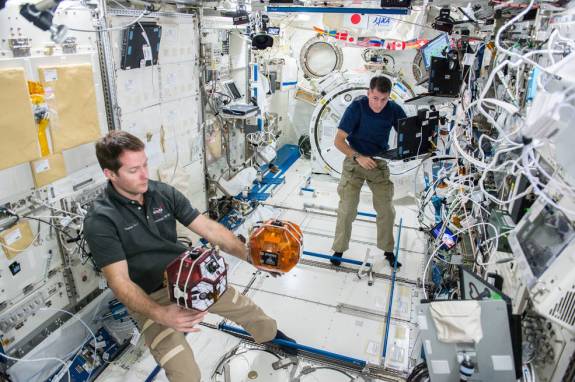
One part Star Wars and two parts Arthur C. Clarke, one of the new things being tested in space is something called ‘Spheres.’

It is the name for three small “free-flying satellites” on board the International Space Station. Students in middle school have been getting involved in using SPHERES (which is an acronym for ‘Synchronized Position Hold Engage and Reorient Experimental Satellite’) in micro-gravity experiments. One of the goals of SPHERES has been to see if these small satellites could one day solve the problem of space debris, apart from other future space missions.


Arthur C Clarke was the earliest proponent of communication satellites. His 1945 Proposal was on Geostationary Satellite Communications. This March would be the 10th anniversary of Clarke’s passing.